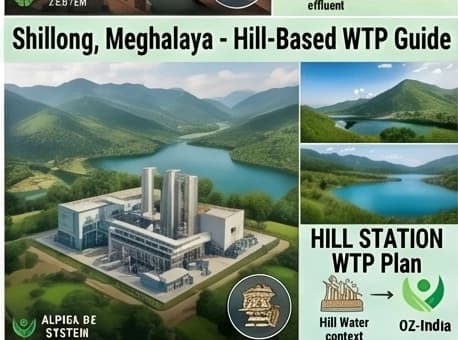
UV water treatment in Shillong addresses 5 key needs: (1) hill station tourism and hotel sector requiring chemical-free, taste-neutral potable water for guests from Meghalaya's ultra-soft rainwater supply, (2) Jaintia Hills coal mining Acid Mine Drainage (AMD) zones where pH 3–5 water requires neutralization before UV, (3) pharmaceutical and food processing GMP water systems in Byrnihat EPIP industrial estate, (4) Nongthymmai and Shillong Civil Hospital NABH water quality compliance, and (5) Cherrapunji-area eco-tourism and living root bridge tourism requiring chemical-free UV for sensitive forest watershed zones. Meghalaya's exceptionally soft rainwater (TDS 20–60 mg/L) makes UV without RO appropriate for most applications — the primary challenges are acid drainage and organic colour from peat bogs.
Why UV Water Treatment Matters in Shillong
Shillong, the "Scotland of the East," is Meghalaya's capital and Northeast India's premier hill station. At 1,491 metres elevation in the Khasi Hills, it receives among India's highest rainfall (2,500–3,000 mm annually, with Cherrapunji at 11,000+ mm making it the world's wettest place). This unique hydrology creates Meghalaya's distinctive water quality profile: ultra-soft rainwater-fed streams and springs with TDS as low as 20–60 mg/L, but also significant contamination from coal mining in Jaintia Hills (Acid Mine Drainage — pH 3–5), and organic colour from peat bogs and dense forest leaf litter that reduces UV transmittance.
UV water treatment in Shillong must address two fundamentally different water source profiles: (1) clean, ultra-soft highland springs and municipal supply where UV-only treatment (with activated carbon pre-filtration) is ideal and RO is not required; and (2) Jaintia Hills coal belt water where Acid Mine Drainage creates severely acidified, heavy-metal-contaminated water (iron 5–50 mg/L, pH 3–5, manganese, arsenic) requiring complex pre-treatment before UV. The contrast between Shillong's tourism sector's need for pleasant-tasting soft water and the coal belt's extreme contamination makes water treatment design in Meghalaya uniquely varied.
Coal mining in Jaintia Hills (East Jaintia Hills, West Jaintia Hills districts) produces Acid Mine Drainage (AMD) with pH 3–5, iron 5–50 mg/L, manganese 2–10 mg/L, and measurable arsenic. UV disinfection CANNOT treat AMD — acidic pH destroys quartz sleeves over time and the extreme iron content fouls UV chambers within hours. AMD requires lime neutralization (raising pH to 7–8), iron and manganese chemical precipitation and filtration, and settling before any UV installation. Never install UV on untreated mine drainage water in Jaintia Hills without full AMD pre-treatment chain.
Meghalaya's Water Sources and Quality Profile
Shillong municipal water is supplied by the PHED Meghalaya from the Umiam Lake (Barapani) reservoir and spring sources in the Khasi Hills. Umiam Lake water has very low TDS (30–80 mg/L), very low iron (<0.05 mg/L), zero fluoride (<0.1 mg/L), and moderate coliform (20–100 MPN/100 mL from Shillong's significant urban population draining to the lake catchment). After conventional WTP treatment, Shillong municipal water is generally good quality at the outlet — UV at the building level addresses the last-mile pipe contamination risk.
Spring water in the Khasi and Jaintia Hills (used extensively by rural communities and eco-resorts) has TDS 20–60 mg/L — among the world's softest potable water. This is excellent for UV treatment without RO. However, very soft water with TOC from forest leaf litter and peat can have UVT of 60–75% — lower than ideal. Granular activated carbon pre-filtration improves UVT to >85% before UV, ensuring reliable 40 mJ/cm² dose delivery.
Water Quality by Zone — Shillong
| Zone / Source | TDS (mg/L) | Key Concern | Coliform Risk | Pre-treatment Required |
|---|---|---|---|---|
| Municipal Umiam Lake / Khasi springs | 30–80 | Organic colour (TOC) | Moderate | 5µ + GAC + UV |
| Khasi Hills highland spring (eco-resort) | 20–60 | Humic/peat colour, wildlife coliform | High (wildlife) | Ceramic 0.1µ + GAC + UV |
| Jaintia Hills coal zone (AMD affected) ⚠ | 500–3,000 | pH 3–5, Fe 5–50 mg/L, Mn, As | Moderate | Full AMD treatment MANDATORY before UV |
| Byrnihat EPIP industrial estate | 100–300 | Borehole slightly higher TDS | Low–moderate | 5µ + UV (or RO + UV for pharma) |
| Cherrapunji / Mawsynram eco-tourism | 15–50 | Extremely soft — humic acids | High (dense forest ecology) | Ceramic + GAC + UV (chemical-free) |
Hill Station Tourism — Chemical-Free UV for Hotels and Resorts
Shillong's tourism economy — drawing 8–10 lakh visitors annually to Ward's Lake, Don Bosco Museum, Elephant Falls, and the living root bridges of Nongriat (East Khasi Hills) — demands high-quality potable water for the hotel and hospitality sector. Meghalaya's soft, naturally mineral-poor water (TDS 30–80 mg/L) has a pleasant, clean taste that hotels wish to preserve. Chlorination at municipal levels (0.2–0.5 mg/L residual) is detectable by guests, creating a chlorine taste problem in hotel drinking water and kitchen preparations.
UV water treatment in Shillong hotels solves this elegantly: a granular activated carbon (GAC) filter removes residual chlorine and organic colour from the municipal supply, raising UVT to >85%, and UV at 40 mJ/cm² provides final zero-coliform disinfection without any chemical residual. The result is neutral-tasting, crystal-clear water that preserves the natural soft water character of Meghalaya's highlands — exactly what premium hotels (Radisson Blu, Ri Kynmaw, Hotel Polo Towers Shillong) seek for guest satisfaction. FSSAI State License requirements for hotel restaurants are simultaneously satisfied by UV's zero-E. coli guarantee.
Cherrapunji and Living Root Bridge Eco-Tourism
Cherrapunji (Sohra) and Mawsynram — the world's two wettest places — attract significant eco-tourism. The living root bridges of Nongriat village (200 steps below Tyrna village, accessible only by foot) require eco-resort and community water supply. Water here is spring-fed, extremely soft (TDS 15–50 mg/L), and free of industrial contamination, but carries wildlife coliform from the dense subtropical forest ecosystem.
Chemical water treatment in Cherrapunji eco-tourism settings is environmentally inappropriate — chlorine discharge would affect the pristine living root bridge forest watershed, which is under conservation. UV is mandated by the Meghalaya Tourism Policy's eco-tourism guidelines as the preferred water treatment method for living root bridge circuit eco-resorts and homestays. Ceramic or hollow fibre pre-filtration (0.1µ) removes turbidity and larger pathogens from spring water before UV at 40 mJ/cm² provides the final biological safety barrier.
Jaintia Hills Coal Mining — AMD Treatment Before UV
East and West Jaintia Hills districts were formerly India's most productive coal mining zones under the controversial rat-hole mining method (banned by the National Green Tribunal in 2014, though illegal mining continues and remediation is ongoing). Acid Mine Drainage from abandoned mines and active seeps has severely contaminated the Lunar River, Myntdu River, and numerous hill streams in Jaintia Hills, with documented fish kills and drinking water contamination in villages throughout the affected zone.
For communities in AMD-affected Jaintia Hills requiring safe drinking water, UV is the final step in a long treatment sequence: (1) collection from AMD-affected source; (2) lime slurry addition to raise pH from 3–5 to 7–8; (3) aeration to oxidise dissolved ferrous iron (Fe²⁺) to ferric (Fe³⁺); (4) settling pond for iron-manganese hydroxide precipitation; (5) multimedia filtration to remove precipitated solids; (6) GAC filtration for residual organics; (7) UV at 40 mJ/cm² for final disinfection. Only after this complete AMD treatment sequence does UV become viable and effective. The MPCB (Meghalaya Pollution Control Board) and NGT monitor AMD remediation in Jaintia Hills — UV as the final clean treatment step aligns with MPCB's treatment train requirements for community water supply in mine-affected zones.
Byrnihat EPIP — Pharmaceutical and Food Processing
Byrnihat's Export Promotion Industrial Park (EPIP), located on the Assam-Meghalaya border 18 km from Shillong, hosts pharmaceutical formulation units, food processing, and beverage manufacturing. The EPIP's proximity to the Meghalaya-Assam state border creates a multi-regulatory environment: MPCB (Meghalaya) jurisdiction for environmental compliance, but FSSAI and CDSCO (national regulators) for food safety and drug manufacturing standards.
Pharma units at Byrnihat EPIP seeking WHO-GMP or Schedule M 2025 certification require purified water (PW) generation with RO → UV (185+254 nm) → storage in SS 316L tanks with UV recirculation loop. The high-rainfall environment creates unique challenges: high humidity accelerates UV controller electronic corrosion (IP65-rated enclosures recommended), and power supply at Byrnihat EPIP can be affected by seasonal flooding of the NH-6 approach road. Redundant UV systems with manual bypass valves are recommended for pharma plants with continuous 24×7 production requirements.
UV System Sizing — Shillong Applications
| Application | Flow Rate | UV Dose | Recommended System | Notes |
|---|---|---|---|---|
| Household (Shillong municipal) | 15–25 LPH | 40 mJ/cm² | Philips TUV 16W | GAC pre-filter for UVT improvement |
| Hotel / resort (Shillong hill station) | 500–3,000 LPH | 40 mJ/cm² | Philips TUV 36W–55W | Chemical-free — guest preference |
| Living root bridge eco-resort | 100–400 LPH | 40 mJ/cm² | Philips TUV 16W (solar-compatible) | Off-grid solar DC option |
| Byrnihat EPIP pharma PW | 500–2,000 LPH | 185+254 nm | Dual-wavelength TUV 55W/95W | Schedule M 2025 + IP65 enclosure |
| Civil Hospital Shillong ICU / OT | 300–1,000 LPH | 80 mJ/cm² | Philips TUV 95W (high-dose) | NABH IPSG-8 compliance |
| Jaintia Hills community (post-AMD treatment) | 200–1,000 LPH | 40 mJ/cm² | Philips TUV 36W | After full AMD treatment chain |
Philips TUV Product Recommendations — Shillong
| Philips TUV Model | Wattage | Flow Capacity | Best For | Lamp Life |
|---|---|---|---|---|
| Philips TUV 16W | 16W | Up to 1,500 LPH | Household, eco-resort, community spring | 9,000 hours |
| Philips TUV 36W | 36W | Up to 3,000 LPH | Hotel, Jaintia community, restaurant | 9,000 hours |
| Philips TUV 55W | 55W | Up to 5,000 LPH | Byrnihat EPIP pharma PW, large hotel | 12,000 hours |
| Philips TUV 95W | 95W | Up to 9,000 LPH | Hospital ICU/OT (80 mJ/cm²), food factory | 12,000 hours |
| TUV 16W DC solar version | 16W (12V DC) | Up to 1,000 LPH | Living root bridge eco-resorts, off-grid Nongriat | 9,000 hours |
Frequently Asked Questions — UV Water Treatment Shillong
Q1: Is Shillong's ultra-soft water (TDS 30–80 mg/L) safe to drink directly after UV without RO?
Yes — Shillong's soft highland water is one of the few locations in India where UV-only treatment (without RO) is genuinely appropriate for most applications. Very low TDS does not require demineralization. The only caution is organic colour: Khasi Hills spring water and Umiam Lake water carry humic/fulvic acids from forest organic matter, which reduce UV transmittance (UVT). Install a granular activated carbon (GAC) filter before UV to remove organic colour — this improves UVT from 60–75% to >85%, ensuring reliable 40 mJ/cm² dose delivery. With GAC + UV, Shillong's water is among India's easiest to treat to potable standard.
Q2: Why is Jaintia Hills coal mining AMD water so dangerous, and can UV fix it?
Jaintia Hills coal mining (rat-hole method) exposes iron pyrite in coal seams to oxygen and rainwater, creating sulfuric acid — Acid Mine Drainage (AMD) with pH 3–5, iron 5–50 mg/L, and manganese 2–10 mg/L. This is one of India's most severe water contamination problems. UV absolutely cannot treat AMD: (1) the acidic pH slowly etches quartz UV sleeves; (2) extreme iron (5–50 mg/L vs. the critical 0.3 mg/L threshold) would coat UV sleeves with iron deposits within hours; (3) manganese and arsenic in AMD cannot be removed by UV. AMD requires a multi-stage chemical treatment process (neutralization, oxidation, precipitation, filtration) before water even approaches UV-treatable quality. UV is the safe final disinfection step after, not a substitute for, AMD treatment.
Q3: Can living root bridge eco-resorts in Nongriat use solar-powered UV?
Yes — and this is the most practical option. Nongriat village (accessible only by 2–3 hour trek from Tyrna) has no grid power connection. Solar-DC UV systems (12V or 24V DC, 16W equivalent lamp, 100W solar panel + 100Ah battery) operate continuously from solar power, treating spring water for eco-resort guests and villagers. A ceramic pre-filter (0.1µ, gravity-fed) before the solar UV unit removes turbidity and larger pathogens, with UV providing final viral and bacterial kill. The complete solar-UV system with ceramic pre-filter, solar panel, battery, and UV unit can be trekked in (components sized for porter-carrying) and installed without electrical infrastructure. This is the preferred water treatment approach for Nongriat under Meghalaya Tourism's eco-tourism guidelines.
Q4: Does the Byrnihat EPIP pharmaceutical plant need UV qualification for Schedule M 2025?
Yes. Schedule M 2025 requires IQ/OQ/PQ validation for all purified water (PW) equipment including UV systems. At Byrnihat EPIP pharma plants, the high humidity (Meghalaya's 80–95% RH during monsoon) makes UV controller electronics vulnerable — IP65-rated enclosures are mandatory. UV IQ documentation records the system as built (lamp model, flow meter calibration, chamber dimensions). OQ tests UV intensity across the rated flow range. PQ demonstrates 6–12 months of consistent microbial performance with test data. CDSCO inspectors from Guwahati Regional Office conduct GMP inspections at Byrnihat EPIP annually — UV qualification files must be accessible during inspection.
Q5: How does high rainfall in Meghalaya affect UV system maintenance schedules?
Meghalaya's extremely high rainfall (Shillong 2,500 mm/year, Cherrapunji 11,000+ mm/year) creates specific UV maintenance challenges: (1) Water supply turbidity spikes dramatically during heavy rain events (turbidity can exceed 100 NTU in municipal supply during peak monsoon) — UV systems must be pre-filtered with sediment filters that are checked and replaced more frequently in Shillong (every 4–6 weeks in monsoon vs. every 3 months in normal season). (2) High humidity promotes electronic corrosion — UV controller panels need IP65+ rated enclosures with silica gel desiccant pouches replaced annually. (3) Philips TUV lamps are unaffected by humidity inside sealed quartz sleeves — replace at 9,000/12,000 hours regardless of season.
Alpha UV Systems supplies Philips TUV-based UV systems for hill station hotels, eco-tourism resorts, pharmaceutical units, hospitals, and community water projects across Shillong and Meghalaya. We include Jaintia Hills AMD pre-treatment design guidance, solar-DC off-grid UV packages, and Schedule M 2025 qualification support.
WhatsApp Us for Shillong QuoteStandards, authorities & further reading
External references used to inform this guide. Regulations evolve — check the latest revision on each authority's site before compliance decisions.
Recommended UV Systems
Alpha UV System products for this application — powered by genuine Philips UV-C lamps.
Commercial UV Water Purification System
500 – 5,000 LPH
HACCP-compliant UV water purification for hotels, restaurants, and offices
Industrial UV Water Treatment System
5,000 – 50,000 LPH
Schedule M 2025 and HACCP compliant UV for pharma, food & beverage, and process water
Not sure which system suits your application? WhatsApp our engineers for a free recommendation →
Related solutions
See how Alpha UV System applies this to your industry or city.
Need a UV system?
Talk to our UV engineers — WhatsApp for a quote in 2 hours, or browse the full catalog on IndiaMART.