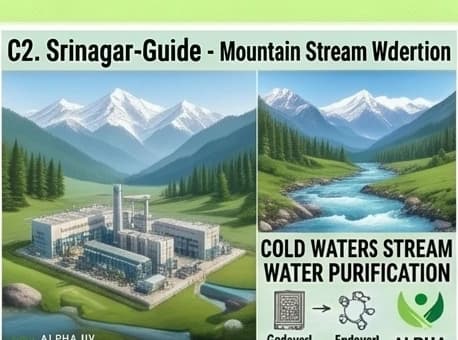
UV water treatment in Srinagar and the Kashmir Valley addresses four key needs: (1) post-overhead-tank disinfection for Srinagar's residential areas — SMC (Srinagar Municipal Corporation) supply from Jhelum River springs and the Harwan Reservoir loses residual chlorine in overhead tanks; Kashmir's milder climate (20–32°C summer) reduces but doesn't eliminate bacterial regrowth risk, particularly in the monsoon months (July–August); (2) Dal Lake houseboat and shikara tourism UV — Dal Lake's 1,200+ houseboats receive millions of tourists annually, requiring potable water treatment suitable for international tourist standards; Dal Lake's water quality is complex (lake eutrophication, nutrient loading) and point-of-use UV is essential for houseboat drinking and kitchen water; (3) apple and fruit processing UV — Kashmir produces 2 million tonnes of apples annually (70% of India's apple production), with apple juice, apple concentrate, apple cider vinegar, and dried fruit processing requiring FSSAI food safety water compliance; and (4) JKPCB STP compliance for Srinagar's Lake Zone and residential complexes. Alpha UV System supplies Philips UV-C lamp UV systems to Srinagar with 5–7 day delivery and JKPCB documentation support.
Srinagar — J&K's summer capital, set in the Kashmir Valley's 1,590-metre elevation bowl between the Pir Panjal and main Himalayan ranges — is India's most topographically distinctive major city. The city's water landscape is characterised by an extraordinary natural resource: Kashmir's high-altitude springs (nallahs), the Jhelum River (which flows through the valley), Dal Lake (the famous urban lake that is simultaneously a wetland, floating garden zone, and tourism hub), and Wular Lake (one of Asia's largest freshwater lakes). This natural abundance paradoxically creates specific water treatment challenges: Dal Lake's water quality has degraded severely from nutrient loading (the floating gardens, houseboat sewage, and urban runoff have eutrophied the lake), and the springs, while cleaner, face contamination from the dense urban expansion of Srinagar's population.
Kashmir's apple economy — a $2+ billion annual industry — produces the "King of Indian Apples" (Kashmiri apples are premium-priced in south India, Himachal, and export markets). The Sopore apple belt (Sopore is Asia's largest apple market), Baramulla, Shopian, and Pulwama districts supply the apple orchards. Apple processing (juicing, concentrate, cider, vinegar, dried apple rings) in the valley has grown significantly, creating FSSAI food contact water UV requirements at processing units.
Srinagar Water Quality by Zone
| Zone / Area | Supply Type | Key Water Issue | UV Solution |
|---|---|---|---|
| Central Srinagar (Lal Chowk, Rajbagh) | SMC piped supply (Jhelum / Harwan springs) | Bacterial risk in monsoon July–August (turbidity surge); supply intermittency; aging SMC distribution; winter frozen pipe risks | Post-tank UV at 40 mJ/cm²; 5 µm pre-filter; monsoon pre-filter check monthly; insulate pipe before UV in winter |
| Dal Lake houseboat zone | SMC piped connection + dal water (non-potable) | 1,200+ houseboats; international tourist potable water; Dal Lake eutrophication; no sewage discharge allowed | Houseboat point-of-use UV; international tourist WHO standard; Dal Lake water NOT for potable use (eutrophied) |
| Sopore / Baramulla apple belt | Spring / nallah + municipal supply + borewell | Apple processing — juice, concentrate, cider vinegar; FSSAI food contact water; EU/Middle East apple export audit | FSSAI food UV; apple juice water UV; no chlorine in apple juice contact; 316L SS; export audit |
| Anantnag / Shopian (south Kashmir) | Spring / jal supply + borewell | Agricultural zone; apple orchards (Shopian Golden apple); walnut processing; JKPCB STP compliance | Post-tank UV; apple and walnut food processing UV; STP UV; JKPCB documentation |
| Jammu-Srinagar highway towns (Kud, Patnitop) | Spring + municipal supply | Highway tourism (Vaishno Devi route); dhabas and hotels; mountain spring water (clean but coliform risk near dhaba activity) | Hotel UV; dhaba kitchen UV; highway tourism food safety; spring water UV even if apparently clear |
UV for Dal Lake Houseboats and Kashmir Tourism
Dal Lake's 1,200+ houseboats — carrying 3–5 million tourist overnight stays annually — are an iconic Srinagar experience. The houseboats receive SMC piped water connections for drinking and kitchen use, but the connection quality and houseboat-internal plumbing (many houseboats are old with wooden pipes and copper fittings of uncertain quality) means that a point-of-use UV at the houseboat kitchen drinking water tap provides the final microbiological safety step that international tourists expect.
Dal Lake's own water is NOT suitable for potable use (even after UV): Dal Lake has severe eutrophication from the estimated 1 million people living on and around the lake's periphery, the floating garden (rad) agricultural nutrient runoff, and historical sewage discharge from houseboats before the National Lake Conservation Programme (NLCP) sewage diversion works. The lake has elevated algae (bloom events), high BOD, and nutrient levels. UV can disinfect bacteria and viruses but cannot remove the algal toxins (cyanotoxins from blue-green algal blooms), nutrient load, or the complex organic matter in Dal Lake water. Only the SMC piped supply (treated spring/Jhelum water) should be used for drinking and cooking on houseboats — with UV as the final polishing step.
International tourist expectations: Kashmir tourism is predominantly domestic (north and south Indian tourists) with a significant foreign tourist segment (European, Central Asian, Middle East visitors during summer). Foreign tourists from Western markets expect WHO-standard drinking water at accommodation. A Srinagar houseboat with visible UV system at the kitchen water point communicates water safety credentials that international guests find reassuring — particularly given concerns about tap water quality in India.
| Application | Flow Rate | UV Dose | Notes |
|---|---|---|---|
| Residential apartment (Srinagar city) | 1–3 m³/h | 40 mJ/cm² | Post-overhead-tank UV; 5 µm pre-filter; monsoon July–August monthly pre-filter check; no freeze risk (UV chamber indoors) |
| Dal Lake houseboat (kitchen drinking water) | 0.5–2 m³/h | 40 mJ/cm² | Compact UV for houseboat kitchen; SMC piped supply only (not dal water); WHO international tourist standard |
| Apple juice / concentrate processing (Sopore) | 2–10 m³/h | 40 mJ/cm² | FSSAI food contact water; no chlorine (off-flavour in apple juice); EU/Middle East export audit; 316L SS |
| Walnut / dried fruit processing (south Kashmir) | 1–5 m³/h | 40 mJ/cm² | FSSAI food contact water; no chlorine in walnut/dried apple contact; export quality; 316L SS |
| Hotel / resort (Srinagar Gulmarg Pahalgam) | 2–10 m³/h | 40 mJ/cm² | Hotel drinking water UV; international tourist WHO standard; Legionella WMP for 4-star+ properties |
| STP outlet — 300 KLD (Srinagar residential / Dal Zone) | 20–30 m³/h | 40 mJ/cm² | Philips TUV 95W; JKPCB consent; Dal Lake wetland protection compliance; NLCP Dal restoration programme |
Srinagar has sub-zero winters — can UV systems operate in freezing temperatures?
UV chambers (the steel reactor body containing the lamp and quartz sleeve) do not freeze — the water flowing through the chamber maintains above-zero temperature as long as water is moving. However, the supply pipes leading to the UV system and the 5 µm pre-filter housing can freeze if installed in uninsulated spaces (unheated storerooms, exterior wall mounting).
Installation recommendations for Srinagar and Kashmir Valley: (a) install UV systems in heated interior spaces — not in unheated lofts, exterior wall niches, or cold storage areas; (b) insulate the supply pipe to the UV system if it passes through an unheated wall or exterior space — pipe insulation foam prevents freezing in Kashmir's -5°C to -10°C winter nights; (c) if the building is unoccupied for extended winter periods (seasonal closure of houseboat, summer resort, etc.), close the water supply valve before UV system and drain the pre-filter housing — frozen water in the plastic pre-filter housing can crack the housing; (d) UV lamp performance at cold temperatures (0–5°C water temperature): Philips UV-C lamps maintain their rated output at normal operating temperatures, but very cold water can reduce the lamp's warm-up efficiency immediately after startup. After extended winter shutdown, allow the lamp to run for 5–10 minutes before resuming normal use — the lamp warms up and reaches full UV output within this period.
Alpha UV System supplies UV disinfection systems to Dal Lake houseboats, apple and fruit processors, hotels, residential complexes, and STP operators across Srinagar, Sopore apple belt, Anantnag, Shopian, Baramulla, Gulmarg, Pahalgam, and the Kashmir Valley. JKPCB STP documentation. FSSAI apple and fruit processing UV. Dal Lake compliant STP UV. Philips UV-C lamps. 5–7 day delivery to Srinagar.
WhatsApp Us for Srinagar / Kashmir UV System SupplyRecommended UV Systems
Alpha UV System products for this application — powered by genuine Philips UV-C lamps.
Commercial UV Water Purification System
500 – 5,000 LPH
HACCP-compliant UV water purification for hotels, restaurants, and offices
Industrial UV Water Treatment System
5,000 – 50,000 LPH
Schedule M 2025 and HACCP compliant UV for pharma, food & beverage, and process water
Not sure which system suits your application? WhatsApp our engineers for a free recommendation →
Related solutions
See how Alpha UV System applies this to your industry or city.
Need a UV system?
Talk to our UV engineers — WhatsApp for a quote in 2 hours, or browse the full catalog on IndiaMART.