Quick Answer: What Does a UV Water Treatment System Do for a Hotel in India?
A UV water treatment system for a hotel in India delivers continuous, chemical-free microbiological disinfection at every critical water use point — kitchen ingredient water, bar and beverage stations, central domestic supply, and swimming pool recirculation. UV-C light at 254 nm inactivates bacteria, viruses, and protozoa (including Cryptosporidium) to a 4-log reduction without adding chlorine, altering taste, or producing disinfection byproducts. For Indian hotels, the system simultaneously solves two separate compliance requirements: FSSAI Regulation 2.3.1 for food-ingredient water in hotel kitchens, and HACCP Critical Control Point (CCP) documentation for international brand audits. Alpha UV System supplies and commissions UV water treatment systems for 5-star hotels, business hotels, and resort properties across India — from Delhi NCR and Gurgaon to Mumbai and beyond.
The Hotel Water Quality Challenge in India
A hotel's water infrastructure is one of its most complex operational systems. At any given hour, the same incoming municipal or borewell supply is simultaneously demanded by the main kitchen, the restaurant bar, ice machines, the laundry, cooling towers, guestroom taps, and the swimming pool. Each use point carries a different quality requirement, a different regulatory exposure, and a different consequence for guest experience if water quality fails.
For hotels in India, the stakes are particularly high. Municipal water quality in Indian cities — including Delhi NCR, Gurgaon, and Mumbai — is variable by season, with microbial contamination risk elevated during monsoon periods when distribution networks experience pressure drops and cross-contamination. Borewell-dependent hotels face different risks: stable microbiology but potential hardness, iron, and seasonal turbidity fluctuations that affect UV transmittance if not pre-filtered.
The guest experience dimension is equally demanding. A 5-star property cannot serve drinking water, beverages, or ice that carries a chlorine odour — yet municipal supplies require chlorination at the source. The UV water treatment system for a hotel in India removes neither minerals nor chlorine chemically, but when positioned after a carbon pre-filter (standard in hotel beverage installations), it delivers the taste-neutral, microbiologically safe water that fine dining requires.
The regulatory dimension is where operational risk crystallises. FSSAI classifies water used in food preparation as a food ingredient. Under FSSAI Regulation 2.3.1, that ingredient must meet microbiological standards — and critically, there must be documented evidence of the treatment process. A hotel kitchen that relies on municipal supply alone, without a documented on-site treatment step, cannot demonstrate FSSAI compliance during an inspection. A UV system with proper documentation closes this gap entirely.
FSSAI Compliance for Hotel Kitchens: What Inspectors Look For
FSSAI inspectors visiting hotel food service operations have a specific checklist for water quality. Understanding what triggers a compliance finding — and what closes it — is essential for any hotel food safety manager deploying a UV water treatment system for a hotel in India.
Documented treatment process: The inspector will ask to see evidence that water used in the kitchen is treated to a known standard. A UV system satisfies this if the operator can produce a dose calculation report showing that the system delivers a minimum of 40 mJ/cm² at the maximum design flow rate. This report, prepared and signed by an engineer, becomes the treatment process documentation for the FSSAI audit file.
Critical Control Point records: Under HACCP (which FSSAI's food safety management guidance references), water treatment is typically identified as a CCP in the food production flow. The inspector will look for CCP monitoring records — in the case of UV treatment, this means a log of UV intensity sensor readings, ideally automated and printable from the system controller. Alpha UV System hotel installations include a data-logging controller that generates these records automatically.
Corrective action documentation: HACCP requires not just monitoring but a documented corrective action for each CCP deviation. For UV water treatment, the corrective action is lamp replacement when the UV intensity sensor triggers an alarm. The inspector will look for a corrective action procedure and evidence that it has been tested. Alpha UV System's installation package includes a laminated corrective action card posted at each system location.
Supplier qualification records: An increasingly common FSSAI inspection requirement — particularly for hotel water purification FSSAI compliance — is evidence that the UV lamp supplier is a qualified, traceable manufacturer. Philips UV-C lamp certificates of analysis (COA), with serial numbers matched to the installed lamp, satisfy this requirement. These COAs are provided with every Alpha UV System installation and replaced when lamps are changed during annual maintenance.
Where UV Systems Are Installed in a Hotel
A complete UV disinfection hotel deployment covers four primary installation points. Each serves a distinct regulatory and operational purpose:
MUNICIPAL / BOREWELL SUPPLY
|
[Pre-treatment: Sediment + Carbon Filtration]
|
-------+---------------------------+
|                           |
[Central UV System]         [Swimming Pool UV]
(Domestic water supply)     (Pool recirculation circuit)
|
-------+---------------------------+
|                           |
[Kitchen UV System]       [Bar / Beverage UV]
(Ingredient water,        (Presentation water,
ice machines,             cocktail & mocktail
vegetable washing)        stations, espresso)
Main kitchen supply UV: Installed on the cold water main feeding the hotel kitchen, upstream of all preparation points. This is the most critical installation for hotel water purification FSSAI compliance. The system treats all ingredient water in a single step — covering every cooking process, ice machine, beverage station, and vegetable wash sink downstream. Typical capacity range: 2,000–10,000 LPH depending on kitchen volume and F&B covers per day.
Bar and beverage station UV: A dedicated, smaller UV unit at the bar or beverage station where water quality is directly perceptible to guests. A UV system hospitality India installation at the bar treats water just before it is served as still or sparkling water, used in cocktails, or passed through an espresso machine. Because UV adds nothing to the water, the flavour profile of premium beverages is unaffected. Typical capacity: 500–1,500 LPH.
Central domestic water supply UV: A high-capacity UV system on the main hotel water supply line, upstream of the overhead storage or distribution tank. This treats all domestic water delivered to guestrooms, bathrooms, and housekeeping points. For 5-star hotel UV system deployments, this installation also satisfies international brand audit requirements for whole-property water quality documentation. Typical capacity: 5,000–30,000 LPH.
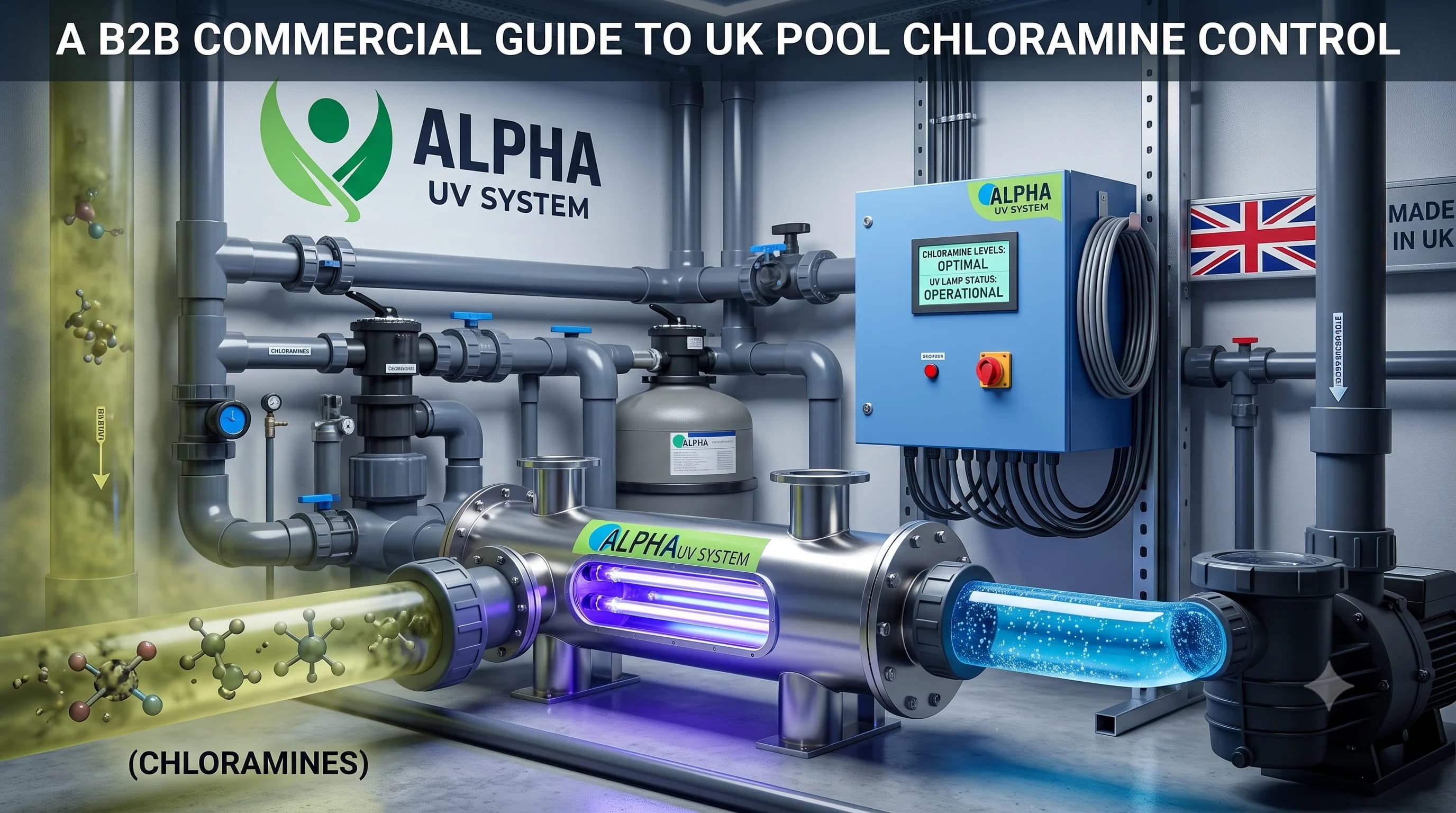
Swimming pool UV: A separate UV system on the pool recirculation circuit, sized to treat the full pool volume through the UV chamber at least once every four to six hours. Pool UV does not replace chlorine — it controls chloramine formation and provides protection against Cryptosporidium, which is chlorine-resistant. See the swimming pool section below for details on chloramine control and combined residual reduction.
Hotel UV System Capacity Sizing Guide
Correct capacity sizing is the most important technical decision in a UV water treatment system hotel India project. An undersized system allows water to pass through the UV chamber faster than the validated flow rate, reducing UV dose below the 40 mJ/cm² threshold and creating a compliance gap. The table below provides planning estimates by hotel type:
| Hotel Type | Approximate Rooms | Kitchen UV (LPH) | Central Supply UV (LPH) | Pool UV (m³/hr) |
|---|---|---|---|---|
| Boutique / Heritage (no pool) | 15–30 | 500–1,000 | 1,500–3,000 | — |
| 3-star business hotel | 50–80 | 1,500–2,500 | 3,000–6,000 | 10–20 |
| 4-star hotel (mid-scale F&B) | 100–150 | 3,000–5,000 | 6,000–12,000 | 20–40 |
| 5-star hotel (full F&B, banquet) | 200–350 | 5,000–10,000 | 12,000–25,000 | 40–80 |
| Luxury resort (multiple F&B outlets) | 200–500+ | 8,000–15,000 | 20,000–40,000 | 60–120 |
These figures are planning estimates only. Accurate sizing for a UV water treatment system hotel India project requires the hotel's design occupancy rate, F&B covers per day across all outlets, laundry load, pool volume, municipal supply pressure and flow rate, and pre-treatment configuration. Alpha UV System provides free site-specific sizing calculations for hotel properties — contact our team with your property details for a written sizing report.
UV vs Chlorination for Hotel Water: Why Hotels Choose UV
Hotels that upgrade from chlorination to UV disinfection cite three reasons almost universally: taste, HACCP simplicity, and chemical handling elimination. Understanding the trade-offs is important for hotel engineers and food safety managers evaluating their options for hotel water quality India compliance.
Taste and beverage quality: Chlorine disinfection at concentrations sufficient for microbiological control produces a detectable taste and odour in drinking water. In hotel kitchens, chlorine affects the flavour of stocks, sauces, coffee, and any preparation where water flavour is perceptible. UV disinfection adds nothing to the water — it changes only the microbiological status. For a 5-star property, this is not a marginal benefit; it is a fundamental quality requirement.
Disinfection byproducts (DBPs): Chlorination of water containing natural organic matter produces trihalomethanes (THMs) and haloacetic acids (HAAs) — regulated DBPs with long-term health implications. UV produces no DBPs. For hotel properties positioning themselves on wellness and sustainability, eliminating DBP formation from the water supply is a meaningful differentiator.
HACCP CCP simplicity: A chlorination system requires ongoing chemical dosing management — monitoring residual chlorine concentration, adjusting dosing pump rates, testing, and recording. Each of these steps is a potential HACCP deviation point. A UV system's CCP is a single parameter: UV intensity in mW/cm², monitored continuously by a sensor and logged automatically. HACCP documentation for UV water treatment is substantially simpler to maintain than for chlorination.
Chemical storage and handling: Hotels in India are increasingly subject to scrutiny on chemical storage under fire safety, environmental, and occupational health regulations. Eliminating chlorine storage from a hotel kitchen or plant room removes a chemical hazard and simplifies regulatory exposure. UV systems have no chemical inputs — only electrical power and an annual lamp replacement.
UV vs Chlorine vs RO: Comparison for Hotel Water Applications
| Parameter | UV Disinfection | Chlorination | Reverse Osmosis (RO) |
|---|---|---|---|
| Microbiological efficacy | 4-log bacteria, virus, Cryptosporidium | High for bacteria; poor for Cryptosporidium | Physical removal of bacteria and protozoa; variable for viruses |
| Effect on taste and odour | None — water unchanged | Adds chlorine taste and odour | Removes minerals; flat taste without remineralisation |
| Disinfection byproducts | None | THMs, HAAs at standard dosing levels | None (physical process) |
| HACCP CCP documentation | Single parameter: UV intensity log | Multiple parameters: residual, pH, contact time | Multiple parameters: TDS, pressure, membrane integrity |
| Chemical inputs required | None | Chlorine (storage, dosing, handling) | Antiscalant, periodic acid/alkali CIP chemicals |
| Water recovery / waste | 100% — no waste water | 100% — no waste water | 60–75% recovery; 25–40% reject water |
For most hotel water quality India requirements, the optimal configuration is UV disinfection combined with sediment and carbon pre-filtration — not RO. RO is appropriate where TDS reduction is required (high-hardness boreholes), but for municipal supply treatment in hotels, UV with pre-filtration delivers better taste, lower waste, lower operating cost, and simpler HACCP documentation than either RO or chlorination alone.
HACCP Documentation Package for Hotel UV Systems
Every Alpha UV System hotel installation includes a HACCP-oriented documentation package designed specifically to satisfy FSSAI inspectors and international brand audits. The table below describes each document and its function in the compliance file:
| Document | What It Contains | Audit Function |
|---|---|---|
| UV Dose Calculation Report | Validated flow rate, UV transmittance assumption, lamp output, chamber geometry, calculated UV dose at maximum flow (mJ/cm²) | Proves 40 mJ/cm² delivery at peak demand — the FSSAI technical threshold for microbiological inactivation |
| Philips TUV Lamp Certificate of Analysis (COA) | Serial-number authenticated lamp specification, UV output at rated hours, manufacturer quality declaration | Demonstrates traceable, qualified lamp supply — required for hotel water purification FSSAI supplier qualification checks |
| HACCP CCP Record Template | CCP identification (water treatment), critical limit (UV intensity ≥ X mW/cm²), monitoring method (automatic sensor log), corrective action (lamp replacement alarm response), verification (quarterly water quality test) | Provides the complete HACCP CCP documentation for water treatment — ready to insert into the hotel's HACCP plan |
| Corrective Action Procedure Card | Step-by-step response when UV alarm triggers: isolate supply, contact Alpha UV System (24–48 hour emergency response), document deviation, verify restoration | Demonstrates HACCP corrective action control — inspectors look for posted, practised procedures, not just written ones |
| Operation and Maintenance Manual | System specifications, pre-filter replacement schedule, lamp replacement interval (annually or at 9,000 hours), cleaning procedure, troubleshooting guide | Required for HACCP verification and brand audit maintenance programme documentation |
| Commissioning Test Report | Installed flow rate, UV intensity at commissioning, pre-filter condition, electrical installation sign-off | Baseline record for ongoing monitoring — auditors check that current sensor readings match commissioning values |
This documentation package satisfies the HACCP FSSAI hotel water requirements for kitchen water treatment. For properties with FSMS (Food Safety Management System) certification under FSSAI Schedule 4, the package maps directly to the water quality control requirements in the FSMS standard.
Swimming Pool UV: Chloramine Control and Cryptosporidium Protection
Swimming pool UV disinfection serves a different purpose than potable water UV. Hotel pools in India — particularly 5-star hotel UV system deployments — use UV on the recirculation circuit to address two problems that conventional chlorination cannot solve alone: chloramine accumulation and Cryptosporidium risk.
Chloramine control: When chlorine reacts with bather-introduced nitrogen compounds (urine, sweat, cosmetics), it forms combined chlorine — chloramines — which are responsible for the characteristic "pool smell," eye and skin irritation, and respiratory complaints from hotel guests. A medium-pressure UV system on the pool recirculation circuit photolytically destroys chloramines, reducing combined residual chlorine by 50–80% without reducing free chlorine. The result is a pool that smells clean, feels comfortable, and requires less top-up chlorine dosing. This is a measurable guest experience improvement at any hotel UV system hospitality India property with a pool.
Cryptosporidium protection: Cryptosporidium parvum, a protozoan oocyst, is chlorine-resistant at normal pool disinfection concentrations. UV at 40 mJ/cm² achieves a 3-log inactivation of Cryptosporidium — the protection level recommended by the WHO for recreational water. For hotel pools that serve international guests, this protection level is increasingly specified in brand standards for luxury properties.
Combined residual reduction: By destroying chloramines, pool UV reduces total chlorine demand, which reduces chlorine consumption and the frequency of pool superchlorination (shock dosing). Hotels with UV-equipped pools typically report 30–40% reduction in chlorine consumption — a direct operating cost saving alongside the guest experience improvement.
Pool UV systems for hotels are sized based on pool volume, turnover rate, and bather load. Alpha UV System provides medium-pressure UV systems for hotel pools, which are more effective at chloramine destruction than low-pressure systems and require less frequent lamp changes given higher output per lamp.
Guestroom Water Quality: Central UV vs Point-of-Use UV
Hotel operators frequently ask whether to treat water centrally — a single high-capacity UV water treatment system hotel India installation on the main supply — or at each point of use, with individual UV units at guestroom taps or floor-level distribution points. Both approaches have merit; the right choice depends on the property's infrastructure age and layout.
Central UV (recommended for new builds and large properties): A central UV system treats all domestic water in a single step before it enters the distribution network. This provides the lowest capital cost per room, simplest maintenance (one system, one lamp, one annual service), and the most straightforward HACCP documentation. The limitation is that central treatment does not protect against re-contamination within the distribution network — a concern for older hotels with long pipe runs, dead-legs, or legacy distribution tanks that are difficult to clean.
Point-of-use UV (recommended for older properties with complex distribution): Individual UV units at each guestroom or floor distribution point ensure that water is treated immediately before use, regardless of what happens within the building's distribution network. This approach is more expensive to install and maintain but provides a stronger assurance of quality at the tap for properties where central treatment cannot guarantee distribution network integrity.
Hybrid approach (most common in 5-star properties): Central UV for the domestic supply, combined with dedicated kitchen UV and bar UV systems for the food service areas. This provides whole-property treatment at reasonable cost while adding an extra treatment step at the points of highest FSSAI regulatory scrutiny. Most 5-star hotel UV system installations in India use this hybrid configuration.
Regulatory Compliance Checklist for Hotel Water in India
Hotel water quality in India is governed by overlapping regulatory frameworks. The checklist below covers the primary requirements that a UV water treatment system hotel India deployment must address:
- FSSAI Regulation 2.3.1 (kitchen and ingredient water): Documented on-site treatment to microbiological standards. UV dose calculation report and CCP records are the primary evidence. Applicable to all hotels with food service operations — restaurant, banquet, or in-room dining.
- HACCP plan (FSMS-certified properties): Water treatment identified as a CCP with monitoring records, corrective action procedure, and verification protocol. Required for FSSAI Schedule 4 compliance and most international brand audits.
- Bureau of Indian Standards IS 10500:2012 (drinking water): The Indian standard for potable water quality, which hotel domestic supply must meet. UV disinfection with pre-filtration is the most direct path to microbiological compliance with IS 10500.
- Local municipal regulations: Delhi, Mumbai, Bengaluru, and other major cities have municipal bylaws governing private water storage (overhead tanks, underground sumps) and on-site treatment. Many now require treatment documentation for commercial premises. Alpha UV System's commissioning report satisfies these requirements.
- International brand standards (IHG, Marriott, Accor, Taj): International hotel brand operating standards typically specify water quality testing protocols, treatment requirements, and documentation standards as part of the property quality assurance programme. Alpha UV System's documentation package is designed to meet these standards and has been accepted by multiple international brand audit teams.
- Swimming pool regulation (State Pollution Control Board / municipal): Pool water quality standards vary by state. Central UV with maintained free chlorine satisfies the most stringent state-level pool standards in India.
Case Study: Taj Hotels — Multi-Property UV Water Treatment Deployment
Taj Hotels, India's most recognised luxury hospitality brand, operates properties across the country under rigorous food safety management systems that must satisfy both FSSAI inspections and internal brand audits. When Taj Hotel properties began evaluating UV water treatment system hotel India solutions for their kitchen and domestic water supply, the procurement and food safety teams had a specific requirement that eliminated most suppliers: traceable, documented engineering — not just equipment supply.
The specific requirements Taj Hotels brought to the supplier evaluation were: a signed UV dose calculation report from a qualified engineer; Philips TUV lamp certificates of analysis with serial number matching; a HACCP CCP documentation template compatible with their existing HACCP plan format; and a supplier with the engineering capability to respond to a lamp alarm within 24–48 hours at any property location.
Alpha UV System was selected as the preferred supplier across multiple Taj Hotels properties. Our IIT-trained engineering team prepared property-specific dose calculation reports for each installation point — kitchen UV, bar UV, and central supply UV — at each property. Lamp COAs were matched by serial number to the installed system and filed in the property's FSSAI audit folder. The HACCP CCP template was formatted to slot directly into Taj Hotels' existing HACCP plan structure, requiring no modification by the property food safety manager.
The audit outcomes across Taj Hotels properties that use Alpha UV System have been consistently clean. FSSAI inspectors reviewing kitchen water treatment documentation have found complete, signed engineering documentation at every property. International brand audit teams reviewing the food safety management systems have found HACCP CCP records with complete monitoring logs and corrective action evidence. No property using Alpha UV System has received a water treatment non-conformance finding in a formal audit since installation.
For multi-property hotel groups, Alpha UV System provides standardised documentation formats across all sites — simplifying the group-level food safety audit process and allowing the corporate food safety team to review a consistent documentation structure regardless of which property is being audited.
Case Study: 5-Star Hotel Delhi NCR — Installation, Commissioning and FSSAI Audit Pass
A 5-star business hotel in Gurgaon, Delhi NCR — 280 rooms, two full-service restaurants, a rooftop bar, banquet facilities, and an outdoor swimming pool — approached Alpha UV System following a near-miss at a routine FSSAI inspection. The inspector had asked for kitchen water treatment documentation; the hotel's existing system (a domestic filter without UV) could not produce the dose calculation or CCP records the inspector required. The inspection resulted in a conditional compliance notice with a 60-day remediation deadline.
Alpha UV System conducted a site survey within the remediation window, covering the kitchen main supply, bar and beverage station, central domestic supply header, and pool recirculation room. The survey identified four installation points, sized the systems based on the hotel's peak demand calculations, and produced a written sizing and specification report that was submitted to the hotel's engineering and food safety teams for review before any procurement decision was made.
The installation was completed in two phases: kitchen UV and bar UV in week one (priority for FSSAI compliance), and central supply UV and pool UV in week three. Each system was commissioned with a flow-rate verification test and UV intensity measurement at commissioning flow. Commissioning reports were prepared for each installation point and added to the FSSAI audit file within 24 hours of commissioning.
At the follow-up FSSAI inspection 45 days after the conditional notice was issued, the inspector reviewed the UV dose calculation reports, Philips TUV lamp COAs, HACCP CCP template with initial monitoring logs, and commissioning test reports. The inspection resulted in full compliance clearance — the conditional notice was closed with no further action required. The hotel's food safety manager subsequently noted that the Alpha UV System documentation package was more complete than what they had previously received from other water treatment suppliers.
This case is representative of how the UV water treatment system hotel India compliance process works in practice: installation is straightforward; documentation is where the compliance outcome is determined.
Maintenance and AMC for Hotel UV Systems
A hotel UV system operates continuously — 24 hours a day, 365 days a year — and must never fail silently. A UV lamp that fails without triggering an alarm allows untreated water to pass through the system without any visible indication to kitchen or housekeeping staff. Proper maintenance and an AMC (Annual Maintenance Contract) with guaranteed response time are therefore not optional additions to a hotel UV system — they are compliance requirements.
Annual maintenance schedule:
- Lamp replacement (12 months or 9,000 operating hours, whichever comes first): Philips TUV lamps maintain output above the rated threshold for this interval. Annual replacement at a scheduled time (rather than waiting for lamp failure) prevents compliance gaps. New lamp COA is filed in the FSSAI audit folder at each replacement.
- Quartz sleeve inspection and cleaning: Scale and biofilm on the quartz sleeve reduce UV transmittance to the water. Annual cleaning restores sleeve transmittance and should be followed by a UV intensity verification test.
- Pre-filter replacement: Sediment and carbon pre-filters upstream of the UV system protect the lamp chamber from turbidity and organic load. Pre-filter replacement interval depends on incoming water quality — typically every 3–6 months for Indian municipal supply.
- UV intensity calibration check: Annual verification that the UV intensity sensor reading corresponds to actual lamp output, using a calibrated reference meter. Sensor drift can create false compliance if not checked.
- Flow rate verification: Annual check that the system flow rate has not increased beyond the validated maximum — a risk in properties that have expanded F&B operations since original commissioning.
Emergency response: Alpha UV System provides 24–48 hour emergency response for hotel AMC clients across India. A UV alarm at a hotel kitchen is treated as a critical event — not a scheduled service call. Our response protocol includes remote diagnosis (lamp failure vs sensor fault vs controller fault), dispatch of replacement components, and on-site attendance within 24–48 hours of the alarm notification.
Documentation at each service visit: Every AMC service visit generates a service record that is added to the hotel's FSSAI audit file — lamp replacement with new COA, sleeve condition photograph, UV intensity before and after cleaning, and engineer sign-off. These records form the ongoing HACCP CCP verification evidence that FSSAI inspectors and brand auditors review at each inspection.
Frequently Asked Questions
Will a UV system guarantee we pass our next FSSAI audit for kitchen water?
A properly installed and documented UV system addresses the specific water treatment evidence that FSSAI inspectors look for under Regulation 2.3.1. Alpha UV System's documentation package — dose calculation report, Philips TUV lamp COA, HACCP CCP template, and commissioning report — has been accepted at FSSAI inspections at hotel properties across India. No water treatment system can guarantee an audit outcome, but complete, signed engineering documentation eliminates the most common ground for a water treatment non-conformance finding. Properties that have used Alpha UV System's documentation package have not received water treatment non-conformance findings at FSSAI inspections.
How do I know what capacity UV system my hotel needs?
Capacity sizing for a UV water treatment system hotel India project requires four inputs: the hotel's peak hour water demand at the installation point (kitchen, bar, or central supply), the UV transmittance of the incoming water at your location, the desired UV dose (40 mJ/cm² is the standard for FSSAI compliance), and the pre-filtration configuration. Alpha UV System provides free written sizing calculations for hotel properties — contact our team with your room count, F&B covers per day, and municipal/borewell water source. We will provide a sizing report within 24–48 hours, before any commercial discussion.
Does pool UV replace chlorine in the hotel pool?
No — and no reputable supplier will tell you otherwise. Pool UV on the recirculation circuit destroys chloramines and provides Cryptosporidium protection, but free chlorine must be maintained in the pool water to provide residual disinfection between recirculation cycles and to kill pathogens introduced by bathers. The correct configuration is UV plus maintained free chlorine at 1–3 ppm. The benefit is that UV-equipped pools require less free chlorine to maintain the same hygiene standard, because chloramine accumulation is controlled — fewer chlorine odour complaints, less shock dosing, lower chlorine consumption. For HACCP hotel water India documentation, the pool UV is documented as a supplementary treatment CCP alongside the chlorine residual CCP.
What does hotel UV system maintenance involve and how often is it needed?
The primary maintenance event is annual lamp replacement — Philips TUV lamps are rated for 9,000 hours and should be replaced on a 12-month schedule to ensure continuous compliance. The quartz sleeve is cleaned at the same visit. Pre-filters upstream of the UV system require replacement every 3–6 months depending on incoming water quality. Alpha UV System's AMC for hotel clients covers the annual lamp and sleeve service, pre-filter replacement, UV intensity verification, and 24–48 hour emergency response for lamp alarms — with service records added to the FSSAI audit file at each visit.
Will UV remove the chlorine taste from our kitchen and beverage water?
UV disinfection alone does not remove chlorine — it only inactivates microorganisms. To eliminate chlorine taste and odour from beverage and kitchen water, the UV system should be preceded by a granular activated carbon (GAC) filter, which adsorbs free chlorine and organic compounds that contribute to taste and odour. This is standard practice in hotel bar and beverage UV installations. The combination of carbon pre-filter plus UV provides taste-neutral water with full microbiological treatment — no chlorine taste, no byproducts, full FSSAI-compliant disinfection documentation. For properties that want visible evidence of treatment quality, UV systems can be paired with periodic third-party water quality testing, which Alpha UV System can arrange on request.
Our hotel is part of an international brand (IHG / Marriott / Accor). Will Alpha UV System's documentation satisfy their brand audit requirements?
Alpha UV System's documentation package has been reviewed and accepted by brand audit teams at international hotel groups operating in India. The dose calculation report, Philips TUV lamp COA, HACCP CCP template, and commissioning report map to the water treatment documentation requirements in international brand operating standards. For brand audit preparation, we can also provide our ISO 9001:2015 quality management certificate, CE marking documentation, and RoHS compliance certificates — the supplier qualification documents that international brand auditors request. Contact our team with your specific brand's water quality standard document and we will confirm alignment before installation.
UV Water Treatment System for Your Hotel: Next Steps
A UV water treatment system hotel India deployment is one of the most straightforward compliance and guest experience investments a hotel operator can make. The technology is proven, the regulatory framework is clear, and the documentation package that satisfies FSSAI and brand auditors is well-defined. The gap, in most hotels that face compliance issues, is not the equipment — it is the engineering documentation that turns a UV system from a box on the wall into an auditable Critical Control Point.
Alpha UV System designs, manufactures, supplies, and commissions UV water treatment systems for hotels across India — from boutique heritage properties to 5-star international brand hotels in Delhi NCR, Gurgaon, Mumbai, and beyond. Our IIT-trained engineering team prepares property-specific dose calculation reports, sources Philips TUV lamps with traceable COAs, and provides HACCP documentation packages that have passed FSSAI inspections and international brand audits at Taj Hotels properties and other leading hotel clients.
To receive a free sizing calculation, documentation checklist, and indicative quotation for your hotel property, contact Alpha UV System or visit our commercial UV applications page. Our team responds within 24–48 hours with a written sizing report — no commitment required.
Recommended UV Systems
Alpha UV System products for this application — powered by genuine Philips UV-C lamps.
Commercial UV Water Purification System
500 – 5,000 LPH
HACCP-compliant UV water purification for hotels, restaurants, and offices
Industrial UV Water Treatment System
5,000 – 50,000 LPH
Schedule M 2025 and HACCP compliant UV for pharma, food & beverage, and process water
Not sure which system suits your application? WhatsApp our engineers for a free recommendation →
Related solutions
See how Alpha UV System applies this to your industry or city.
Need a UV system?
Talk to our UV engineers — WhatsApp for a quote in 2 hours, or browse the full catalog on IndiaMART.