Quick Answer: What Is a Commercial UV Water Treatment System?
A commercial UV water treatment system uses ultraviolet light at 254 nm wavelength to inactivate bacteria, viruses, and protozoa in water — without adding any chemicals. In India, a commercial UV water treatment system is defined as a system rated at 500 LPH or above, designed for continuous-duty operation in hotels, restaurants, food processing plants, offices, schools, or institutional buildings. These systems operate at a validated UV dose of 40 mJ/cm² minimum, which is the threshold required for HACCP compliance and FSSAI water quality documentation.
The eight core advantages of a commercial UV water treatment system India operators rely on are: chemical-free disinfection, no THM byproducts, consistent dose delivery, HACCP CCP validation, zero taste or odour impact, lower 3-year operating cost than chlorination, continuous flow operation, and automated alarm monitoring. Each is covered in detail below, with data.
Why Commercial Operations Need UV Water Treatment
Commercial water users — hotels, restaurants, corporate offices, schools, and food manufacturers — face a water quality challenge that residential users do not encounter: regulatory audit. FSSAI water treatment requirements for licensed food businesses include documented evidence that water used in food preparation meets microbiological standards (total coliform: absent in 100 ml; E. coli: absent in 100 ml). HACCP systems, now mandatory for FSSAI Schedule 4 licence holders, require identified and validated Critical Control Points (CCPs) for water quality.
A correctly installed commercial UV water treatment system India addresses both requirements simultaneously. The UV system becomes a documented CCP with a validated dose parameter (40 mJ/cm²), a continuous monitoring signal (UV intensity sensor), and an automated alarm circuit — all of which are required elements of a HACCP CCP record. No other single-unit water treatment technology provides this combination for commercial kitchens and food processing lines.
Beyond compliance, UV water treatment delivers a measurable guest experience benefit in hospitality settings. UV disinfection hotel India properties report zero chlorine taste in drinking water, ice, and beverages — a quality gap that chlorinated municipal supply water cannot close. For 5-star and premium hotels, this translates directly to beverage quality scores and guest satisfaction metrics.
FSSAI Water Treatment and HACCP Compliance Requirements
FSSAI Schedule 4 mandates that food business operators (FBOs) with central kitchens, food processing units, and large catering operations maintain a documented water quality management system. The relevant requirements are:
- Microbiological standard: Water used in food preparation must meet BIS IS:10500 standards — total coliform absent/100 ml, E. coli absent/100 ml.
- HACCP CCP documentation: Water treatment must be identified as a CCP with a defined critical limit (UV dose ≥ 40 mJ/cm²), a monitoring procedure (UV intensity sensor log), corrective actions for CCP deviation (alarm + automatic shutdown), and verification records (quarterly microbiological testing).
- Audit-ready documentation: FSSAI inspectors increasingly request UV dose calculation reports, lamp authenticity certificates, and CCP monitoring logs during Schedule 4 licence inspections.
A commercial UV water treatment system India suppliers must be able to provide the full compliance documentation package — not merely the hardware. Alpha UV System includes a HACCP CCP template, UV dose calculation report, Philips UV-C lamp Certificate of Authenticity (serial number traceable), and control panel operation manual with every commercial installation.
8 Key Advantages of a Commercial UV Water Treatment System India
1. Chemical-Free Disinfection
A commercial UV water treatment system India produces microbiologically safe water without adding any chemicals to the water supply. UV-C light at 254 nm penetrates microbial cell walls and disrupts DNA replication — inactivating pathogens without any chemical agent. For commercial kitchens, this means no chemical residue in food preparation water, no taste impact on beverages, and no chemical procurement, storage, or handling requirements on-site.
FSSAI-registered food businesses operating in urban India increasingly cite chemical-free operation as a key reason for switching from chlorination to a commercial UV water treatment system. In food processing, where ingredient water quality affects product taste, shelf life, and FSSAI audit outcomes, UV is now the industry standard.
2. No THM Disinfection Byproducts
Chlorine reacts with naturally occurring organic matter in source water to form trihalomethanes (THMs) and haloacetic acids (HAAs) — collectively known as disinfection byproducts (DBPs). The BIS IS:10500 standard caps total THMs at 0.1 mg/L. In practice, municipal supply water entering commercial buildings in Delhi NCR, Mumbai, and other metro cities frequently arrives with residual chlorine levels that generate measurable THM concentrations in food contact water.
A commercial UV water treatment system India does not produce any chemical byproducts. Water chemistry is unchanged by UV treatment — only the microbial load is reduced. For beverage manufacturers, breweries, and food processing plants where water chemistry directly affects product quality, this is a non-negotiable advantage. It is also a HACCP-relevant point: THM concentration in food contact water is a potential chemical hazard that must be managed under FSSAI HACCP plans.
3. Consistent, Validated Dose Delivery
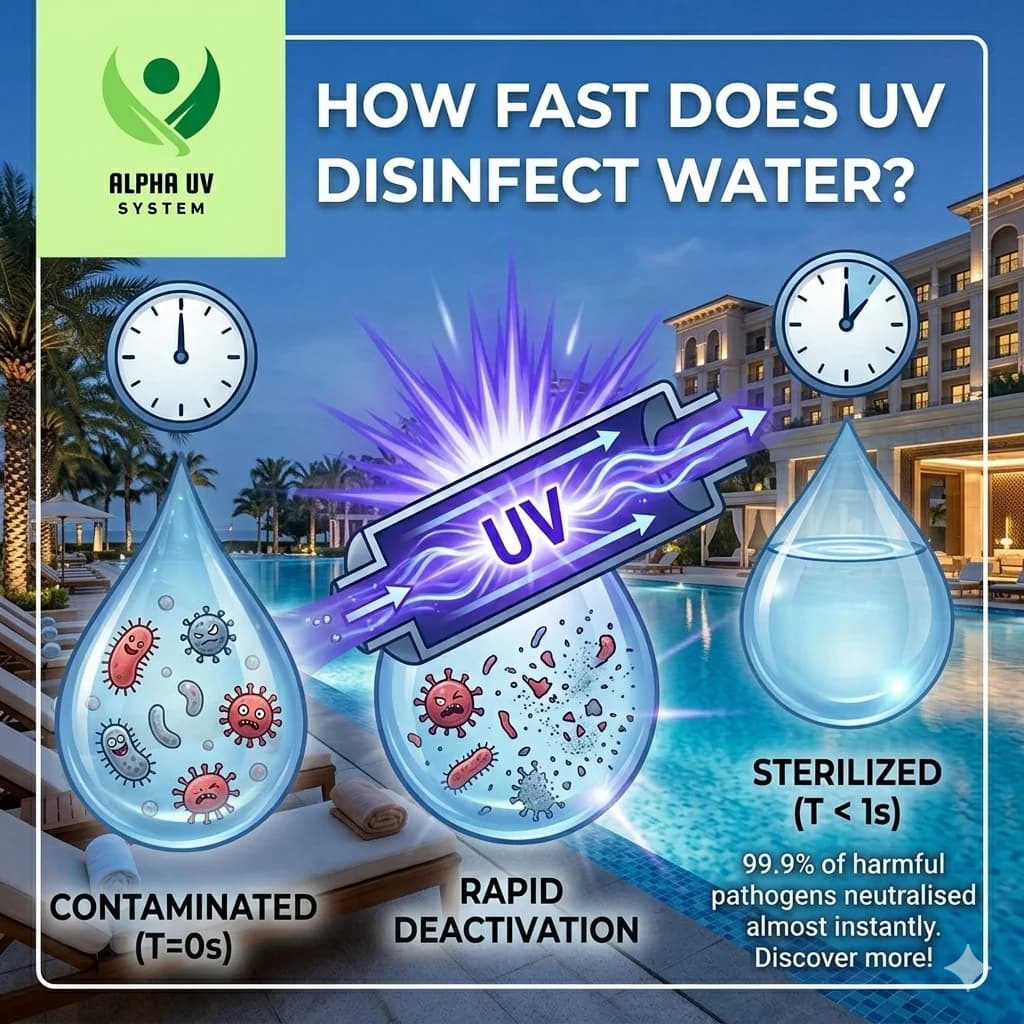
UV disinfection dose = UV intensity (mW/cm²) × exposure time (seconds). For a correctly sized commercial UV water treatment system India, at the rated flow rate, this product is always ≥ 40 mJ/cm² — the validated minimum for 4-log (99.99%) reduction of E. coli, total coliform, Salmonella, and most enteric viruses. Unlike chlorination, where effective dose depends on chemical concentration, contact time, pH, temperature, and organic load — all of which vary daily — UV dose is a fixed engineering parameter of the system design.
This consistency is the foundation of HACCP compliance. A CCP must have a measurable, controllable critical limit. UV intensity (monitored in real time by the sensor) is exactly that. No other common commercial water purification system provides equivalent dose consistency without operator intervention.
4. HACCP CCP Validation and Documentation
Every commercial UV water treatment system India installation from Alpha UV System is delivered with a HACCP CCP package that includes:
- UV dose calculation report signed by an IIT-trained engineer (confirms 40 mJ/cm² at rated flow)
- Philips UV-C lamp Certificate of Authenticity with traceable serial number
- CCP monitoring log template (UV intensity, alarm status, daily sign-off)
- Corrective action protocol (alarm activation procedure, shutdown criteria, re-verification procedure)
- Quarterly microbiological verification schedule
This documentation package is designed for FSSAI Schedule 4 audits and internal HACCP certification audits (BRC, FSSC 22000, ISO 22000). Our engineers have worked directly with QA teams at major hotel chains, QSR operators, and food manufacturers to ensure the documentation is written for the audit — not against a generic template.
5. Zero Impact on Taste, Odour, or Water Chemistry
Chlorination at commercial dosing levels introduces a detectable chlorine taste and odour to drinking water, ice, and water-based beverages. This is a guest experience problem for hotels and restaurants, a product quality problem for beverage manufacturers, and an operator problem for commercial kitchens where staff drinking water quality affects welfare compliance.
A commercial UV water treatment system India removes this problem entirely. UV treatment does not alter the taste, odour, colour, pH, or mineral content of water. The water that enters the UV chamber exits chemically identical — only microbiologically safer. In UV disinfection hotel India installations, this single factor has driven adoption among 5-star properties more than any other advantage.
6. Lower 3-Year Operating Cost Than Chlorination
UV capital cost is higher than chlorination. But over a 3-year operating cycle, a commercial UV water treatment system India is significantly cheaper to operate. The detailed ROI comparison is presented in the table below, but the headline figure: for a 2,000 LPH commercial system, UV operating cost over 3 years is approximately 55–65% lower than equivalent chlorination, driven by the elimination of chemical procurement costs and the reduced maintenance requirement of a Philips UV-C lamp system (16,000-hour lamp life, zero consumables between lamp replacements).
7. Continuous Flow Operation with No Downtime for Dosing
Commercial UV water treatment systems operate in-line, treating water at full flow rate continuously. There is no batch dosing, no contact time requirement, no waiting period. Water enters the UV chamber and exits treated in a single pass at the system's rated flow rate. For commercial kitchens operating during peak service periods — when water demand spikes unpredictably — this is a practical advantage that dosing-based systems cannot match.
A chlorination system requires a contact tank with a minimum 30-minute retention time to achieve rated disinfection performance. For a 2,000 LPH system, this means a 1,000-litre contact tank — a significant space and capital requirement that a commercial UV water treatment system India eliminates entirely.
8. Automated Alarm Monitoring and Audit Trail
Commercial UV water treatment systems from Alpha UV System include a UV intensity sensor and alarm circuit as standard. If UV intensity drops below the validated minimum (due to lamp aging, fouling, or lamp failure), the alarm activates and — in systems with automated valve control — the outlet valve closes to prevent passage of untreated water. This automated CCP monitoring creates an automatic audit trail: the system log records UV intensity over time, and alarm events are timestamped.
No equivalent automatic monitoring exists for chlorination. Residual chlorine monitoring requires manual test strips or an inline analyser — both of which require operator action to generate a record. For HACCP auditors and FSSAI inspectors, a UV system's automated monitoring record is a stronger compliance document than a manual chlorination log.
Comparison: UV vs Chlorination vs RO for Commercial Use
The table below compares the three primary commercial water purification system options across six parameters relevant to Indian commercial operators. Note: ozonation is excluded from this comparison as it is not commonly deployed at commercial kitchen scale in India.
| Parameter | Commercial UV System | Chlorination | RO System |
|---|---|---|---|
| Disinfection performance | 4-log (99.99%) bacteria & virus; effective against Cryptosporidium at 80+ mJ/cm² | 3–4-log bacteria; poor against Cryptosporidium; pH and ammonia dependent | Physical removal of bacteria; limited virus removal; no protozoan kill guarantee |
| Chemical byproducts | None | THMs, HAAs — regulated under BIS IS:10500 | None (concentrate discharge is a waste issue) |
| Taste / odour impact | None — water chemistry unchanged | Chlorine taste and odour detectable at commercial doses | Removes minerals; may produce flat taste; demineralised water not recommended for drinking |
| HACCP CCP suitability | High — measurable dose, automated sensor monitoring, audit trail | Medium — dose variable, manual monitoring required | Low — membrane integrity testing required; no real-time CCP parameter |
| 3-year operating cost (2,000 LPH) | ~₹45,000–65,000 (lamp replacement + power) | ~₹1,40,000–2,00,000 (chemicals + maintenance) | ~₹1,80,000–2,80,000 (membrane replacement + power + reject water) |
| Space and infrastructure | Compact in-line unit; no contact tank required | Requires dosing pump + contact tank (1,000 L for 2,000 LPH) | Large footprint; reject water drain required; pressure booster pump |
Commercial UV Capacity Guide: Application to LPH
Selecting the correct capacity for a commercial UV water treatment system India requires an honest assessment of peak demand — not average demand. The table below provides capacity guidance for common commercial applications. All figures assume a 30% headroom above calculated peak demand, which is standard practice for HACCP-validated systems (oversizing ensures dose is maintained if flow temporarily exceeds nominal rating).
| Commercial Application | Recommended Capacity (LPH) | Notes |
|---|---|---|
| Small restaurant (50–100 covers) | 500–1,000 LPH | Ingredient water + kitchen washing; single point of use |
| QSR / large restaurant (200+ covers) | 1,000–2,500 LPH | Multiple points of use; beverage station + food prep |
| Boutique / business hotel (30–50 rooms) | 2,000–3,500 LPH | Kitchen + bar + housekeeping; F&B load is the driver |
| Full-service hotel (100+ rooms, F&B) | 5,000–10,000 LPH | Multiple branches recommended; banquet kitchen separate |
| Corporate office (500 persons) | 1,000–2,000 LPH | Drinking water + pantry; peak load: morning shift start |
| School / college canteen | 2,000–5,000 LPH | Canteen + water cooler supply; peak: lunch break demand |
| Food processing — beverages / dairy | 5,000–20,000 LPH | Ingredient water; continuous-duty specification required |
| Hospital / healthcare facility | 3,000–8,000 LPH | Potable water + kitchen; non-potable streams need separate system |
ROI Analysis: UV vs Chlorination Over 3 Years
The 3-year total cost of ownership comparison below is based on a 2,000 LPH system operating 18 hours/day, 330 days/year — a realistic schedule for a mid-size hotel kitchen or large restaurant. Capital costs are 2026 market figures for installed systems in Delhi NCR and Mumbai.
| Cost Component | Commercial UV System (2,000 LPH) | Chlorination (2,000 LPH equivalent) |
|---|---|---|
| Capital cost (installed) | ₹1,20,000–1,60,000 | ₹60,000–90,000 (pump + contact tank + installation) |
| Chemical cost (Year 1) | Nil | ₹40,000–65,000 (sodium hypochlorite) |
| Chemical cost (Year 2) | Nil | ₹45,000–70,000 |
| Chemical cost (Year 3) | Nil | ₹48,000–75,000 |
| Lamp replacement (Year 2) | ₹18,000–25,000 (Philips UV-C lamp at 16,000 hrs) | Nil |
| Maintenance (3 years) | ₹8,000–12,000 (quartz sleeve cleaning, annual check) | ₹20,000–35,000 (pump servicing, dosing calibration) |
| Power cost (3 years) | ₹12,000–18,000 (Philips UV-C lamp: ~55W) | ₹8,000–12,000 (dosing pump: lower wattage) |
| 3-year total cost | ₹1,58,000–2,15,000 | ₹2,21,000–3,47,000 |
| 3-year operating cost advantage | UV saves ₹63,000–1,32,000 over 3 years at this scale |
The UV advantage grows with system size. At 5,000 LPH — typical for a 100-room hotel in Delhi NCR or Mumbai — chemical costs for chlorination are proportionally higher, and the UV system's power consumption advantage (high-output Philips UV-C lamp operates at ~120W) remains modest. At hotel scale, the 3-year UV saving is typically ₹2,00,000–3,50,000 against chlorination.
HACCP and FSSAI Compliance: What Your Audit Requires
HACCP compliance for water treatment is not simply a matter of installing a commercial UV water treatment system India and assuming it satisfies the requirement. FSSAI and third-party food safety auditors (BRC, FSSC 22000, SQF) require documented evidence that the CCP is validated, monitored, and verified. The table below maps HACCP CCP requirements to the specific documentation Alpha UV System provides.
| HACCP CCP Requirement | What Is Required | Alpha UV System Documentation |
|---|---|---|
| CCP Identification | Water treatment identified as a CCP in the HACCP plan | HACCP CCP template with UV system as documented CCP |
| Critical Limit | Defined measurable limit (UV dose ≥ 40 mJ/cm²) | UV dose calculation report (IIT-trained engineer sign-off) |
| Monitoring Procedure | Real-time monitoring of critical limit parameter | UV intensity sensor + alarm circuit (factory tested) |
| Corrective Action | Defined action when CCP deviation occurs | Alarm activation protocol + shutdown procedure in manual |
| Verification | Periodic confirmation that CCP is effective | Quarterly microbiological test schedule template |
| Record Keeping | Ongoing monitoring records | Daily UV intensity log template + alarm event log |
| Lamp Authenticity | Evidence of genuine Philips UV-C lamp (FSSAI may request) | Philips UV-C Certificate of Authenticity (serial number traceable) |
Our IIT-trained engineers have worked directly with quality assurance teams at Taj Hotels, McDonald's India operations managers, and Britannia Industries plant managers to understand what each client's specific audit requires. The documentation Alpha UV System provides is written for the audit, not against a generic template.
Case Studies: Commercial UV Water Treatment System India
Taj Hotels — Delhi NCR Properties
Taj Hotels properties in Delhi NCR operate Alpha UV System commercial UV water treatment systems for kitchen water, bar water, and drinking water supply. The primary driver for Taj was UV disinfection hotel India specification: eliminating chlorine taste from drinking water, ice, and cocktail preparation while maintaining HACCP CCP documentation for their central kitchen FSSAI licence. Alpha UV System supplied 5,000 LPH units for the primary kitchen supply, with separate 2,000 LPH units for the bar and F&B prep areas. The HACCP documentation package was reviewed and accepted by Taj's internal food safety team on the first submission.
McDonald's India — Restaurant Water Purification
McDonald's India restaurant water purification specifications require a commercial water purification system that delivers consistent microbiological quality at every ingredient water and beverage station point of use. Alpha UV System commercial UV systems are installed at multiple McDonald's India locations for ingredient water treatment. The specification requirement — UV dose ≥ 40 mJ/cm² with automated alarm monitoring — is met by Alpha UV System's standard commercial range. McDonald's India's internal food safety auditors accepted the UV dose calculation report and Philips lamp certificates as valid CCP validation documentation.
IIT Kanpur — Campus Water Safety
IIT Kanpur campus water supply for 10,000+ students and staff presented a centralised commercial UV water treatment system India challenge: multiple distribution points, variable demand, and the institutional requirement for documented water safety records. Alpha UV System installed a high-capacity UV system for centralised drinking water treatment serving the campus water distribution network. The system's automated alarm monitoring provided IIT Kanpur's facilities team with a continuous operational record without manual testing requirements for daily operation.
Britannia Industries — Food Processing Compliance
Britannia Industries food production facilities operate a commercial UV water treatment system for ingredient water in biscuit and bakery manufacturing lines. For food processing at this scale, FSSAI HACCP compliance is non-negotiable — ingredient water quality affects both regulatory status and product shelf life. The UV vs chlorine commercial choice at Britannia was driven by the THM issue: chlorination of ingredient water introduced chemical byproducts that affected FSSAI food safety audit outcomes. Alpha UV System's chemical-free disinfection resolved the compliance issue while improving ingredient water consistency.
Which Commercial UV System to Choose: Alpha UV System Recommendation
For operators evaluating a commercial UV water treatment system India, Alpha UV System recommends the following selection criteria:
- Philips UV-C lamp technology: The lamp is the performance-critical component of any UV system. Alpha UV System uses Philips UV-C lamps exclusively — not Chinese OEM lamps. Philips UV-C lamps carry a Certificate of Authenticity with traceable serial numbers, are rated at 16,000 operating hours with less than 20% intensity degradation at end of life, and are manufactured to consistent output specifications. This is the single most important differentiator between audit-compliant and non-compliant UV systems in India.
- IIT-trained engineering support: Every Alpha UV System commercial installation is engineered by an IIT-trained engineer who provides the UV dose calculation report. This is not a generic datasheet calculation — it is a site-specific report based on your water UVT, flow rate, and pressure conditions.
- HACCP documentation package: Any commercial UV water treatment system India should include a complete HACCP CCP documentation package as standard, not as a paid add-on.
- 24-48 hour response: For commercial operations, system downtime is a compliance event. Alpha UV System provides 24–48 hour response for commercial clients across India, with spare lamps and quartz sleeves stocked at our Greater Noida facility.
Alpha UV System's commercial range covers 500 LPH to 20,000 LPH. For a sizing recommendation and quotation, visit our commercial UV application page or WhatsApp our engineering team.
Sector-Specific Applications
Hotels and Hospitality
UV disinfection hotel India adoption has grown sharply since 2022, driven by the combination of FSSAI F&B licence requirements and 5-star brand standards that specify chemical-free water treatment. In Delhi NCR and Mumbai — the two highest-density hotel markets in India — Alpha UV System has installed commercial UV water treatment systems in properties ranging from 30-room boutique hotels (1,000 LPH) to 300-room full-service properties with banquet facilities (10,000 LPH, multiple branches). The key specification point for hotels: the UV system for kitchen and bar water should be separate from the system serving housekeeping and general building supply, allowing independent HACCP documentation for the food and beverage operation.
Restaurants and QSRs
Restaurant water purification is the highest-volume application for commercial UV water treatment system India suppliers. FSSAI requires that all water used in food preparation at licensed restaurants meets IS:10500 microbiological standards. A commercial UV system at 500–2,500 LPH covers the full range of restaurant sizes, from 50-cover neighbourhood restaurants to 300-cover destination dining venues. For QSRs (quick service restaurants) with beverage stations, the UV system is typically installed as the primary treatment at the point where municipal supply enters the kitchen — providing a single, documented CCP that covers all downstream uses.
Corporate Offices and Business Parks
Corporate offices in Noida, Gurgaon, and Mumbai business districts increasingly specify a commercial water purification system as part of workplace safety and ESG compliance. For offices with 500+ occupants, a 1,000–2,000 LPH commercial UV system provides continuous safe drinking water and pantry water without the chemical taste associated with municipal chlorinated supply. In business parks where multiple tenants share a building water supply, a single large UV system at the building entry point is the most cost-effective solution.
Schools and Institutions
Schools, colleges, and government institutions are a growing market for the commercial UV water treatment system India. FSSAI's mid-day meal programme requirements include water safety documentation at schools. IIT and NIT campuses, government hostels, and municipal schools in Delhi NCR and UP are among Alpha UV System's institutional clients. Capacity requirements range from 2,000 LPH for a 500-student school to 10,000+ LPH for large university campuses.
Food Processing and Manufacturing
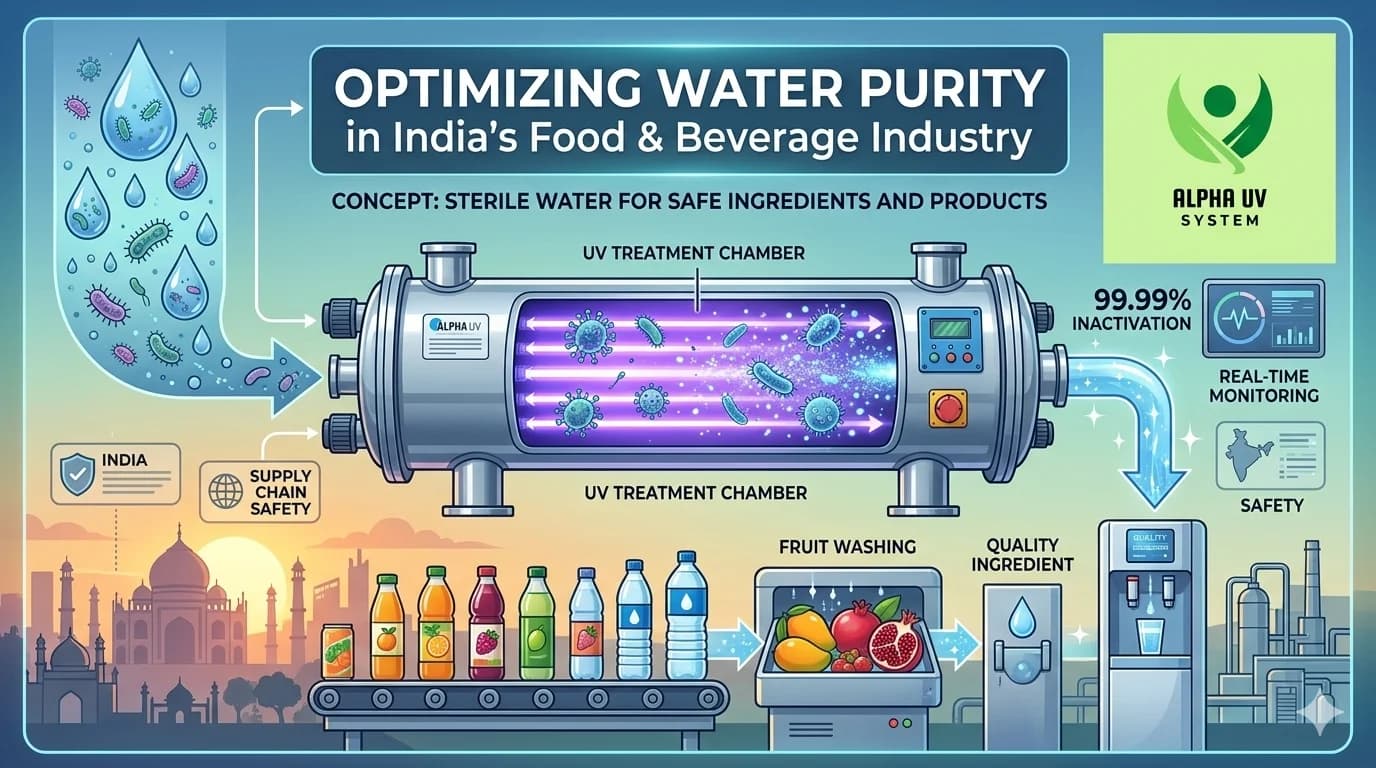
Food processing is the technically most demanding application for a commercial UV water treatment system India. Ingredient water quality in beverage manufacturing, dairy processing, bakery operations, and packaged food production directly affects product microbiological quality, shelf life, FSSAI compliance, and export certification. Alpha UV System's continuous-duty commercial systems (rated for 24/7 operation) cover ingredient water at 5,000–20,000 LPH for food manufacturing plants in Delhi NCR, Haryana, and Maharashtra.
Frequently Asked Questions
What is the minimum UV dose required for HACCP compliance in India?
HACCP compliance for water treatment in India requires a minimum validated UV dose of 40 mJ/cm² at the system's rated flow rate. This dose achieves a minimum 4-log (99.99%) reduction of E. coli and total coliform — the microbiological standard required under BIS IS:10500 and FSSAI water quality regulations. Alpha UV System provides a UV dose calculation report with every commercial installation confirming that 40 mJ/cm² is achieved at the specified flow rate. Systems operating below 40 mJ/cm² do not qualify as a valid HACCP CCP.
How is a commercial UV water treatment system different from a residential UV system?
A commercial UV water treatment system India differs from residential units in four key ways: (1) Capacity — commercial systems start at 500 LPH and extend to 20,000+ LPH versus residential units at 15–60 LPH; (2) Duty cycle — commercial systems are rated for continuous 18–24 hour per day operation versus residential systems rated for intermittent use; (3) Build standard — commercial systems use SS316 chambers, industrial-grade solenoid valves, and UV intensity sensors as standard; (4) Documentation — commercial systems include a HACCP CCP documentation package that residential units do not provide. Using a residential UV unit in a commercial food operation does not satisfy FSSAI HACCP requirements.
Does a UV water treatment system remove TDS or dissolved chemicals?
No. A commercial UV water treatment system India does not remove total dissolved solids (TDS), heavy metals, nitrates, pesticides, or other dissolved chemical contaminants. UV disinfection only inactivates microbiological contaminants — bacteria, viruses, and protozoa. If your source water has elevated TDS, fluoride, arsenic, or nitrate, a pre-treatment or parallel RO system is required to address those parameters. UV and RO are frequently installed together in commercial kitchens: RO handles chemical quality, UV handles microbiological quality of the RO permeate (which can be recontaminated post-membrane if the storage tank or pipework is not maintained).
What is the maintenance schedule for a commercial UV water treatment system?
A commercial UV water treatment system India requires the following maintenance: (1) Lamp replacement — every 16,000 operating hours (Philips UV-C lamp rated life); at 18 hours/day operation this is approximately every 2.4 years. (2) Quartz sleeve cleaning — every 3–6 months depending on water turbidity and iron content; fouled quartz reduces UV transmission and can drop system dose below the critical limit. (3) UV intensity sensor calibration — annually. (4) Microbiological verification testing — quarterly water samples from the UV system outlet, tested against IS:10500 standards. Alpha UV System provides a maintenance schedule template as part of the commercial installation documentation package.
Can a commercial UV system treat borewell water or hard water?
A commercial UV water treatment system India can treat borewell water for microbiological contaminants, but two pre-treatment requirements apply: (1) UVT (UV transmittance) must be ≥ 75% at 254 nm. Borewell water with high iron, manganese, or turbidity typically has lower UVT, which reduces effective UV dose. A sediment filter and iron removal unit should be installed before the UV system in these cases. (2) Hardness does not directly affect UV performance, but scale formation on the quartz sleeve reduces UV transmission over time — requiring more frequent sleeve cleaning in hard water areas (Rajasthan, Haryana, Western UP). Alpha UV System sizes commercial systems with UVT headroom to maintain 40 mJ/cm² even as quartz sleeve condition changes between cleaning cycles.
What certifications should a commercial UV water treatment system have in India?
A commercial UV water treatment system India used in food and beverage applications should meet the following: (1) BIS IS:14011 — the Indian standard for UV water disinfection equipment; (2) Philips UV-C lamp Certificate of Authenticity — confirming genuine Philips lamp with traceable serial number; (3) UV dose calculation report — confirming 40 mJ/cm² at rated flow, signed by a qualified engineer; (4) HACCP CCP documentation — for FSSAI Schedule 4 licence holders. Alpha UV System provides all of the above with every commercial installation. Operators should be cautious of suppliers offering only a BIS mark without supporting dose calculations and lamp authenticity documentation.
Conclusion: The Commercial Case for UV Water Treatment in India
A commercial UV water treatment system India is now the default choice for hotels, restaurants, food processors, corporate offices, and institutions that face FSSAI or HACCP compliance requirements. The eight advantages covered in this guide — chemical-free disinfection, no THM byproducts, consistent dose delivery, HACCP CCP documentation, zero taste impact, lower 3-year operating cost, continuous flow operation, and automated alarm monitoring — make the UV vs chlorine commercial comparison straightforward at most commercial scales.
The critical decision is not whether to install UV, but which commercial UV water treatment system India to install. Lamp technology (Philips UV-C, not Chinese OEM), engineering documentation (IIT-trained engineer sign-off), and the completeness of the HACCP documentation package are the differentiators that determine whether your system satisfies an FSSAI inspector or a third-party food safety auditor.
Alpha UV System has installed commercial UV water treatment systems for Taj Hotels, McDonald's India, IIT Kanpur, and Britannia Industries. Our IIT-trained engineering team designs, documents, and supports every installation with audit-ready HACCP compliance documentation.
For a sizing recommendation and quotation for your facility, visit our commercial UV application page or WhatsApp our engineering team directly.
Recommended UV Systems
Alpha UV System products for this application — powered by genuine Philips UV-C lamps.
Commercial UV Water Purification System
500 – 5,000 LPH
HACCP-compliant UV water purification for hotels, restaurants, and offices
Industrial UV Water Treatment System
5,000 – 50,000 LPH
Schedule M 2025 and HACCP compliant UV for pharma, food & beverage, and process water
Not sure which system suits your application? WhatsApp our engineers for a free recommendation →
Related solutions
See how Alpha UV System applies this to your industry or city.
Need a UV system?
Talk to our UV engineers — WhatsApp for a quote in 2 hours, or browse the full catalog on IndiaMART.