Quick Answer
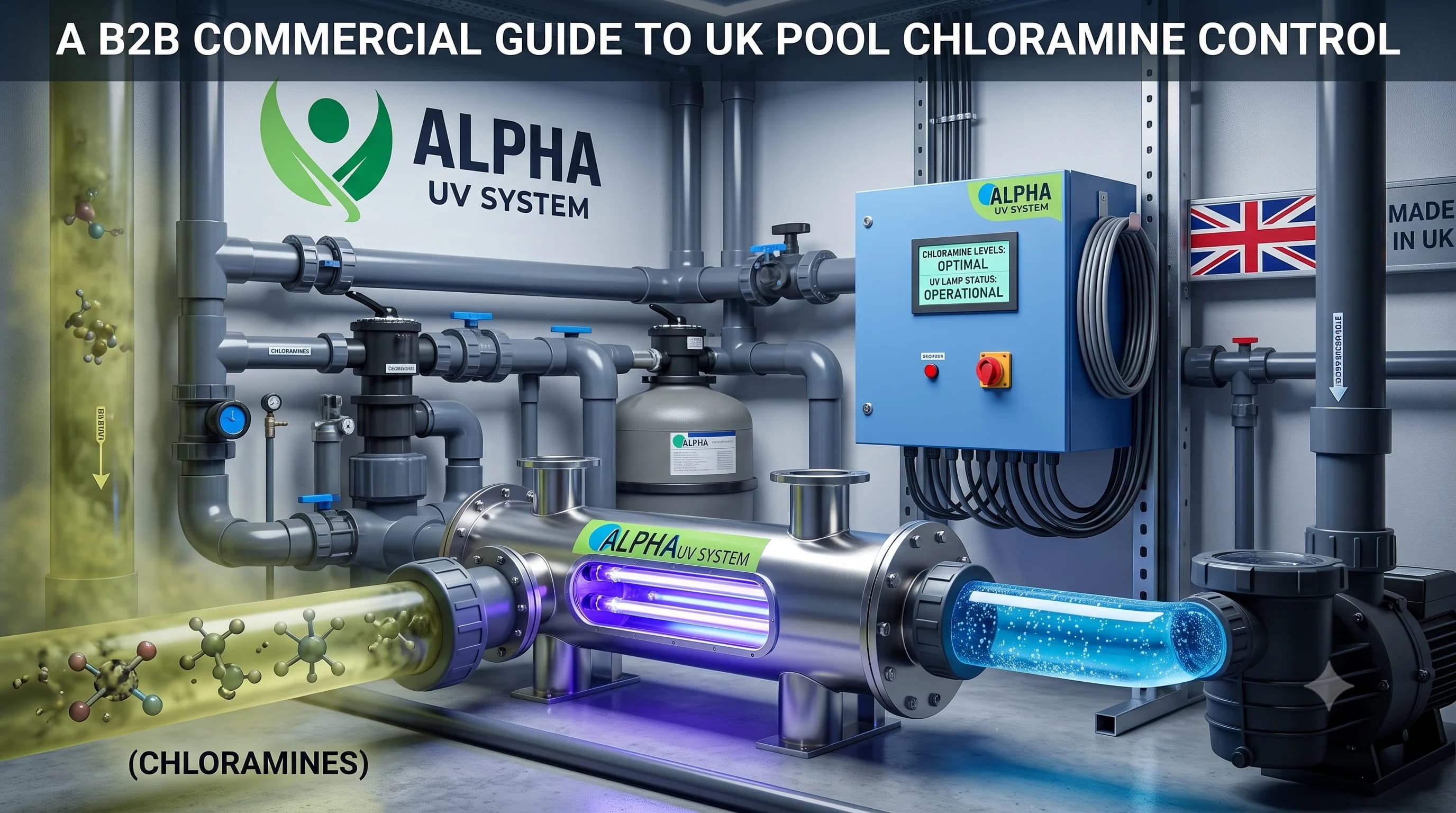
UK swimming pool water quality is governed by the Pool Water Treatment Advisory Group (PWTAG) Code of Practice and Technical Notes, with Health and Safety Executive (HSE) enforcement authority under the Health and Safety at Work Act. PWTAG recommends that combined chlorine (chloramine) concentration be kept below 0.2 mg/L — a level that represents best practice for indoor pool air quality, but is routinely exceeded in pools with high bather turnover without active chloramine destruction. Medium-pressure UV disinfection, as specified in BSI EN 15056 (Requirements for UV systems for swimming pools), destroys all three chloramine species (monochloramine, dichloramine, nitrogen trichloride) through photolysis at 200–300 nm, simultaneously inactivating Cryptosporidium parvum — the organism responsible for 75% of UK recreational water illness outbreaks and completely resistant to chlorine at pool concentrations. PWTAG Technical Note TN6 (Ultraviolet Treatment) recommends medium-pressure UV for indoor commercial pools with bather loads above 300 bathers per day and for competition pools where trichloramine (NCl₃) respiratory sensitisation is a documented occupational health concern. Indian-manufactured medium-pressure UV systems — CE-marked, BSI EN 15056-compliant, Philips UV-C lamps — represent a 30–50% cost advantage against equivalent UK/European-manufactured systems for UK pool operators and hotel leisure centre developers.
UK Swimming Pool Chloramine Regulation — PWTAG and HSE Framework
The UK does not have a statutory standard for combined chlorine in swimming pools equivalent to the German DIN 19643 standard — instead, PWTAG Code of Practice and its Technical Notes set the industry benchmark that pool operators are expected to follow, with HSE enforcement based on the general duty of care under HSWA. The key regulatory references are:
| Reference | Publisher | Combined chlorine guidance | UV relevance |
|---|---|---|---|
| PWTAG Code of Practice (2017 edition) | Pool Water Treatment Advisory Group | Combined Cl < 0.2 mg/L recommended; total Cl = free Cl + combined Cl, keep ratio < 0.5 | UV as primary chloramine control technology |
| PWTAG Technical Note TN6 — UV | PWTAG | Specifies UV for combined chlorine control and Cryptosporidium inactivation | Medium-pressure UV specified; 25 mJ/cm² for Cryptosporidium; higher dose for chloramine |
| BSI EN 15056:2006 — UV systems for pools | British Standards Institution | Defines UV system performance requirements for pool disinfection | Type approval standard for pool UV systems in UK/EU markets |
| HSE HSG282 — Control of Legionella in recreational water | Health and Safety Executive | Legionella risk management in pool systems | UV also controls Legionella in pool water at 40 mJ/cm² |
| WHO Guidelines for Safe Recreational Water Environments (Vol. 2) | World Health Organization | Combined chlorine < 0.6 mg/L (WHO minimum); PWTAG recommends tighter limit | UV + reduced chlorine approach endorsed by WHO Vol. 2 |
Why Chloramine Control Matters for UK Pool Operators
The UK has seen a series of high-profile occupational health cases and regulatory interventions related to trichloramine (NCl₃) exposure in indoor swimming pool facilities:
- Competitive swimmer respiratory sensitisation: Multiple published UK studies (Imperial College London, University of Birmingham) have documented asthma development and respiratory sensitisation in elite swimmers training in indoor pools with high trichloramine levels. UK Swimming (national governing body) has issued guidance on pool air quality for training facilities.
- Pool attendant occupational health claims: HSE has investigated several cases of occupational asthma in pool lifeguards and swim instructors attributed to chronic trichloramine exposure. COSHH (Control of Substances Hazardous to Health) Regulations place a duty on pool operators to reduce chemical exposure by all practicable means — UV is the practicable engineering control for trichloramine.
- Hotel pool complaints: UK consumer complaints about "strong chlorine smell" in hotel pools — which is invariably a combined chlorine / trichloramine smell, not excess free chlorine — create reputational risk for hotel chains. Major UK hotel groups (Marriott, Hilton, IHG UK operations) have specified medium-pressure UV in their pool design standards in response to this issue.
- School pool incidents: Several UK local authority school pools have had children and staff evacuated following high trichloramine buildup events. These incidents trigger Ofsted facility compliance reviews and generate significant negative press coverage.
How Medium-Pressure UV Destroys Chloramines
Medium-pressure UV systems emit polychromatic UV-C and UV-B radiation across the 200–300 nm spectrum. This polychromatic emission is the key difference from low-pressure UV (single wavelength at 254 nm) for chloramine destruction:
- Monochloramine (NH₂Cl): Peak photolysis absorption at 245 nm and 300 nm — medium-pressure UV destroys monochloramine efficiently across its emission spectrum
- Dichloramine (NHCl₂): Peak absorption at 245 nm and 295 nm — photolysed effectively by medium-pressure UV
- Nitrogen trichloride (NCl₃): Peak absorption at 222 nm — the UV wavelength most effective for trichloramine destruction; medium-pressure UV output at 222 nm gives it a decisive advantage over low-pressure UV for trichloramine control in high-bather-load UK pools
Low-pressure UV (254 nm single wavelength) has limited chloramine destruction capability because the 254 nm wavelength is below the peak absorption of dichloramine and nitrogen trichloride. For UK pools with combined chlorine control as the primary UV objective — as opposed to Cryptosporidium inactivation alone — medium-pressure UV is the technically correct specification.
Cryptosporidium in UK Pools — The Other UV Benefit
The Health Protection Agency (now Public Health England / UKHSA) identified Cryptosporidium as responsible for 75% of confirmed recreational water illness outbreaks in UK public pools over the 2000–2015 reporting period. The UK Cryptosporidium pool outbreak record includes incidents at municipal leisure centres, hotel pools, holiday parks, and school pools — all facilities where Cryptosporidium contamination (introduced by a single symptomatic bather) could not be controlled by chlorine at any practical concentration.
PWTAG TN6 specifies UV at a minimum 25 mJ/cm² dose for Cryptosporidium control — but medium-pressure UV systems for chloramine control routinely deliver 60–100 mJ/cm² in normal operation, providing 4-log (99.99%) Cryptosporidium inactivation as a co-benefit of chloramine treatment.
BSI EN 15056 Compliance — What It Means for UK Pool UV Specifications
BSI EN 15056 (Requirements for UV systems used for water disinfection — Modules and complete installations — swimming pools) is the applicable product standard for UV systems installed in UK and European swimming pools. Key EN 15056 requirements:
- Type testing at rated UV dose: System must be tested and certified at the UV dose stated in the product documentation
- UV intensity sensor with alarm: Mandatory — EN 15056 requires continuous UV dose monitoring with an alarm that alerts the operator when dose falls below the certified level
- Documented dose-response data: UV dose at rated flow rate must be stated in the system data sheet
- Medium-pressure lamp certification: For medium-pressure systems, lamp type testing and output documentation required
Alpha UV System's medium-pressure pool UV systems are designed to EN 15056 functional requirements with CE marking — making them compatible with UK pool operator procurement specifications that call for EN 15056 compliance.
System Sizing for UK Pools
| Pool type | Pool volume | Recirculation rate | UV system capacity | UV dose |
|---|---|---|---|---|
| Hotel leisure pool (25m, low bather load) | 250–400 m³ | 30–60 m³/hr | 30,000–60,000 LPH MP UV | 40–60 mJ/cm² |
| Public leisure centre (25m, high bather load) | 500–800 m³ | 80–150 m³/hr | 80,000–1,50,000 LPH MP UV | 60–100 mJ/cm² |
| Competition pool (50m) | 2,500 m³ | 200–400 m³/hr | 2,00,000–4,00,000 LPH MP UV | 60 mJ/cm² |
| Spa / hydrotherapy pool | 20–50 m³ | 10–30 m³/hr | 10,000–30,000 LPH MP UV | 40–60 mJ/cm² |
| Paddling pool / splash pad | 5–20 m³ | 5–15 m³/hr | 5,000–15,000 LPH LP or MP UV | 40 mJ/cm² |
Indian UV Systems for UK Pool Operators — Cost and Quality Advantage
For UK pool developers, hotel chains, and leisure centre operators, Indian-manufactured UV systems from Alpha UV System offer a significant cost advantage against equivalent European and UK-manufactured systems:
- Price advantage: CE-marked Indian manufactured medium-pressure UV systems for a 25m hotel pool are typically priced 30–50% below equivalent UK/European-origin systems of the same specification (same Philips UV-C lamps, same SS316L construction, same EN 15056-compliant monitoring)
- MSME manufacturing advantage: India's RODTEP export incentive scheme and MSME cost structure make Indian UV systems cost-competitive for UK import even after freight, CE testing, and UK customs duties
- Direct engineer support: Alpha UV System provides commissioning documentation in UK PWTAG format and telephone/video technical support during UK installation
- Lead time: Standard delivery ex-Greater Noida within 6–8 weeks for UK orders; express dispatch within 3–4 weeks for urgent projects
UK Swimming Pool UV Systems from Alpha UV System
Alpha UV System supplies medium-pressure UV systems for UK swimming pool applications. Systems are CE-marked, designed to BSI EN 15056 functional requirements, and use Philips UV-C lamps. Documentation package for UK export orders includes: CE Declaration of Conformity, UV validation certificate, material certificates (EN 10204 3.1 for SS316L), PWTAG-compatible commissioning data sheet, and lamp performance data sheet.
Contact us for UK swimming pool UV system specifications and export pricing: WhatsApp +91 93183 05878 or call +91 95995 00580.
Related guides: UV disinfection for swimming pools in India | UV system export from India | UV systems for export markets
Recommended UV Systems
Alpha UV System products for this application — powered by genuine Philips UV-C lamps.
Commercial UV Water Purification System
500 – 5,000 LPH
HACCP-compliant UV water purification for hotels, restaurants, and offices
Industrial UV Water Treatment System
5,000 – 50,000 LPH
Schedule M 2025 and HACCP compliant UV for pharma, food & beverage, and process water
Not sure which system suits your application? WhatsApp our engineers for a free recommendation →
Related solutions
See how Alpha UV System applies this to your industry or city.
Need a UV system?
Talk to our UV engineers — WhatsApp for a quote in 2 hours, or browse the full catalog on IndiaMART.