Quick Answer
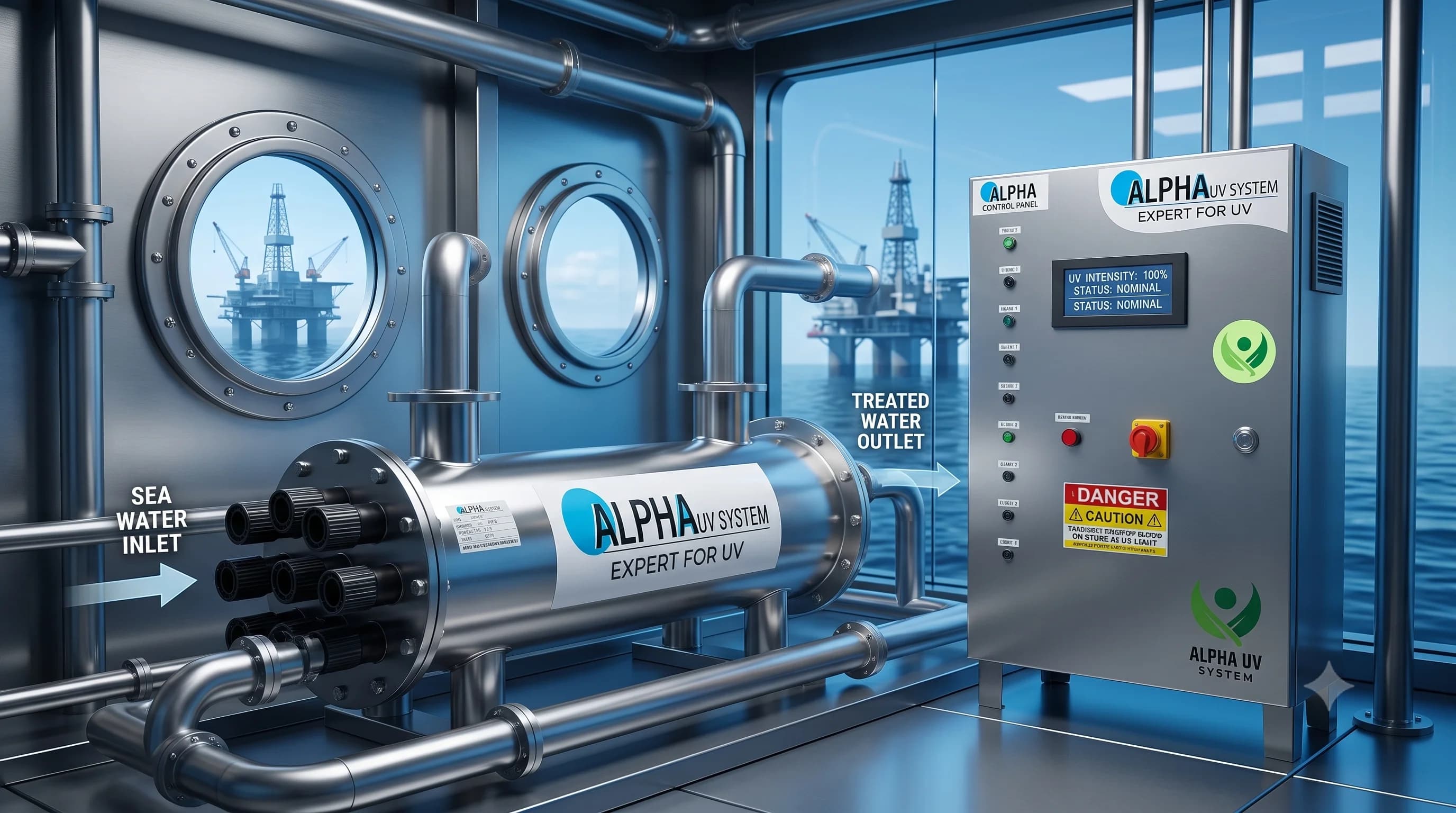
UV water treatment for offshore and marine applications is used primarily for three purposes: (1) post-desalination disinfection — RO and thermal desalination units produce permeate with zero disinfection residual that must be UV-disinfected before entering the potable water distribution system; (2) ship potable water disinfection — IMO resolution A.749(18) and SOLAS Chapter II-1 require vessels to maintain potable water free from pathogenic microorganisms, and UV at 40 mJ/cm² is the accepted chemical-free disinfection method for ships where chlorine dosing creates crew exposure risk and corrosion problems in copper alloy distribution fittings; and (3) offshore platform water treatment — drilling platforms, production platforms, and FPSOs (Floating Production Storage and Offloading vessels) draw make-up potable water from supply vessels or onboard RO units, with UV as the terminal disinfection step. Marine-grade UV systems differ from industrial land-based systems in three areas: construction material (duplex SS 2205 or SS316L with passivation, saltwater-resistant), environmental rating (IP66 minimum for all offshore zones — IP67 for splash zones), and certification (DNV GL, ABS, Lloyd's Register, or BV type approval for installation on classed vessels). Alpha UV System manufactures marine-grade UV systems for Indian offshore operators, Indian shipyards, and export markets in the Gulf, Southeast Asia, and East Africa.
Water Treatment Challenges Specific to Offshore and Marine Environments
Offshore and marine water treatment systems face constraints that land-based industrial systems do not:
- No reliable chemical supply chain: Offshore platforms and vessels cannot replenish sodium hypochlorite or other liquid chemicals on demand. Chemical storage creates SOLAS fire and hazardous materials compliance issues. UV requires only electricity and an annual lamp replacement — the lamp can be held in stock onboard.
- Salt spray and humidity: All equipment on offshore decks and in engine room sea chest areas is exposed to salt-laden air at 100% relative humidity. Control panels and electrical components require minimum IP66 protection; duplex stainless or coated carbon steel enclosures resist chloride-induced crevice corrosion over the 15–25 year vessel life.
- Vibration and shock loading: Marine UV reactors must be certified to vibration and shock test standards (DNV GL type approval includes vibration testing at 1–50 Hz) that are not applicable to land-based systems. Lamp-to-quartz sleeve clearance must be maintained under vibration to prevent sleeve contact fracture.
- Variable inlet water quality: Ships taking on water at different ports receive water with highly variable UVT and microbial load. The UV reactor must be designed for worst-case UVT (typically 75%) to guarantee dose delivery regardless of source port water quality.
- Space constraints: Offshore platform utility areas and ship engine rooms have extremely limited installation space. Marine UV reactors are designed for compact footprints with horizontal or vertical installation options and minimal straight pipe run requirements.
IMO and SOLAS Potable Water Standards for Marine UV
The International Maritime Organization (IMO) and SOLAS (International Convention for the Safety of Life at Sea) set the regulatory framework for potable water quality on vessels:
| Standard | Requirement | UV relevance |
|---|---|---|
| IMO Resolution A.749(18) — Code on Intact Stability | Potable water must be free from pathogenic microorganisms at the point of consumption | UV at 40 mJ/cm² achieves zero coliforms at point of use |
| SOLAS Chapter II-1 Regulation 35 | Potable water systems must be designed to prevent contamination | UV positioned at RO permeate outlet and/or at tank outlet prevents post-treatment contamination |
| WHO Guidelines for Drinking Water Quality (GDWQ) | Zero E. coli/100 ml; zero total coliforms/100 ml | UV 40 mJ/cm² achieves compliance — accepted by port state control inspections |
| IMO Ballast Water Management Convention (D-2) | ≥50 mJ/cm² UV dose (as part of UV+filtration type-approved system) | Separate from potable water UV — see ballast water guide |
| Indian Directorate General of Shipping (DGS) | IMO-aligned potable water standards for Indian-flagged vessels | UV systems on Indian-flagged vessels must meet IMO standards |
Post-Desalination UV Disinfection
The most critical marine UV application is post-desalination disinfection. Both RO membrane desalination and multi-effect distillation (MED) / multi-stage flash (MSF) thermal desalination produce permeate that is microbiologically unsafe for direct consumption:
- RO permeate: RO membranes remove 99.9–99.999% of bacteria but are not a sterile barrier. A membrane with a pinhole defect (invisible in routine pressure testing) allows bacterial passage. RO permeate also has zero disinfection residual — any bacteria that penetrate the membrane, or that enter via biofilm regrowth in the distribution system, remain alive. UV at 40 mJ/cm² positioned at the RO permeate outlet is the terminal disinfection barrier.
- Thermal desalination permeate (MED/MSF): Thermal desalination units operating at 55–70°C achieve pasteurisation temperatures that kill most pathogens in the distillate. However, the cooling and distribution system downstream of the distillation unit is at ambient temperature — biofilm regrowth is a documented issue in thermal desalination systems that are not UV-treated at the point of use. UV disinfection at the storage tank inlet and distribution system is standard practice.
For offshore platforms drawing potable water from supply boat transfers, UV is installed at the platform storage tank inlet — after the supply vessel hose connection — to treat any contamination introduced during transfer operations.
Marine-Grade UV System Construction
Materials for Marine UV Systems
| Component | Standard industrial spec | Marine/offshore spec | Reason for upgrade |
|---|---|---|---|
| Reactor chamber | SS316L | SS316L passivated or duplex SS2205 | Chloride stress corrosion cracking in seawater-exposed environments requires duplex SS for splash zones |
| Control panel enclosure | IP65 mild steel powder coat | IP66 SS316L or GRP (Glass Reinforced Plastic) | Salt spray resistance; IP66 = protected against heavy seas and jet water |
| Cable glands | Standard PG-thread nylon | Marine-grade IP68 brass or SS glands | Salt ingress resistance; vibration loosening prevention |
| Lamp end cap seals | EPDM O-ring | PTFE-coated EPDM or PTFE O-ring | Salt and chemical resistance in marine atmosphere |
| Mounting brackets | Carbon steel powder coat | SS316L or hot-dip galvanised | Corrosion resistance on offshore deck |
| Pipe connections | Standard PN10 flanges | ANSI 150 or DIN PN16 flanges with SS316L hardware | Marine piping standards; vibration-resistant bolting |
Marine Classification Society Certifications
UV disinfection systems installed on classed vessels (ships and offshore platforms certified by a classification society) must carry type approval from the relevant classification society:
- DNV GL (Det Norske Veritas — Germanischer Lloyd): Norway/Germany — most widely recognised globally, required for North Sea offshore platforms
- American Bureau of Shipping (ABS): USA — required for US-flagged vessels and Gulf of Mexico platforms
- Lloyd's Register (LR): UK — required for UK-flagged vessels
- Bureau Veritas (BV): France — required for French-flagged vessels and many West African offshore projects
- Indian Register of Shipping (IRS): India — required for Indian-flagged vessels and vessels built in Indian shipyards for Indian owners
Alpha UV System works with classification society-approved UV system ranges for Indian shipyard projects and offshore contracts. For export projects requiring DNV GL, ABS, or LR approval, contact us for the certified system documentation package.
Specific Offshore and Marine UV Applications
FPSO — Floating Production Storage and Offloading
FPSOs are among the most demanding marine UV applications: they operate remotely for 15–20 years between dry dock inspections, carry crew of 100–200 people requiring continuous potable water supply, and cannot be taken to port for equipment servicing. UV systems on FPSOs must be designed for in-situ lamp replacement without opening the pressure boundary (lamp replacement through a lamp access port), with spare lamps and quartz sleeves held onboard. Lamp life data and end-of-life replacement triggers must be documented in the vessel maintenance management system (MMS).
Offshore Supply Vessels and Platform Support Vessels
Supply vessels transferring potable water to offshore platforms serve as the primary water supply chain for many Indian offshore installations in the Arabian Sea and Bay of Bengal. UV disinfection on supply vessels — positioned at the water tank inlet and outlet — ensures that water quality is maintained from shore loading through transfer to the platform storage tank. This is a requirement under SOLAS and is increasingly specified by Indian oil and gas operators (ONGC, Cairn, Reliance) in their supply vessel charters.
Indian Shipbuilding — UV Specification
Indian shipyards (Cochin Shipyard, Hindustan Shipyard, Mazagon Dock, L&T Shipbuilding) building vessels for Indian Navy, Coast Guard, and commercial operators specify UV systems under DGQA (Directorate General of Quality Assurance) or Indian Register of Shipping (IRS) standards. Alpha UV System's marine-grade UV systems meet IRS requirements and are suitable for specification in new Indian naval and commercial vessel construction.
Marine UV System Sizing
| Application | Typical flow rate | UV dose | System type |
|---|---|---|---|
| Small vessel / yacht potable water | 100–500 LPH | 40 mJ/cm² | Single LP lamp, compact marine housing |
| Offshore supply vessel (50–100 crew) | 500–2,000 LPH | 40 mJ/cm² | Single 55W LP lamp, IP66, SS316L |
| Platform support vessel (100–200 crew) | 1,000–5,000 LPH | 40 mJ/cm² | Twin LP lamp, IP66, bypass, alarm |
| Offshore platform (200–500 crew) | 3,000–15,000 LPH | 40 mJ/cm² | Multi-lamp, SCADA-ready, redundant unit |
| FPSO / large platform (>500 crew) | 10,000–50,000 LPH | 40 mJ/cm² | Multi-lamp array, IRS/DNV approved |
| Post-desalination (RO permeate) | Matched to RO capacity | 40 mJ/cm² | Installed at RO product water outlet |
Marine and Offshore UV Systems from Alpha UV System
Alpha UV System manufactures UV water treatment systems for marine and offshore applications from our Greater Noida facility. Marine-grade systems are available in SS316L and duplex SS2205 construction, IP66 control panels, and IRS-compatible documentation packages for Indian vessel certification. For vessels requiring DNV GL, ABS, or LR class approval, we supply systems with the appropriate type approval documentation.
We supply to Indian shipyards, ONGC-contractor supply vessels, offshore platform operators in the Arabian Sea and Bay of Bengal, and Indian naval and Coast Guard procurement programmes. Export supply to GCC, Southeast Asia, and East Africa is available with CE-marked systems, export certificate of conformity, and INR/USD pricing in MSME Udyam RODTEP-eligible export format.
IIT-trained engineers. Philips UV-C lamps. MSME Udyam registered manufacturer. 24–48 hour NCR response; export orders dispatched ex-Greater Noida within 3–6 weeks.
Contact us for marine and offshore UV system specifications: WhatsApp +91 93183 05878 or call +91 95995 00580.
Related guides: UV ballast water treatment — IMO BWM Convention guide | UV disinfection systems — complete buyer's guide | UV + RO filtration systems | UV system export from India — Made in India guide
Recommended UV Systems
Alpha UV System products for this application — powered by genuine Philips UV-C lamps.
Commercial UV Water Purification System
500 – 5,000 LPH
HACCP-compliant UV water purification for hotels, restaurants, and offices
Industrial UV Water Treatment System
5,000 – 50,000 LPH
Schedule M 2025 and HACCP compliant UV for pharma, food & beverage, and process water
Not sure which system suits your application? WhatsApp our engineers for a free recommendation →
Related solutions
See how Alpha UV System applies this to your industry or city.
Need a UV system?
Talk to our UV engineers — WhatsApp for a quote in 2 hours, or browse the full catalog on IndiaMART.