Quick Answer
UV water treatment is the only disinfection method compatible with winery process water because it leaves no chemical residual that could react with wine components. Chlorine — even at residuals as low as 0.05 mg/L, far below the BIS IS 10500 drinking water limit of 0.2 mg/L — reacts with chlorophenols and other phenolic precursors in grape skins, winery equipment, and wooden barrels to form 2,4,6-trichloroanisole (TCA), 2,4,6-tribromoanisole (TBA), and related chloroanisole compounds. These are the specific chemicals responsible for "cork taint" and "musty" wine off-flavours — detectable by trained tasters at thresholds as low as 5 ng/L (5 parts per trillion). A single winery water source carrying even a brief chlorine residual spike can contaminate an entire vintage batch through chloroanisole formation in wooden barrel staves, cork bark, and cellar walls. UV water treatment at 40 mJ/cm² achieves ≥4-log inactivation of Brettanomyces bruxellensis, Acetobacter, Lactobacillus, and wild Saccharomyces without any chlorine, without any residual, and with continuous monitoring documentation for FSSAI HACCP compliance. For Indian wineries in Nashik, Sangli, Baramati, Bangalore, and Hampi wine regions, UV water treatment is the specification of choice for grape wash water, barrel sanitisation water, CIP rinse water, and bottling line water.
The Chloroanisole Problem — Why Chlorine Cannot Be Used in Wineries
Chloroanisoles are organic compounds formed when chlorine (or chlorinated phenols) reacts with naturally occurring phenolic compounds in wood, bark, and grape-derived materials. The three main chloroanisoles of concern in wine production are:
| Compound | Formation pathway | Off-flavour description | Human detection threshold in wine |
|---|---|---|---|
| 2,4,6-Trichloroanisole (TCA) | Chlorine + 2,4,6-trichlorophenol (from chlorine + phenol residues) | Musty, damp cardboard, "cork taint" | 2–5 ng/L (parts per trillion) |
| 2,3,4,6-Tetrachloroanisole (TeCA) | Chlorine + tetrachlorophenol | Antiseptic, medicinal, musty | 4–6 ng/L |
| Pentachloroanisole (PCA) | Chlorine + pentachlorophenol (from treated wood) | Musty, mouldy | ~15 ng/L |
The critical point for winery water treatment is that chloroanisole formation does not require high chlorine concentrations. The chlorine residual in municipal water supply (0.1–0.2 mg/L free chlorine at the tap) is sufficient to initiate chloroanisole formation when the water contacts winery materials containing phenolic precursors — oak barrels, cork stoppers, pallets, cellar walls treated with chlorinated timber preservatives, and grape marc residues. A winery that uses municipal supply water with even a low chlorine residual for barrel washing or cellar floor cleaning is introducing chloroanisole precursors that can then be transferred to wine during ageing.
Winery Microbiological Threats UV Controls
Beyond the chloroanisole problem, winery process water must control several specific spoilage organisms that cause wine quality failures:
Brettanomyces bruxellensis — The Critical Wine Spoilage Yeast
Brettanomyces bruxellensis (Brett) is the most economically significant wine spoilage organism in the global wine industry. Brett metabolises hydroxycinnamic acids in wine (ferulic acid, coumaric acid) to produce 4-ethylphenol (4-EP) and 4-ethylguaiacol (4-EG) — compounds that cause "barnyard," "band-aid," "horse blanket," and "medicinal" off-flavours at concentrations above 400–600 μg/L for 4-EP. Brett is extremely difficult to eliminate from a winery once established — it colonises wooden barrel staves, winery drain lines, and floor cracks. UV water treatment of barrel wash water at 60–80 mJ/cm² is one of the key Brett control measures in winery hygiene protocols, along with SO₂ management and barrel toasting practices. UV inactivates Brett cells suspended in wash water, preventing re-inoculation of cleaned barrels from contaminated wash water.
Acetobacter and Lactic Acid Bacteria
Acetobacter species convert ethanol to acetic acid (vinegar) in the presence of oxygen — a defect called "volatile acidity" (VA) that renders wine unacceptable above 0.6–1.0 g/L acetic acid. Lactobacillus and other lactic acid bacteria (LAB) cause wine faults including mousiness (2-acetyltetrahydropyridine formation), ropiness (extracellular polysaccharide production), and acrolein formation. Both organism groups are controlled by UV at 40 mJ/cm² in process water used for equipment wash-down, floor cleaning, and grape handling.
Wild Saccharomyces and Non-Saccharomyces Yeasts
Wild yeast from contaminated process water can initiate uncontrolled fermentation in grape juice or wine, competing with selected inoculated wine yeast strains and producing undesirable fermentation byproducts (higher alcohols, ethyl acetate at high concentrations). UV treatment of crush pad wash water and tank cleaning water controls wild yeast contamination at the point of entry into the winery.
UV Water Treatment Applications in Wineries
Grape Wash Water
Grapes arriving at the winery crush pad carry soil organisms, mould spores, and wild yeast from the vineyard. Some wineries wash harvested grapes with water sprays before crushing — a practice more common in mechanically harvested vineyards where soil contamination from vine floor is higher. UV treatment of grape wash water at 40 mJ/cm² reduces the microbial load introduced into the crush, lowering the wild yeast and mould count in the fermentation must. Note: UV treatment does not replace sulfur dioxide (SO₂) addition as the primary must protection agent — it reduces the starting microbial challenge that SO₂ must manage.
Barrel Washing and Sanitisation Water
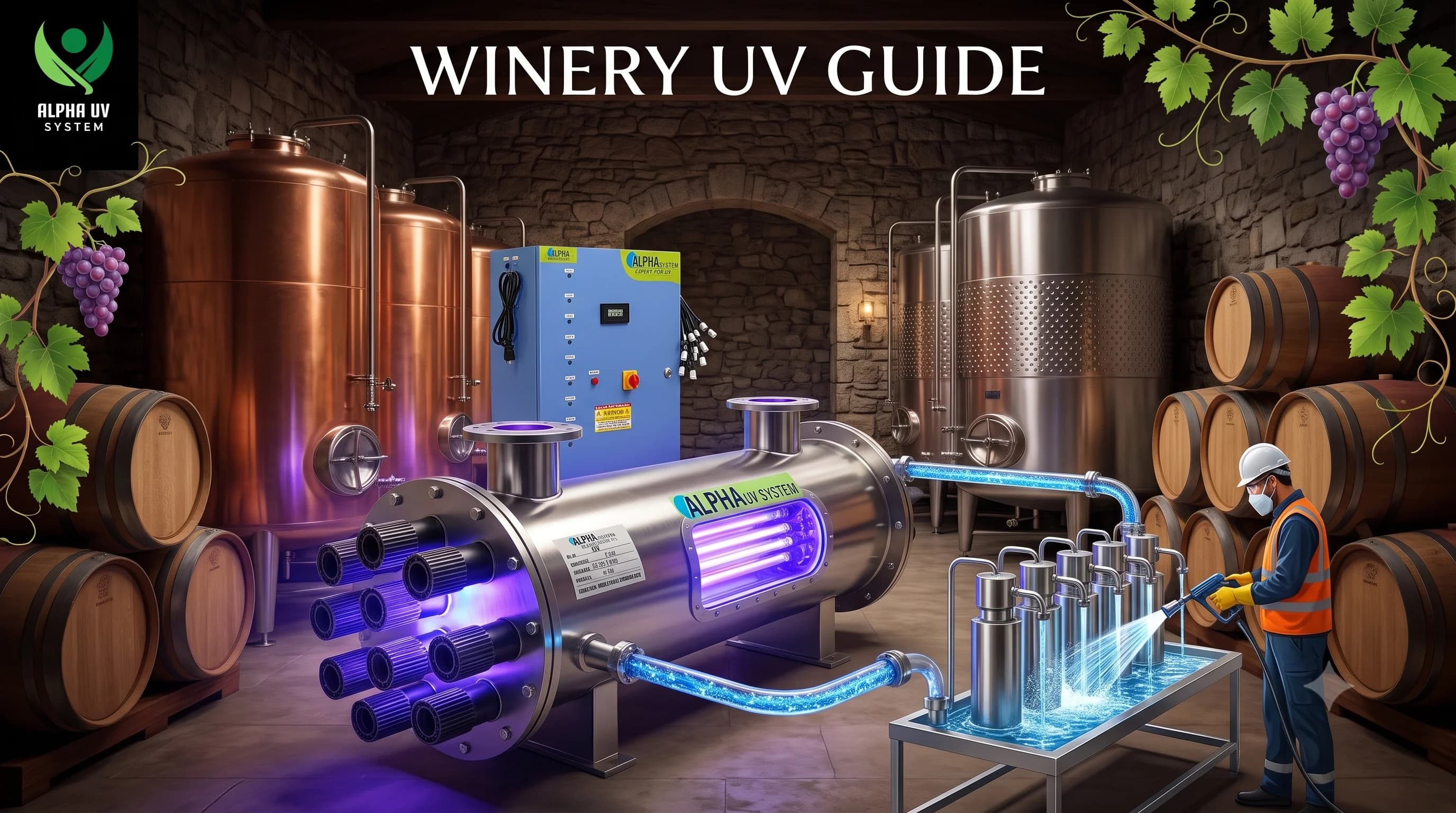
Oak barrels used for wine ageing are the primary reservoir of Brettanomyces in a winery. Barrel washing protocols typically use hot water (60–80°C steam or hot water) for surface sanitisation, followed by cold water rinse. UV treatment of the cold rinse water at 60–80 mJ/cm² ensures that the final water contacting the barrel interior is microbiologically clean — preventing re-inoculation from contaminated water sources. This is particularly important in wineries drawing water from storage tanks or header tanks that may harbour biofilm.
CIP Rinse Water — Tanks, Pumps, Lines
Clean-in-place (CIP) systems in modern wineries use caustic wash (NaOH), acid rinse (citric acid or phosphoric acid), and final water rinse cycles to clean fermentation tanks, pumps, and transfer lines. The final water rinse must be microbiologically clean — any residual bacteria or yeast cells in the rinse water are deposited directly on freshly cleaned equipment surfaces. UV treatment of CIP final rinse water at 40 mJ/cm² eliminates this contamination pathway. UV is positioned on the water supply line to the CIP skid, upstream of the final rinse circuit.
Bottling Line Water
Bottling line water is used for bottle rinsing (pre-fill rinse), label glue cooling, and capsule application cooling. Bottle rinse water contacts the interior of bottles immediately before filling — any microbiological contamination in rinse water is deposited inside the bottle and can cause post-bottling refermentation, haze formation, or off-flavour development. UV treatment of bottling line water at 40 mJ/cm² is standard practice in FSSAI-compliant Indian wine bottling operations.
Cellar Floor and Equipment Wash-Down
Winery cellar floors, drains, and equipment wash-down requires water that is clean enough to not introduce new contamination while removing organic material from previous production cycles. UV treatment of cellar wash-down water at 40 mJ/cm² reduces the viable organism load in the water that contacts cellar floors, drains, and barrel storage areas — reducing the Brettanomyces and Acetobacter contamination that would otherwise accumulate in drain biofilm over multiple vintages.
FSSAI Compliance for Indian Wineries
Indian wine production is regulated by FSSAI under the Food Safety and Standards (Alcoholic Beverages) Regulations, 2018. FSSAI requires wine manufacturers to implement HACCP-based food safety management systems. For the water CCP in winery HACCP plans:
- All water in contact with wine, grapes, or wine-contact surfaces must meet BIS IS 10500 microbiological standards (zero coliforms at point of use)
- Chlorine cannot be used for process water disinfection in wineries where chloroanisole formation risk exists (as documented in FSSAI guidance for wine FBOs)
- UV disinfection with continuous UV intensity monitoring is the FSSAI-accepted CCP control measure — the UV intensity sensor log serves as the CCP monitoring record for FSSAI audits
UV Water Treatment for Indian Wine Regions
India's wine industry is concentrated in Maharashtra (Nashik, Sangli, Satara, Baramati) and Karnataka (Bangalore, Hampi), with emerging production in Himachal Pradesh, Rajasthan, and Goa. Key water quality considerations by region:
- Nashik and Sangli (Maharashtra): Groundwater is moderately hard (hardness 200–400 mg/L as CaCO₃). Iron content in shallow borewells can be 0.5–2.0 mg/L — above the ≤0.3 mg/L required at the UV inlet. Iron removal filter required before UV for borewell sources. Municipal supply in Nashik carries chlorine residual (0.1–0.15 mg/L) — activated carbon filter required before UV to remove chlorine.
- Bangalore and Karnataka: Granite aquifer groundwater has good clarity (UVT typically 88–92%) — UV system sizing is straightforward. Seasonal turbidity during pre-monsoon period (April–May) may require 5-micron pre-filter.
- Himachal Pradesh (Shimla, Kullu): Surface water sources (springs, streams) have high seasonal turbidity during snowmelt. Multi-media filtration + UV is the correct treatment train.
UV System Sizing for Indian Wineries
| Application | Flow rate | UV dose | System | Price range (INR) |
|---|---|---|---|---|
| Small boutique winery (<10,000 cases/year) | 500–1,000 LPH | 40 mJ/cm² | Single LP lamp, SS316L | ₹35,000–60,000 |
| Mid-size winery (10,000–50,000 cases/year) | 1,000–5,000 LPH | 40 mJ/cm² | Single 75W LP, sensor + alarm | ₹75,000–1,50,000 |
| Large winery (50,000–2,00,000 cases/year) | 5,000–20,000 LPH | 40–60 mJ/cm² | Twin LP lamp, SCADA-ready | ₹1,50,000–4,00,000 |
| Barrel wash dedicated unit | 1,000–3,000 LPH | 60–80 mJ/cm² (Brett target) | Higher-dose LP, bypass | ₹80,000–2,00,000 |
UV Water Treatment Systems for Wineries from Alpha UV System
Alpha UV System supplies UV water treatment systems to wineries across India's major wine-producing regions. Our food-grade SS316L reactors use Philips UV-C lamps and produce zero chemical residual — the only disinfection method compatible with wine production. Our systems include UV intensity sensors with continuous monitoring outputs for FSSAI HACCP CCP documentation.
We provide site water quality assessment (chlorine residual, iron, hardness, UVT), treatment train specification (carbon filter for dechlorination + UV), and commissioning with FSSAI HACCP documentation. IIT-trained engineers. MSME Udyam registered manufacturer. 24–48 hour NCR response; winery commissioning visits to Maharashtra and Karnataka within 5–7 days.
Contact us for winery UV water treatment specifications: WhatsApp +91 93183 05878 or call +91 95995 00580.
Related guides: UV water treatment for breweries | UV for food and beverage industry | UV vs chlorine — why wineries must avoid chlorine
Recommended UV Systems
Alpha UV System products for this application — powered by genuine Philips UV-C lamps.
Commercial UV Water Purification System
500 – 5,000 LPH
HACCP-compliant UV water purification for hotels, restaurants, and offices
Industrial UV Water Treatment System
5,000 – 50,000 LPH
Schedule M 2025 and HACCP compliant UV for pharma, food & beverage, and process water
Not sure which system suits your application? WhatsApp our engineers for a free recommendation →
Related solutions
See how Alpha UV System applies this to your industry or city.
Need a UV system?
Talk to our UV engineers — WhatsApp for a quote in 2 hours, or browse the full catalog on IndiaMART.