Quick Answer
Industrial water treatment systems in India use a combination of filtration, softening, chemical dosing, membrane separation, and UV disinfection arranged in a treatment train matched to the specific water source quality and process use requirement. UV disinfection is the terminal disinfection step in most industrial water treatment trains — positioned after filtration (to remove turbidity that would shield pathogens from UV exposure) and before the point of use (to inactivate any pathogens that survived filtration or entered via biofilm in distribution pipework). In pharmaceutical manufacturing, UV is mandatory under Schedule M GMP. In food and beverage processing, UV is required for FSSAI HACCP CCP compliance. In power generation cooling towers, UV controls Legionella. In STPs and ETPs, UV replaces chlorination for CPCB-compliant effluent discharge. Across all industrial applications, UV delivers the same benefit: continuous, chemical-free, documented 4-log pathogen inactivation that meets Indian regulatory requirements without chemical residuals, byproducts, or discharge compliance risk.
Industrial Water Treatment Train — Where UV Fits
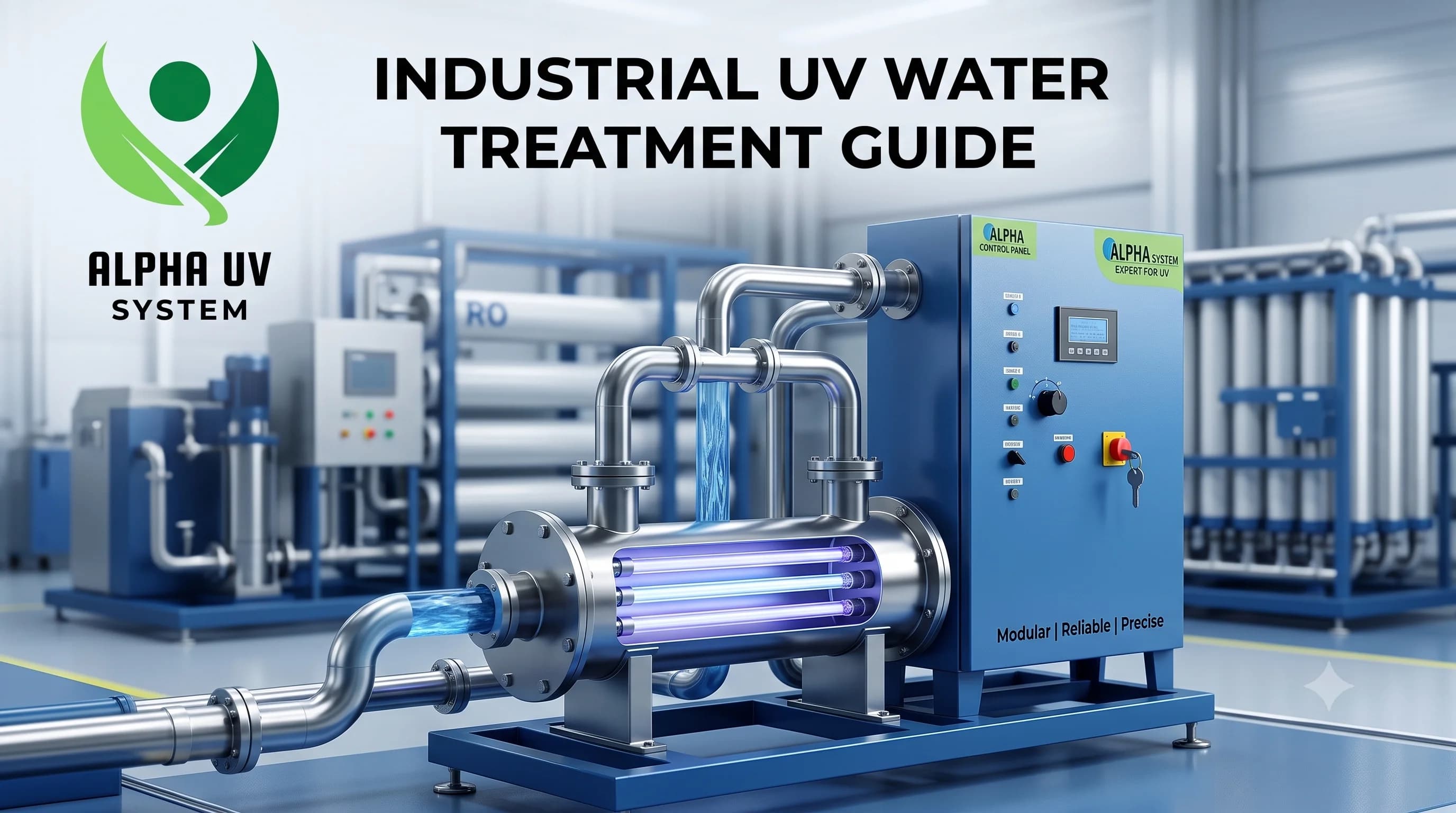
An industrial water treatment system is designed as a series of unit operations, each removing a specific category of contaminant. The sequence is determined by the source water characteristics and the end-use requirements. UV disinfection always comes last in the treatment train — not because it is the least important step, but because it requires the upstream steps to have already removed the turbidity, organic matter, and other UV-absorbing substances that would reduce its dose delivery.
Standard industrial water treatment train positions:
| Treatment step | What it removes | UV interaction |
|---|---|---|
| Screening / straining | Large particles, debris | Upstream of all treatment — UV not affected |
| Coagulation / flocculation | Colloids, fine particles, turbidity | Reduces UV-absorbing particles in raw water |
| Sedimentation / clarification | Flocculated solids | Reduces turbidity before filtration |
| Sand / multimedia filtration | Suspended solids, turbidity to ≤1 NTU | Required upstream of UV — turbidity ≤1 NTU at UV inlet |
| Activated carbon (GAC) | Chlorine, organics, taste and odour | Removes chlorine that absorbs UV at 254 nm; UV positioned downstream |
| Softening / antiscalant | Hardness (calcium, magnesium) | Prevents calcium scale on UV quartz sleeve in hard water areas |
| Iron / manganese removal | Dissolved and particulate iron, manganese | Iron ≤0.3 mg/L required at UV inlet — iron fouls quartz sleeve |
| Ultrafiltration (UF) | Bacteria, protozoa, colloids, large viruses | UV downstream of UF — inactivates small viruses UF cannot remove |
| Reverse osmosis (RO) | Dissolved salts, organics, most microorganisms | UV downstream of RO — protects against membrane integrity failure and biofilm regrowth |
| Electrodeionisation (EDI) | Remaining ions in RO permeate | UV downstream of EDI — pharmaceutical water loop protection |
| UV disinfection | Bacteria, viruses, protozoa — all pathogens | Final barrier — positioned last in the treatment train |
UV Disinfection in Indian Industrial Water Treatment by Sector
Pharmaceutical Manufacturing
Pharmaceutical industrial water treatment systems in India must meet Schedule M (GMP for Pharmaceuticals) requirements for purified water (TVC < 100 CFU/ml) and Water for Injection (WFI, TVC < 10 CFU/100 ml). The standard treatment train is: Municipal supply → Activated carbon → Water softener → RO (multi-pass) → EDI → UV disinfection (point-of-use + loop return). UV is installed at two points: after the RO/EDI system as the primary disinfection step, and on the distribution loop return to prevent biofilm regrowth in the loop pipework between the UV reactor and the point of use. UV intensity is logged continuously as the primary TVC control record between periodic microbiological sampling. See our guide on UV water treatment for pharmaceutical purified water and WFI.
Food and Beverage Processing
FSSAI Schedule IV requires all water in contact with food or food-contact surfaces to meet BIS IS 10500 microbiological standards at the point of food contact. Food and beverage industrial water treatment trains typically include: Municipal supply / borewell → Sediment pre-filtration → Iron removal (where needed) → Activated carbon (dechlorination from municipal supply) → 5-micron cartridge filter → UV disinfection. The activated carbon step before UV is critical — residual chlorine in municipal supply water absorbs UV at 254 nm, reducing dose delivery efficiency. UV is positioned as the final step and its intensity sensor output is the FSSAI HACCP CCP monitoring record. Applications include: bottled water, dairy processing, brewery and beverage production, packaged foods, meat and poultry processing. See our guides on UV for dairy and UV for breweries.
Textile and Dyeing Industry
Textile effluent treatment plants (ETPs) face a specific UV challenge: dyestuff in textile wastewater absorbs UV light at 254 nm, reducing UVT to 20–40% — far below the ≥75% UVT required for standard UV system sizing. Textile ETP UV disinfection requires UV pre-treatment for colour removal (ozone AOP or activated carbon adsorption) to raise UVT above 60% before the UV reactor can deliver adequate dose. Where pre-treatment is in place, UV at 60–100 mJ/cm² achieves CPCB fecal coliform discharge limits for textile ETP effluent to receiving water bodies. Reactor sizing for textile ETP UV must use measured post-colour-removal UVT — not a default assumed value.
Power Generation and Cooling Towers
Power generation industrial water treatment systems use UV disinfection for two purposes: (1) make-up water disinfection — ensuring that water entering the cooling circuit is microbiologically clean, reducing biological fouling of heat exchangers and condenser tubes, and (2) cooling tower water treatment — UV at 40–80 mJ/cm² on the tower basin recirculation line reduces Legionella pneumophila (the cause of Legionnaires' disease — transmitted via cooling tower aerosols), reduces overall biofilm formation in the tower, and allows reduction of biocide (chlorine, bromine, isothiazolinone) dosing by 40–60%, reducing chemical cost and chemical discharge compliance risk. See our guide on UV for cooling towers.
Aquaculture and Seafood Processing
Aquaculture industrial water treatment systems face the unique constraint that the treated water is in direct contact with fish and shrimp throughout the grow-out period — making chemical disinfection (chlorine, ozone) impractical at disinfection concentrations. UV sterilization at 30–100 mJ/cm² is the only practical disinfection technology for recirculating aquaculture systems (RAS) and hatchery inflow water. Targets: Vibrio parahaemolyticus (shrimp pathogen), Aeromonas hydrophila, white spot syndrome virus, and infectious pancreatic necrosis virus. See our guide on UV for aquaculture in India.
Chemical and Petrochemical
Chemical and petrochemical industrial water treatment systems use UV in process water disinfection for products where biological contamination creates yield losses or product quality failures — fermentation intermediates, biochemical synthesis streams, and process cooling water where biological fouling of heat exchangers reduces thermal efficiency. UV disinfection of cooling water is also relevant for CPCB compliance — cooling water blowdown from chemical plants has a CPCB standard for biological parameters before discharge.
How to Select UV Disinfection for an Industrial Water Treatment System
The UV disinfection system specification for an industrial water treatment application requires three measurements from the actual source water after upstream treatment:
1. Design Flow Rate
Use the peak process demand, not the average. Industrial water treatment systems that are sized for average flow will deliver under-dosed water during peak production periods — typically coinciding with maximum product demand. For batch-process industries (food and beverage, pharmaceutical), the peak flow is often 2–4× the average flow during filling operations. Confirm the peak flow with the production planning team, not just the operations team — production plans drive actual water demand.
2. UV Transmittance (UVT) of Treated Water
Measure UVT at 254 nm using a UV spectrophotometer on a water sample taken after all upstream treatment steps, at the actual operating conditions (not just dry-season best-case water quality). UVT varies seasonally and with upstream process changes. Design the UV system for the minimum expected UVT (typically monsoon or post-monsoon period) — not the annual average.
3. Required UV Dose
| Application | Standard UV dose | Regulatory basis |
|---|---|---|
| Drinking water / food process water | 40 mJ/cm² | BIS IS 10500, FSSAI Schedule IV, WHO GDWQ |
| Pharmaceutical purified water | 40–100 mJ/cm² | Schedule M GMP, Indian Pharmacopoeia |
| STP/ETP effluent discharge | 40–80 mJ/cm² | CPCB General Discharge Standards |
| Aquaculture / recirculating systems | 30–100 mJ/cm² | Application-specific — pathogen targets |
| Cooling tower make-up and basin | 40–80 mJ/cm² | ASHRAE 188 Legionella control |
| Ballast water treatment | ≥50 mJ/cm² | IMO BWM Convention D-2 Standard |
Industrial UV System Specification Checklist
- Reactor chamber material: SS316L with EN 10204 3.1 material certificate — required for food, pharmaceutical, and potable water contact applications
- Lamp type and make: Philips UV-C low-pressure (LPHO) or medium-pressure lamps with published output degradation curves — required for dose calculation at lamp end-of-life
- UV intensity sensor: Calibrated, with 4–20 mA output and alarm relay — mandatory for validated disinfection
- Operating pressure rating: Confirm the reactor pressure rating against the industrial system operating pressure — industrial systems commonly run at 6–16 bar, requiring certified pressure vessels
- Flow rate validation: Confirm the supplier's UV dose validation certificate states dose at your actual peak flow rate and your actual measured UVT — not a default assumed value
- Bypass line and isolation valves: Required for industrial systems where continuous operation is mandatory during UV maintenance (lamp change, sleeve cleaning)
- SCADA integration: Modbus RTU/TCP or 4–20 mA output — required for systems where the UV intensity record is a regulatory compliance document
Industrial Water Treatment UV Systems from Alpha UV System
Alpha UV System designs and manufactures UV disinfection systems for industrial water treatment trains across all major Indian industrial sectors. Our systems range from 500 LPH point-of-use reactors for pharmaceutical loop return applications to 5,00,000 LPH multi-lamp banks for municipal and large industrial applications. All systems use Philips UV-C lamps, SS316L reactors with material certificates, and IP65 control panels with 4–20 mA UV intensity output and Modbus communication.
Our IIT-trained engineering team provides: source water quality assessment (UVT, turbidity, iron, hardness), treatment train review, UV system sizing and selection, and regulatory compliance documentation for Schedule M, FSSAI, CPCB, NABH, and BIS IS 10500 audits. MSME Udyam registered manufacturer, Greater Noida. 24–48 hour NCR site survey, nationwide project delivery and commissioning.
Contact us to specify UV disinfection for your industrial water treatment system: WhatsApp +91 93183 05878 or call +91 95995 00580.
Related guides: UV disinfection systems — complete buyer's guide | UV filtration systems — how UV integrates with filtration | UV installation and commissioning guide | UV system monitoring and control
Recommended UV Systems
Alpha UV System products for this application — powered by genuine Philips UV-C lamps.
Commercial UV Water Purification System
500 – 5,000 LPH
HACCP-compliant UV water purification for hotels, restaurants, and offices
Industrial UV Water Treatment System
5,000 – 50,000 LPH
Schedule M 2025 and HACCP compliant UV for pharma, food & beverage, and process water
Not sure which system suits your application? WhatsApp our engineers for a free recommendation →
Related solutions
See how Alpha UV System applies this to your industry or city.
Need a UV system?
Talk to our UV engineers — WhatsApp for a quote in 2 hours, or browse the full catalog on IndiaMART.