Quick Answer
The IMO Ballast Water Management Convention (BWM Convention), in force since September 2017, requires all ships to manage ballast water to meet the D-2 biological discharge standard: less than 10 viable organisms per m³ for organisms ≥50 microns, less than 10 viable organisms per ml for organisms 10–50 microns, and specified limits for E. coli, intestinal enterococci, and toxicogenic Vibrio cholerae. UV disinfection combined with a 20–40 micron automatic backwash filter is the treatment technology used in approximately 60–70% of type-approved Ballast Water Management Systems (BWMS) globally — it is chemical-free, leaves no residual in discharged ballast water, and treats at the flow rates required for ballasting operations (1,000–10,000 m³/hr on large bulk carriers and tankers). The minimum UV dose required for IMO D-2 standard compliance is ≥50 mJ/cm² for UV + filtration systems. All BWMS must carry IMO type approval under Resolution MEPC.300(72) (2018 Guidelines — MEPC G8), which requires bioassay challenge testing at the type approval authority's facility before market authorisation. Indian-flagged ships must comply with BWM Convention requirements enforced by the Indian Directorate General of Shipping (DGS) under the Merchant Shipping Act, 1958.
Why Ballast Water Treatment Matters — The Invasive Species Problem
Ships take on ballast water in one port to maintain stability when not carrying cargo, and discharge that water in another port when cargo is loaded. A large bulk carrier may take on 50,000–100,000 tonnes of ballast water in one ocean region and discharge it in another, transferring thousands of aquatic organisms — bacteria, phytoplankton, zooplankton, fish larvae, invertebrate eggs — with each ballasting cycle. Several of the most economically damaging biological invasions in history have been caused by ballast water transfer:
- Zebra mussel (Dreissena polymorpha): Native to the Caspian Sea, introduced to the North American Great Lakes via ballast water in the 1980s. Now causes billions of dollars annually in fouling damage to water intake systems, power plants, and water infrastructure.
- Comb jelly (Mnemiopsis leidyi): Introduced to the Black Sea from North American ballast water in the 1980s; collapsed the Black Sea anchovy fishery within a decade.
- Cholera (Vibrio cholerae O1 El Tor): The 1991 Latin American cholera pandemic is linked to ballast water discharge in Peruvian ports by Asian ships.
- Asian shore crab, European green crab: Introduced to US/Australian coasts via ballast water, now dominant invasive species in affected coastal ecosystems.
IMO BWM Convention — Legal Framework
The International Convention for the Control and Management of Ships' Ballast Water and Sediments (BWM Convention) was adopted by IMO in 2004 and entered into force on 8 September 2017. It requires all ships engaged in international voyages to carry and implement a Ship-Specific Ballast Water Management Plan (BWMP) and to comply with one of two discharge standards:
D-1 Standard (Exchange Standard — being phased out)
Ships exchange ballast water at sea (minimum 200 nautical miles from the nearest land, in water ≥200 m depth) before entering port. D-1 is based on dilution — mid-ocean water contains far fewer coastal organisms than nearshore water. D-1 compliance is the transitional standard and is being phased out as D-2 treatment becomes mandatory for all ships under the IMO phase-in schedule.
D-2 Standard (Treatment Standard — the UV target)
The D-2 discharge standard requires treated ballast water to contain:
| Organism category | D-2 discharge limit | UV dose relevance |
|---|---|---|
| Viable organisms ≥ 50 μm | < 10 per m³ | Removed by 20–40 μm pre-filter (filtration step) |
| Viable organisms 10–50 μm | < 10 per mL | Primary UV target — inactivated at 50 mJ/cm² |
| Toxicogenic Vibrio cholerae | < 1 CFU per 100 mL | Achieved at ≤10 mJ/cm² — UV dose requirement is set by the 10–50 μm organisms |
| Escherichia coli | < 250 CFU per 100 mL | Achieved at 10–20 mJ/cm² — well within UV system capacity |
| Intestinal Enterococci | < 100 CFU per 100 mL | Achieved at 15–20 mJ/cm² — within UV system capacity |
UV + Filtration — The Dominant BWMS Technology
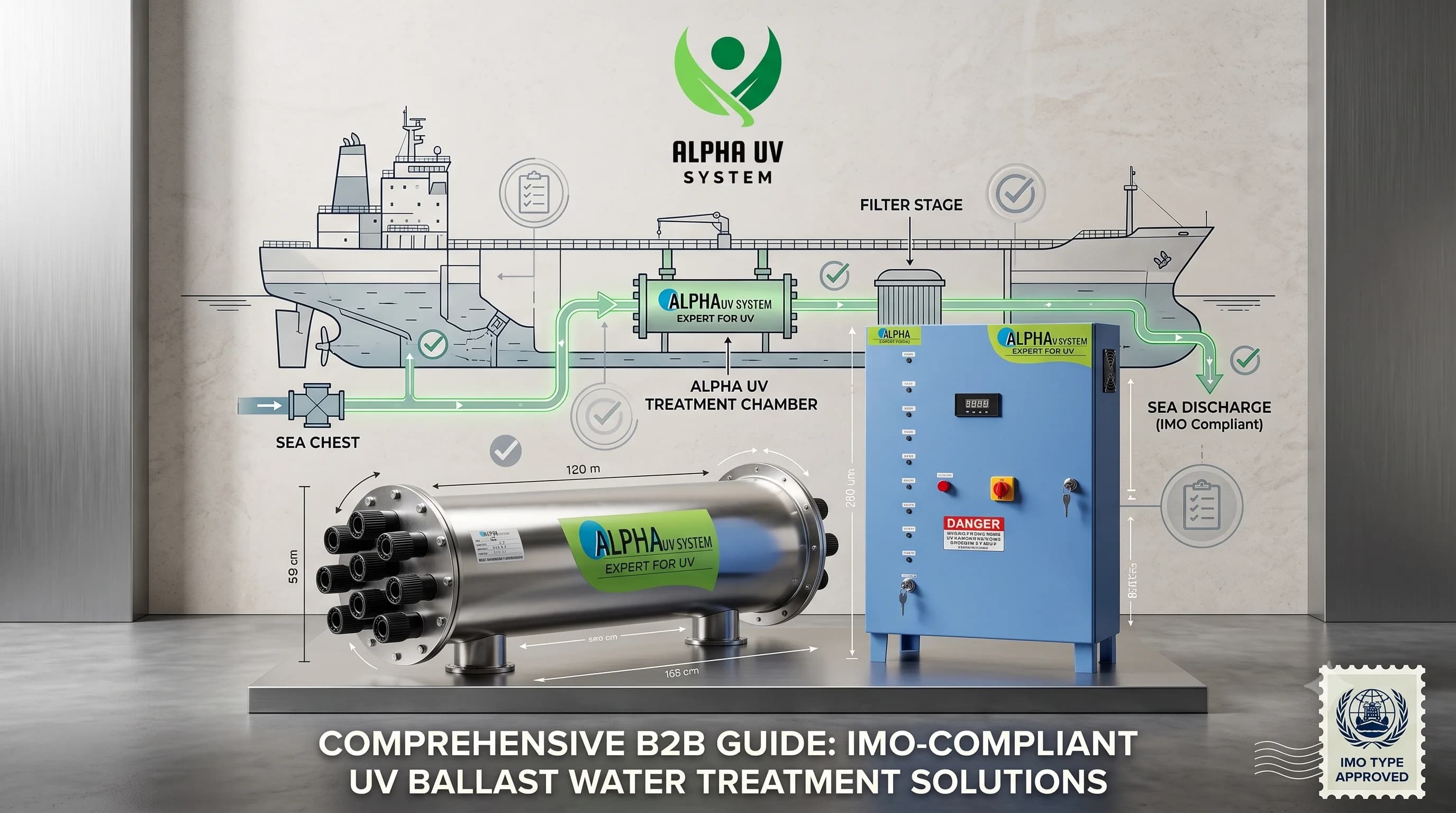
The filter + UV treatment train is used in approximately 60–70% of all IMO type-approved BWMS worldwide. The treatment sequence is:
- Automatic backwash filter (20–40 μm): Installed on the ballast water inlet line. Removes organisms ≥50 μm (the organisms in the first D-2 discharge category) and reduces the sediment and turbidity load that would reduce UV dose delivery in the UV reactor downstream.
- UV reactor(s): Medium-pressure or high-intensity low-pressure UV reactor array, sized for the maximum ballasting flow rate (pumping rate can be 1,000–10,000 m³/hr on large ships). UV dose ≥50 mJ/cm² at worst-case UVT (typically 65% for near-port coastal water that may be turbid and biologically rich).
- Neutralisation unit (for some systems): Some type-approved BWMS use a UV oxidation step (UV + hydrogen peroxide) as a booster for particularly challenging source waters. Most UV-only systems do not require chemical addition.
UV Dose Requirements for Ballast Water Treatment
The 50 mJ/cm² minimum UV dose for D-2 compliance is significantly higher than the 40 mJ/cm² used for drinking water — because the target organisms in ballast water include phytoplankton and zooplankton (algae, copepods, dinoflagellates) that are far larger and have much higher UV dose requirements for inactivation than bacteria:
| Organism type | UV dose for effective inactivation | Relevance to D-2 |
|---|---|---|
| Bacteria (E. coli, Vibrio) | 6–20 mJ/cm² | Well below D-2 dose — not the design driver |
| Phytoplankton (diatoms, dinoflagellates) | 40–80 mJ/cm² | Primary UV design organism for D-2 10–50 μm category |
| Copepod nauplii (larvae) | 50–100 mJ/cm² | UV design driver at many BWMS type approval facilities |
| Larger zooplankton (>50 μm) | Removed by pre-filter — UV not relied upon | Pre-filter required in all UV BWMS |
IMO Type Approval — MEPC.300(72) G8 Guidelines
All Ballast Water Management Systems must carry IMO type approval before commercial installation on ships. The current type approval framework is Resolution MEPC.300(72), adopted in April 2018 (the "2018 BWMS Code" or "G8 revised guidelines"). Key requirements:
- Land-based testing: Type approval testing is conducted at an IMO-recognised test facility using natural seawater at three test salinities (fresh, brackish, marine) and at the system's minimum rated flow rate. The UV system must achieve D-2 standard compliance in bioassay testing using natural organism communities — not surrogate indicator organisms.
- Shipboard testing: After land-based testing, the system undergoes shipboard operational testing on a vessel in normal commercial service for a specified number of ballasting cycles. This is required to demonstrate that the system functions reliably under actual ship operation conditions.
- Final approval: Granted by a flag state administration (DGS for Indian-flagged vessels, MCA for UK-flagged, USCG for US-flagged, etc.) based on the land-based and shipboard test results reviewed by a Recognized Organization (DNV GL, ABS, BV, LR, IRS acting as flag state agents).
Indian Port State Control — BWM Enforcement in Indian Ports
India ratified the BWM Convention and enforces D-2 requirements through the Directorate General of Shipping (DGS) under the Merchant Shipping Act, 1958. Port State Control (PSC) inspections at Indian ports (Mumbai, JNPT, Mundra, Chennai, Vishakhapatnam, Haldia) check:
- Ship-Specific Ballast Water Management Plan (BWMP) — must be approved by flag state
- Ballast Water Record Book (BWRB) — records of each ballasting and deballasting operation with volumes, locations, treatment method used, and D-2 compliance status
- BWMS Commissioning Certificate — confirming the type-approved system is operational and has been commissioned per manufacturer's instructions
- BWMS operational status — PSC officers may witness a ballasting operation to verify that the BWMS is operating as certified
Non-compliant vessels (no type-approved BWMS, non-functioning BWMS, or Ballast Water Record Book discrepancies) are subject to PSC detention in Indian ports until deficiencies are corrected.
Retrofitting UV BWMS on Existing Vessels
The IMO BWM Convention phase-in schedule has required retrofitting of UV BWMS on all ships that did not have a type-approved system installed at new build. Retrofitting presents specific challenges:
- Space and weight constraints: Existing ship engine rooms and pump rooms were not designed for BWMS installation. Compact UV reactor configurations with minimum straight pipe run requirements and modular skid packages are needed.
- Power supply: Medium-pressure UV reactors for large ships may require 100–500 kW electrical power — the ship's electrical system capacity must be verified before BWMS specification.
- Back-pressure on ballast pumps: The filter + UV reactor combination adds hydraulic resistance to the ballast system. BWMS hydraulic data sheets (pressure drop at rated flow) must be reviewed by the ship's engineer before installation.
- Dry dock scheduling: Most BWMS retrofits are conducted during scheduled dry dock — the IMO installation deadline must be tracked against the vessel's dry dock schedule to ensure compliance without emergency retrofit at sea.
Selecting a UV BWMS — What to Verify
- Confirmed IMO type approval number: Verify the type approval status on IMO's BWMS type approval database — available at gisis.imo.org. Some systems marketed as "type approval pending" have not completed the full G8 process.
- Rated flow range covers your ballasting rate: Each type-approved system is certified at specific flow rates. A BWMS certified for 500 m³/hr cannot be used on a ship that ballasts at 1,500 m³/hr without a separate type approval at that flow rate.
- Salinity range covers your trading area: Systems certified for full salinity (marine) only may not achieve D-2 in fresh water or brackish water ports. Check the type approval certificate's salinity range against the vessel's trading pattern.
- After-sales service and spare parts availability: UV lamps and filter elements for BWMS are replaced on schedule — confirm that the system manufacturer or their authorised agent has spare parts available ex-stock in the ports your vessel calls.
Ballast Water UV Treatment from Alpha UV System
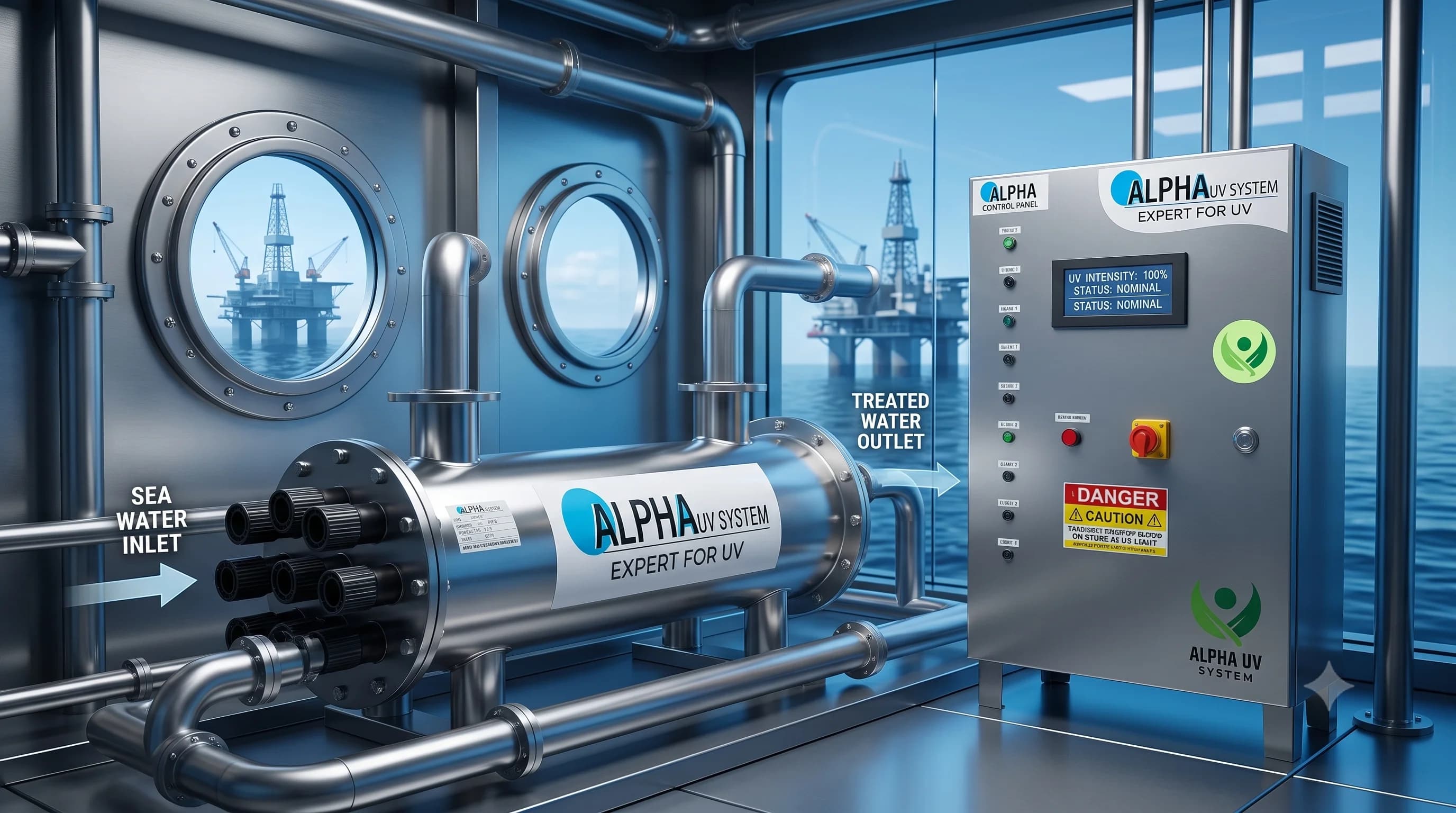
Alpha UV System designs high-flow UV reactor systems for ballast water treatment applications, working with Indian shipyards and shipping companies on IMO BWM Convention compliance programmes. Our UV reactor engineering team provides flow and UVT analysis, reactor sizing for D-2 standard compliance, and integration with upstream filtration systems.
For new build vessels at Indian shipyards and retrofit programmes for existing Indian-flagged vessels, Alpha UV System provides UV system supply, installation support, and commissioning documentation compatible with IRS (Indian Register of Shipping) survey requirements. Export supply available for GCC, Southeast Asia, and East Africa operators.
IIT-trained engineers. SS316L and duplex SS construction. MSME Udyam registered manufacturer, Greater Noida.
Contact us for ballast water UV system specifications: WhatsApp +91 93183 05878 or call +91 95995 00580.
Related guides: UV water treatment for offshore and marine applications | UV disinfection systems — complete buyer's guide | UV system export from India
Recommended UV Systems
Alpha UV System products for this application — powered by genuine Philips UV-C lamps.
Commercial UV Water Purification System
500 – 5,000 LPH
HACCP-compliant UV water purification for hotels, restaurants, and offices
Industrial UV Water Treatment System
5,000 – 50,000 LPH
Schedule M 2025 and HACCP compliant UV for pharma, food & beverage, and process water
Not sure which system suits your application? WhatsApp our engineers for a free recommendation →
Related solutions
See how Alpha UV System applies this to your industry or city.
Need a UV system?
Talk to our UV engineers — WhatsApp for a quote in 2 hours, or browse the full catalog on IndiaMART.