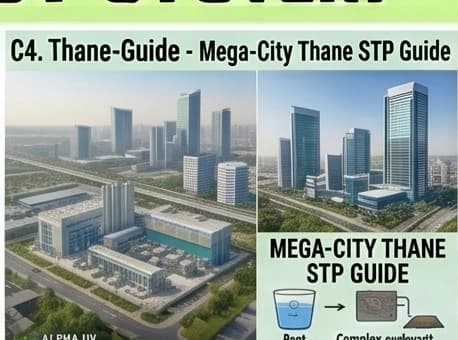
UV water treatment in Thane addresses three key needs: (1) post-overhead-tank disinfection for Thane's massive and rapidly growing residential areas — TMC (Thane Municipal Corporation) supply from the Ulhas River and Vaitarna system loses residual chlorine in overhead tanks during Maharashtra's summer (temperatures reach 38–42°C in April–May; Thane's humidity amplifies bacterial growth risk year-round); (2) Dombivli and Ambernath MIDC pharmaceutical and chemical cluster UV — Thane district's MIDC estates (Dombivli MIDC, Ambernath MIDC, Taloja MIDC, Mahape MIDC near Navi Mumbai) host India's most concentrated pharmaceutical and specialty chemical manufacturing zones, with Schedule M 2025, WHO-GMP, and US FDA compliance requirements; and (3) MPCB STP compliance for Thane's extraordinarily high-density residential stock — Thane city has population density among the highest in Maharashtra, and the MPCB enforces STP compliance particularly strictly in the MMR (Mumbai Metropolitan Region) context. Alpha UV System supplies Philips UV-C lamp UV systems to Thane with 5–7 day delivery and MPCB documentation support.
Thane — part of the Mumbai Metropolitan Region (MMR) and Maharashtra's largest district by area and one of India's fastest-growing cities — has transformed from a quiet suburb of Mumbai to an independent commercial and industrial powerhouse. The city of Thane (Thane Municipal Corporation jurisdiction), and the broader Thane district encompassing Kalyan, Dombivli, Ambernath, Ulhasnagar, Bhiwandi, Navi Mumbai, and the rapidly urbanising peri-urban zones, constitute one of India's most complex urban agglomerations.
UV water treatment in Thane is shaped by two dominant contexts: the residential UV market (driven by Thane's massive population growth — the TMC area alone has 2 million+ residents, with the broader Kalyan-Dombivli-Ulhasnagar urban complex adding 3 million more) and the industrial UV market (driven by Thane district's MIDC estates hosting 10,000+ chemical, pharmaceutical, engineering, and textile manufacturing units). The Dombivli MIDC and Ambernath MIDC are among India's most significant pharmaceutical and specialty chemical manufacturing concentrations — supplying API (Active Pharmaceutical Ingredients), intermediates, and formulations to global pharmaceutical companies.
MPCB's STP compliance enforcement in the MMR is among Maharashtra's strictest — the Ulhas River basin (which receives Thane district's drainage) and the Kalyan creek have been subject to MPCB and NGT proceedings. High-rise residential towers in Thane (50+ floors, 500+ apartments) generate enormous sewage volumes and are required to have MPCB-consented STP with UV disinfection at the final effluent. UV water treatment in Thane's high-rise residential sector is a significant and growing market driven by RERA and MPCB building consent requirements.
Thane Water Quality by Zone and UV Requirement
| Zone / Area | Supply Type | Key Water Quality Issue | Recommended UV Solution |
|---|---|---|---|
| Thane city (Kopri, Wagle Estate, Ghodbunder) | TMC piped supply (Ulhas / Vaitarna) | High-density residential; post-tank bacterial growth in humid coastal climate; TMC supply intermittency in summer peak | Post-tank UV at 40 mJ/cm²; 5 µm pre-filter; MPCB STP for high-rise complexes; April–May critical |
| Dombivli MIDC (pharmaceutical / chemical) | MIDC supply + borewell | India's most concentrated specialty chemical zone; API pharmaceutical units; MPCB strict ETP; US FDA-audited plants | Pharmaceutical UV (185+254 nm); Schedule M 2025 IQ/OQ/PQ; chemical ETP UV; US FDA CFR Part 11 |
| Ambernath MIDC (pharmaceutical / engineering) | MIDC supply + borewell | API and bulk drug manufacturers; defence public sector units (OFE Ambernath); MPCB ETP; WHO-GMP export units | Pharmaceutical PW UV; WHO-GMP IQ/OQ/PQ; MPCB ETP UV; Ordnance Factory potable UV |
| Kalyan-Dombivli (residential megacity) | KDMC supply (Ulhas River) | 3M+ urban agglomeration; massive high-rise residential STP compliance requirement; MPCB building consent UV | Post-tank UV; STP UV for all complexes ≥50 KLD; MPCB RERA building consent UV; large-scale residential |
| Badlapur / Ambernath residential (growth fringe) | Municipal supply + borewell + tanker | Rapid growth beyond TMC; borewell TDS 300–600 mg/L; MPCB STP compliance as urbanisation advances | Post-tank UV; STP UV; borewell TDS check; MPCB building consent documentation |
UV Water Treatment for Dombivli and Ambernath MIDC's Pharmaceutical-Chemical Cluster
The Dombivli MIDC — colloquially called "Chemical Capital of India" — hosts over 500 chemical and pharmaceutical manufacturing units in an approximately 3 sq km area. The cluster produces specialty chemicals (dyes, pigments, intermediates), API (Active Pharmaceutical Ingredients) for global pharmaceutical companies, and fine chemicals used in electronics and personal care. US FDA, EU GMP, and WHO-GMP are the operating compliance standards for the export-oriented API manufacturers at Dombivli, making it one of India's most regulated industrial zones for water quality.
UV water treatment in Dombivli MIDC pharmaceutical units serves the critical purified water function: API manufacturing requires water for synthesis reactions, equipment cleaning, and product washing. Purified Water for pharmaceutical synthesis (USP/BP Purified Water) requires UV at 185 nm (TOC reduction from RO permeate) and 254 nm (loop disinfection in recirculating PW systems). The IQ/OQ/PQ documentation for Dombivli pharmaceutical UV systems is regularly reviewed by US FDA inspectors during CGMP audits — Dombivli API plants that export to the USA receive FDA inspection every 2–3 years, and water system documentation is a standard inspection item.
Ambernath MIDC's defence connection: the Ordnance Factory Equipment Ambernath (OFE) — producing military ordnance equipment — coexists with pharmaceutical and chemical manufacturers in the Ambernath MIDC zone. The OFE has its own water supply infrastructure under MES (Military Engineering Services), but pharmaceutical companies in the surrounding Ambernath MIDC require commercial UV water treatment systems meeting CDSCO and export regulatory standards.
UV System Sizing for Thane Applications
| Application | Flow Rate | UV Dose Required | Key Notes |
|---|---|---|---|
| Residential apartment (Thane / Kalyan-Dombivli) | 1–3 m³/h | 40 mJ/cm² | Post-overhead-tank UV; 5 µm pre-filter; TMC/KDMC supply; April–May summer + year-round humidity |
| High-rise residential (100+ flats) building supply | 5–15 m³/h | 40 mJ/cm² | Building-level UV for large MMR complexes; MPCB RERA consent; STP UV for complexes ≥50 KLD |
| API pharmaceutical PW system (Dombivli MIDC) | 2–10 m³/h | 80–120 mJ/cm² | 185+254 nm dual-wavelength; TOC reduction; loop disinfection; Schedule M 2025; US FDA CFR Part 11; IQ/OQ/PQ |
| Chemical plant process water (Dombivli / Ambernath) | 5–30 m³/h | 40 mJ/cm² | MPCB ETP UV; chemical plant clean utility; MPCB coliform limit for Ulhas River tributary discharge |
| Hospital potable (Thane Civil / Jupiter Hospital) | 5–30 m³/h | 40–80 mJ/cm² | NABH/JCI documentation; ICU 80 mJ/cm²; dialysis AAMI/ISO 13959; Thane large hospital market |
| STP 100 KLD (medium residential complex) | 8–12 m³/h | 40 mJ/cm² | Philips TUV 55W × 2; MPCB consent; RERA building occupancy UV condition |
| STP 300 KLD (large residential / IT campus) | 20–30 m³/h | 40 mJ/cm² | Philips TUV 95W × 4; MPCB consent; dual-lamp redundancy; online monitoring for MMR zone |
Recommended UV Systems for Thane — Philips UV-C Lamp Models
UV water treatment in Thane's high-density MMR context demands UV systems that are reliable in continuous operation (Thane's large residential complexes run UV 24×7, 365 days), dimensionally compact for high-rise pump rooms, and backed by compliance documentation appropriate for MPCB's strict MMR enforcement regime. All Alpha UV System products use Philips UV-C lamps — mandatory for MPCB STP documentation and preferred by pharmaceutical auditors at Dombivli MIDC.
| Application / Segment | Recommended UV System | Philips Lamp Model | Flow Capacity | Key Advantage for Thane |
|---|---|---|---|---|
| Individual residential flat | Alpha UV 16W Domestic | Philips TUV 16W | Up to 1.5 m³/h | Compact for MMR apartment; continuous operation; low noise; annual lamp replacement |
| Residential building (common supply) | Alpha UV 55W SS316L | Philips TUV 55W | Up to 8 m³/h | Building-level UV for 20–50 flat complexes; MPCB documentation; 316L SS body |
| API / pharma PW system (Dombivli / Ambernath) | Alpha UV 185+254nm Pharma System | Philips TUV 36W–55W (fused silica) | 2–10 m³/h | US FDA / WHO-GMP / Schedule M 2025; IQ/OQ/PQ; TOC + disinfection dual function |
| STP 100 KLD (medium residential) | Alpha UV 95W Industrial | Philips TUV 95W | Up to 20 m³/h | MPCB RERA compliance; intensity monitoring alarm; MMR enforcement ready |
| STP 300+ KLD (large complex / IT park) | Alpha UV Multi-lamp 95W × 4 | Philips TUV 95W × 4 | Up to 80 m³/h | High-rise Thane STP; dual redundancy; MPCB online monitoring compatible; 24×7 operation |
Regulatory Compliance Reference for Thane UV Systems
| Regulation / Authority | Applicable Sector | UV Requirement | Key Documentation |
|---|---|---|---|
| MPCB STP Consent (MMR / Ulhas basin) | Residential / commercial complexes ≥50 KLD | UV at 40 mJ/cm² on STP final effluent; BOD <10 mg/L (MMR stricter than standard); FC <1,000 MPN/100 mL | UV commissioning report; intensity monitoring log; MPCB consent; RERA building UV condition compliance |
| CDSCO Schedule M 2025 / WHO-GMP (Pharma) | Dombivli MIDC / Ambernath MIDC pharmaceutical | Purified Water UV; IQ/OQ/PQ validation; periodic requalification; TOC <500 µg/L | UV IQ/OQ/PQ validation; PW TOC and conductivity records; CDSCO inspection file; US FDA audit file |
| US FDA 21 CFR Part 11 (Export pharma) | US FDA-registered pharmaceutical plants (Dombivli) | Electronic records for UV monitoring; audit trail for UV parameters; validated software for monitoring | Electronic UV monitoring records; 21 CFR Part 11 compliant data logging; US FDA audit-ready |
| MPCB ETP Consent (Chemical / industrial) | Dombivli chemical MIDC ETP | ETP final effluent UV; MPCB coliform limit for Ulhas creek discharge; online monitoring | MPCB ETP consent conditions; UV commissioning; MPCB online monitoring compliance |
| RERA / Building Consent (Maharashtra) | New residential buildings in Thane / Kalyan-Dombivli | MPCB STP UV as condition in RERA and MIDC building approval; occupancy certificate requires UV operational | MPCB STP consent with UV; UV operational proof for RERA occupancy; developer compliance records |
Frequently Asked Questions — UV Water Treatment in Thane
Why do Dombivli MIDC pharmaceutical plants face US FDA UV requirements?
Dombivli MIDC is one of India's most US FDA-inspected industrial zones because many of the 500+ chemical and pharmaceutical companies in the estate supply active pharmaceutical ingredients (APIs) or drug intermediates to US FDA-regulated drug manufacturers in the USA and Europe. When a US pharmaceutical company uses an Indian API, that API manufacturer's plant in Dombivli must comply with US FDA's Current Good Manufacturing Practice (CGMP) regulations — specifically 21 CFR Part 211 for pharmaceuticals and 21 CFR Part 11 for electronic records. Water system qualification is a standard US FDA inspection item: the water purification system (RO + UV + polishing) must be validated (IQ/OQ/PQ), UV parameters must be monitored and recorded electronically with an audit trail (Part 11), and the purified water quality (TOC, conductivity, microbiological counts) must be periodically tested and documented. Alpha UV System's pharmaceutical UV systems for Dombivli include IQ/OQ/PQ documentation in the format required by both CDSCO (Schedule M 2025) and US FDA inspectors.
MPCB is reportedly very strict about STP UV in Thane high-rises — what specifically do they check?
MPCB's Thane regional office is one of Maharashtra's most active in STP compliance enforcement, particularly for high-rise residential complexes in the Thane-Kalyan-Dombivli zone. During STP inspections, MPCB engineers specifically check: (1) UV lamp status — is the lamp on and operating? (a UV system where the lamp has failed but the controller still shows "on" is a common enforcement issue); (2) UV intensity log — is there a paper or digital record of UV intensity (mW/cm²) readings taken at least weekly? Intensity logs are required to demonstrate that the UV system has been operating at rated effectiveness, not just that it's been switched on; (3) lamp replacement records — when was the last Philips lamp replaced, and what is the invoice? Lamps beyond 10,000 hours of operation are assumed to be below-rated output; (4) pre-filter replacement records — a clogged pre-filter reduces UV effectiveness; MPCB checks that pre-filter replacement is occurring every 3 months or as required. Alpha UV System provides complete STP UV monitoring templates with every supply — this is the documentation that MPCB Thane inspectors check.
Is the Ulhas River supply quality in Thane and Kalyan affected by industrial pollution?
The Ulhas River — which flows through the Ambernath-Badlapur chemical belt before entering the TMC and KDMC water supply intakes — has historically been affected by industrial effluent from the Dombivli and Ambernath MIDC chemical units. MPCB's enforcement on the Dombivli MIDC zone's ETP compliance has improved Ulhas water quality in recent years, but the river still receives some degree of industrial runoff during monsoon and heavy rain events (when MIDC stormwater drainage can carry contaminated runoff). The TMC and KDMC WTPs treat Ulhas water to BIS 10500 standards, and the treated supply is safe. However, the post-storage contamination risk (residual chlorine dissipation in overhead tanks at Thane's warm temperatures) means UV at the tank outlet is important. For properties near the Ambernath MIDC zone, it is additionally advisable to have the piped supply tested during monsoon season when the Ulhas's industrial runoff risk is highest.
Is UV mandatory for RERA occupancy certificates in Thane?
Yes — in practice, UV as part of a functioning MPCB-consented STP is a prerequisite for RERA occupancy certificate issuance for residential complexes above 50 KLD sewage generation in Thane. MPCB's STP consent for new residential buildings specifically includes UV disinfection as a consent condition. The Thane Municipal Corporation's building completion certificate process cross-checks MPCB STP consent before issuing the occupancy certificate that RERA mandates. Developers and housing societies in Thane who have completed construction but not installed operational STP UV systems are blocked from getting RERA-compliant occupancy certificates. This has made STP UV installation a critical path item in Thane residential project completion timelines — Alpha UV System supplies STP UV systems within 5–7 days to ensure project completion timelines are not delayed by UV procurement.
Alpha UV System supplies UV disinfection systems to pharmaceutical API manufacturers, chemical plants, high-rise residential complexes, hospitals, and STP operators across Thane, Dombivli MIDC, Ambernath MIDC, Kalyan-Dombivli, Badlapur, and the Ulhas basin. MPCB RERA STP documentation. US FDA 21 CFR Part 11 pharmaceutical UV. Schedule M 2025 IQ/OQ/PQ. Philips UV-C lamps. 5–7 day delivery to Thane.
WhatsApp Us for Thane UV System SupplyRecommended UV Systems
Alpha UV System products for this application — powered by genuine Philips UV-C lamps.
Commercial UV Water Purification System
500 – 5,000 LPH
HACCP-compliant UV water purification for hotels, restaurants, and offices
Industrial UV Water Treatment System
5,000 – 50,000 LPH
Schedule M 2025 and HACCP compliant UV for pharma, food & beverage, and process water
Not sure which system suits your application? WhatsApp our engineers for a free recommendation →
Related solutions
See how Alpha UV System applies this to your industry or city.
Need a UV system?
Talk to our UV engineers — WhatsApp for a quote in 2 hours, or browse the full catalog on IndiaMART.