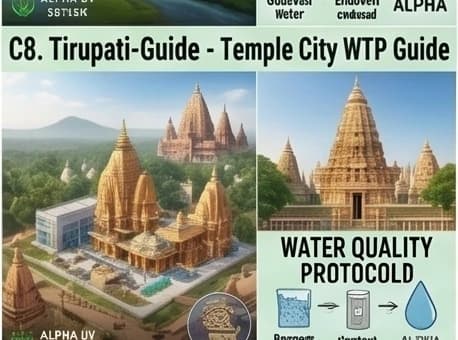
UV water treatment in Tirupati addresses three key needs: (1) post-overhead-tank disinfection for Tirupati's residential areas — TMC (Tirupati Municipal Corporation) supply from the Swarnamukhi River loses residual chlorine in overhead tanks during Tirupati's intense summer (temperatures reach 42–44°C in April–May in the Rayalaseema-AP border zone); (2) TTD pilgrim infrastructure UV — the Tirumala Tirupati Devasthanams (TTD), which manages the Venkateswara Temple complex at Tirumala Hills (approximately 75,000–100,000 pilgrims daily, making it India's most visited temple), provides enormous-scale pilgrim water, feeding, and accommodation services requiring documented FSSAI-compliant water treatment; and (3) pharmaceutical cluster UV at Tirupati's APSIDC industrial estate — Tirupati has attracted pharmaceutical manufacturers who are also subject to the APPCB STP compliance requirements under the Krishna-Godavari basin. Alpha UV System supplies Philips UV-C lamp UV systems to Tirupati with 5–7 day delivery and APPCB documentation support.
Tirupati — divided between the foothill city (Tirupati) and the Tirumala Hills above (where the Venkateswara Temple stands at 853 metres elevation) — is unique in India's urban landscape because of the extraordinary concentration of pilgrims. The Venkateswara Temple receives 60,000–100,000 pilgrims daily (15–25 million annually), more than any other place of worship in the world. The TTD (Tirumala Tirupati Devasthanams), which administers the temple and its facilities, is one of India's wealthiest religious trusts and operates an enormous pilgrim infrastructure: free feeding (Anna Prasadam for 50,000 pilgrims daily), pilgrim accommodation (multiple choultries and rest houses at Tirumala), and medical facilities.
Water safety at Tirumala scale is an operational challenge of significant complexity. The hills receive water from local tank systems and the Papavinasanam dam above Tirumala. The Tirupati city below receives Swarnamukhi River supply. Both require UV treatment given the extreme pilgrim density — a waterborne illness event at Tirumala at peak pilgrim density would be a public health catastrophe given the elderly and health-vulnerable pilgrim demographic.
Tirupati Water Quality by Zone
| Zone / Area | Supply Type | Key Water Issue | UV Solution |
|---|---|---|---|
| Tirupati city (Renigunta Road, Leela Mahal) | TMC piped supply (Swarnamukhi River) | Bacterial regrowth in 43°C summer; Swarnamukhi seasonal flow variation; supply intermittency in summer | Post-tank UV at 40 mJ/cm²; 5 µm pre-filter; April–May critical |
| Tirumala Hills (temple complex, pilgrim facilities) | Papavinasanam dam + TTD water supply | 75,000+ pilgrims/day; Anna Prasadam kitchen; choultry water; aged TTD distribution; extreme pilgrim density | TTD kitchen UV; choultry drinking water UV; large-flow pilgrim supply UV; FSSAI Anna Prasadam compliance |
| Renigunta (airport / industrial zone) | APSIDC supply + borewell | Airport operations; pharmaceutical APSIDC units; logistics warehousing; APPCB STP compliance | Pharmaceutical UV; APPCB STP UV; airport potable UV; FSSAI industrial canteen UV |
| Srikalahasti / Chittoor (satellite towns) | Municipal supply + borewell | Kalam temple town (Srikalahasti); agricultural market towns; borewell TDS 300–800 mg/L; fluoride risk in hard rock zones | Post-tank UV; NABL test borewell for fluoride before use; APPCB STP UV; RO+UV for high TDS/fluoride |
UV for TTD's Tirumala Pilgrim Infrastructure
The TTD's Anna Prasadam (free meal) programme — serving 50,000+ pilgrims daily at Tirumala with South Indian meals — is one of the world's largest free feeding operations. The kitchen infrastructure at Tirumala (multiple large-capacity kitchens producing rice, sambar, rasam, and traditional South Indian dishes) uses enormous volumes of water for cooking, washing, and equipment cleaning. FSSAI food safety compliance requires UV-treated water at all food contact points in large institutional kitchens.
TTD's water treatment philosophy: the temple administration (TTD) is acutely conscious of the sacred character of the pilgrimage and the expectation of purity in all aspects of the temple's operations. Chemical disinfection (chlorine) in the drinking water and food preparation water at Tirumala's pilgrim facilities is a sensitive issue — pilgrims at India's most revered Vaishnava shrine have expectations of chemical purity in the water. UV treatment — which uses UV light rather than chemicals, produces no chemical by-products, and leaves no residual taste or odour — is uniquely appropriate for the Tirumala pilgrim infrastructure. UV provides documented microbiological safety without contradicting the ritual and perceived purity concerns of the pilgrim population.
| Application | Flow Rate | UV Dose | Notes |
|---|---|---|---|
| Residential apartment (Tirupati city) | 1–3 m³/h | 40 mJ/cm² | Post-overhead-tank UV; 5 µm pre-filter; April–May Rayalaseema summer critical |
| TTD Anna Prasadam kitchen (Tirumala) | 10–50 m³/h | 40 mJ/cm² | FSSAI large institutional kitchen; 50,000 meals/day; chemical-free for pilgrimage context; large-flow sizing |
| TTD choultry / pilgrim accommodation (Tirumala) | 5–30 m³/h | 40 mJ/cm² | Pilgrim rest house drinking water; 75,000 daily pilgrim capacity; capacity sizing for peak darshan days |
| Pharmaceutical unit (Renigunta APSIDC) | 2–10 m³/h | 80 mJ/cm² | 185 nm + 254 nm; Schedule M 2025 IQ/OQ/PQ; APPCB STP documentation; CDSCO compliance |
| Hotel / pilgrim guesthouse (Tirupati city) | 2–10 m³/h | 40 mJ/cm² | FSSAI hotel kitchen; pilgrim accommodation UV; chemical-free preferred; Legionella WMP for 3-star+ |
| STP outlet — 300 KLD (Tirupati residential) | 20–30 m³/h | 40 mJ/cm² | Philips TUV 95W; APPCB consent documentation; Swarnamukhi-Penna basin compliance |
Why is chemical-free UV preferred for Tirupati's pilgrim facilities over standard chlorination?
The preference for chemical-free UV at pilgrimage sites — Tirupati, Varanasi, Haridwar, Amritsar's Golden Temple — reflects a convergence of practical food safety and perceived ritual purity considerations. At the Venkateswara Temple specifically:
Practical reasons: (a) chlorination of the large-volume cooking water at TTD kitchens can create chlorinated compounds (trihalomethanes, chlorophenols) that affect the taste of food prepared with the water. Rice, sambar, and rasam cooked with chlorinated water can have off-flavours that are detectable to regular pilgrims — UV-treated water has no taste or odour effect on food; (b) chlorine residual in pilgrim drinking water — at concentrations sufficient for disinfection (0.2–0.5 mg/L residual) — is detectable as taste and some pilgrims object to it; UV-treated water has no taste difference from untreated water; (c) at 75,000+ pilgrims/day, even a small percentage of complaints about water taste or quality can generate significant feedback and reputation concerns for TTD.
Documented compliance reasons: FSSAI food safety regulations require microbial testing of food contact water with documented treatment records. UV systems provide: lamp-on/off logs, intensity sensor readings, and pre-filter maintenance records that serve as the documentation required for FSSAI institutional kitchen compliance. Chemical treatment requires residual testing records that are operationally more complex to maintain in the TTD's very large multi-kitchen distributed operation.
Alpha UV System supplies UV disinfection systems to TTD pilgrim facilities, pharmaceutical manufacturers, hotels, residential complexes, and STP operators across Tirupati, Tirumala Hills, Renigunta APSIDC, Srikalahasti, and the Chittoor district. APPCB STP documentation. FSSAI pilgrim kitchen UV. Chemical-free UV for sacred pilgrimage infrastructure. Philips UV-C lamps. 5–7 day delivery to Tirupati.
WhatsApp Us for Tirupati UV System SupplyRecommended UV Systems
Alpha UV System products for this application — powered by genuine Philips UV-C lamps.
Commercial UV Water Purification System
500 – 5,000 LPH
HACCP-compliant UV water purification for hotels, restaurants, and offices
Industrial UV Water Treatment System
5,000 – 50,000 LPH
Schedule M 2025 and HACCP compliant UV for pharma, food & beverage, and process water
Not sure which system suits your application? WhatsApp our engineers for a free recommendation →
Related solutions
See how Alpha UV System applies this to your industry or city.
Need a UV system?
Talk to our UV engineers — WhatsApp for a quote in 2 hours, or browse the full catalog on IndiaMART.