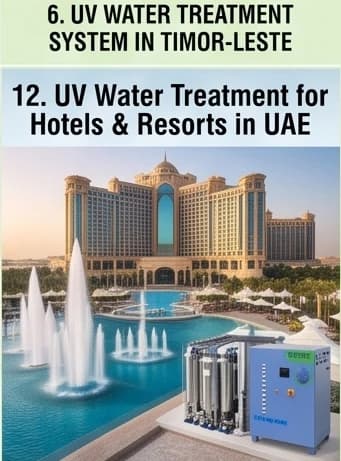
Quick Answer: UV water treatment UAE hotels market is driven by the world's most hotel-dense tourist destination — UAE hosts 140,000+ hotel rooms, 1,200+ hotels and hotel apartments across Dubai (120,000 rooms), Abu Dhabi (32,000 rooms), and Sharjah (18,000 rooms), receiving 25+ million international visitors annually. Dubai Municipality Food Safety Regulation No. 4 of 2009 and Technical Guideline TG-W-001 mandate HACCP for all hotel food and beverage operations, with water quality as a prerequisite programme (PRP) requiring validated, continuously monitored disinfection for all food-contact water. DTCM (Dubai Tourism and Commerce Marketing) Pool Safety Standards 2022, TCA Abu Dhabi pool guidelines, and UAE.S 1875 (swimming pool water standard) require medium-pressure UV for Cryptosporidium control in spa pools and indoor pools — used in combination with residual chlorine (not as a standalone disinfectant). Legionella risk management in cooling towers (UAE EAD Legionella Guideline 2021) is a further UV application in hotel HVAC systems. NSF/ANSI 55 Class A at 40 mJ/cm² for potable applications; medium-pressure UV at 60+ mJ/cm² for pool/spa applications. Alpha UV ships within 48 hours to Dubai International Airport or 10–14 days to Jebel Ali Port.
UAE Hotel Sector Water Treatment Requirements — Overview
The UAE hospitality sector — built on the twin pillars of Dubai's iconic luxury tourism (Burj Al Arab, Atlantis The Palm, JW Marriott Marquis, Waldorf Astoria DIFC) and Abu Dhabi's premium leisure tourism (Emirates Palace/Mandarin Oriental, Rosewood Abu Dhabi, Yas Island resort cluster) — operates in a regulatory environment where water quality failures carry disproportionately severe consequences: Dubai Municipality food safety violations result in immediate facility closure; DTCM pool safety non-compliance triggers licence suspension.
The UV water treatment UAE hotels requirement spans four distinct systems within a single hotel property: kitchen and F&B water, spa and pool water, cooling tower water (Legionella), and building domestic cold water (Legionella and general microbiological risk). Most large UAE 5-star hotels (200+ rooms) have UV systems installed across all four categories — typically replacing or supplementing legacy chlorine dosing systems that create organoleptic issues (chlorine taste and smell affecting guest experience in premium hospitality) and HACCP compliance documentation gaps.
Kitchen and Food Service Water — DM HACCP Compliance
Dubai Municipality Food Safety Regulation No. 4 of 2009 — enforced through the DM Food Safety Department's grading system (A, B, C, Close grades) — applies to all hotel restaurants, banqueting kitchens, staff canteens, and room service operations. Water quality is assessed as a prerequisite programme (PRP), with kitchen water treatment as a documented HACCP control measure.
| Kitchen Water Use | HACCP Risk | DM Requirement | Alpha UV Solution |
|---|---|---|---|
| Potable drinking water — post-softener supply to kitchen | Pseudomonas in ion exchange resin; Legionella in softened water storage; zero Cl post-softener | TG-W-001: zero E. coli, zero Pseudomonas in food contact water; continuous monitoring required | AU-M 25 post-softener, 40 mJ/cm², NSF/ANSI 55 Class A, UVI sensor with continuous MODBUS logging |
| Ice machine water supply | Listeria monocytogenes and Salmonella in ice — documented cause of hotel food poisoning outbreaks globally; ice machines are HACCP high-risk points | DM HACCP: ice machine water = food-contact water; potable quality required; ice machine included in HACCP PRP | AU-S 15 or AU-M 25 at ice machine inlet; zero Cl; NSF/ANSI 55 Class A |
| Vegetable and produce wash water | Salmonella and E. coli transfer from contaminated produce to wash water; water to food cross-contamination | DM HACCP: potable water for vegetable washing; no chlorine wash residue on ready-to-eat produce (post-wash is not heat-treated) | AU-M 25, zero Cl, 40 mJ/cm²; replaces chlorine-dip wash that requires precise control and post-rinse |
| Steamers and hot water equipment feed | Legionella in calorifier/booster heater dead legs; cold feed to heater below 50°C is Legionella growth zone | DM TG-W-001: Legionella control plan for hot water systems in hotels >100 rooms | AU-M 25 at cold water supply pre-calorifier; eliminates Legionella load entering hot water system |
The UV water treatment UAE hotels kitchen application is driven by an additional factor: guest experience quality. Chlorine in kitchen water — at the 0.2–0.5 mg/L levels maintained by DEWA/ADWEA/SEWA in the distribution network, with additional chlorination from some hotel water management systems — imparts detectable taste and odour in beverages, especially in delicate tea, fresh-pressed juices, and mineral water blended cocktails. Five-star hotel beverage operations routinely specify zero-chlorine kitchen water — UV at 40 mJ/cm² post-RO or post-softener delivers zero chemical residual alongside DM HACCP-compliant disinfection.
Spa and Pool Water — DTCM, TCA Abu Dhabi and UAE.S 1875
The UAE's 5-star resort sector — particularly Dubai's beachfront (JBR Walk, Palm Jumeirah, La Mer) and Abu Dhabi's Yas Island and Saadiyat Island resorts — operates indoor spa pools, outdoor swimming pools, and hydrotherapy suites under strict regulatory oversight. DTCM Pool Safety Standards 2022 (Dubai) and TCA Abu Dhabi Pool Guidelines (2020) both incorporate UV as the recommended technology for Cryptosporidium control in indoor spa pools and hotel plunge pools.
| Pool/Spa Type | Regulatory Standard | UV Requirement | Alpha UV System |
|---|---|---|---|
| Indoor spa pool / hydrotherapy (Jacuzzi, plunge pool) | DTCM Pool Safety 2022; UAE.S 1875; TCA Abu Dhabi 2020 — Cryptosporidium control mandatory for spa pools with multiple users per session | Medium-pressure UV at >60 mJ/cm² in recirculation loop; combined with residual chlorine (0.5–2 mg/L); combined chloramine (chloramine UV photolysis is secondary benefit) | AU-M 25 MP (medium-pressure broadband, 254–400 nm), 60+ mJ/cm², pool recirculation bypass |
| Outdoor swimming pool (hotel resort) | Dubai Municipality health circular on pool safety; UAE.S 1875 swimming pool standard | UV recommended for Cryptosporidium control; mandatory for pools with children's zones; medium-pressure UV photolysis of chloramines (combined chlorine reduces to free active Cl) | AU-M 30 MP or AU-L 80 MP, sized to 25–100% bypass flow of pool recirculation |
| Hot tub / whirlpool (guest room or spa) | DTCM; DM HSE — hot tub Legionella risk (36–41°C water temp = Legionella optimal growth) | LP UV at 40 mJ/cm² + residual bromine or chlorine; UV dramatically reduces chemical demand in high-temperature whirlpool environment | AU-S 15, 40 mJ/cm², combined with bromine residual; reduces TBM (total bromine demand) by 60–70% |
| Water park / aquatic attraction (Yas Waterworld, Wild Wadi) | DM / Abu Dhabi Public Health — commercial aquatic attraction: Cryptosporidium and E. coli control; mandatory UV for wave pool, lazy river, children's slides | Large-flow medium-pressure UV system; UV at 80 mJ/cm² for Cryptosporidium inactivation (10 log reduction target per AWWA guidelines); combined with residual Cl | AU-XL 200 or AU-L 80 parallel arrays; custom CFD-validated reactor for large-volume aquatic attractions |
The combined chloramine issue is particularly significant in UAE hotel pools. In high-bather-load indoor pools (spa facilities in 5-star hotels with high international visitor turnover), combined chloramines (monochloramine, dichloramine, trichloramine) accumulate rapidly — causing the "chlorine smell" (actually trichloramine, not free chlorine) that guests associate with poorly managed pools and that triggers eye and skin irritation complaints. Medium-pressure UV in the recirculation loop photolyses combined chloramines at 240–265 nm wavelength — substantially reducing free combined chlorine concentration and improving both guest experience and indoor air quality.
Legionella Risk Management — Cooling Towers and Hot Water Systems
UAE hotel cooling systems — massive HVAC installations for buildings of 200–500+ rooms operating in ambient temperatures of 40–48°C — generate persistent Legionella risk in cooling towers and evaporative condensers. The UAE EAD Legionella Control Guideline (2021), DM HSE Circular (2019), and Abu Dhabi EAD Technical Guidance collectively require hotels to implement a Water Safety Plan (WSP) covering cooling towers, hot water calorifiers, spa pools, and decorative water features.
| Legionella Risk System | Control Method | UV Role | Specification |
|---|---|---|---|
| Cooling tower basin (open recirculating) | Continuous biocide (oxidising or non-oxidising) + physical control (blow-down, drift eliminators) | UV at cooling tower basin inlet reduces total microbial load, reducing biocide demand by 40–60%; continuous operation | AU-M 30/40 at make-up water inlet or recirculation bypass; LP UV, 40 mJ/cm² |
| Hot water calorifiers (>500 L storage) | Thermal disinfection (store at >60°C, distribute at >50°C); UV at cold feed | UV at cold water supply to calorifier reduces Legionella load entering storage — reduces thermal disinfection frequency requirement | AU-M 25 on cold water supply to calorifiers; 40 mJ/cm² |
| Decorative fountain / indoor water feature | DM/TCA: Legionella <100 CFU/L; biocide or UV treatment for all decorative water features accessible to guests | LP UV at recirculation pump outlet; eliminates Legionella without visible chemical treatment in luxury hotel lobby water features | AU-S 15, 40 mJ/cm², recirculation loop installation; aesthetically appropriate stainless housing |
| Spa pool recirculation (hot, 37–40°C) | Combined UV + residual bromine/chlorine; DTCM requires Legionella control plan for spa pools | MP UV at 60+ mJ/cm² for Cryptosporidium and Legionella dual control; photolysis of combined halogens | AU-M 25 MP, spa pool recirculation bypass, DTCM-compliant documentation |
Dubai Municipality HSE issued Circular No. (6) of 2019 specifically requiring hotels with 100+ rooms to maintain a documented Legionella Management Plan — with water sampling records, risk assessment, and treatment monitoring. UAE hotels that have switched from chemical-only Legionella control to UV-assisted programmes have documented 40–60% reductions in biocide chemical spend alongside improvement in Legionella test results, justifying UV capital cost recovery within 18–24 months of installation.
International Hotel Brand Water Quality Standards in UAE
Major international hotel brands operating in the UAE — Marriott International (JW Marriott, W Hotels, Westin, Sheraton, Ritz-Carlton, St. Regis, Four Points), Hilton (Waldorf Astoria, Conrad, Hilton, DoubleTree), IHG (InterContinental, Crowne Plaza, Holiday Inn), Hyatt (Park Hyatt, Andaz, Grand Hyatt), and Accor (Sofitel, Pullman, Novotel) — each maintain global water quality and safety standards for their properties:
- Marriott Global Water Quality Standard (GWQS): Potable water in hotel kitchen: zero E. coli, zero Pseudomonas; validated treatment at point of use; UV NSF/ANSI 55 Class A accepted as compliant treatment
- Hilton WaterSense / Brand Operating Standards: Cooling tower: Legionella management plan; spa/pool: TDS, microbiological standards; kitchen: validated disinfection
- IHG Green Engage / Water Quality Policy: Drinking water: WHO guidelines compliance; validated treatment documented; UV at 40 mJ/cm² listed as compliant method
- Hyatt Hotel Brand Standards: Swimming pool and spa: Cryptosporidium control via UV; kitchen water: HACCP-compliant treatment
The UV water treatment UAE hotels international brand compliance requirement creates a market where specifications are aligned across Dubai, Abu Dhabi, and Sharjah hotel projects — the same Alpha UV AU-M 25 (kitchen), AU-M 25 MP (spa pool), AU-M 30 (cooling tower) specification used at a JW Marriott in Dubai Marina is replicated at Marriott-branded properties in Abu Dhabi and Ras Al Khaimah.
FAQ
Is UV sufficient as the sole water treatment in a Dubai hotel kitchen?
UV at 40 mJ/cm² is sufficient as the primary disinfection method in Dubai hotel kitchens supplied from DEWA desalinated water (post-softener or post-RO). DEWA water has no turbidity, no suspended solids, and high UVT (85–94%), making it ideal for UV treatment without upstream pre-filtration in most building plumbing configurations. However, in buildings with older GI plumbing where UVT may be reduced by iron particles, a 5-micron pre-filter upstream of the UV chamber is recommended. UV does not remove dissolved chemical contaminants — for reverse osmosis-grade water in high-end hotel F&B operations, UV follows RO and addresses the biological risk of RO permeate storage, not chemical removal.
What is the DTCM requirement for UV in hotel spa pools in Dubai?
DTCM Pool Safety Standards 2022 require Cryptosporidium control in indoor spa pools (Jacuzzis, plunge pools, hydrotherapy pools) with multiple user turnover per session. Medium-pressure UV at a minimum 60 mJ/cm² (measured with calibrated detector at maximum recirculation flow) is the DTCM-recommended technology for Cryptosporidium inactivation — achieving 3 log (99.9%) reduction at 60 mJ/cm². UV is used in combination with residual free chlorine (0.5–2 mg/L) or bromine (2–4 mg/L), not as a standalone disinfectant. DTCM requires documented quarterly UV system inspection and annual third-party validation of UV dose delivery.
How much can a UAE hotel reduce its chemical costs by switching to UV?
Hotels transitioning from chlorine-only pool and cooling tower treatment to UV-assisted programmes have documented: (1) pool/spa chlorine demand reduction of 40–65% (UV photolyses combined chloramines, reducing the total free chlorine needed to maintain residual); (2) cooling tower biocide reduction of 40–60% (UV at make-up water inlet reduces total microbial load entering the tower, reducing biocide frequency and dose); (3) elimination of kitchen chlorine tablet/hypochlorite purchase (zero-chemical kitchen water via UV). For a 300-room 5-star UAE hotel, total chemical cost savings from UV installation are typically USD 25,000–60,000/year, with UV capital cost recovery in 18–30 months.
Does Dubai Municipality require UV systems specifically, or just any validated disinfection?
DM Technical Guideline TG-W-001 and Food Safety Regulation No. 4 require "validated, continuously monitored disinfection" for food-contact water and hotel water systems — they do not mandate UV specifically. However, UV at NSF/ANSI 55 Class A with continuous UVI monitoring satisfies the "validated and continuously monitored" requirement by design, whereas batch chlorination (pouring hypochlorite periodically) does not provide continuous monitoring evidence for CCP audit purposes. UV is the practical market standard in UAE hotel HACCP compliance because it provides inherent continuous monitoring.
What UV system is used for the Burj Al Arab or similar ultra-luxury properties?
Ultra-luxury UAE hotel properties typically specify the full UV treatment matrix: AU-M 25 at post-softener kitchen supply (multiple units for large banqueting kitchens), AU-M 25 MP at each spa pool circuit, AU-M 30 at cooling tower make-up, and AU-S 15 at decorative water features. For properties with private beach club facilities and outdoor pool areas (Palm Jumeirah beach club resorts), AU-L 80 MP for outdoor pool recirculation. Alpha UV systems are specified by MEP consultants (Cundall, WSP, Arup, Royal HaskoningDHV — all active in Dubai luxury hospitality) as standard in new hotel and hotel apartment developments.
How does UV help UAE hotels meet parent brand global water quality audits?
International hotel brand auditors (Marriott GWQS, Hilton Brand Assurance, IHG Quality Management) assess water treatment as part of annual property quality inspections. UV systems with continuous UVI monitoring and MODBUS data logging provide auditors with 12-month operating records demonstrating sustained dose compliance — a significantly stronger audit submission than batch chlorination logs or periodic microbiological test results alone. Brand auditors in UAE properties have consistently rated UV-equipped hotels higher on water safety PRP scores than equivalent properties using manual chlorination, accelerating brand quality tier progression.
Standards, authorities & further reading
External references used to inform this guide. Regulations evolve — check the latest revision on each authority's site before compliance decisions.
- Central Pollution Control Board (CPCB), Government of India
- Central Ground Water Board (CGWB)
- BIS IS 10500:2012 — Drinking Water Quality Specification
- WHO — Guidelines for Drinking-water Quality (4th ed.)
- FSSAI — Food Safety & Standards Authority of India
- NSF/ANSI 55 — Ultraviolet Microbiological Water Treatment Systems
Recommended UV Systems
Alpha UV System products for this application — powered by genuine Philips UV-C lamps.
Commercial UV Water Purification System
500 – 5,000 LPH
HACCP-compliant UV water purification for hotels, restaurants, and offices
Industrial UV Water Treatment System
5,000 – 50,000 LPH
Schedule M 2025 and HACCP compliant UV for pharma, food & beverage, and process water
Not sure which system suits your application? WhatsApp our engineers for a free recommendation →
Related solutions
See how Alpha UV System applies this to your industry or city.
Need a UV system?
Talk to our UV engineers — WhatsApp for a quote in 2 hours, or browse the full catalog on IndiaMART.