Quick Answer: How Energy Efficient Are UV Water Systems?
UV water systems are energy efficient beyond what most buyers expect. A residential 500 LPH system draws just 11 watts — less than a standard LED bulb — and costs approximately ₹77 per year to run continuously at the average Indian domestic electricity rate of ₹8 per kWh. Larger commercial and industrial systems scale predictably: a 10,000 LPH unit uses 200 watts and costs roughly ₹1,401 per year at continuous operation. Even at 10,000 watts for a 2,00,000 LPH municipal-scale installation, UV disinfection energy cost India remains competitive against all heating-based alternatives because UV treats water at room temperature, without pumps, compressors, or phase change.
The short answer to whether are UV water systems energy efficient: yes, emphatically. The UV lamp is the only significant power draw. There is no pump energy, no heating energy, no pressurisation, and no chemical manufacturing embedded in the running cost. Among all pathogen-removal technologies, UV consistently delivers the lowest electricity cost per litre of safe water produced.
How UV Generates So Little Energy Consumption
To understand why UV system electricity consumption India is so low, it helps to understand what is actually happening inside the reactor. Water flows past a UV-C lamp emitting light at approximately 253.7 nanometres. At this wavelength, photons penetrate the cell walls of bacteria, viruses, and protozoa, disrupting their DNA so they cannot replicate. The water itself is not changed, heated, filtered, or pressurised — it simply passes through the UV field.
Compare this with the energy demands of alternative processes. Reverse osmosis requires a high-pressure pump running at 4–10 bar to force water through a semi-permeable membrane. Boiling requires enough thermal energy to raise water temperature to 100°C. Chlorination requires no electricity at the point of use, but the chemicals require significant energy to manufacture at the production facility — energy that does not appear on your electricity bill but exists in the supply chain.
UV disinfection sidesteps all of this. The UV water purifier running cost is essentially the cost of powering one lamp. That is why are UV water systems energy efficient is not a difficult question to answer — the physics make efficiency almost inevitable.
Modern Philips UV-C lamps used in quality UV systems also convert electrical energy to UV-C output very efficiently. A well-designed 11W lamp in a 500 LPH system can deliver a UV dose of 30–40 mJ/cm² — sufficient for a 4-log (99.99%) reduction of bacteria and a 3-log (99.9%) reduction of protozoa — while consuming less electricity than leaving a phone charger plugged in overnight.
Power Consumption by UV System Size
The table below shows UV system power consumption figures for common system sizes, from small residential units to large municipal installations. All figures assume a single-lamp configuration except at the largest sizes, where multi-lamp banks are standard.
| System Size (LPH) | Lamp Power (Watts) | kWh per Day (24h operation) | kWh per Month | Typical Application |
|---|---|---|---|---|
| 100 LPH | 6 W | 0.144 | 4.3 | Single tap, small flat |
| 500 LPH | 11 W | 0.264 | 7.9 | Family home (3–5 members) |
| 1,000 LPH | 25 W | 0.600 | 18.0 | Small restaurant, clinic |
| 3,000 LPH | 55 W | 1.320 | 39.6 | Medium commercial, hostel |
| 5,000 LPH | 120 W | 2.880 | 86.4 | Large commercial, school |
| 10,000 LPH | 200 W | 4.800 | 144.0 | Industrial, small STP |
| 50,000 LPH | 1,500 W | 36.000 | 1,080.0 | Large industrial, WTP |
| 2,00,000 LPH | 10,000 W | 240.000 | 7,200.0 | Municipal STP, large WTP |
Notice that power consumption does not scale linearly with flow rate. A system treating 1,000 LPH at 25W is handling 10 times the flow of a 100 LPH system at 6W, but uses only about 4 times the electricity. This is because UV lamp efficiency improves at higher power ratings, and reactor geometry can be optimised at larger sizes to extract more disinfection from each watt of lamp power.
Annual Electricity Cost by System Size
The following table calculates UV disinfection energy cost India for each system size at the domestic tariff of ₹8/kWh, assuming continuous 24-hour operation. For commercial installations, apply ₹10/kWh for a proportionally higher figure.
| System Size (LPH) | Lamp Power (W) | Annual kWh (24h/day) | Annual Cost at ₹8/kWh | Annual Cost at ₹10/kWh | Monthly Cost at ₹8/kWh |
|---|---|---|---|---|---|
| 100 LPH | 6 W | 52.6 | ₹421 | ₹526 | ₹35 |
| 500 LPH | 11 W | 96.4 | ₹771 | ₹964 | ₹64 |
| 1,000 LPH | 25 W | 219.0 | ₹1,752 | ₹2,190 | ₹146 |
| 3,000 LPH | 55 W | 481.8 | ₹3,854 | ₹4,818 | ₹321 |
| 5,000 LPH | 120 W | 1,051.2 | ₹8,410 | ₹10,512 | ₹701 |
| 10,000 LPH | 200 W | 1,752.0 | ₹14,016 | ₹17,520 | ₹1,168 |
| 50,000 LPH | 1,500 W | 13,140.0 | ₹1,05,120 | ₹1,31,400 | ₹8,760 |
| 2,00,000 LPH | 10,000 W | 87,600.0 | ₹7,00,800 | ₹8,76,000 | ₹58,400 |
The 500 LPH home system figure is worth emphasising: ₹771 per year at ₹8/kWh works out to ₹64 per month for continuous operation. Many households run the UV system only 12–16 hours per day (matching water-use hours), cutting the annual cost to ₹385–515. By any measure, are UV water systems energy efficient is answered by these numbers — the running cost is genuinely negligible for residential applications.
India Electricity Rate Context
Electricity tariffs vary significantly across Indian states, which affects the UV system electricity consumption India cost calculation. The ₹8/kWh figure used above represents a reasonable 2026 average for domestic consumers in urban India, but actual rates range from approximately ₹5.50/kWh in states like Himachal Pradesh and Uttarakhand to ₹9–11/kWh in Maharashtra, Tamil Nadu, and parts of Rajasthan.
Commercial tariffs are typically ₹9–13/kWh depending on load category and state. Industrial high-tension tariffs can be lower on a per-unit basis (₹6–8/kWh) for large consumers because they benefit from time-of-use scheduling and direct substation supply.
For a 500 LPH home UV system at the highest domestic rate (₹11/kWh), the annual electricity cost rises to approximately ₹1,062 — still under ₹90 per month and still dramatically lower than any heating-based alternative. The practical conclusion is that state electricity tariff variations matter more at industrial scale (50,000–2,00,000 LPH) where annual electricity bills reach lakhs of rupees, and less at residential scale where even a doubling of the tariff keeps the UV water purifier running cost well under ₹150 per month.
One important planning note for commercial buyers: BEE (Bureau of Energy Efficiency) star ratings for UV systems are not yet mandated in India as of 2026, unlike for air conditioners and refrigerators. UV system procurement should therefore rely on lamp wattage specifications and flow rate data rather than a star label when evaluating UV system power consumption for a specific application.
Energy Per Litre Treated: How UV Compares
The most technically rigorous way to compare water treatment energy efficiency is energy per litre of safe water produced. This metric captures both the power draw of the system and the effective yield of treated water — which matters enormously when comparing UV with RO, which wastes 30–50% of input water as reject.
| Technology | Energy per Litre Treated (Wh/L) | Notes |
|---|---|---|
| UV (500 LPH, 11W) | 0.022 Wh/L | 11W ÷ 500 LPH; zero water rejection |
| UV (10,000 LPH, 200W) | 0.020 Wh/L | Slightly more efficient at scale |
| RO (500 LPH rated, 50% recovery) | 0.44 Wh/L | 110W pump; only 250 LPH of product water |
| Boiling (20L/day family) | 13.3 Wh/L | 267 Wh per 20L batch; gas LPG equivalent |
| Chlorination (chemical dosing) | 0.005–0.015 Wh/L | Dosing pump only; chemical energy excluded |
UV at 0.022 Wh per litre sits between chlorination (near-zero electricity, but chemical cost) and RO (20 times higher electricity per litre of product water). Against boiling, UV is approximately 600 times more energy efficient per litre of safe water produced. These figures directly answer whether are UV water systems energy efficient in a comparative context: UV is the most energy-efficient disinfection technology that eliminates pathogens without adding chemicals.
UV vs RO Energy Consumption: Deep Dive
UV vs RO energy consumption is one of the most common comparisons buyers make, particularly for residential and commercial applications. The difference is substantial and worth examining in detail.
An RO system rated at 500 LPH requires a high-pressure pump drawing 60–80 watts and typically a booster pump drawing an additional 40–50 watts, for a total of 100–130 watts. At a 50% recovery rate (typical for domestic RO under moderate TDS conditions), the system produces only 250 litres of product water per hour while treating 500 litres of input — and the 250 litres of reject water carries away approximately half the pumping energy with it. The effective energy cost per litre of product water is therefore roughly (110W ÷ 250 LPH) = 0.44 Wh/L.
The UV system at the same nominal flow rate uses 11 watts and produces all 500 litres as treated water, yielding 0.022 Wh/L. That is a UV vs RO energy consumption ratio of approximately 20:1 in UV's favour on a per-litre basis.
| Parameter | UV System (500 LPH) | RO System (500 LPH rated) |
|---|---|---|
| Total electrical draw | 11 W | 110–130 W |
| Product water per hour | 500 L | 250 L (50% recovery) |
| Energy per litre product | 0.022 Wh/L | 0.44–0.52 Wh/L |
| Annual electricity cost (₹8/kWh, 24h) | ₹771 | ₹7,706–₹9,125 |
| Water wastage per year (at 24h, 50% reject) | 0 litres | 43,80,000 litres |
| Reduces TDS? | No | Yes (removes dissolved salts) |
| Pathogen removal | 4-log bacteria, 3-log protozoa | Partial (membrane-size dependent) |
This does not mean RO is the wrong choice for all applications. If source water has high TDS, nitrates, arsenic, fluoride, or heavy metals, RO's dissolved-solids removal capability is essential and UV alone cannot address those concerns. In practice, many quality installations combine both: an RO system for dissolved-solids reduction followed by a UV stage for final pathogen kill — capturing the benefits of both while UV system power consumption adds only 11–25 watts to the RO's existing draw.
For clean municipal supply where TDS is acceptable but microbial safety is the concern, UV alone is the energy-optimal solution. UV vs RO energy consumption favours UV by a factor of 20 or more on a per-litre basis — a difference that accumulates meaningfully over the 5–8 year life of either system.
UV vs Boiling Water: Energy Comparison
Boiling remains the most widely used water purification method in rural India and among households without mains supply reliability. The energy cost comparison with UV is stark.
A family of four consuming 20 litres of safe drinking water per day through boiling requires:
- Electric kettle at 1,500–2,000W for 8–10 minutes per 2-litre batch: approximately 0.2–0.28 kWh per batch
- 10 batches per day to produce 20 litres: 2.0–2.8 kWh/day
- Annual electricity cost at ₹8/kWh: ₹5,840–₹8,176 per year
- If using LPG (approx ₹900 per 14.2 kg cylinder, 5 litres boiled per 0.1 kg gas): ₹450–₹650 per month in gas cost alone
The same family with a 500 LPH UV system pays ₹771 per year in electricity for continuous operation — treating all 500 litres per hour of household supply, not just the 20 litres they happen to think of boiling. The UV system also treats water used for washing vegetables, rinsing dishes, and cooking, which boiling typically misses. Total monthly savings versus electric boiling: ₹400–₹600. The payback period for the UV system capital cost through energy savings alone is typically 12–24 months depending on the capital cost of the unit.
UV vs Chlorination: An Honest Energy Comparison
Chlorination is the only water treatment technology that uses less electricity than UV at the point of treatment. A chemical dosing pump for sodium hypochlorite or chlorine tablets draws 5–15 watts — comparable to a small UV lamp — and in many gravity-feed municipal systems, no pump is needed at all. On pure electricity consumption terms, chlorination wins.
However, the energy comparison should account for total energy in the system. Chlorine production is energy-intensive: electrolytic chlorine production requires approximately 2,500–3,500 kWh per tonne of chlorine. Transportation, storage refrigeration, and handling add further embedded energy. When the full lifecycle energy is considered, the gap between UV and chlorination narrows considerably — particularly at small scale where UV system electricity consumption India is measured in units per month rather than per year.
The more meaningful differences between UV and chlorination are not energetic but operational: UV leaves no chemical residual (which means no chemical taste but also no pipeline protection), while chlorination provides residual disinfection in distribution networks but generates trihalomethanes (THMs) and other disinfection byproducts when chlorine reacts with organic matter in water. For point-of-use applications at the property level, UV's near-zero electricity draw and zero chemical residual make it the preferred technology for buyers prioritising both energy efficiency and water taste quality.
Continuous vs Intermittent Operation: Which Saves More Energy?
A common question when evaluating UV water purifier running cost is whether switching the system off when not in use saves meaningful electricity. The answer is nuanced and depends on system size.
For residential systems (6–25W), the electricity saving from running 12 hours versus 24 hours is approximately ₹35–87 per year. Against this saving, consider that each UV lamp startup cycle subjects the electrode to thermal stress — a phenomenon that accumulates over thousands of cycles and shortens lamp life. Philips UV-C lamps are rated for approximately 9,000 hours of continuous burning, but frequent switching can reduce effective life by 15–30%. A lamp costing ₹1,500–₹2,500 switched on and off 10 times per day may need replacement in 7,000 hours rather than 9,000 hours — a ₹300–₹700 accelerated replacement cost that easily exceeds the ₹35–87 annual electricity saving.
For this reason, most residential UV system installations run continuously. The UV disinfection energy cost India for a home system at ₹8/kWh is so low that continuous operation is the economically rational choice when lamp life is factored in.
For larger systems (120W and above) where electricity costs are meaningful, a more sophisticated analysis applies. A 5,000 LPH system saving 12 hours per day of 120W operation saves approximately ₹4,205 per year at ₹8/kWh. At this scale, flow-sensor control begins to make economic sense, provided the lamp is not cycling on and off every few minutes but rather operating in longer blocks.
Flow Sensor Activation: How It Works and When It Makes Sense
Flow-sensor-controlled UV systems activate the lamp only when water is flowing through the reactor. A paddle-type or magnetic flow sensor mounted in the inlet pipe detects flow and signals the UV ballast to energise the lamp. When flow stops, the lamp de-energises after a configurable delay (typically 30–120 seconds) to avoid rapid cycling.
Flow sensor control is most valuable in applications where water demand is very irregular — a small hotel with predictable 6am–10pm demand, an office with weekend closure, or an industrial process line with defined production shifts. In these cases, the lamp operates during actual treatment periods and rests during known idle periods.
Flow sensor control is less appropriate in applications where water demand is genuinely random and continuous — for example, a residential tank fill system where the float valve opens unpredictably, or a hospital where water is drawn at all hours. Rapid cycling in these applications accelerates electrode wear faster than continuous operation would.
If your application is suitable for flow control, the combination of electricity saving and extended lamp life can reduce UV system power consumption costs by 30–60% over continuous operation while maintaining disinfection reliability, provided the minimum lamp warm-up time (typically 30–60 seconds) is respected before water is allowed to reach the point of use.
Industrial-Scale Energy Efficiency
At large flow rates, are UV water systems energy efficient is a procurement-critical question because electricity costs are significant in absolute terms. A 50,000 LPH system at 1,500W running 24 hours costs ₹1,05,120 per year at ₹8/kWh — a meaningful operating expense that must be factored into the water treatment budget.
However, industrial UV systems offer two efficiency advantages over residential units:
- Better energy per litre at scale: A 50,000 LPH system at 1,500W achieves 0.030 Wh/L — still extremely low in absolute terms and far below any RO or thermal alternative at equivalent scale.
- Multi-lamp optimisation: Large reactors with multiple UV lamps allow individual lamp circuits to be switched off during low-demand periods without cycling any single lamp rapidly. This is standard practice in municipal water treatment plants using UV, where UV system electricity consumption India is managed through lamp-bank switching controlled by flow meters.
Cost per cubic metre of treated water at industrial scale:
| System Size | Power (W) | Daily Throughput (m³/day) | Energy Cost per m³ (₹8/kWh) | Energy Cost per m³ (₹10/kWh) |
|---|---|---|---|---|
| 10,000 LPH | 200 W | 240 m³ | ₹0.067 | ₹0.083 |
| 50,000 LPH | 1,500 W | 1,200 m³ | ₹0.10 | ₹0.125 |
| 2,00,000 LPH | 10,000 W | 4,800 m³ | ₹0.167 | ₹0.208 |
At ₹0.10–₹0.20 per cubic metre, UV disinfection is among the lowest-cost treatment steps in an industrial water treatment plant. It is typically far less expensive per cubic metre than coagulation chemicals, activated carbon filtration media replacement, or RO membrane replacement — making UV not only energy efficient but also cost-efficient at scale.
Total Cost of Ownership Including Energy: 3-Year Comparison
Energy efficiency is best evaluated over the full operating life of a system. The table below compares UV, RO, and boiling for a family of four over three years, including capital cost, annual electricity, and annual consumable costs (lamps for UV, membranes and filters for RO, LPG for boiling).
| Cost Component | UV (500 LPH) | RO (500 LPH) | Electric Boiling |
|---|---|---|---|
| Capital cost (system) | ₹8,000–₹15,000 | ₹12,000–₹25,000 | ₹1,500–₹3,000 (kettle) |
| Annual electricity (24h, ₹8/kWh) | ₹771 | ₹7,706–₹9,125 | ₹5,840–₹8,176 |
| Annual consumables | ₹1,500–₹2,500 (lamp, annual) | ₹4,000–₹8,000 (membranes, filters) | ₹0 (no consumables) |
| Annual water wastage cost | ₹0 | ₹2,000–₹4,000 (reject water at municipal rate) | ₹0 |
| 3-Year Total Cost | ₹16,813–₹29,375 | ₹58,118–₹97,375 | ₹23,020–₹28,528 |
UV delivers the lowest 3-year total cost among the three technologies that provide meaningful pathogen removal, assuming source water is microbiologically the primary concern (i.e., TDS is acceptable). The UV water purifier running cost advantage is most visible when electricity and consumables are combined: UV's low lamp wattage means the annual electricity bill stays under ₹800, while the annual lamp replacement adds ₹1,500–₹2,500 — giving a total annual running cost of approximately ₹2,271–₹3,271 versus ₹13,706–₹21,125 for RO.
Carbon Footprint: UV vs Alternatives
The energy efficiency of UV water systems translates directly into a lower carbon footprint. Using India's 2025–26 grid emission factor of approximately 0.82 kg CO₂ per kWh (Central Electricity Authority data), the carbon cost of each technology is:
| Technology | Energy per Litre (Wh/L) | CO₂ per 1,000 Litres (g CO₂) | Annual CO₂ for Family of 4 (20L/day) |
|---|---|---|---|
| UV (500 LPH, 11W) | 0.022 Wh/L | 18 g | 132 g CO₂/year |
| RO (500 LPH, 110W) | 0.44 Wh/L | 361 g | 2,635 g CO₂/year |
| Electric boiling | 13.3 Wh/L | 10,906 g | 79,614 g CO₂/year |
| Chlorination (dosing pump) | 0.010 Wh/L | 8 g (electricity only) | 58 g CO₂/year (electricity only) |
UV generates approximately 132 grams of CO₂ per year for a family of four's drinking water — roughly equivalent to charging a smartphone twice. Boiling generates nearly 80 kg of CO₂ per year, over 600 times more. RO sits at approximately 2.6 kg — still 20 times higher than UV. For organisations with net-zero commitments or sustainability reporting requirements, UV is the clearly preferable pathogen-removal technology from a Scope 2 emissions standpoint.
Tips to Minimise Energy Consumption of UV Systems
While UV system electricity consumption India is already low, the following measures can further reduce running costs without compromising disinfection performance:
- Right-size the system to actual flow demand: Oversizing a UV system wastes lamp power treating more water than you draw. A 500 LPH system for a family that draws 50 LPH at peak is running at 10% capacity utilisation. Choose a system sized to your actual peak flow, not a theoretical maximum.
- Use flow-sensor control for large systems with defined operating schedules: As described above, flow sensor activation is cost-effective for systems of 3,000 LPH and above with clear on/off usage patterns.
- Maintain quartz sleeve cleanliness: A fouled quartz sleeve reduces UV-C transmission into the water, meaning the lamp must work harder (or dosing falls below safe levels). Regular quarterly cleaning maintains efficiency and ensures the rated lamp power is used effectively.
- Replace lamps on schedule, not based on visible light output: UV-C output degrades before visible light output drops. A lamp still producing visible light at 12,000 hours may be delivering only 50–60% of its rated UV-C dose. Replacing on the manufacturer's recommended schedule (typically 9,000 hours or 1 year) maintains system efficiency and safety.
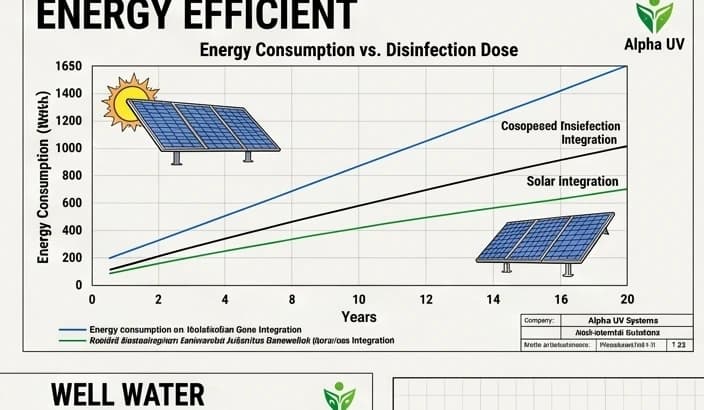
- Consider solar power for remote or off-grid applications: A 6–25W UV system for residential use can be powered by a 50–100W solar panel with a small battery buffer, eliminating grid electricity cost entirely for rural or off-grid installations.
- Maintain pre-filtration to reduce turbidity: High turbidity in source water does not increase lamp wattage, but it does require a higher UV dose to achieve pathogen kill, which may necessitate slower flow rates or a larger (higher-wattage) system. Keeping pre-filtration in good condition ensures you get full disinfection performance from the installed lamp power.
Frequently Asked Questions
How much electricity does a home UV water system use per month?
A residential 500 LPH UV system with an 11W Philips UV-C lamp running continuously uses 0.264 kWh per day, or 7.9 kWh per month. At ₹8/kWh, this costs approximately ₹64 per month for 24-hour continuous operation. Running the system 12 hours per day (sufficient for most households) halves this to approximately ₹32 per month. Either figure confirms that are UV water systems energy efficient is answered with a clear yes for home use — the cost is comparable to charging a laptop daily.
Should I run my UV system 24/7 or switch it off when not in use?
For residential systems (6–25W), continuous 24/7 operation is recommended. The electricity cost of continuous operation is negligible (₹32–₹64 per month), and frequent on-off cycling shortens lamp life by stressing the electrode on each startup. Turning a residential UV system off overnight saves at most ₹30–₹50 per year in electricity while potentially shortening a ₹1,500–₹2,500 lamp's life by 15–30%. For systems of 3,000 LPH and above, flow-sensor control with a time-delay shutdown provides meaningful savings when usage is intermittent and predictable.
Is UV more energy efficient than RO?
Yes, significantly. UV vs RO energy consumption favours UV by approximately 20:1 on a per-litre-of-safe-water basis. A 500 LPH UV system at 11W produces 0.022 Wh per litre of treated water. A comparable RO system uses 110–130W and produces only 250 litres of product water per hour (due to 50% reject), making its effective energy consumption 0.44 Wh per litre of product — roughly 20 times higher. UV also wastes zero water, while RO wastes 30–50% of input. The annual electricity cost difference is approximately ₹7,000–₹8,000 in favour of UV for a residential-scale comparison.
Can a UV water system run on solar power?
Yes. UV systems are well-suited to solar power because their electricity draw is constant and low — a residential 6–25W system can run on a single 50–100W solar panel with a small 12V or 24V battery buffer for cloudy days. The DC ballasts available for many UV systems (particularly smaller units) allow direct solar operation without an inverter, improving overall system efficiency. UV's compatibility with solar power makes it the preferred off-grid water disinfection technology in rural India, where grid supply may be unreliable and UV disinfection energy cost India from solar approaches zero per kWh once the panel is installed.
Do LED UV systems use less electricity than conventional lamp UV systems?
UV-C LED systems are available and use less electricity per watt of UV output in some configurations, but they currently cost significantly more than mercury-vapour UV-C lamp systems at equivalent dose delivery for water treatment applications. Conventional Philips UV-C lamp-based systems remain the cost-optimal choice for most water treatment applications in 2026 because lamp efficiency, dose delivery, and total ownership cost are better established. UV-C LED technology is improving rapidly and may become cost-competitive within the next 3–5 years, particularly for small-flow residential applications.
What does UV disinfection cost per cubic metre at industrial scale?
At industrial scale, UV disinfection energy cost India is extremely competitive. A 10,000 LPH system at 200W costs approximately ₹0.067 per cubic metre of treated water at ₹8/kWh. A 50,000 LPH system at 1,500W costs approximately ₹0.10 per cubic metre. These figures are typically 5–15 times lower than the electricity cost per cubic metre for equivalent RO treatment and 100+ times lower than thermal treatment alternatives. When lamp replacement and maintenance are added, total UV treatment cost at industrial scale typically ranges from ₹0.50 to ₹2.00 per cubic metre — still far below most competing disinfection technologies that achieve equivalent log reductions.
Conclusion
The evidence across every system size, every comparison technology, and every application scale reaches the same conclusion: are UV water systems energy efficient — yes, they are among the most energy-efficient pathogen-removal technologies available. At residential scale, a 500 LPH system costs ₹64 per month to run continuously while treating all water in a household. At commercial scale, 200W treats 10,000 litres per hour at ₹0.067 per cubic metre. At industrial scale, UV disinfection energy cost India per litre is measured in fractions of a paisa.
UV does not reduce TDS or remove dissolved chemicals — if your source water has these concerns, a combined UV-plus-RO approach is appropriate, and UV system power consumption adds only marginally to the RO system's existing draw. But for the specific task of eliminating microbial pathogens from water, no other technology delivers the combination of complete effectiveness, zero chemical residual, and near-minimal electricity consumption that UV provides.
If you are evaluating UV system electricity consumption India for a specific flow rate or application — residential, commercial, food processing, pharmaceutical, or municipal — our team can specify the most energy-efficient configuration for your flow rate, source water quality, and operating schedule.
WhatsApp our team at +91 93183 05878 with your flow rate and application type. We will provide a complete UV system power consumption calculation, annual electricity cost estimate, and system recommendation at no charge.
Standards, authorities & further reading
External references used to inform this guide. Regulations evolve — check the latest revision on each authority's site before compliance decisions.
Recommended UV Systems
Alpha UV System products for this application — powered by genuine Philips UV-C lamps.
Commercial UV Water Purification System
500 – 5,000 LPH
HACCP-compliant UV water purification for hotels, restaurants, and offices
Industrial UV Water Treatment System
5,000 – 50,000 LPH
Schedule M 2025 and HACCP compliant UV for pharma, food & beverage, and process water
Not sure which system suits your application? WhatsApp our engineers for a free recommendation →
Need a UV system?
Talk to our UV engineers — WhatsApp for a quote in 2 hours, or browse the full catalog on IndiaMART.