Quick Answer: UV Water System Flow Rate and Capacity
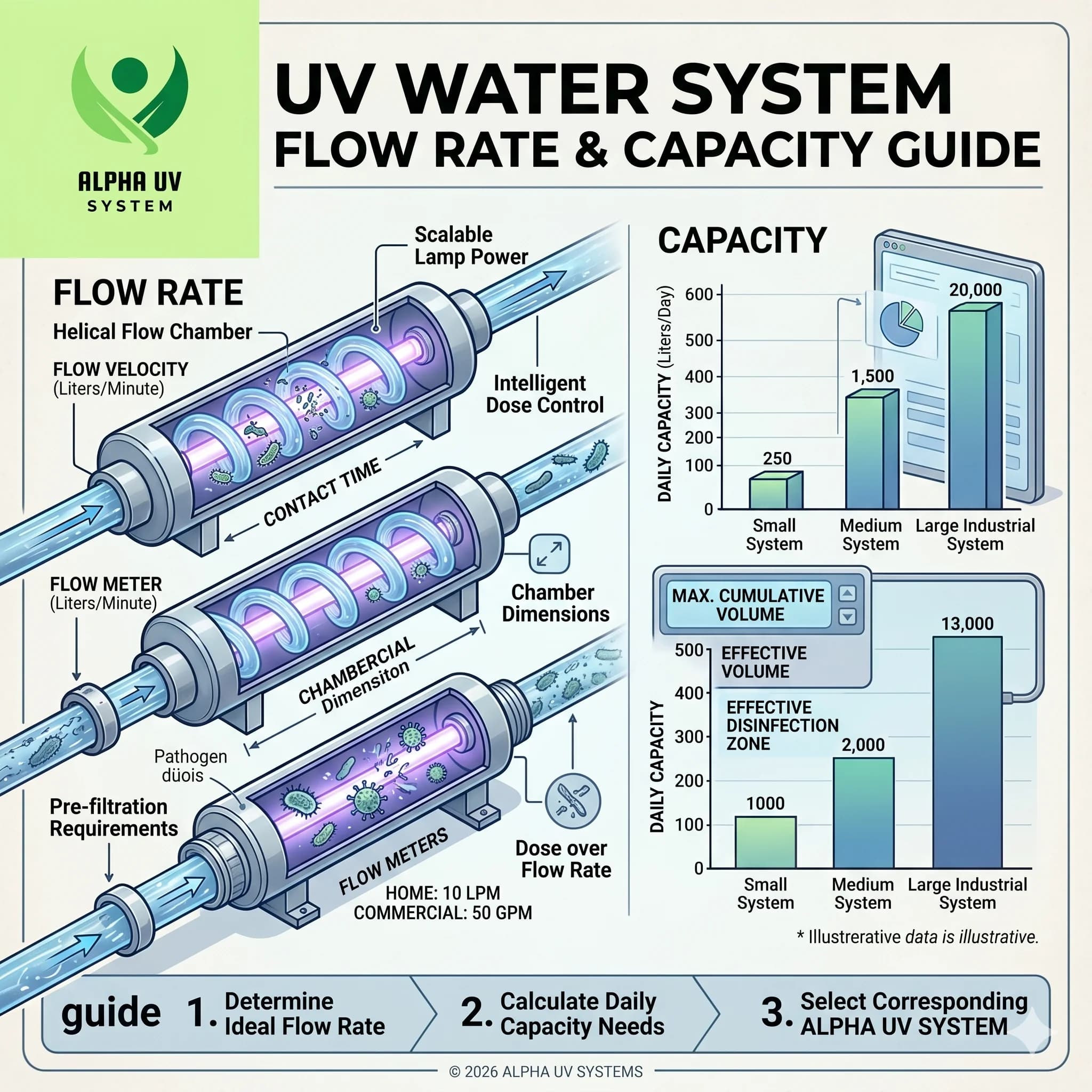
This UV water system flow rate capacity guide covers everything you need to select the right system size for any application in India. UV disinfection systems are available from 100 LPH for a single household kitchen tap all the way to 5,00,000 LPH (500 KLD) for large municipal water treatment plants. The rated flow rate — the number printed on the nameplate — is not an average or a guideline. It is the maximum flow at which the system delivers the required minimum UV dose of 40 mJ/cm². Exceed that flow and the UV dose falls below the minimum threshold, which means pathogens may survive treatment.
Two critical rules govern UV system sizing:
- Under-sizing: If your actual peak demand exceeds the rated flow, water passes through the chamber too quickly, UV exposure time is insufficient, and you get pathogen breakthrough. The system appears to be working — lamps are lit — but the water is not fully disinfected.
- Over-sizing: If you buy a system far larger than your actual demand, you spend more capital than necessary and lamps may age out before their rated hours are reached due to low utilisation cycles.
The goal of this UV water system flow rate capacity guide is to help you size accurately: match your peak demand, add the right safety margin, and select a configuration that fits your application.
Why UV Dose and Flow Rate Are Linked — The Physics
Understanding how to size a UV water system for any application starts with understanding the fundamental physics of UV disinfection. The UV dose delivered to water is defined as:
UV Dose (mJ/cm²) = UV Intensity (mW/cm²) × Exposure Time (seconds)
The UV intensity at any point in the chamber is determined by the lamp wattage, the quartz sleeve transmission efficiency, the chamber diameter, and — critically — the UV transmittance (UVT) of the water being treated. For a given system installed on a given water source, intensity is essentially fixed. What changes with flow rate is the exposure time:
Exposure Time (s) = Chamber Volume (litres) ÷ Flow Rate (LPS)
When you increase the flow rate above the rated value, exposure time decreases proportionally. Because UV intensity stays the same but contact time falls, the dose delivered to each unit of water falls below 40 mJ/cm². This is why the rated flow in this UV water system flow rate capacity guide is treated as a hard upper limit, not a nominal operating point.
Dose vs Flow Rate — What Happens at Different Flow Levels
The following table shows the UV dose delivered at various fractions of a system's rated flow rate, and the practical risk at each level. These figures assume a 40 mJ/cm² design dose at rated flow and a constant UV intensity (UVT and lamp output unchanged).
| Flow Rate (% of Rated) | Example: Rated 1,000 LPH | UV Dose Delivered | Practical Risk |
|---|---|---|---|
| 50% of rated | 500 LPH | ~80 mJ/cm² | None — over-disinfection. Harmless but doses are well above requirement. No operational concern. |
| 100% of rated | 1,000 LPH | 40 mJ/cm² | None — design dose delivered. Full disinfection confirmed at this exact flow. |
| 150% of rated | 1,500 LPH | ~27 mJ/cm² | Moderate risk — dose is below 40 mJ/cm² minimum. Resistant organisms (Cryptosporidium, adenovirus) may survive. Not acceptable for drinking water. |
| 200% of rated | 2,000 LPH | ~20 mJ/cm² | High risk — significant pathogen breakthrough. E. coli and common bacteria may survive at this dose level. System is effectively under-treating. |
The 150% and 200% scenarios are not hypothetical — they occur in the field when system sizing is based on average demand rather than peak demand, or when a pump is upgraded after the UV system is installed. This UV water system flow rate capacity guide specifically addresses how to avoid both scenarios.
How to Measure Your Actual Flow Rate
Before selecting a UV system, measure the actual flow rate at your installation point during peak demand — not at a tap but at the point where the UV system will be installed (main inlet, overhead tank outlet, pump discharge). The bucket method is the most reliable field measurement approach:
- Get a calibrated 10-litre bucket (most hardware stores sell them with litre markings)
- Open the valve or tap at the installation point to its normal operating position
- Time how many seconds it takes to fill the bucket to the 10-litre mark
- Repeat three times and take the average
Calculate flow rate using:
Flow Rate (LPH) = (10 ÷ Time in seconds) × 3,600
Example: If the bucket fills in 18 seconds: (10 ÷ 18) × 3,600 = 2,000 LPH. Your UV system must be rated at least 2,000 LPH at this installation point, and with a 20–25% safety margin, you should select a 2,500 LPH or standard 3,000 LPH unit.
For borewell-fed systems, note that the borewell pump's maximum output flow rate is your sizing ceiling — the UV system must be able to handle the full pump output at maximum discharge.
Peak Demand vs Average Demand — Always Size for Peak
One of the most common sizing mistakes covered in this UV water system flow rate capacity guide is calculating average daily consumption and dividing by operating hours. That method produces an average demand figure — which is almost always lower than peak demand, and therefore always the wrong number to use for sizing.
Consider a typical Indian middle-class household in a 3 BHK flat:
- Morning rush (6:00–8:30 AM): Two bathrooms simultaneously, kitchen, washing — 3 taps open at the same time, each at 10 LPM. Peak instantaneous demand: 30 LPM = 1,800 LPH.
- Evening: One bathroom, kitchen — 2 taps. Peak instantaneous demand: 20 LPM = 1,200 LPH.
- Overnight: Near-zero consumption.
Average hourly demand across 24 hours might calculate to 400–600 LPH. But the UV system must treat water at 1,800 LPH during the morning peak — or water will pass through faster than the chamber can disinfect it. For this household, the correct UV system size is a 2,000 LPH or 3,000 LPH unit, not a 500 LPH unit that "covers daily average".
For apartment complexes and commercial buildings, peak demand typically occurs during 7:00–9:00 AM and 6:00–9:00 PM. Sizing must account for the coincident peak — the number of outlets simultaneously active during those windows, not the total number of outlets in the building.
Application Capacity Table — UV System LPH Sizing India
This table is a starting reference for UV system LPH sizing India. Actual sizing requires measuring your specific peak flow rate using the bucket method or pump data sheet. Always add a 20–25% safety margin to the calculated demand before selecting a standard system size.
| Application | Typical Peak Flow (LPM) | Recommended UV System (LPH) | Alpha UV Product Category |
|---|---|---|---|
| Single kitchen tap (municipal supply) | 3–5 LPM | 100–300 LPH | Residential compact |
| 1 BHK flat — whole house (2 occupants) | 8–12 LPM | 500–750 LPH | Residential standard |
| 2 BHK flat — whole house (4 occupants) | 15–20 LPM | 1,000–1,500 LPH | Residential standard |
| 3 BHK flat / large apartment (5–6 occupants) | 25–35 LPM | 2,000–3,000 LPH | Residential high-flow |
| Villa / bungalow / farmhouse | 30–50 LPM | 2,500–4,000 LPH | Residential / light commercial |
| Small restaurant / food stall / cloud kitchen | 20–40 LPM | 1,500–3,000 LPH | Commercial food grade |
| Hotel (20–50 rooms) | 60–120 LPM | 4,000–8,000 LPH | Commercial |
| Hotel (50–150 rooms) | 120–250 LPM | 8,000–16,000 LPH | Commercial multi-lamp |
| Apartment complex (50–100 flats) | 150–300 LPM | 10,000–20,000 LPH | Commercial multi-lamp |
| Office building (200–500 occupants) | 80–160 LPM | 5,000–10,000 LPH | Commercial |
| School / college campus | 100–300 LPM | 6,000–20,000 LPH | Commercial / institutional |
| Industrial plant / food processing | 200–800 LPM | 12,000–50,000 LPH | Industrial |
| Pharmaceutical plant (process water) | 80–500 LPM | 5,000–30,000 LPH | Pharma SS316L |
| STP / ETP tertiary disinfection | 500–3,000 LPM | 30,000–2,00,000 LPH | Industrial / open channel |
| Municipal water treatment plant | 3,000–8,500 LPM | 2,00,000–5,00,000 LPH | Open-channel municipal |
Residential UV System Sizing Guide — India
Residential UV disinfection capacity calculation in India depends on two variables: the number of occupants (which determines simultaneous outlet usage) and the water source (which determines the maximum available flow rate). This UV water system flow rate capacity guide recommends the following residential sizing approach:
1 BHK Flat (Municipal Supply)
A standard 1 BHK flat with 2 occupants on municipal corporation supply has a typical peak demand of 8–12 LPM at the main inlet. A 500 LPH UV system covers this comfortably with margin. If a water purifier (RO) is also installed, the RO pump draws water independently — check whether the UV is on the feed line to the RO or on the treated output. For kitchen tap-only treatment, 100–300 LPH is sufficient.
2 BHK Flat (Borewell Supply)
For a 2 BHK flat with borewell supply, the limiting factor is the borewell pump's maximum output — typically 1,000–1,500 LPH for a 0.5 HP submersible pump. A UV system rated at 1,500 LPH installed on the pump discharge line treats all water entering the overhead tank. If the pump is upgraded later to a 1 HP model (potentially 2,000–3,000 LPH output), the UV system becomes under-rated — a critical sizing consideration noted throughout this UV water system flow rate capacity guide.
Villa / Bungalow / Farmhouse
A villa with a borewell, overhead tank, garden irrigation, and multiple bathrooms typically needs a 2,500–5,000 LPH UV system on the main supply line. Garden drip irrigation does not require disinfected water, so if irrigation is on a separate line, the UV system can be sized for the domestic supply only — reducing the required capacity significantly.
Apartment Complex / Housing Society
For apartment complexes, UV disinfection capacity calculation should be based on coincident peak demand — typically 60–70% of total flats using water simultaneously during morning rush at 10–15 LPM each. A 100-flat society with 70% coincidence at 12 LPM per flat has a peak demand of 840 LPM = 50,400 LPH. Round up to 60,000 LPH with safety margin. This scale typically requires multi-lamp systems and in some cases open-channel configuration.
Commercial UV System Sizing Guide
Commercial UV flow rate calculation India requires a different approach from residential sizing because occupancy patterns and water use norms vary significantly by application type.
Hotels
Hotel water demand is typically calculated at 200–300 litres per room per day for a mid-range property, and 400–500 litres per room per day for a 5-star property. Peak demand occurs during morning checkout (7:00–10:00 AM) when multiple rooms are simultaneously using bathrooms and the kitchen is at full production. For a 100-room hotel at 300 L/room/day with peak demand at 15% of daily consumption occurring in a 2-hour morning window: (100 rooms × 300 L × 15%) ÷ 120 minutes = 37.5 LPM per hour, meaning peak instantaneous demand can reach 150–200 LPM. Select a UV system rated at 12,000–15,000 LPH with 20% margin.
Restaurants
A restaurant kitchen uses water for food preparation, dishwashing, staff consumption, and toilet facilities. Typical water demand for a 50-cover restaurant is 25–40 LPM during service. A 3,000 LPH UV system on the kitchen supply line with a dedicated UV water system flow rate capacity guide sizing check is appropriate for this scale. Large banquet or catering operations may need 5,000–10,000 LPH.
Schools and Colleges
Educational institutions have sharply peaked demand during school hours, particularly at break times. Calculate demand as: (number of students × 5 litres per break) ÷ 30 minutes (break duration) = LPM required. A 1,000-student school at 5 L per break over 30 minutes needs (5,000 L) ÷ (30 × 60 s) = 2.78 LPS = 167 LPM = 10,000 LPH. Select a 12,000 LPH UV system to include safety margin.
Industrial UV System Sizing Guide
Industrial UV disinfection capacity calculation starts not from occupancy but from production rate requirements.
Pharmaceutical Plants
In pharmaceutical facilities, water-for-injection (WFI) loops and purified water (PW) distribution loops have fixed flow rates determined by the loop design. The UV system must handle the full loop recirculation flow, which is typically 2–5× the point-of-use demand. Obtain the loop design flow rate from your engineering team and size the UV system to match — this is not a case for the bucket method. UV flow rate calculation India for pharma applications should always reference the P&ID loop flow specification.
Food Processing Plants
Food processing UV system capacity is typically tied to production line throughput. A beverage bottling line at 10,000 bottles per hour at 500 ml per bottle requires 5,000 litres per hour of treated water minimum — plus cleaning-in-place (CIP) water that may be on a separate UV circuit. For FSSAI compliance, the UV system must be rated for the peak process water demand, not average daily consumption.
STP and ETP Tertiary Disinfection
For sewage treatment plant (STP) and effluent treatment plant (ETP) tertiary UV disinfection, sizing is straightforward: the UV system capacity must equal or exceed the STP design flow rate in KLD converted to LPH. A 200 KLD STP requires a UV system rated at 200,000 LPH (2,00,000 LPH). For STP applications with variable influent flow, size for the design peak flow (typically 1.5–2× average daily flow for urban STPs).
Multi-Lamp UV Systems — When and Why
For flow rates above approximately 10,000–20,000 LPH, single-lamp UV chambers become physically impractical. A single low-pressure Philips UV-C lamp can only be manufactured to a certain active length — typically up to 1.5 metres for standard commercial units. To deliver adequate dose across a large chamber cross-section at high flow rates, multiple lamps are required.
Multi-lamp UV systems offer two significant advantages beyond simply achieving higher flow rates:
Redundancy Benefit
In a 4-lamp UV system, if one lamp fails, the remaining three lamps continue to provide treatment — at approximately 75% of rated dose. Depending on the dose margin built into the system design, this may still exceed the minimum 40 mJ/cm² required for safe disinfection. A monitoring system with low-UV alarms gives the facility time to replace the failed lamp (typically 24–48 hours from notification) without a complete shutdown. This redundancy benefit is one of the primary reasons multi-lamp systems are specified for critical applications such as hospitals, pharmaceutical plants, and municipal supply.
Lamp Failure Impact by Configuration
| System Configuration | Rated Flow (LPH) | Dose at Full Flow | Dose if 1 Lamp Fails | Safe to Operate? |
|---|---|---|---|---|
| Single-lamp | 5,000 | 40 mJ/cm² | 0 mJ/cm² | No — full shutdown required |
| 2-lamp parallel | 10,000 | 40 mJ/cm² | ~20 mJ/cm² | No — reduce flow to 50% of rated |
| 4-lamp parallel | 20,000 | 40 mJ/cm² | ~30 mJ/cm² | Marginal — reduce flow 25% as precaution |
| 6-lamp parallel | 30,000 | 40 mJ/cm² | ~33 mJ/cm² | Short-term acceptable; replace promptly |
Open-Channel vs Closed-Vessel — The 50,000 LPH Threshold
Closed-vessel UV systems (pressurised stainless steel chambers) are the standard configuration for all residential, commercial, and most industrial UV disinfection capacity calculation purposes — up to approximately 50,000 LPH. Above this threshold, open-channel UV systems become technically and economically superior for several reasons:
- Pressure limitations: At very high flow rates, the hydraulic pressure drop across a closed-vessel chamber becomes prohibitive — requiring much larger pumps and generating excess heat.
- Maintenance access: Open-channel systems allow lamp access without dewatering or depressurising the system — critical for municipal plants that cannot interrupt supply.
- Expandability: Open-channel systems can be expanded by adding lamp banks to an existing channel without replacing the entire chamber — matching capacity growth without capital replacement.
- Cost at scale: At 2,00,000–5,00,000 LPH, open-channel systems cost 30–50% less per KLD of capacity than equivalent closed-vessel systems.
Open-channel UV systems are the standard in municipal water treatment plants globally and are appropriate for any STP or municipal application above 500 KLD in India.
Pre-Treatment and UVT Impact on Effective UV System Capacity
The rated flow rate on a UV system nameplate assumes a specific UV transmittance (UVT) of the water — typically 95% UVT for drinking water applications. When the actual water UVT is lower, the effective rated capacity of the system is reduced. This is one of the most overlooked factors in UV disinfection capacity calculation India.
UVT measures what percentage of UV-C light passes through a 10 cm column of the water. At 95% UVT, nearly all UV-C reaches across the chamber. At 75% UVT (typical for turbid borewell water or poorly filtered surface water), a significant fraction of UV-C is absorbed before reaching the far side of the chamber — meaning the effective intensity seen by water flowing near the chamber wall is much lower, reducing effective dose.
| Water UVT (%) | Water Type (Typical India) | Effective Capacity vs Rated | Pre-Treatment Requirement |
|---|---|---|---|
| 95%+ | Municipal treated supply, RO permeate | 100% — rated flow applies | 5-micron pre-filter only |
| 85–95% | Good borewell, filtered surface water | ~90% of rated flow | 10-micron + activated carbon recommended |
| 75–85% | Poor borewell, river water | ~75% of rated flow | Multi-media + carbon filtration required |
| Below 75% | High-turbidity, iron-heavy water | Below 60% — not suitable without treatment | Full pre-treatment train mandatory |
If your water has UVT of 80%, size your UV system at 125% of your measured peak demand (inverse of the 0.80 UVT factor) to compensate. This is in addition to the standard 20–25% safety margin. For any UV system application where the water source is a borewell or surface water, measure UVT before finalising the sizing — Alpha UV System's engineering team can advise on UVT testing methods and pre-treatment requirements.
Safety Margin — Always Add 20–25% Above Calculated Demand
Every UV water system flow rate capacity guide recommendation in this document includes a safety margin. The standard practice is to add 20–25% to your calculated peak demand before selecting a system. Here is why each component of this margin matters:
- Measurement variation: The bucket method gives a point-in-time measurement. Actual peak demand may be higher on certain days (guests, festivals, simultaneous laundry + bathing + cooking).
- Lamp ageing: UV lamp output declines over the lamp's rated 9,000-hour life. A new lamp delivers 100% rated output; at end of life it delivers approximately 80–85%. The system must still deliver full dose at the end of the lamp's life.
- Quartz sleeve fouling: Even with a cleaning wiper, quartz sleeve transmission declines between cleaning intervals — reducing effective intensity and therefore effective dose at rated flow.
- Future demand growth: Adding family members, commissioning additional bathrooms, or installing an additional tap point all increase peak demand. A 20% margin absorbs minor growth without requiring an immediate upgrade.
Common UV System Sizing Mistakes
This UV water system flow rate capacity guide documents the most frequent sizing errors encountered in the Indian market:
Mistake 1: Sizing for Average Demand, Not Peak Demand
Calculating total daily water use and dividing by 24 hours gives average hourly demand — which is typically 30–50% of peak hourly demand. A UV system sized on average demand will be undersized for every peak demand event, delivering below-standard UV dose during the hours when the most water is being consumed.
Mistake 2: Ignoring Borewell Pump Flow Rate
For borewell-fed systems, the UV system must be rated to handle the full discharge flow of the pump. If a 1 HP borewell pump discharges at 3,000 LPH and the UV system is only rated at 1,500 LPH, half the water bypasses at full dose — or worse, all water passes through at half the dose if the plumbing does not allow bypass. Always match UV system capacity to the pump's maximum discharge, not to household consumption.
Mistake 3: No Redundancy Planning for Critical Applications
For hospitals, pharmaceutical plants, food processing facilities, and municipal supply applications, installing a single UV system with no standby creates a single point of failure. If the system goes offline for lamp replacement or maintenance, the facility either shuts down treated water supply or runs without UV disinfection. Critical applications should specify either a parallel standby UV system or multi-lamp configuration with documented lamp failure protocols.
Mistake 4: Not Accounting for Water UVT
Assuming the rated flow applies to borewell or surface water without measuring UVT is one of the most common causes of field sizing failures. A system rated at 5,000 LPH for 95% UVT water may only effectively treat 3,500 LPH at 80% UVT. UVT testing takes less than 10 minutes with a simple photometer — it should be standard practice in any UV disinfection capacity calculation for non-municipal water sources.
Mistake 5: Upgrading the Pump After Installing the UV System
When a pump is upgraded to a higher-horsepower model after the UV system is already installed, the new pump's higher discharge flow rate will exceed the UV system's rated capacity. This happens regularly in apartment buildings and industrial facilities. When planning a pump upgrade, always verify that the existing UV system can handle the new pump's discharge flow — or plan to upgrade the UV system simultaneously.
How Alpha UV System Sizes Your UV System
Alpha UV System's engineering team follows a structured UV disinfection capacity calculation process for every project, whether it is a 500 LPH residential unit or a 2,00,000 LPH industrial system:
- Application identification: Drinking water, process water, STP effluent, or HVAC — each has a different required UV dose and material specification.
- Flow rate verification: Request the actual pump data sheet or conduct an on-site bucket method measurement during peak demand hours. Never accept "estimated" figures for system sizing.
- Water quality assessment: UVT measurement, iron and manganese levels (which cause quartz fouling), turbidity (which requires pre-filtration), and hardness (which affects pre-filter sizing).
- Dose selection: 40 mJ/cm² for drinking water, 40–100 mJ/cm² for industrial process water, 30–40 mJ/cm² for STP tertiary treatment per CPHEEO norms.
- Safety margin application: Standard 25% margin on top of peak demand, plus UVT correction factor if applicable.
- Configuration recommendation: Single-lamp, multi-lamp, or open-channel based on the calculated flow rate and application criticality.
- Pre-treatment specification: Filter train sized to maintain water quality at or above the UVT assumed in the UV system sizing — because a UV system is only as effective as the water entering it.
For a sizing consultation, WhatsApp +91 93183 05878 with your application type, water source, and measured or estimated peak flow rate. Alpha UV System responds to all technical enquiries with a written sizing recommendation.
Frequently Asked Questions
Can I increase the flow rate of my existing UV system?
No. The rated flow rate of a UV system is fixed by the lamp power output and the chamber geometry — both of which are fixed at manufacture. Operating above rated flow reduces UV dose below the minimum safe threshold. If your demand has grown beyond your system's rated flow, the correct solution is to upgrade to a higher-capacity system or install an additional UV unit in parallel. Do not simply run the existing system above its rated flow and assume it is still treating water adequately — the lamps will appear lit and the system will appear operational while delivering insufficient UV dose.
What happens if water flows above the rated flow rate?
Water passes through the UV chamber faster than the design allows, reducing the UV exposure time. Since UV dose = intensity × time, a shorter exposure time means a lower delivered dose. At 150% of rated flow, dose falls to approximately 27 mJ/cm² — below the 40 mJ/cm² minimum for drinking water disinfection. At 200% of rated flow, dose falls to approximately 20 mJ/cm², at which level many pathogens including E. coli survive treatment. The system gives no visible indication of this failure — the lamp remains lit, the flow indicator shows flow, but the water is not being adequately disinfected.
How many LPH does an Indian household need?
It depends on the house type, number of occupants, and water source. As a general reference for UV system capacity for home India: a 1 BHK flat with municipal supply needs 500–750 LPH; a 2 BHK flat with borewell supply needs 1,000–1,500 LPH (or match the pump discharge); a 3 BHK flat or villa needs 2,000–3,000 LPH for whole-house treatment. For kitchen-tap-only treatment, 100–300 LPH is sufficient in any household. Use the bucket method during morning peak hours to measure your specific peak flow before purchasing.
What is the largest UV system Alpha UV System supplies?
Alpha UV System designs and supplies closed-vessel UV systems up to 2,00,000 LPH for STP, industrial, and large commercial applications. For municipal water supply projects requiring 2,00,000–5,00,000 LPH and above, open-channel UV systems are engineered to site-specific flow requirements. For large-scale municipal projects, contact the Alpha UV System engineering team via WhatsApp +91 93183 05878 or call +91 95995 00580 for a project-specific consultation.
My borewell pump says 1 HP — what LPH does that mean?
Pump horsepower alone does not determine discharge flow rate — head pressure, pipe diameter, and pump curve characteristics all affect actual discharge. A 0.5 HP submersible borewell pump typically discharges 800–1,500 LPH at typical residential head pressures. A 1 HP pump typically discharges 1,500–2,500 LPH. A 1.5 HP pump may discharge 2,500–4,000 LPH. However, these are approximate ranges — always measure using the bucket method at the pump discharge point, or obtain the pump manufacturer's performance curve at your site's static head. Size your UV system to the measured maximum discharge, not the nameplate horsepower.
How does water UVT affect my UV system capacity?
UVT (UV transmittance) directly affects the intensity of UV-C light that reaches water flowing through the outer portions of the UV chamber. At 95% UVT, the rated flow on the nameplate applies directly. At 85% UVT, the effective safe capacity is approximately 90% of rated. At 75% UVT, effective capacity drops to approximately 75% of rated — meaning a 10,000 LPH system should only be operated at 7,500 LPH maximum on 75% UVT water. Pre-filtration (multimedia filter + activated carbon) can raise UVT significantly, often from 75–80% up to 90–95%, restoring the full rated capacity. For any application on borewell or surface water, measure UVT before finalising sizing. Alpha UV System can advise on both UVT measurement and the pre-treatment train required to achieve target UVT.
Conclusion
This UV water system flow rate capacity guide has covered the complete picture of UV system LPH sizing India — from the physics of how UV dose relates to flow rate, to the bucket method for measuring your peak demand, to the specific sizing considerations for residential, commercial, industrial, and STP applications across India. The most important takeaway is that the rated flow rate is a hard engineering limit, not a nominal figure, and sizing must always be based on measured peak demand rather than average consumption.
Key rules from this UV water system flow rate capacity guide: always measure flow at the installation point during morning peak hours; add 20–25% safety margin to your measurement; account for water UVT if your source is borewell or surface water; size multi-lamp systems for any application above 10,000–20,000 LPH; and plan for open-channel configuration at 50,000 LPH and above.
Alpha UV System's engineering team sizes UV systems across all capacity ranges for customers across India and internationally. For a no-obligation sizing consultation for your specific application, WhatsApp +91 93183 05878 or call +91 95995 00580 with your application type, water source, and flow rate requirement.
Standards, authorities & further reading
External references used to inform this guide. Regulations evolve — check the latest revision on each authority's site before compliance decisions.
Recommended UV Systems
Alpha UV System products for this application — powered by genuine Philips UV-C lamps.
Commercial UV Water Purification System
500 – 5,000 LPH
HACCP-compliant UV water purification for hotels, restaurants, and offices
Industrial UV Water Treatment System
5,000 – 50,000 LPH
Schedule M 2025 and HACCP compliant UV for pharma, food & beverage, and process water
Not sure which system suits your application? WhatsApp our engineers for a free recommendation →
Need a UV system?
Talk to our UV engineers — WhatsApp for a quote in 2 hours, or browse the full catalog on IndiaMART.