Quick Answer
Can I use UV on cloudy turbid water?
No — UV disinfection does not work reliably on cloudy or turbid water. UV-C light cannot penetrate suspended particles, and pathogens can shelter inside particle aggregates completely beyond UV reach. Water must be below 1 NTU turbidity with UV transmittance above 75% before entering the UV chamber. A 5-micron sediment pre-filter solves this for most Indian households and commercial users.
Why UV Cannot Disinfect Turbid Water
The most common question we receive from buyers in UP, Bihar, Maharashtra, and Delhi is: can I use UV on cloudy turbid water directly, without any pre-treatment? The answer is no — and understanding why matters before you invest in a UV system.
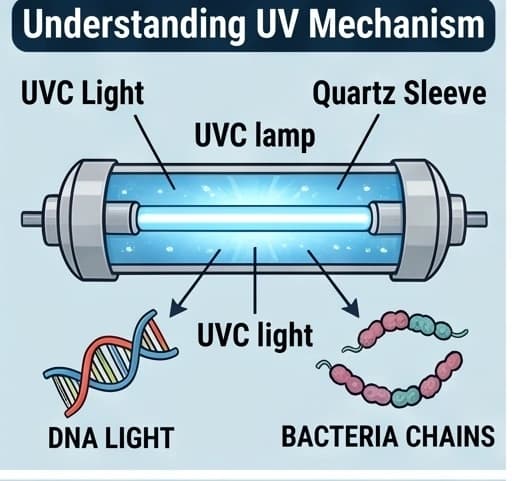
UV disinfection works through a single mechanism: UV-C photons at 254 nm must physically strike the DNA of a pathogen and cause damage severe enough to prevent reproduction. If those photons never reach the pathogen, the water passes through the UV chamber completely unprotected — even while the lamp glows at full power.
In turbid water, four things go wrong simultaneously:
- Suspended particles absorb UV-C before the light reaches pathogens further into the water column. Every soil aggregate, iron floc, and organic particle competes with pathogens for UV-C photons — and wins, because particles are larger and far more numerous.
- Suspended particles scatter UV-C in all directions, reducing the straight-line dose that travels toward pathogens in the bulk water. Scattering reduces effective path length and therefore dose delivery.
- Pathogens physically hide inside particle aggregates. A Cryptosporidium oocyst or Giardia cyst lodged inside a 10-micron soil clump is completely shielded from UV-C. The particle absorbs all incident UV-C before it reaches the pathogen at the core. No amount of lamp power overcomes this geometric shielding.
- UV failure is invisible. The UV lamp continues to illuminate. Water flows through normally. There is no alarm, no odour, no colour change. Turbid water treated by UV looks exactly like safe water — but it is not.
This is why asking can I use UV on cloudy turbid water without understanding the physics leads to a dangerous false sense of security. The system appears to work, but disinfection is incomplete.
UV Transmittance (UVT) — The Key Measurement
The engineering parameter that governs whether you can use UV on cloudy turbid water is UV Transmittance (UVT) — the percentage of UV-C light that passes through a 1 cm column of water at 254 nm.
- UVT 100% means perfectly clear water — every photon passes through. You can use UV on cloudy turbid water only when it has been pre-treated to approach this range.
- UVT 0% means completely opaque water — no photons pass through.
- Standard UV disinfection systems are rated at UVT 75%. Below this threshold, the dose delivered at the rated flow rate drops sharply and pathogen inactivation becomes unreliable.
UVT and turbidity (NTU) are directly linked. As NTU rises, UVT falls. The relationship is not perfectly linear — it depends on particle type, dissolved organics, and iron content — but the general correspondence is consistent enough to use NTU as a practical field indicator of whether you can use UV on cloudy turbid water safely.
The table below shows how turbidity affects UV dose and disinfection safety:
| Turbidity (NTU) | Typical UVT | UV Dose at Rated Flow | Disinfection Status |
|---|---|---|---|
| Below 0.5 NTU | 90–100% | 40 mJ/cm² | Fully effective |
| 0.5–1 NTU | 80–90% | 36–40 mJ/cm² | Effective — within specification |
| 1–5 NTU | 65–80% | 25–35 mJ/cm² | Marginal — some pathogen survival possible |
| 5–10 NTU | 50–65% | 15–25 mJ/cm² | Inadequate — significant pathogen risk |
| Above 10 NTU | Below 50% | Below 15 mJ/cm² | Dangerous — UV effectively non-functional |
The WHO guideline for drinking water UV disinfection requires a minimum delivered dose of 40 mJ/cm² to achieve 4-log (99.99%) inactivation of bacteria and viruses, and 3-log (99.9%) inactivation of Cryptosporidium. At NTU above 5, no standard residential UV system achieves this threshold at its rated flow rate. So the answer to can I use UV on cloudy turbid water above 5 NTU is clearly no — not without pre-treatment.
What Causes Turbidity in Indian Water Sources
Indian water quality varies dramatically by source, season, and region. Understanding your specific source is the first step in deciding whether you can use UV on cloudy turbid water as-is, or whether pre-treatment is needed.
- Municipal supply (Delhi, Mumbai, clear season): Post-treatment municipal water is usually below 1 NTU. With a 5-micron sediment pre-filter, you can use UV on this water directly in most clear-season months.
- Municipal supply (monsoon season): Treatment plant capacity can be overwhelmed during June–September peak monsoon, allowing turbidity of 2–10 NTU through the distribution network. You cannot use UV on cloudy turbid water from a monsoon-season municipal supply without enhanced pre-filtration in place.
- Borewell water in North India (UP, Bihar, Haryana): Typically 2–20 NTU depending on local geology and season. Often contains iron, which contributes additional turbidity through iron precipitate formation. You cannot use UV on cloudy turbid water from a borewell without a 5-micron sediment pre-filter at minimum; iron-bearing boreholes need an iron removal filter first.
- Water tankers: Quality is highly variable — drivers fill from different sources, and storage in the tanker adds sediment. Typical turbidity ranges from 5–50 NTU. You cannot use UV on cloudy turbid water from a tanker without staged pre-filtration.
- Open wells: Range from 5–100+ NTU, peaking sharply after monsoon rains wash surface soil into the well. Open well water during monsoon in Maharashtra and Bihar is among the highest-turbidity domestic water sources in India — you cannot use UV on cloudy turbid water from open wells without a full pre-treatment train.
- High-iron borewell water: Dissolved iron oxidises to ferric hydroxide when water is exposed to air, forming a red-brown floc that both increases turbidity and coats the UV quartz sleeve. This requires iron removal before sediment filtration before UV.
| Source | Typical Turbidity | UV-Ready Without Treatment? | Pre-treatment Needed |
|---|---|---|---|
| Delhi / Mumbai municipal (clear season) | 0.5–2 NTU | Borderline | 5-micron sediment filter |
| Delhi / Mumbai municipal (monsoon) | 2–10 NTU | No | Enhanced pre-filtration |
| North India borewell (no iron) | 1–5 NTU | No | 5-micron sediment filter |
| North India borewell (high iron) | 5–20 NTU | No | Iron filter + sediment |
| Water tanker | 5–50 NTU | No | Coagulation + sediment |
| Open well (dry season) | 2–15 NTU | No | Sediment + possible carbon |
| Open well (monsoon) | 20–200 NTU | No | Full pre-treatment train |
How Pre-Filtration Solves the Turbidity Problem
Once you understand that you cannot use UV on cloudy turbid water without pre-treatment, the practical question becomes: what pre-treatment is needed, and how complex is it? The good news is that for most users in India asking can I use UV on cloudy turbid water from my source, the answer involves only a simple sediment cartridge filter — not a complex multi-stage system.
For most Indian households and small commercial users, the answer is simpler than expected. A 5-micron sediment cartridge filter installed upstream of the UV chamber removes the suspended particles responsible for turbidity. This single step is sufficient to bring most municipal and lightly turbid borewell water below 0.5 NTU — well within the range where UV delivers a full 40 mJ/cm² dose.
The pre-treatment required scales with the turbidity of the incoming water. Use the following guide to identify what stands between your current source and the point where you can use UV on cloudy turbid water safely:
- Below 1 NTU (clear municipal): One 5-micron polypropylene cartridge filter. Cartridge replaced every 3–6 months. Cost: approximately ₹150–300 per cartridge. After this pre-filter, you can use UV on your water even in cloudy or turbid periods — the cartridge does the turbidity work.
- 1–5 NTU (lightly turbid borewell): One 5-micron cartridge, replaced more frequently (every 4–8 weeks depending on actual turbidity load). Sufficient to bring water below 0.5 NTU. You can use UV on cloudy turbid water from a lightly turbid borewell once this cartridge is in place.
- 5–20 NTU (turbid borewell or tanker): 10-micron cartridge followed by 5-micron cartridge in series. Two-stage filtration extends cartridge life and reliably achieves below 1 NTU output.
- Above 20 NTU (very turbid water, open well, monsoon runoff): Coagulation or flocculation stage (alum dosing) to agglomerate fine particles, followed by 10-micron and 5-micron cartridges in series. This three-stage approach can handle up to 200 NTU input and produce below 1 NTU output for UV entry. Only after this multi-stage treatment can I use UV on cloudy turbid water from a high-turbidity source.
- Any source with iron above 0.3 mg/L: Iron removal filter (greensand or birm media) placed before the sediment cartridge. This removes dissolved iron before it can oxidise and form turbidity-causing iron floc. Without this step, the 5-micron cartridge and quartz sleeve foul rapidly.
| Turbidity Level | Typical Source | Required Pre-treatment | Result |
|---|---|---|---|
| Below 1 NTU | Clear municipal | 5-micron sediment cartridge | UV-ready in all seasons |
| 1–5 NTU | Lightly turbid borewell | 5-micron sediment cartridge | UV-ready |
| 5–20 NTU | Turbid borewell or tanker | 10-micron + 5-micron in series | UV-ready |
| Above 20 NTU | Very turbid, open well, monsoon | Coagulation + 10-micron + 5-micron | UV-ready after multi-stage |
| Any, with iron above 0.3 mg/L | Borewell with iron | Iron filter + sediment | UV-ready, quartz sleeve protected |
Effect of Turbidity on the Quartz Sleeve
Even if you never asked can I use UV on cloudy turbid water and simply connected a UV system to a turbid source without pre-filtration, the quartz sleeve would tell you something is wrong within weeks — not through an alarm, but through accelerating fouling.
The quartz sleeve is the transparent tube that surrounds the Philips UV-C lamp inside the UV chamber. UV-C passes through this sleeve into the water. In clean water, a quartz sleeve stays clear for 3–6 months before it requires cleaning. In turbid water without pre-filtration, the same sleeve accumulates a layer of iron scale, calcium carbonate, and organic deposits within 2–4 weeks. This scale layer blocks UV-C transmission, reducing effective dose even further on top of the turbidity-caused reduction in the water itself. This is an additional reason why you cannot use UV on cloudy turbid water without pre-filtration — the sleeve compounds the dose shortfall over time.
The combined effect of turbid water and fouled quartz sleeve creates an extreme dose shortfall:
- A fouled sleeve reduces UV-C output through the sleeve by 20–60%.
- Turbid water simultaneously reduces UV-C transmission through the water by 25–50%.
- Together, effective dose can drop below 10 mJ/cm² — less than one-quarter of the WHO-required minimum — while the system appears to run normally.
Cleaning the quartz sleeve involves removing it from the chamber, soaking in a citric acid solution (one tablespoon of food-grade citric acid per litre of warm water) for 20–30 minutes, then rinsing before reinstalling. Without pre-filtration, this cleaning becomes a monthly task rather than a bi-annual one — adding labour and risk of sleeve damage during repeated removal. The practical cost of not pre-filtering runs to ₹500–2,000 per year in premature sleeve replacements and additional maintenance visits. Every buyer who asks can I use UV on cloudy turbid water without a pre-filter should factor this hidden maintenance cost into the calculation — it eliminates any perceived saving from skipping pre-filtration.
Monsoon Season — The Critical Period
The question can I use UV on cloudy turbid water during monsoon deserves a specific answer because the Indian monsoon (June–September) changes the turbidity picture dramatically for every source type.
During monsoon:
- Municipal supply turbidity rises as surface runoff overwhelms treatment plant capacity. Delhi and Mumbai distribution networks sometimes deliver water at 3–8 NTU during peak monsoon — above the 1 NTU threshold for safe UV use.
- Borewell and shallow groundwater turbidity increases 5–20x as surface water infiltrates through soil, carrying suspended particles. A borewell that reads 2 NTU in March may read 15–30 NTU in August in Bihar and eastern UP.
- Open well turbidity can reach 100–500 NTU within hours of a heavy rain event in Maharashtra and Odisha — completely beyond the range where UV has any meaningful effect.
- Pathogen load in all water sources peaks during monsoon — the exact period when the UV system is most stressed by reduced UVT.
Monsoon maintenance actions that must be taken for UV systems to remain effective:
- Replace the sediment pre-filter cartridge before monsoon (June) and once during monsoon (August) — not on a calendar schedule, but when pressure drop across the cartridge indicates clogging.
- Inspect and clean the quartz sleeve in October after monsoon ends, since iron and organic fouling rates are highest during the monsoon months.
- For tanker-fed systems in urban Maharashtra and Bihar, add a second pre-filter stage during monsoon if single-cartridge output exceeds 1 NTU.
- Conduct a visual turbidity check (clear glass against white background) daily during the first two weeks of monsoon to confirm pre-filtration is keeping up.
The answer to can I use UV on cloudy turbid water during monsoon without changing your pre-filter is definitively no — monsoon demands more frequent pre-filter maintenance, not less.
UV Dose Calculation with Reduced UVT
For technically inclined users evaluating whether they can use UV on cloudy turbid water at reduced flow rates as a workaround, this section provides the dose arithmetic. This is a common question: if the problem is insufficient dose, why not slow the water down to increase exposure time and compensate? The answer is that you can partially compensate — but cannot reliably solve — turbidity-driven dose shortfall through flow reduction alone.
UV dose is calculated as:
UV Dose (mJ/cm²) = Lamp UV-C Output (mW/cm²) × UVT factor × Exposure Time (seconds)
Exposure time is inversely proportional to flow rate — reducing flow rate by half doubles exposure time and therefore doubles dose. However, UVT is a multiplier on the entire dose, and its effect compounds the flow rate relationship.
| UVT | Flow at 100% Rated | Flow at 75% Rated | Flow at 50% Rated |
|---|---|---|---|
| 90% | 40 mJ/cm² — safe | 53 mJ/cm² — safe | 80 mJ/cm² — very safe |
| 75% | 33 mJ/cm² — marginal | 40 mJ/cm² — just safe | 60 mJ/cm² — safe |
| 60% | 27 mJ/cm² — unsafe | 33 mJ/cm² — marginal | 40 mJ/cm² — just safe |
| 45% | 20 mJ/cm² — dangerous | 25 mJ/cm² — unsafe | 33 mJ/cm² — marginal |
The table shows that reducing flow rate to 50% partially compensates for reduced UVT at 60%, bringing dose to the just-safe threshold. However, this approach is not a reliable solution for several reasons:
- Turbidity is not constant — it varies hour to hour and season to season. A flow restriction that works at 60% UVT provides inadequate dose when turbidity spikes and UVT drops to 45%.
- Particle shielding of pathogens is not addressed by any flow rate adjustment. Even at 40 mJ/cm² in the bulk water, pathogens inside particles remain shielded.
- Operating a UV system at reduced flow rate reduces throughput and creates a secondary pressure problem in the supply line.
The only reliable answer to can I use UV on cloudy turbid water is to remove the turbidity before the UV chamber — not to compensate for it after the fact with flow restriction.
Turbidity Testing — How to Know if Your Water Is UV-Ready
Before deciding whether you can use UV on cloudy turbid water from your specific source, test the turbidity. The decision to add pre-filtration — and what type — depends entirely on a measured NTU value, not a visual guess. Three testing methods are available at different cost and precision levels:
- Visual test (free): Fill a 500 mL clear glass with water and hold it against a plain white background in natural daylight. If the water is visibly hazy, cloudy, yellowish, or brownish, it is almost certainly above 2 NTU and requires pre-treatment. If the water is clear and colourless, it is likely below 2 NTU — but this visual check cannot distinguish between 0.3 NTU and 1.5 NTU, so it is not definitive.
- Portable turbidity meter (₹3,000–8,000): Handheld nephelometers give NTU readings to one decimal place. Suitable for commercial users, school systems, or community water points where regular monitoring is needed. Most cost-effective for ongoing operational monitoring of multiple sources.
- NABL-accredited laboratory test (₹200–500): A water sample submitted to a NABL lab returns a certified NTU value within 24–48 hours. This is the recommended approach before commissioning a UV system on a new water source — it provides a defensible baseline and typically includes UVT measurement alongside turbidity, giving both the NTU and the actual UVT at 254 nm for your specific water.
Target: water entering the UV chamber should be below 1 NTU. Below 0.5 NTU provides comfortable margin across all seasonal variations. Once pre-filtration brings your water below 0.5 NTU consistently, you can use UV on cloudy turbid water — because it is no longer cloudy or turbid by the time it enters the UV chamber. A single 5-micron sediment filter achieves this for most users year-round.
Frequently Asked Questions
My water looks clear but has a slight yellow tint — can I use UV on cloudy turbid water in this case?
A yellow tint with visual clarity is a different problem from particle turbidity. Yellow colour in clear water typically indicates dissolved humic acids (from decaying organic matter in soil) or dissolved iron at low concentration — both of which absorb UV-C strongly even when the water looks clear. So in this case you cannot use UV on cloudy turbid water — or apparently clear but coloured water — without treatment to remove the dissolved colour. A NABL lab test for colour (true colour, in Hazen units) and UVT at 254 nm will confirm whether the UV-C absorption is significant. Activated carbon filtration or coagulation-flocculation removes humic colour and improves UVT to safe levels before UV.
What turbidity NTU is acceptable for UV disinfection?
The WHO drinking water guideline and USEPA UV guidance both specify below 1 NTU as the acceptable turbidity before UV treatment. At 1 NTU, UVT is typically 80–85% and the 40 mJ/cm² dose is achievable. Below 0.5 NTU is preferable and provides performance headroom during seasonal variation. Above 1 NTU, UV dose delivery becomes progressively less reliable. Above 5 NTU, you should not use UV as the primary disinfection method without compensating system design.
My borewell water is clear in winter but cloudy in monsoon — what should I do?
This is a very common situation in UP, Bihar, and Haryana, where shallow boreholes interact with surface infiltration during monsoon. The correct approach is to size your pre-filtration for the worst-case monsoon turbidity, not the dry-season clarity. If your borewell reads 1 NTU in December and 12 NTU in August, you can use UV on that borewell water in December with a single 5-micron cartridge — but you cannot use UV on cloudy turbid water at 12 NTU without upgrading to a two-stage 10-micron + 5-micron filter rated for monsoon load. Replace cartridges more frequently during June–September. A system pre-filtered for the clear season will fail during the monsoon period — which is precisely when waterborne pathogen risk is highest.
Can I use UV on water from a water tanker?
Water tanker quality is too variable to use UV directly without testing and pre-treatment. Tankers fill from different sources, mix loads, and accumulate sediment in the tank. Turbidity from a tanker can range from 3 NTU to 50 NTU in the same week. So when buyers in Delhi NCR ask can I use UV on cloudy turbid water delivered by tanker, the answer is: yes, but only after staged pre-filtration. For tanker-fed systems in Delhi NCR, Maharashtra, and Bihar, the minimum pre-treatment is a 10-micron followed by 5-micron two-stage cartridge filter, changed frequently. For consistently high-turbidity tanker supply above 20 NTU, a coagulation pre-treatment stage is the most cost-effective solution before UV.
If I reduce the flow rate, can UV work on turbid water?
Reducing flow rate increases exposure time and therefore dose, which partially compensates for reduced UVT. However, this is not a reliable solution to the question of whether you can use UV on cloudy turbid water. Turbidity varies — a flow setting calibrated for 60% UVT is unsafe if UVT drops to 45% during a turbidity spike. More importantly, particle shielding of pathogens is unaffected by any flow rate — a pathogen inside a 10-micron particle aggregate receives zero UV-C dose regardless of how slow the flow. And crucially: even if you could use UV on cloudy turbid water by slowing the flow, you would not know when turbidity changed and made your compensated flow rate unsafe again. The correct solution is pre-filtration to remove turbidity before the UV chamber, eliminating the variable entirely.
How often should I replace the sediment pre-filter to maintain UV effectiveness?
Replacement frequency depends entirely on the turbidity load — not on a fixed calendar schedule. A 5-micron cartridge used on below 1 NTU municipal water typically lasts 3–6 months. The same cartridge on 5 NTU borewell water may need replacement every 4–6 weeks. The practical indicator is pressure drop: when water pressure after the filter drops noticeably, the cartridge is clogged and needs replacement. During monsoon, check pressure drop weekly. A clogged pre-filter means you effectively cannot use UV on cloudy turbid water safely anymore — the clogged cartridge allows turbid water to bypass through gaps as pressure builds, or the reduced flow from clogging changes the UV exposure time unpredictably. The pre-filter condition is as important as the UV lamp condition for maintaining safe disinfection.
If you are still uncertain whether you can use UV on cloudy turbid water from your specific source — or need help specifying the right pre-treatment train for your borewell, tanker supply, or monsoon-affected municipal connection — send us the details on WhatsApp. Share your water source type, approximate turbidity if known, and intended use (household, commercial, or industrial). Our team responds within 24–48 hours with a practical pre-treatment and UV system recommendation.
WhatsApp us for turbid water UV system advice
Standards, authorities & further reading
External references used to inform this guide. Regulations evolve — check the latest revision on each authority's site before compliance decisions.
Recommended UV Systems
Alpha UV System products for this application — powered by genuine Philips UV-C lamps.
Commercial UV Water Purification System
500 – 5,000 LPH
HACCP-compliant UV water purification for hotels, restaurants, and offices
Industrial UV Water Treatment System
5,000 – 50,000 LPH
Schedule M 2025 and HACCP compliant UV for pharma, food & beverage, and process water
Not sure which system suits your application? WhatsApp our engineers for a free recommendation →
Need a UV system?
Talk to our UV engineers — WhatsApp for a quote in 2 hours, or browse the full catalog on IndiaMART.