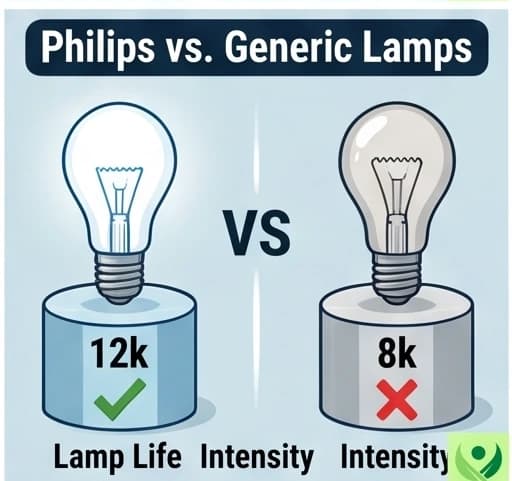
Philips UV lamps vs Chinese UV lamps: Philips TUV lamps offer 9,000-hour rated life with ±5% output consistency, a serial-number Certificate of Authenticity accepted by CDSCO and FSSAI auditors, and RoHS certification. Chinese OEM lamps offer 4,000–6,000 hour rated life with no third-party certified output data, no audit traceability, and no independently verified RoHS compliance. For any regulated water treatment application in India, Philips UV-C lamps are the only compliant choice.
Why the UV Lamp Is the Most Important Component in a UV System
Every UV water disinfection system is, at its core, a UV lamp delivery device. The stainless steel reaction chamber, the quartz sleeve, the flow sensor, the controller — all of these components exist for one purpose: to position water correctly relative to the lamp and ensure that lamp keeps operating at rated output. The lamp itself is the only component that actually disinfects. Every other part is infrastructure built around it.
This single fact makes the lamp choice the most consequential specification decision in any UV system procurement in India. When procurement managers, facility engineers, and pharma QA teams ask about Philips UV lamps vs Chinese UV lamps India, they are really asking a more fundamental question: will this system deliver the required UV dose reliably for its entire service life, and will it hold up under a regulatory audit?
The standard disinfection target for water treatment is 40 mJ/cm² — the dose required for 4-log reduction of pathogens including Cryptosporidium, Giardia, and E. coli. That dose is a function of lamp UV-C output at 253.7 nm, water flow rate, and the geometry of the reaction chamber. Change the lamp output — through degradation, inconsistency, or outright misrepresentation — and the system no longer delivers the required dose even if the flow rate and chamber design are unchanged.
In regulated applications — pharmaceutical water systems under CDSCO Schedule M, food processing water under FSSAI, drinking water under BIS IS 10500, or effluent treatment under CPCB — failing to deliver that dose is not a theoretical risk. It is an audit finding, a corrective action, and in pharmaceutical manufacturing, potentially a production hold. The entire conversation about Philips UV lamps vs Chinese UV lamps India starts and ends with this single engineering reality.
The Core Technical Differences: Certified Output, Consistency, and Rated Life
When buyers compare Philips UV lamps vs Chinese UV lamps India, the technical differences are not marginal. They are differences in kind — between certified, independently verified performance data and unverifiable manufacturer claims.
Certified UV-C Output at 253.7 nm
Philips TUV low-pressure UV-C lamps have a published, certified UV-C output measured in microwatts per centimetre squared (µW/cm²). This output is measured by Signify (the Philips professional lighting brand) under ISO-accredited laboratory conditions at 253.7 nm — the germicidal peak wavelength. The certified output is the number used in dose calculations, and it carries a traceable certification that can be audited.
Chinese OEM lamps marketed in India typically publish output figures in their datasheets, but those figures are unverifiable nominal values. They are measured under optimal conditions with new equipment, using internal testing with no third-party accreditation. Independent testing of Chinese OEM UV-C lamps sold in India has consistently found actual output 15–30% below the claimed datasheet value at the time of purchase — before any ageing degradation is factored in.
Output Consistency Across Rated Life
The second critical difference in the Philips UV lamps vs Chinese UV lamps India comparison is output consistency over time. Philips TUV lamps maintain UV-C output within ±5% of rated value throughout their 9,000-hour rated life at 80% UV-C output. This predictability is what makes dose calculations meaningful. If a system is designed to deliver 40 mJ/cm² at rated flow with a Philips UV-C lamp, it will continue to deliver that dose reliably up to the 9,000-hour replacement point.
Chinese OEM lamps in the Indian market typically show output degradation of 25–40% over their 4,000–6,000 hour rated life, with significant unit-to-unit variation within the same batch. A UV system designed for 40 mJ/cm² using a Chinese OEM lamp may be delivering 25–30 mJ/cm² in the final 1,000–2,000 hours of lamp life — well below the 40 mJ/cm² threshold required for 4-log disinfection. In a pharmaceutical water system or a beverage processing line, that dose gap is the difference between compliant and non-compliant water.
Rated Life and Replacement Frequency
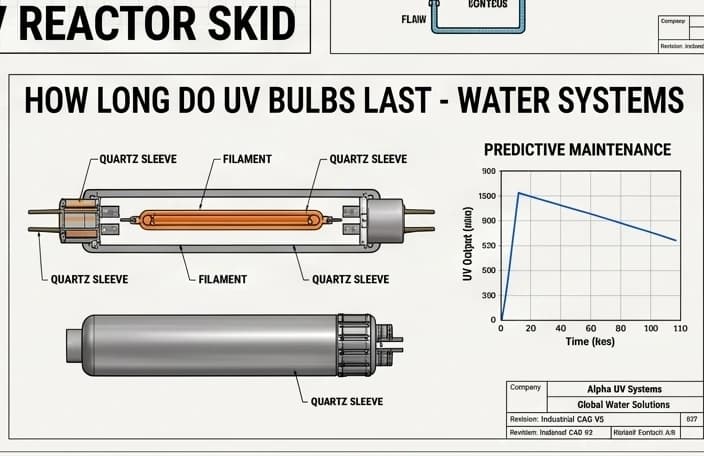
Philips TUV UV-C lamps are rated at 9,000 hours. This is the operating duration at which output falls to 80% of the initial certified value — the practical end-of-life point for dose-critical applications. Chinese OEM UV-C lamps sold in India are typically rated at 4,000–6,000 hours, with the 6,000-hour figures applying to the better-quality end of the Chinese OEM market.
The rated life difference is not simply a maintenance inconvenience. In a continuously operating system running 8,760 hours per year, the difference between 9,000 hours and 5,000 hours means the difference between approximately 3 lamp changes over 3 years and 5–6 lamp changes over the same period. Each lamp change involves downtime, labour, and the risk of system contamination during the lamp and sleeve replacement procedure. For pharmaceutical manufacturing environments operating under GMP, each lamp change event is a documented intervention that needs to be justified, recorded, and verified with a dose check after restart.
| Factor | Philips TUV UV-C Lamp | Chinese OEM UV-C Lamp | What It Means for Buyers |
|---|---|---|---|
| UV-C output certification | ISO-accredited lab, traceable COA | Manufacturer claim, no third-party verification | Only Philips output can be used in auditable dose calculations |
| Rated life | 9,000 hours at 80% UV-C output | 4,000–6,000 hours (claimed, unverified) | Philips needs ~3 changes vs 5–6 changes per 3 years continuous operation |
| Output consistency | ±5% across rated life | 25–40% degradation over rated life | Chinese OEM may not deliver 40 mJ/cm² dose in final lamp hours |
| Audit traceability | Serial-number COA, Signify authentication | No serial number, no authentication database | CDSCO and FSSAI auditors cannot verify Chinese OEM lamp authenticity |
| RoHS compliance | EU Directive 2011/65/EU certified | Self-declared, not independently verified | Philips RoHS documentation accepted for CE and export compliance |
| Germicidal wavelength | 253.7 nm, independently verified | Nominal 254 nm, not independently verified | Off-peak wavelength output reduces effective germicidal dose |
| Packaging and identification | Individual Signify-branded box with barcode | Generic packaging, often bulk-bagged | Genuine Philips lamps are individually identifiable on receipt |
| Indian regulatory acceptance | Accepted by CDSCO, FSSAI, CPCB auditors | Frequently rejected at audit | Using Chinese OEM lamps in regulated applications creates audit exposure |
The Audit Traceability Problem: Why CDSCO Asks for the Lamp COA
The audit traceability gap is arguably the most decisive factor in the Philips UV lamps vs Chinese UV lamps India comparison for institutional and industrial buyers. It converts what might seem like a technical performance question into a direct compliance and business risk issue.
For pharmaceutical manufacturing under CDSCO Schedule M, the qualification of a Water for Injection (WFI) or purified water system requires documented Installation Qualification (IQ), Operational Qualification (OQ), and Performance Qualification (PQ). The IQ documentation for the UV disinfection stage must identify the lamp model, rated UV-C output, and a traceable certificate confirming the lamp's identity and certified performance. This is not an informal expectation — it is a documented requirement of the qualification protocol.
Philips TUV UV-C lamps address this requirement directly. Every lamp is issued a Certificate of Authenticity (COA) bearing a unique serial number. That serial number is registered in Signify's lamp authentication database, which authorised Philips distributors and their customers can access for real-time verification. A CDSCO auditor can confirm — in the room, during the inspection — that the lamp serial number in the IQ documentation corresponds to a genuine Philips product supplied through Signify's authorised network.
Chinese OEM lamps have no equivalent system. There is no serial number. There is no authentication database. There is no COA in the sense that CDSCO auditors understand the term. When an inspector asks for lamp authentication documentation for a system fitted with Chinese OEM lamps, the only response available is a supplier invoice — which proves the buyer paid for lamps, but does not prove those lamps are what the seller claimed, what output they actually produce, or whether they are genuine or counterfeit versions of a claimed brand.
The consequences are concrete. Pharmaceutical water systems in India have received CDSCO observations specifically citing inadequate UV lamp documentation. In several cases, the corrective action required lamp replacement with certified alternatives, repeat OQ dose verification, and in the most severe cases, a hold on WFI system qualification while corrective measures were completed. The production downtime cost associated with a WFI qualification hold in a pharmaceutical manufacturing facility — measured in batch failures, delivery delays, and regulatory standing — vastly exceeds any initial saving on lamp purchase price.
| Application | Regulatory Body | Lamp Documentation Required | Consequence of Missing Docs |
|---|---|---|---|
| Pharmaceutical purified water / WFI | CDSCO (Schedule M) | Lamp model, certified UV-C output, serial-number COA, IQ/OQ records | Observation, corrective action, possible qualification hold |
| Food and beverage process water | FSSAI | Lamp certification, disinfection validation records, replacement log | Non-compliance notice, product recall risk |
| Municipal drinking water treatment | BIS IS 10500 / State authority | UV dose verification, lamp certified output records | System rejection, re-tendering requirement |
| Effluent treatment plant | CPCB / State PCB | UV dose records, lamp change log, certified output documentation | Consent-to-operate conditions unmet, enforcement action |
| Export to EU / Middle East | CE / Importer requirement | RoHS compliance certificate, lamp COA, CE documentation package | Shipment rejection, loss of export certification |
RoHS Compliance: What It Means for Export and Institutional Buyers
The RoHS dimension of the Philips UV lamps vs Chinese UV lamps India comparison is particularly important for manufacturers exporting UV-treated products to Europe or supplying equipment to multinational institutional buyers who require CE compliance.
Philips TUV UV-C lamps are certified compliant with EU Directive 2011/65/EU — the Restriction of Hazardous Substances directive — which limits the use of lead, mercury, cadmium, hexavalent chromium, polybrominated biphenyls (PBB), and polybrominated diphenyl ethers (PBDE) in electrical and electronic equipment. This RoHS compliance documentation is independently verified and forms part of the CE certification package that Alpha UV System provides for export customers.
Chinese OEM UV-C lamps sold in India frequently carry RoHS declarations, but those declarations are self-issued by the manufacturer without independent third-party testing. European importers, CE notified bodies, and institutional procurement teams experienced in supply chain compliance are aware of this distinction. A self-declared RoHS claim without independent verification does not satisfy the requirements of the EU's harmonised standard framework, and in the event of a product liability or regulatory investigation, a self-declaration from an unaccredited Chinese OEM would not constitute adequate due diligence.
For Indian pharmaceutical exporters, beverage manufacturers supplying EU markets, and equipment manufacturers seeking CE marking, the use of Philips TUV UV-C lamps — with their independently verified RoHS certification — is the only defensible choice from a documentation standpoint.
Total Cost of Ownership: The 3-Year Analysis for Indian Buyers
The single most common misconception driving the choice of Chinese OEM lamps over Philips UV-C lamps in India is that Chinese OEM lamps are more cost-effective over the system life. When evaluated on a 3-year total cost of ownership basis, this claim does not hold up to scrutiny for any system operating more than 4,000 hours per year — which includes any system in continuous or near-continuous industrial operation.
Consider a UV system operating continuously at 8,760 hours per year. Over three years, total operating hours are 26,280. With Philips TUV UV-C lamps rated at 9,000 hours, the system requires approximately 3 lamp changes over the three-year period. With Chinese OEM lamps rated at 5,000 hours (the mid-range Chinese OEM claim), the system requires approximately 5–6 lamp changes over the same period.
Each lamp replacement event carries direct costs — the lamp itself, plus the labour to shut down the system, drain and dry the chamber, replace the lamp and quartz sleeve, restart, and verify dose with a UV intensity meter. In industrial settings in India, this event costs ₹2,000–4,000 in labour and downtime per occurrence, excluding lamp price. Two to three additional replacement events over three years adds ₹4,000–12,000 in maintenance costs before the lamp cost differential is even considered.
In pharmaceutical and food-grade environments, lamp replacement also triggers documentation requirements — change records, re-verification, updated maintenance logs — that create indirect costs in QA staff time. And when a Chinese OEM lamp's output degrades to below the 40 mJ/cm² dose threshold in its final hours of service life before scheduled replacement, the system is producing non-compliant water that may not be detected without continuous UV intensity monitoring.
| Cost Element | Philips TUV | Chinese OEM | Philips Advantage |
|---|---|---|---|
| Lamp changes over 3 years | ~3 | ~5–6 | 2–3 fewer replacement events |
| Labour / downtime cost per change | ₹2,000–4,000 | ₹2,000–4,000 | Fewer events = lower total labour cost |
| Total labour / downtime cost (3 yr) | ₹6,000–12,000 | ₹10,000–24,000 | ₹4,000–12,000 saved |
| Audit documentation cost | Included (COA with every lamp) | Not available — audit exposure | Avoids corrective action and re-qualification costs |
| CDSCO corrective action risk (pharma) | Negligible — COA accepted | High — ₹50,000–3,00,000 per event | Single audit failure exceeds all lamp cost savings |
| Dose compliance in final lamp hours | Maintained (±5% output) | At risk (25–40% degradation) | Continuous dose compliance without early replacement |
| RoHS export documentation | Provided (CE export package) | Self-declared, insufficient for CE | Required for EU / Middle East export |
Output Degradation Over Lamp Life: What Dose Data Shows
Understanding output degradation is central to the Philips UV lamps vs Chinese UV lamps India comparison for any buyer operating a dose-critical system. UV-C lamp output does not remain constant over the lamp's service life — it declines as the lamp ages, and the rate and pattern of that decline is fundamentally different between Philips TUV lamps and Chinese OEM alternatives.
Philips TUV low-pressure UV-C lamps are designed and manufactured to maintain output within ±5% of the rated value from initial operation through 9,000 hours. The degradation curve is gradual, well-characterised, and predictable. System designers can account for it in dose calculations with confidence that actual performance will track the published degradation model.
Chinese OEM UV-C lamps show a markedly different degradation profile. Output typically drops more steeply in the first 500–1,000 hours — a break-in period during which output can fall 10–15% from the claimed initial value. After this initial drop, output continues to decline at a faster rate than Philips TUV lamps, reaching 60–75% of initial output by 4,000–5,000 hours. A system operating with a Chinese OEM lamp that has accumulated 5,000 hours may be delivering a UV dose of only 24–28 mJ/cm² at rated flow — 30–40% below the required 40 mJ/cm² threshold.
| Lamp Age (Hours) | Philips TUV Output (% of rated) | Typical Chinese OEM Output (% of claimed) | UV Dose Impact at 40 mJ/cm² Design Point |
|---|---|---|---|
| 0 (new) | 100% | 85–90% (actual vs claimed) | Chinese OEM may start below 40 mJ/cm² if system designed to claimed output |
| 1,000 | 98–100% | 78–85% | Chinese OEM dose ~34–37 mJ/cm² |
| 2,000 | 97–100% | 74–80% | Chinese OEM dose ~30–33 mJ/cm² |
| 3,000 | 95–100% | 70–76% | Chinese OEM dose ~28–31 mJ/cm² |
| 4,000 | 93–98% | 65–72% | Chinese OEM dose well below 40 mJ/cm² threshold |
| 6,000 | 90–95% | 50–62% (if lamp still operating) | Chinese OEM dose ~20–25 mJ/cm² — non-compliant |
| 9,000 | 80% (rated end-of-life point) | Lamp typically failed or replaced | Philips at 80% output still delivers ~32 mJ/cm² — near threshold |
The practical implication: in a system designed to deliver exactly 40 mJ/cm² at rated flow with a Philips TUV UV-C lamp, output at 9,000 hours is still 80% of rated — approximately 32 mJ/cm² at the design flow, which may be above the dose threshold for some applications or require flow reduction to compensate. The system is operating at its end-of-life design point. The same system fitted with a Chinese OEM lamp may reach a non-compliant dose level at 3,000–4,000 hours — less than halfway through the Philips UV-C lamp's rated life.
How to Verify You Are Getting Genuine Philips Lamps
The Indian UV system market includes a segment of suppliers who claim to use Philips UV-C lamps in their systems but supply counterfeit or substitute lamps. Given the premium Philips TUV commands over Chinese OEM alternatives, the incentive for substitution is real. Any buyer comparing Philips UV lamps vs Chinese UV lamps India and choosing Philips must also verify that genuine Philips lamps are what they are actually receiving.
Three verification steps protect buyers before delivery acceptance.
Request the Philips Lamp COA Before Payment
Any supplier claiming to use genuine Philips TUV UV-C lamps can provide a Certificate of Authenticity with the lamp serial number before the system is paid for. The COA is issued by Signify for every lamp through their authorised distribution network. A supplier who cannot produce the COA does not have genuine Philips UV-C lamps to supply — regardless of what their quotation or brochure states. Request the COA as a pre-payment condition and note that this is non-negotiable for regulated applications.
Verify the Serial Number Against Signify's Authentication System
The serial number on the Philips lamp COA can be verified against Signify's lamp authentication database, which is accessible to authorised Philips distributors and their customers. Alpha UV System, as an authorised Philips UV-C lamp user supplied through Signify's authorised Indian distribution network, can walk customers through this verification process on request and provide confirmation before delivery. If a supplier is unwilling to facilitate serial number verification, treat that as a definitive indicator that the lamps are not genuine.
Inspect the Lamp Packaging on Receipt
Genuine Philips TUV UV-C lamps are supplied in individual Signify-branded packaging — a printed box carrying the lamp model designation, rated specifications, Signify logo, and a barcode that corresponds to the lamp serial number. Lamps received in generic white boxes, unbranded packaging, bulk bags, or tissue wrap are not genuine Philips products, regardless of what the shipping documentation states. Inspect each lamp's individual packaging before accepting the delivery and cross-reference the barcode with the COA serial number provided in advance.
| Verification Step | How to Do It | What to Look For | Red Flag |
|---|---|---|---|
| Request COA before payment | Ask supplier for lamp COA with serial number as pre-payment condition | Signify-issued document with unique serial number and lamp model | Supplier cannot or will not provide COA |
| Verify serial number | Cross-reference COA serial number with Signify authentication system via authorised distributor | Serial number returns a valid match in Signify's database | Serial number not found, or supplier refuses to facilitate verification |
| Inspect individual packaging | Check each lamp's box on delivery against COA serial number | Signify-branded individual box with printed model, specs, logo, barcode | Generic packaging, no barcode, or bulk bagging |
| Check lamp model designation | Read model designation printed on the lamp itself | Designation matches COA and PO specification (e.g., Philips TUV) | Designation absent, differs from COA, or is a handwritten addition |
| Confirm through authorised distributor | Ask supplier to confirm Signify authorised distributor name and verify with Signify India | Supplier names a recognised Signify-authorised Indian distributor | Supplier cannot name their Philips supply source |
| Lamp Series | Wattage | UV-C Output (253.7 nm) | Rated Life | Typical Flow Range | Applications |
|---|---|---|---|---|---|
| Philips TUV (low-pressure) | 8–11 W | 2.5–3.5 W | 9,000 hours | Up to 1,000 LPH | Point-of-use, lab, small pharma |
| Philips TUV (low-pressure) | 16–25 W | 5–8 W | 9,000 hours | 1,000–5,000 LPH | Food processing, institutional |
| Philips TUV (low-pressure) | 30–55 W | 10–18 W | 9,000 hours | 5,000–20,000 LPH | Industrial, pharmaceutical WFI |
| Philips TUV (low-pressure) | 75–150 W | 25–50 W | 9,000 hours | 20,000–100,000 LPH | Municipal water, large ETP |
What Happens When Chinese OEM Lamps Fail an Audit
The audit failure scenario for systems using Chinese OEM UV-C lamps in India is not hypothetical. It follows a predictable sequence that procurement managers should understand before making lamp decisions based on initial price alone.
In a pharmaceutical facility audit under CDSCO Schedule M, the inspector reviews the IQ/OQ documentation for the purified water system. The UV disinfection stage shows a lamp model that is an unbranded or Chinese-branded UV-C lamp. The inspector asks for the lamp's Certificate of Authenticity and certified UV-C output data. The facility QA team cannot provide COA documentation with a traceable serial number because the Chinese OEM lamp does not have one. The inspector raises an observation — typically classified as a major deficiency — citing inadequate qualification of the UV disinfection stage.
The corrective action requires the facility to replace the Chinese OEM lamps with a certified alternative (in practice, Philips TUV UV-C lamps), redo the OQ dose verification with the new lamps installed, update all IQ/OQ documentation with the new lamp specifications and COA serial numbers, and submit the corrective action report to CDSCO before the observation can be closed. The timeline for this process is typically 30–90 days. If the facility is manufacturing products whose water system qualification underpins batch release decisions, the corrective action period creates a direct production impact.
This is the regulatory cost that gets omitted from the Philips UV lamps vs Chinese UV lamps India price comparison when buyers focus only on lamp purchase price. The purchase price difference between a Philips TUV UV-C lamp and a Chinese OEM alternative in India is typically ₹1,500–4,000 per lamp depending on wattage. The cost of a single CDSCO corrective action event — in QA staff time, consultant fees, repeat testing, documentation, production hold — is ₹50,000–3,00,000. The mathematics of this comparison are not ambiguous.
Frequently Asked Questions
What is the rated life of a Philips TUV UV-C lamp?
Philips TUV low-pressure UV-C lamps are rated at 9,000 hours at 80% UV-C output — meaning the lamp continues to emit at least 80% of its certified initial UV-C output at 253.7 nm throughout that operating period. This rated life is measured and certified under ISO-accredited laboratory conditions by Signify, the professional lighting division of Philips. The 9,000-hour rating is approximately 50–100% longer than the rated life of typical Chinese OEM UV-C lamps sold in the Indian market (4,000–6,000 hours), significantly reducing replacement frequency and maintenance costs over the system life.
Can I use Chinese UV lamps in a CDSCO-inspected pharmaceutical water system?
In practice, no — not without significant audit risk. CDSCO Schedule M requires lamp certification and traceable documentation for the UV disinfection stage of pharmaceutical water system qualification. Chinese OEM UV-C lamps do not provide the serial-number Certificate of Authenticity that CDSCO auditors require to verify lamp identity and certified output. Pharmaceutical facilities operating WFI or purified water systems with Chinese OEM lamps have received CDSCO observations requiring corrective action and lamp replacement. For any CDSCO-regulated water system, Philips TUV UV-C lamps with their traceable COA documentation are the only compliant specification.
How do I verify a Philips UV lamp is genuine before accepting delivery?
Three steps: first, request the Philips lamp Certificate of Authenticity with the lamp's unique serial number before payment — a supplier without genuine Philips UV-C lamps cannot provide this. Second, cross-reference that serial number against Signify's lamp authentication database through an authorised Philips distributor. Third, inspect the lamp's individual packaging on delivery — genuine Philips TUV UV-C lamps arrive in Signify-branded individual boxes with printed specifications and a barcode matching the COA serial number. Lamps in generic or unbranded packaging are not genuine Philips products regardless of the supplier's claims.
Why do Chinese OEM UV lamps cost less than Philips lamps?
Chinese OEM UV-C lamps are less expensive at initial purchase because they are manufactured without ISO-accredited output testing, without independent RoHS certification, without a serial-number traceability system, and to lower rated-life specifications (4,000–6,000 hours vs 9,000 hours for Philips TUV). The production and certification costs that Philips bears to deliver verified, traceable, RoHS-compliant lamps are real costs — their absence in Chinese OEM products explains the price difference and directly produces the compliance and performance gaps documented in this comparison. The initial purchase price saving is typically eliminated within the first 18 months of operation through higher replacement frequency and audit exposure.
What is a Philips UV lamp Certificate of Authenticity and why does it matter?
A Philips UV lamp Certificate of Authenticity (COA) is a Signify-issued document bearing a unique serial number that identifies a specific lamp as a genuine Philips TUV UV-C product supplied through Signify's authorised distribution network. The serial number is registered in Signify's authentication database and can be verified in real time. The COA matters because CDSCO, FSSAI, and CPCB auditors use it to verify lamp identity and certified output during facility inspections. Without a COA bearing a verifiable serial number, a UV system cannot demonstrate lamp compliance during a regulatory audit — a deficiency that triggers corrective action requirements in regulated pharmaceutical, food, and water treatment environments.
How often should I replace UV lamps in a water disinfection system?
Philips TUV UV-C lamps should be replaced at 9,000 operating hours — the rated end-of-life point at which output falls to 80% of certified initial value. For a system operating 8 hours per day (2,920 hours per year), that is approximately every 3 years. For continuous operation (8,760 hours per year), replacement is needed approximately every 12–13 months. Chinese OEM UV-C lamps require replacement at 4,000–6,000 hours — significantly more frequently. In dose-critical applications, a UV intensity meter should be used to verify dose after every lamp replacement, and replacement should be triggered when meter readings indicate output has fallen below the design dose threshold regardless of lamp age.
Every Alpha UV System unit ships with genuine Philips TUV UV-C lamps and full Certificate of Authenticity documentation — ready for CDSCO, FSSAI, and CPCB audits. We can provide sample COA documentation before you order. Response within 24–48 hours.
WhatsApp Us for a Philips-Certified UV System QuoteStandards, authorities & further reading
External references used to inform this guide. Regulations evolve — check the latest revision on each authority's site before compliance decisions.
Recommended UV Systems
Alpha UV System products for this application — powered by genuine Philips UV-C lamps.
Commercial UV Water Purification System
500 – 5,000 LPH
HACCP-compliant UV water purification for hotels, restaurants, and offices
Industrial UV Water Treatment System
5,000 – 50,000 LPH
Schedule M 2025 and HACCP compliant UV for pharma, food & beverage, and process water
Not sure which system suits your application? WhatsApp our engineers for a free recommendation →
Need a UV system?
Talk to our UV engineers — WhatsApp for a quote in 2 hours, or browse the full catalog on IndiaMART.