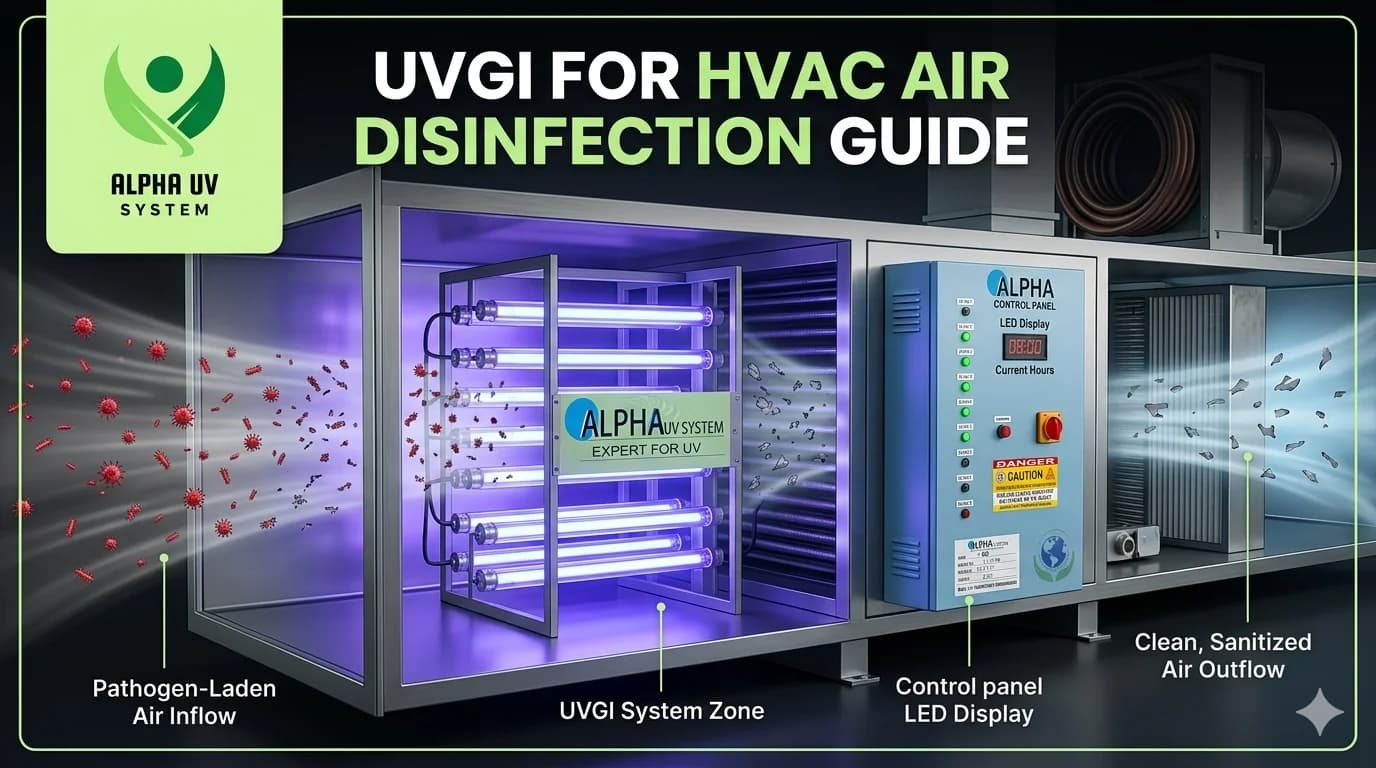
UVGI (Ultraviolet Germicidal Irradiation) for HVAC air disinfection uses UV-C lamps at 254 nm installed inside AHU units and ductwork to inactivate airborne bacteria, viruses, and moulds — achieving 80–99% reduction in viable airborne microorganisms. UVGI in-duct installation prevents mould on cooling coils (improving energy efficiency 10–15%), reduces IAQ complaints, and supports NABH, FSSAI, and Schedule M 2025 compliance in Indian buildings.
What Is UVGI for HVAC Systems?
UVGI HVAC air disinfection refers to the installation of UV-C lamps at 254 nm inside air handling units (AHUs) and ductwork to continuously inactivate airborne bacteria, viruses, moulds, and fungi as building air circulates through the system. Unlike portable room-level UV air purifiers, HVAC-integrated UVGI treats the entire recirculated air volume of a building — every cubic metre of conditioned air passes through the UV-C irradiation zone before being distributed to occupied spaces.
In India, UVGI HVAC air disinfection has shifted from a post-pandemic niche upgrade to a mainstream engineering specification. Hospitals targeting NABH accreditation, pharmaceutical facilities complying with Schedule M 2025, food processing plants under FSSAI audit, and premium commercial buildings pursuing WELL Building Standard or GRIHA certification all now consider UVGI in their AHU specification as a baseline requirement rather than an optional add-on.
The core principle is photonic inactivation: UV-C photons at 254 nm are absorbed by the DNA and RNA of microorganisms, cross-linking nucleotide bases and preventing replication. An inactivated pathogen cannot cause infection even if it reaches an occupant. Because UVGI acts on any airborne biological agent that passes through the irradiation zone, the technology is inherently broad-spectrum — effective against both known pathogens and emerging infectious agents without requiring reformulation or chemical replenishment.
Alpha UV System engineers design and supply UVGI systems for AHU and HVAC ductwork across India — from single AHU retrofit installations in existing hospitals to full multi-unit system design for new pharmaceutical facility construction. This guide covers the technical basis, design principles, sector applications, and maintenance requirements for UVGI HVAC air disinfection in the Indian context.
How UVGI Works in HVAC and AHU Systems
Philips UV-C lamps rated for continuous HVAC duty are mounted inside the AHU casing or ductwork. The lamp emits UV-C radiation at 254 nm — the wavelength of peak germicidal effectiveness, corresponding closely to the absorption peak of nucleic acids (260 nm). As conditioned air flows past the lamp array at the system design velocity, each airborne microorganism receives a UV-C dose determined by the irradiance level and the exposure time (residence time in the irradiation zone).
UV dose (D) = Irradiance (I, µW/cm²) × Exposure time (t, seconds). For in-duct UVGI systems, the exposure time is fixed by duct geometry and air velocity. The design variable is therefore irradiance — achieved by selecting lamp power, lamp quantity, and reflective housing geometry. Alpha UV System engineers calculate the required configuration for each AHU based on duct cross-section dimensions, design supply air velocity (typically 2.0–3.5 m/s for Indian AHUs), and the target log reduction for the pathogens of concern.
Coil Irradiation (Stick-Type Installation)
In coil irradiation configuration, Philips TUV lamps are mounted parallel to the cooling coil face, positioned to shine continuously on the coil surface and drain pan. The objective is not to deliver a germicidal dose to moving air — air velocity is too high for adequate dose at this position — but to maintain the coil surface in a biologically clean state by continuous UV-C irradiation of the static surface. Mould and biofilm cannot establish on a surface receiving continuous UV-C irradiation.
Coil irradiation is the most widely adopted configuration for UVGI HVAC air disinfection India projects because it addresses the single most common and commercially significant HVAC problem in the Indian climate: mould fouling of cooling coils. A fouled coil loses heat transfer efficiency, forcing the chiller to work harder and consuming more energy. UV-C coil irradiation prevents fouling, maintaining the coil at its designed thermal performance.
Air Stream Irradiation (In-Duct Arrays)
Air stream irradiation uses higher-powered Philips UV-C lamp arrays positioned perpendicular to or across the duct cross-section, sized to deliver a germicidal UV dose to all airborne microorganisms in the passing air stream. This configuration is used when active inactivation of airborne pathogens in the supply air is the primary objective — for example, in AHUs serving hospital operating theatres, pharmaceutical clean room airlocks, or isolation ward supply air systems.
Air stream irradiation requires careful design: air velocity must be low enough (or lamp power high enough) that the UV dose delivered exceeds the inactivation threshold for the target pathogen. At standard AHU supply velocities of 2.5–3.5 m/s, achieving 2-log (99%) inactivation of Mycobacterium tuberculosis requires irradiance levels above 250 µW/cm² across the full duct cross-section. Alpha UV System engineers size each system using photometric modelling calibrated to the specific duct geometry and Philips TUV lamp performance data.
| Pathogen | UV Dose Required for 2-Log Reduction (µW·s/cm²) | Log Reduction at 100 µW/cm², 1 s Exposure | Primary Application |
|---|---|---|---|
| Mycobacterium tuberculosis | 10–12 | 2.0–2.5 log (99–99.7%) | Hospital isolation wards, TB clinics |
| Influenza A (H1N1, H3N2) | 3–6 | 3.0+ log (>99.9%) | Hospitals, offices, schools |
| SARS-CoV-2 | 3–7 | 3.0+ log (>99.9%) | Healthcare, high-occupancy buildings |
| Adenovirus | 25–30 | 1.0–1.2 log (90–94%) | Hospitals, paediatric facilities |
| Staphylococcus aureus (MRSA) | 5–7 | 2.5+ log (>99.7%) | Hospital ICUs, operating theatres |
| Aspergillus niger (mould spores) | 132–440 | 0.5–1.0 log (68–90%) air stream; surface: continuous | Pharmaceutical clean rooms, food processing |
| Cladosporium spp. | 100–200 | 0.7–1.2 log; coil surface prevention highly effective | Commercial AHUs, hospitals |
| Factor | Coil Irradiation | Air Stream Irradiation | Recommended For |
|---|---|---|---|
| Primary objective | Surface biofilm prevention on coil and drain pan | Inactivation of airborne pathogens in supply air | Coil: all AHUs; Air stream: high-risk areas |
| Lamp configuration | 1–2 Philips TUV lamps parallel to coil face | Multiple lamp array across duct cross-section | Coil: simpler; Air stream: engineered array |
| Irradiance target | 50–100 µW/cm² at coil surface (continuous) | 100–400 µW/cm² across duct cross-section | Air stream requires higher lamp power |
| Energy benefit | 10–15% coil efficiency recovery | Minimal direct energy benefit | Coil irradiation for energy ROI argument |
| Installation complexity | Low — lamp holder through AHU casing | Medium-High — array mount, ballast wiring | Both retrofittable to existing AHU |
| Typical Indian application | Commercial AHUs, hotels, offices, food plants | Hospital OTs, ICUs, pharma clean rooms | Often combined in healthcare installations |
6 Key Benefits of UVGI in HVAC Systems
1. Airborne Pathogen Control
UVGI HVAC air disinfection at 254 nm inactivates the full range of airborne biological threats: bacteria including Mycobacterium tuberculosis, Staphylococcus aureus (MRSA), and Streptococcus; viruses including influenza A/B, SARS-CoV-2, adenovirus, and rhinovirus; and fungal spores including Aspergillus and Cladosporium species. Studies published in Building and Environment and the American Journal of Infection Control demonstrate 80–99% reduction in viable airborne microorganisms downstream of properly designed in-duct UVGI systems operating at adequate irradiance levels.
For Indian healthcare settings where nosocomial (hospital-acquired) infection prevention is a patient safety and regulatory imperative, UVGI in the AHU represents a significant continuous engineering control measure — one that operates 24 hours a day without requiring occupant behaviour change or consumable replenishment between annual lamp replacements.
2. Indoor Air Quality (IAQ) Improvement
Mould, bacteria, and their metabolic byproducts in HVAC ductwork are a documented cause of musty odours, respiratory irritation, and sick building syndrome complaints in Indian commercial and institutional buildings. UVGI HVAC air disinfection eliminates the biological root cause rather than masking symptoms with air fresheners or chemical treatment. Buildings with UVGI installed consistently report significant reductions in occupant IAQ complaints and measurable improvements in WELL Building Standard air quality metrics. For Indian corporate buildings with significant tenant retention pressure, demonstrable IAQ improvement is a commercially valuable outcome.
3. Mould Prevention on Cooling Coils
India's humid climate — coastal cities, monsoon season across the subcontinent, and the condensing conditions on AHU cooling coils operating at 7–12°C chilled water temperature — creates near-ideal conditions for mould growth on cooling coil surfaces. A fouled coil surface with mould and biofilm accumulation acts as an insulating layer that reduces heat transfer between the air stream and the chilled water circuit. The chiller must work harder to compensate, increasing energy consumption. Simultaneously, the mould colony releases spores and mycotoxins into the supply air stream.
Continuous UV-C irradiation of the coil face using Philips TUV lamps in the coil irradiation configuration prevents mould and biofilm establishment on the coil surface. The coil remains at its designed cleanliness, maintaining design heat transfer efficiency and eliminating the mould spore source from the supply air. This is the most cost-effective UVGI configuration for general commercial HVAC applications in India.
4. Energy Savings (10–15% Coil Efficiency Recovery)
A biologically clean cooling coil transfers heat at its designed efficiency. Tests of UVGI coil irradiation in commercial buildings documented by ASHRAE Technical Committee 2.9 (Building Refrigeration) have demonstrated 10–15% improvement in coil heat transfer efficiency after UV-C coil irradiation restores the coil surface to a clean condition. In an Indian context where AHU cooling loads run for 8–10 months per year and chiller energy accounts for 40–60% of total building electricity consumption in commercial properties, a 10–15% coil efficiency improvement translates to measurable reduction in the electricity bill. Over a 5-year period, this energy saving typically exceeds the capital cost of the UVGI installation — establishing UVGI HVAC air disinfection India projects as energy-positive investments for facility managers.
5. Biological Odour Elimination
Drain pan odour is among the most common IAQ complaints in Indian buildings served by central AHU systems. Stagnant condensate in drain pans — particularly in AHUs that cycle off-peak — supports biological growth: bacteria and moulds that generate volatile organic compounds (VOCs) with characteristic musty or sewage-like odours. These odours enter the supply air stream and reach occupants. UV-C irradiation of the drain pan surface (included in coil irradiation configurations that position lamps to cover both the coil face and the drain pan below) prevents biological growth in the condensate, eliminating the odour source. Buildings report elimination of musty AHU odour within days of UVGI commissioning.
6. Extended HVAC Equipment Lifespan
Biological fouling of heat exchangers, drain pans, and ductwork interiors creates acidic metabolic byproducts that accelerate corrosion of aluminium fins, copper tubes, and galvanised steel ductwork. Keeping these surfaces biologically clean with continuous UVGI extends the maintenance interval and service life of AHU components. The cooling coil does not require manual chemical cleaning (typically performed with acidic or alkaline coil cleaner, which itself causes some fin damage over repeated cycles) as frequently. Annual chemical coil cleaning cycles can often be extended to 2–3 years for UV-C-equipped AHUs, reducing maintenance cost and the risk of fin damage from aggressive chemical cleaning.
UVGI Applications in India by Sector
| Sector | Regulatory Driver | Primary Installation Point | Primary Benefit | Compliance Standard |
|---|---|---|---|---|
| Hospitals (tertiary care) | NABH accreditation; hospital infection control | AHUs serving OT, ICU, isolation wards, transplant units | Nosocomial infection prevention; airborne pathogen inactivation | NABH HIS; NBC 2016 Part 8 |
| Pharmaceutical manufacturing | Schedule M 2025 (CDSCO); GMP compliance | AHUs serving Grade B/C clean rooms, airlocks | Airborne bioburden control; mould prevention | Schedule M 2025; WHO GMP; EU GMP Annex 1 |
| Food processing plants | FSSAI audit; FSSC 22000 | AHUs serving processing halls, packaging areas | Mould and bacterial contamination prevention | FSSAI Food Safety Act; ISO 22000 |
| Commercial offices (premium) | WELL Building Standard; LEED; tenant health requirements | Central AHU supply air plenum; cooling coils | IAQ complaints reduction; wellness certification | WELL v2; LEED v4.1; GRIHA |
| Hotels (5-star) | Brand health standards; guest wellness positioning | Guestroom FCU AHUs; lobby and F&B area AHUs | Odour elimination; demonstrable air quality | Brand standard; WELL Hospitality |
| Residential towers (premium) | Developer wellness positioning; buyer preference | Central fresh air AHU; individual flat FCUs | Mould prevention; allergen reduction | WELL Residential; GRIHA residential |
Hospitals and Healthcare Facilities
UVGI HVAC air disinfection is a tier-1 specification for NABH-accredited hospitals, particularly for the AHUs serving critical patient areas: operating theatres (Class 100,000 to Class 10,000 environments), ICUs, isolation wards, bone marrow transplant units, and burns units where immunocompromised patients face life-threatening risk from airborne opportunistic pathogens including Aspergillus and drug-resistant bacteria. NABH Hospital Information Standards (HIS) specify engineering controls for air quality in these areas. Hospital infection control teams typically require both HEPA filtration and UVGI in AHUs serving high-risk patient areas.
Alpha UV System engineers have supplied UVGI systems for multi-speciality hospitals across Delhi NCR, Uttar Pradesh, and Rajasthan — including isolation ward AHU retrofits and full operating theatre HVAC system design. Our engineering team provides site-specific sizing calculations, irradiance verification, and commissioning documentation for hospital infection control committee review.
Pharmaceutical Facilities (Schedule M 2025)
India's revised Schedule M 2025 (effective pharmaceutical GMP regulations under CDSCO) requires enhanced documentation of air quality controls in pharmaceutical manufacturing. HVAC systems serving Grade B and Grade C classified areas must demonstrate continuous bioburden control. UVGI in the AHU provides a verifiable, continuous biological control measure. For contract manufacturers supplying to international markets (EU, UK, US), alignment with EU GMP Annex 1 (revised 2022) — which explicitly references air disinfection technologies including UVGI — is increasingly required by client quality auditors.
Food Processing Plants (FSSAI)
Airborne mould and bacteria in food processing environments are a leading cause of product spoilage and FSSAI audit non-conformances. The AHU serving exposed food processing areas is a direct pathway for airborne biological contamination of food products. UVGI HVAC air disinfection India installations in food processing typically combine coil irradiation (to eliminate the AHU as a mould source) with air stream irradiation in the supply duct to inactivate any residual airborne biological load before conditioned air reaches the processing hall.
Commercial Offices and Premium Buildings
Post-2020, UVGI has become a standard component of WELL Building Standard and LEED v4.1 air quality strategies in Indian premium commercial real estate. Property developers and building owners in Delhi NCR, Mumbai, and Bengaluru are retrofitting UVGI into existing AHU systems to support building health certifications — a documented differentiator for attracting and retaining corporate tenants. UVGI retrofit into an existing AHU is typically completed in one planned maintenance window without requiring AHU replacement or significant structural modification.
Hotels and Hospitality
UVGI HVAC air disinfection in five-star hotels addresses both guest wellness and operational HVAC performance. Fan coil unit (FCU) AHUs in guestrooms accumulate mould on coil surfaces — producing the musty room odour that generates negative guest reviews. UV-C coil irradiation in FCU AHUs eliminates the odour source and reduces housekeeping complaints. For lobby, ballroom, and food and beverage area central AHUs, air stream UVGI provides documentable pathogen inactivation that hotel operators can communicate as part of their wellness offering.
UVGI vs HEPA Filtration: Complementary Technologies
UVGI HVAC air disinfection and HEPA filtration are frequently compared, but they are not competing alternatives — they address fundamentally different air quality threats. Understanding the distinction is essential for correct system specification.
| Factor | UVGI (In-Duct UV-C) | HEPA Filter (H13/H14) | Combined System |
|---|---|---|---|
| Mechanism | Photonic DNA inactivation of biological agents | Physical capture of particles ≥0.3 µm | Both mechanisms operating simultaneously |
| Effective against bacteria/viruses | Yes — 80–99% inactivation in air stream | Partial — captures but does not inactivate; biofilm risk on filter | Highest biological control |
| Effective against PM2.5 / dust | No — UV-C does not remove particles | Yes — captures particulate matter efficiently | Full particulate + biological control |
| Airflow resistance (pressure drop) | Minimal — no filter media in airstream | High — 200–400 Pa across HEPA filter bank | Higher fan power required |
| Maintenance consumable | Philips UV-C lamp: annual replacement at 9,000 hours | Filter replacement every 6–12 months | Both consumables; UVGI lamp lasts longer |
| Capital cost (per AHU) | Lower initial cost | Higher for HEPA-grade filter housings | Highest but most complete protection |
| Recommended for | All AHUs; essential for biological control | Critical areas requiring particle removal | Hospital OTs, pharma clean rooms, ICUs |
The correct specification for high-IAQ buildings — hospitals, pharmaceutical facilities, and premium commercial buildings — is MERV-13 or better pre-filtration, followed by UVGI in the supply air plenum, followed by HEPA terminal filtration for the highest-risk areas. UVGI in this arrangement also provides a secondary benefit: by inactivating biological growth on the pre-filter surface (where captured organic particulate would otherwise support bacterial and mould colonisation), UVGI extends pre-filter service life and prevents the filter from becoming a biological contamination source.
Sizing and Designing a UVGI System for Your AHU
Correct sizing of a UVGI HVAC air disinfection system requires AHU-specific engineering calculation — there is no universal lamp count that suits all installations. The key design variables are duct cross-section dimensions (width × height in mm), design supply air velocity (m/s), and target pathogen inactivation level (log reduction required).
| AHU Capacity (TR) | Typical Duct Dimensions (mm) | Design Air Velocity (m/s) | Indicative Lamp Configuration | Achievable Irradiance (µW/cm²) |
|---|---|---|---|---|
| 10–20 TR | 400 × 300 to 600 × 400 | 2.0–2.5 | 2 × Philips TUV 55W lamps | 80–120 µW/cm² |
| 20–40 TR | 600 × 400 to 900 × 600 | 2.5–3.0 | 4 × Philips TUV 55W lamps | 100–150 µW/cm² |
| 40–80 TR | 900 × 600 to 1200 × 800 | 2.5–3.5 | 6–8 × Philips TUV 55W lamps | 120–200 µW/cm² |
| 80–150 TR | 1200 × 800 to 1600 × 1000 | 3.0–4.0 | 10–14 × Philips TUV 55W lamps | 150–250 µW/cm² |
| 150–300 TR | 1600 × 1000 to 2400 × 1200 | 3.0–4.5 | 16–24 × Philips TUV 55W lamps | 180–300 µW/cm² |
These are indicative configurations only. Alpha UV System engineers produce a photometric calculation for each specific AHU — accounting for duct geometry, reflective housing material (polished aluminium reflectors increase effective irradiance by 20–40%), lamp spacing, and end-of-life lamp output (rated at 80% UV-C output at 9,000 hours). The system is designed to achieve the target irradiance at end-of-lamp-life, ensuring the pathogen inactivation target is met throughout the annual lamp replacement cycle.
For coil irradiation applications, the sizing calculation is different: one or two Philips TUV lamps positioned to deliver 50–100 µW/cm² uniformly across the coil face surface are typically sufficient for a wide range of AHU sizes, because exposure time is effectively infinite (air velocity across the coil surface is far lower than in the supply duct, and the coil surface itself is static).
Installation and Maintenance Requirements
UVGI installation in an existing AHU is performed during a planned HVAC maintenance shutdown — typically requiring 4–8 hours per AHU depending on system size and access configuration. The installation involves cutting access ports in the AHU casing for lamp holders, mounting the Philips TUV lamp assemblies at the designed positions, installing the ballast/driver unit external to the AHU on the casing exterior, and connecting to a local power circuit with an interlock that cuts power to the UV lamps when the AHU access panel is open (safety interlock). All cabling and lamp holder penetrations through the AHU casing are sealed against air leakage.
Commissioning includes irradiance verification using a UV-C radiometer at the lamp array centre and corners to confirm design irradiance is achieved, UV-C safety signage installation on the AHU access panels, and handover documentation including the irradiance measurement record and lamp replacement schedule.
| Maintenance Activity | Frequency | Specification | Documentation Required |
|---|---|---|---|
| UV-C lamp visual inspection | Quarterly (with routine HVAC maintenance) | Check lamp energisation via indicator light or UV-C viewer card; check for visible damage | Maintenance log entry; flag any non-illuminating lamps |
| Lamp irradiance measurement | Annually (before lamp replacement) | UV-C radiometer measurement at lamp array; compare to commissioning baseline | Irradiance record; note degradation vs. commissioned value |
| Philips UV-C lamp replacement | Annually (at 9,000-hour rated life) | Replace with Philips TUV replacement lamps of the same wattage and base type; do not substitute with non-specified lamps | Replacement record with lamp lot numbers; dispose of spent lamps per e-waste regulations |
| Reflective housing cleaning | Annually (at lamp replacement) | Wipe polished aluminium reflector surfaces with clean dry cloth or IPA-dampened cloth; remove dust accumulation that reduces reflectance | Maintenance log; note any corrosion or reflector damage |
| Safety interlock function test | Annually | Confirm UV lamp de-energises when AHU access panel is opened (interlock function) | Safety inspection record |
| Full irradiance re-verification | After every lamp replacement | UV-C radiometer measurement post-replacement to confirm new lamps achieve commissioning irradiance | Post-replacement irradiance record; file in HVAC maintenance folder |
Philips UV-C lamps used in Alpha UV System HVAC installations are rated at 9,000 hours at 80% UV-C output — approximately 12 months of continuous 24-hour operation. This rating is used as the standard annual replacement trigger. Facilities that operate AHUs on partial-day schedules (e.g., office buildings running AHUs for 12 hours per day) will reach the 9,000-hour lamp life in approximately 24 months, reducing the lamp replacement frequency and annual maintenance cost.
UV-C lamp disposal must comply with Indian e-waste regulations under the E-Waste (Management) Rules 2022, as Philips TUV lamps contain small amounts of mercury. Alpha UV System arranges take-back and compliant disposal for spent lamps on request.
Frequently Asked Questions
Does UVGI in HVAC replace air filters?
No. UVGI and particulate filtration are complementary technologies that address different air quality threats. HEPA or MERV-13 filters capture particulate matter — PM2.5, dust, pollen, and allergens — but do not inactivate pathogens passing through the filter media, and captured organic matter can support biological growth on the filter surface. UVGI inactivates biological agents but cannot remove particulate matter. The correct specification for high-IAQ buildings is pre-filtration (MERV-13 minimum) combined with UVGI in the AHU supply air section — both stages are required for complete air quality control. In critical areas such as hospital operating theatres, a HEPA terminal filter is added downstream of the UVGI stage.
Is UVGI safe for building occupants?
Yes — UVGI installed inside AHU ductwork poses no UV-C exposure risk to building occupants. UV-C lamps are contained within the sealed metal AHU casing and duct. Air that reaches occupants has already passed through the irradiation zone; UV-C radiation does not persist in air after leaving the lamp proximity. The supply air is UV-C-free at all diffusers and grilles. Maintenance personnel follow standard HVAC lock-out/tag-out procedures and must not open AHU access panels while lamps are energised. A safety interlock de-energises the lamps automatically when the access panel is opened.
What maintenance does an HVAC UVGI system need?
Annual lamp replacement is the primary maintenance activity. Philips UV-C lamps in Alpha UV System HVAC installations are rated at 9,000 hours at 80% UV-C output — approximately 12 months of continuous operation. Lamps are visually inspected at each quarterly HVAC service visit and replaced at the annual service. Reflective housing surfaces are cleaned annually at lamp replacement to maintain reflectance efficiency. Post-replacement irradiance verification with a UV-C radiometer confirms the system is delivering the designed irradiance after each lamp change. Total annual maintenance time per AHU is typically under 2 hours.
What UV dose is required for effective airborne pathogen control in HVAC?
For in-duct UVGI, effectiveness is characterised by irradiance (µW/cm²) at the air stream cross-section combined with air residence time in the irradiation zone. Common design targets for Indian healthcare installations are 100–200 µW/cm² at design air velocity, achieving 2-log (99%) inactivation of TB and influenza. For pharmaceutical clean room AHUs, higher irradiance (200–300 µW/cm²) is specified to achieve 2-log inactivation of more UV-resistant mould spores. Alpha UV System engineers calculate the specific irradiance requirement for each AHU based on duct dimensions, air velocity, and the target pathogen inactivation level specified by the infection control or QA team.
Can UVGI be retrofitted into an existing AHU or HVAC system?
Yes — UVGI retrofit into an existing AHU is one of the most common project types for Alpha UV System engineers across India. The installation requires drilling lamp holder access ports in the AHU casing, mounting the Philips TUV lamp assemblies at the calculated positions, mounting the ballast units external to the AHU, connecting a dedicated power circuit, and installing the safety interlock. Most AHU retrofit installations are completed within a single planned maintenance window of 4–8 hours. No modification to the existing duct, fan, or coil system is required. The AHU resumes normal operation immediately after commissioning.
Which building types in India benefit most from UVGI in HVAC?
UVGI HVAC air disinfection India applications with the strongest technical and commercial justification are: hospitals and healthcare facilities (NABH compliance, nosocomial infection prevention), pharmaceutical manufacturing (Schedule M 2025, EU GMP Annex 1 alignment), food processing plants (FSSAI compliance, mould contamination prevention), and premium commercial buildings targeting WELL or LEED certification. Hotels benefit significantly from coil irradiation — eliminating the musty FCU odour that generates guest complaints. Any building with a history of mould problems, drain pan odour, or occupant IAQ complaints is an immediate candidate for UVGI HVAC air disinfection.
Alpha UV System engineers design and supply UVGI systems for AHU and HVAC ductwork across India — hospitals, pharmaceutical facilities, offices, hotels, and food processing plants. Share your AHU specifications and building type and we will design the correct UVGI system. Response within 24–48 hours.
WhatsApp Us for a UVGI HVAC SpecificationStandards, authorities & further reading
External references used to inform this guide. Regulations evolve — check the latest revision on each authority's site before compliance decisions.
Recommended UV Systems
Alpha UV System products for this application — powered by genuine Philips UV-C lamps.
Commercial UV Water Purification System
500 – 5,000 LPH
HACCP-compliant UV water purification for hotels, restaurants, and offices
Industrial UV Water Treatment System
5,000 – 50,000 LPH
Schedule M 2025 and HACCP compliant UV for pharma, food & beverage, and process water
Not sure which system suits your application? WhatsApp our engineers for a free recommendation →
Related solutions
See how Alpha UV System applies this to your industry or city.
Need a UV system?
Talk to our UV engineers — WhatsApp for a quote in 2 hours, or browse the full catalog on IndiaMART.