UV Systems for Tertiary STP Effluent Reuse in India: Which System to Choose?
Tertiary STP effluent reuse is now a regulatory requirement, not an option, for large residential townships, commercial complexes, and industrial parks in Delhi NCR, Maharashtra, Gujarat, Karnataka, and other states where the Central Pollution Control Board (CPCB) and state SPCBs mandate that treated STP effluent be reused for non-potable applications rather than discharged to the sewer or stormwater drain. UV disinfection is the standard recommended technology for the final disinfection stage of tertiary STP effluent for reuse — it meets CPCB fecal coliform standards without introducing chlorine residual that damages vegetation and soil biology in irrigation applications.
This guide covers which UV disinfection systems are appropriate for tertiary STP effluent reuse applications in India, how effluent UVT drives system selection, sizing approaches for different reuse end uses, and a worked comparison of the UV system options available from Indian manufacturers.
CPCB Standards for Treated STP Effluent Reuse in India
The Central Pollution Control Board has issued reuse quality standards for treated STP effluent under the Environment (Protection) Rules. Treated STP effluent for the following reuse applications must meet these microbiological standards:
| Reuse Application | Fecal Coliform Standard | Total Coliform Standard | Minimum UV Dose |
|---|---|---|---|
| Toilet flushing (residential/commercial) | <200 MPN/100 ml | <1,000 MPN/100 ml | 30–40 mJ/cm² |
| Landscape/garden irrigation | <200 MPN/100 ml | <1,000 MPN/100 ml | 30–40 mJ/cm² |
| Cooling tower makeup water | <10 MPN/100 ml | <50 MPN/100 ml | 40–60 mJ/cm² |
| Construction water | <200 MPN/100 ml | <1,000 MPN/100 ml | 30 mJ/cm² |
| Industrial process water (non-food contact) | <10 MPN/100 ml | <50 MPN/100 ml | 40 mJ/cm² |
| Agricultural irrigation (unrestricted) | <1,000 MPN/100 ml | <10,000 MPN/100 ml | 25–30 mJ/cm² |
UV dose requirements shown are for STP effluent with measured UVT of 60–75%, which is typical for well-performing secondary STP effluent in India. Higher UVT (75–85%) reduces lamp requirements; lower UVT (below 55%) requires pre-filtration before UV or a larger UV reactor with additional lamp capacity.
Why UVT of STP Effluent Determines UV System Selection
UV transmittance (UVT) — the percentage of 254 nm UV light transmitted through 1 cm of water — is the single most important factor in UV system sizing for STP effluent reuse. Unlike potable water (typically UVT 85–95%), secondary STP effluent UVT varies widely:
- Good secondary treatment (activated sludge, MBBR, SBR) + tertiary filtration (sand/UF): UVT 65–80%
- Good secondary treatment alone (no tertiary filter): UVT 50–70%
- Poorly performing secondary treatment or seasonal high-load periods: UVT 35–55%
- STP effluent with high iron, tannins, or textile/pharmaceutical wastewater input: UVT as low as 20–40%
A UV system sized for UVT 70% will under-dose and fail to meet CPCB standards if the actual effluent UVT drops to 45% during monsoon season or high-load periods. This is why UVT measurement of actual effluent — not a catalogue assumption — is the essential starting point for UV system sizing for STP reuse applications.
Alpha UV System measures or requests measured UVT from all STP reuse enquiries before providing system recommendations. A UV system sized without a measured UVT is a sizing guess, not an engineering calculation.
Which UV System Types Work for STP Effluent Reuse?
Closed-Vessel UV Reactors (Pressure Systems)
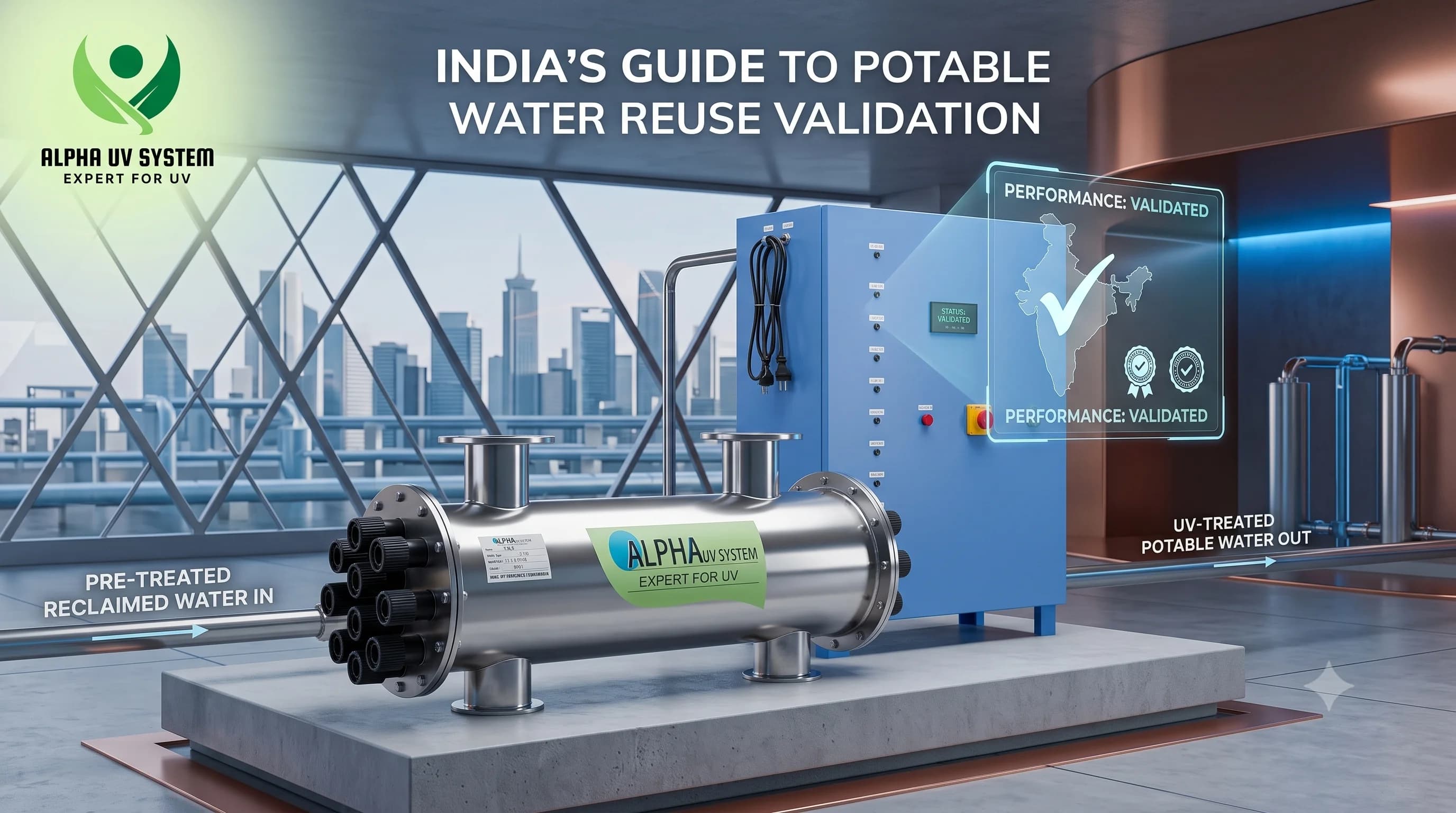
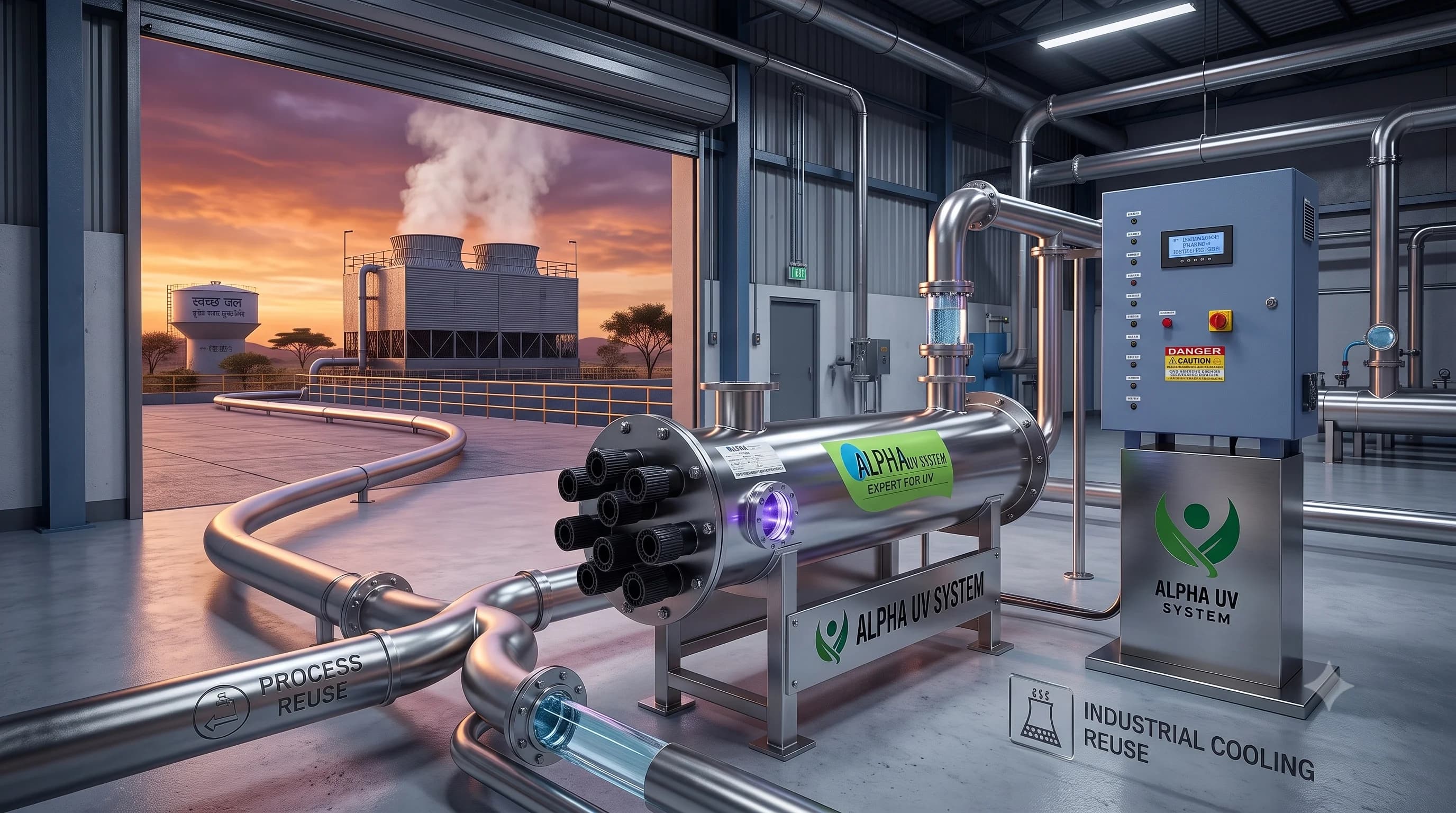
Closed-vessel SS316L UV reactors are the standard UV system type for tertiary STP effluent reuse in India for flow rates from 1,000 LPH to 5,00,000 LPH (0.024 to 12 MLD). The reactor is installed inline on the treated effluent distribution line, after the tertiary filter (if any) and before the reuse distribution header. Key selection factors for closed-vessel reactors in STP reuse:
- Material: SS316L is mandatory for STP effluent — SS304 will corrode from residual chlorine, iron, and sulfur compounds in STP effluent. Some low-cost reactors use SS304 falsely labelled as 316L; request mill certificates.
- Lamp type: Low-pressure amalgam UV-C lamps (Philips TUV series) are preferred for STP effluent reuse over standard LP lamps for their longer lamp life (16,000 hours vs 9,000 hours) and stable UV output across effluent temperature variation.
- UV intensity monitoring: A calibrated UV intensity sensor (NABL-accredited sensor calibration) is required for CPCB compliance documentation at government-mandated STPs. Systems without UV sensors cannot demonstrate real-time dose compliance.
- Flow-proportional control: For STPs with variable effluent flow rates (typical for residential townships with day/night variation), UV output should be modulated to maintain consistent dose across the flow range.
Open-Channel UV Systems (Large Scale)
Open-channel UV systems — horizontal UV lamp arrays installed in open effluent channels — are appropriate for STP effluent reuse at very large scale: above 5 MLD (5,000 m³/day). Open-channel UV is specified in CPHEEO guidelines for municipal STP effluent disinfection and reuse at large urban STPs. At these scales, open-channel systems offer lower capital cost per MLD than closed-vessel reactors and are easier to clean and maintain without pipeline shutdown. Open-channel UV requires an effluent channel depth of 350–600 mm and a lamp module arrangement that maintains the design gap between lamp arrays for uniform UV exposure.
When UVT Is Too Low: Pre-Treatment Before UV
When STP effluent UVT falls below 50%, UV system size increases disproportionately — a UV system sized for UVT 40% requires roughly 2.5× more lamp power than the same system sized for UVT 70% at the same flow rate and dose. At UVT below 40%, it is more cost-effective to add tertiary filtration (pressure sand filter or ultrafiltration membrane) before the UV reactor than to oversize the UV reactor to compensate for low UVT. Standard pre-UV treatment sequence for STP effluent reuse in India: secondary clarifier → pressure sand filter (or UF membrane) → UV reactor → reuse distribution.
UV System Sizing: Worked Examples for STP Reuse
| STP Capacity | Reuse Application | Effluent UVT | Required UV Dose | UV System Specification | Approx. Capital Cost |
|---|---|---|---|---|---|
| 100 KLD | Toilet flushing (township) | 65% | 40 mJ/cm² | 4-lamp closed-vessel reactor, 4 × 75W Philips TUV | INR 1.8–2.4 L |
| 250 KLD | Irrigation + toilet flushing | 60% | 40 mJ/cm² | 6-lamp reactor or 2 × 3-lamp series | INR 3.5–4.5 L |
| 500 KLD | Cooling tower makeup | 65% | 60 mJ/cm² | 8-lamp dual-reactor system with UV sensor | INR 6–8 L |
| 1 MLD | Toilet flushing + irrigation | 55% | 40 mJ/cm² | 12-lamp reactor with N+1 redundancy + UV sensor + flow control | INR 9–13 L |
| 3 MLD | Mixed reuse (township) | 60% | 40 mJ/cm² | Open-channel or 3 × closed-vessel parallel, 24+ lamps total | INR 22–32 L |
| 5 MLD+ | Municipal reuse scheme | 65% | 40 mJ/cm² | Open-channel UV (CPHEEO standard) | INR 40–70 L |
All capital costs indicative for SS316L reactor, Philips TUV lamps, UV sensor, and panel. Actual costs are UVT, flow rate, and site-specific. Costs do not include pre-treatment filtration (sand filter or UF) if required.
Annual Operating Costs for UV STP Reuse Systems
| STP Capacity | Annual Electricity | Annual Lamp Replacement | AMC | Total Annual OPEX |
|---|---|---|---|---|
| 100 KLD | INR 12,000–18,000 | INR 8,000–12,000 | INR 6,000–10,000 | INR 26,000–40,000 |
| 500 KLD | INR 55,000–80,000 | INR 35,000–55,000 | INR 20,000–30,000 | INR 1.1–1.65 L |
| 1 MLD | INR 90,000–1,30,000 | INR 60,000–90,000 | INR 35,000–50,000 | INR 1.85–2.7 L |
| 3 MLD | INR 2.5–3.5 L | INR 1.5–2.2 L | INR 80,000–1.2 L | INR 4.8–6.9 L |
Lamp replacement frequency based on Philips TUV amalgam lamps at 16,000-hour rated life operating 20 hours/day. Electricity costs at INR 8/kWh commercial tariff. Sodium hypochlorite dosing to equivalent CPCB fecal coliform standard costs INR 1.4–2.8L per MLD annually — UV OPEX is consistently 40–60% lower than chlorination at these scales.
Selecting a UV Vendor for STP Effluent Reuse in India
Key criteria when shortlisting UV vendors for an STP tertiary reuse project:
- Provide measured UVT-based sizing: Reject any vendor who sizes from flow rate alone without measuring or requesting effluent UVT. A system sized on catalogue assumptions will under-dose during low-UVT periods.
- SS316L material with mill certificates: Request the SS316L mill test certificate for the reactor chamber material. SS304 systems will corrode from STP effluent chemistry.
- Genuine Philips or certified UV-C lamps with COA: Certificate of Analysis (COA) for lamp UV output at rated wattage and 253.7 nm wavelength. Generic lamp claims without COA documentation should be rejected.
- UV intensity sensor with NABL calibration: Required for any government-mandated STP reuse project where CPCB compliance documentation is needed.
- Local service commitment: Confirm lamp availability within 24–48 hours and on-site technical support response time. A UV system with a 2-week lamp lead time creates compliance exposure every time a lamp fails.
- MSME Udyam registration + ISO 9001: Required for government procurement preference and standard quality management documentation.
Frequently Asked Questions: UV for STP Tertiary Effluent Reuse
Which UV systems are recommended for tertiary STP effluent reuse in India under CPCB guidelines?
CPCB guidelines recommend UV disinfection as the preferred technology for STP tertiary effluent reuse where the reuse application does not require residual disinfectant. Suitable UV systems are closed-vessel SS316L reactors for flows from 1,000 LPH to 5 MLD, and open-channel UV lamp systems above 5 MLD as per CPHEEO guidelines. The system must be sized from measured effluent UVT — not catalogue assumptions — to reliably meet CPCB fecal coliform reuse standards across seasonal UVT variation. Alpha UV System supplies both closed-vessel and open-channel UV systems for STP tertiary effluent reuse, sized from measured UVT with complete CPCB compliance documentation.
Why is UV better than chlorine for STP effluent used in irrigation reuse?
UV is preferred over sodium hypochlorite for STP effluent reuse in irrigation applications because UV leaves no chlorine residual in the treated water. Chlorine residual in irrigation water damages soil microbiology, suppresses soil enzyme activity, and can accumulate as organochlorine compounds in soil over sustained irrigation cycles. UV-treated STP effluent for irrigation is biologically neutral — it meets CPCB fecal coliform irrigation standards without the agronomic drawbacks of chlorinated effluent. For residential townships where treated STP effluent is used for landscape irrigation and toilet flushing (a standard reuse configuration in Delhi NCR and Maharashtra), UV is the standard recommended disinfection technology.
What minimum UVT is required for UV to work on STP effluent in India?
UV disinfection works on STP effluent at UVT as low as 30%, but the UV reactor size and lamp count increase sharply as UVT falls below 50%. Below 50% UVT, adding tertiary filtration (pressure sand filter or ultrafiltration) before the UV reactor is more cost-effective than oversizing the UV reactor. At UVT 35–50%, a pre-UV sand filter (30 minutes contact time, dual-media filter) typically raises UVT to 65–75%, reducing UV reactor cost by 40–60%. Alpha UV System can supply integrated UV + filtration packages for low-UVT STP effluent.
Does UV disinfected STP effluent meet CPCB standards for cooling tower makeup water?
Yes — UV-treated STP effluent at 40–60 mJ/cm² meets CPCB reuse standards for cooling tower makeup water (fecal coliforms less than 10 MPN/100 ml, total coliforms less than 50 MPN/100 ml). A Legionella-specific UV dose of 60–80 mJ/cm² is recommended for cooling tower makeup applications where Legionella pneumophila control is required — hospitals, hotels, and large commercial cooling towers in India should specify the higher dose. UV-treated STP effluent is used for cooling tower makeup in numerous residential townships and commercial complexes across Delhi NCR, Mumbai Metropolitan Region, and Pune.
UV System for Your STP Tertiary Effluent Reuse Project?
Alpha UV System supplies UV disinfection systems for tertiary STP effluent reuse across India — residential townships, commercial complexes, industrial parks, hotels, and municipal STPs. Send us your STP capacity, effluent UVT measurement (or source water details), and reuse application, and our engineering team will size a CPCB-compliant UV system for you within 24–48 hours.
Standards, authorities & further reading
External references used to inform this guide. Regulations evolve — check the latest revision on each authority's site before compliance decisions.
Recommended UV Systems
Alpha UV System products for this application — powered by genuine Philips UV-C lamps.
Commercial UV Water Purification System
500 – 5,000 LPH
HACCP-compliant UV water purification for hotels, restaurants, and offices
Industrial UV Water Treatment System
5,000 – 50,000 LPH
Schedule M 2025 and HACCP compliant UV for pharma, food & beverage, and process water
Not sure which system suits your application? WhatsApp our engineers for a free recommendation →
Need a UV system?
Talk to our UV engineers — WhatsApp for a quote in 2 hours, or browse the full catalog on IndiaMART.