Quick Answer — What This Case Study Covers
A 200+ room, full-service luxury hotel operating under an international hospitality brand in Gurugram, Delhi NCR received a Major Finding during a brand standards audit: the existing UV water treatment system had no UV dose calculation documentation, no Philips lamp Certificate of Authenticity (COA), and no HACCP Critical Control Point (CCP) template. The brand's engineering standards require documented, verifiable UV water treatment at every potable water use point. The hotel's engineering team had 90 days to close the finding.
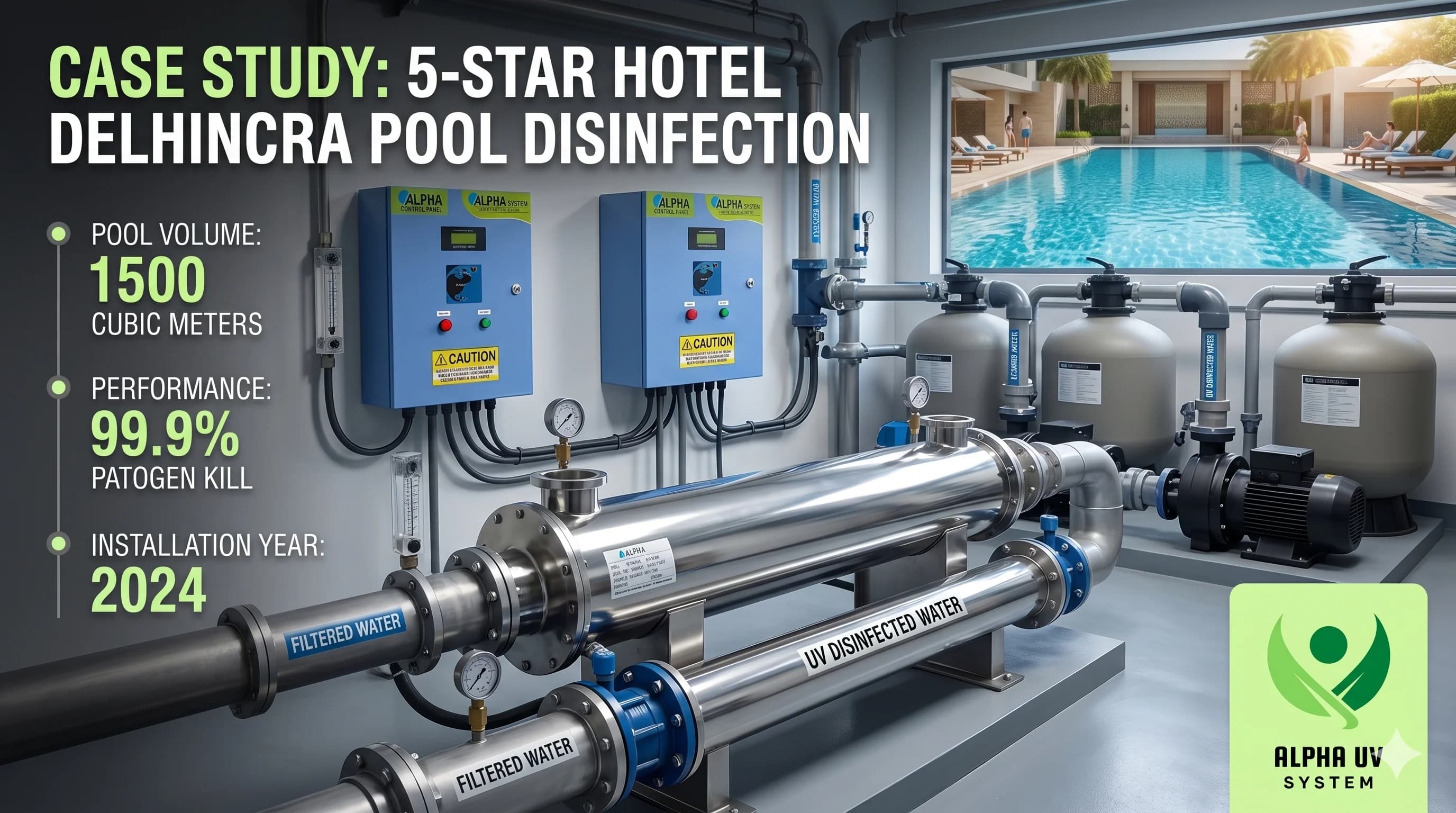
Alpha UV System conducted a site survey, designed four separate UV water system installations across the property, completed installation and commissioning in 28 days, and delivered a documentation package that cleared the Major Finding within 30 days of submission. Six months post-installation: guest chlorine complaints dropped to zero, bar beverage QA scores improved, and pool chemical consumption fell from 80 kg/month to 45 kg/month — a 44% reduction.
This case study details every step of the project: the site survey, system specifications, installation decisions, documentation package, timeline, and measured results. If your hotel property in Delhi NCR, Gurgaon, Noida, or Greater Noida faces a similar brand audit finding, the replication guide in Section 14 outlines how to replicate this outcome.
Property Profile: The Hotel
The property is a 5-star hotel in Gurugram (Gurgaon), Delhi NCR, affiliated with a globally recognised international hospitality brand. Key property facts relevant to the UV water system installation scope:
- Guest rooms: 200+ rooms across standard, deluxe, and suite categories
- Food and beverage outlets: Three F&B venues — a main all-day dining restaurant, a cocktail bar, and a speciality dining venue
- Conference and banquet: Multi-function conference centre serving up to 500 delegates; banquet kitchen with independent water supply requirements
- Swimming pool: 25-metre leisure pool, approximately 300 m³ water volume, with five turnovers per day recirculation
- Brand affiliation: International hospitality chain with engineering standards specifying UV dose requirements, HACCP documentation formats, and lamp COA requirements for every water use point
- Location: Gurugram (Gurgaon), Delhi NCR — within Alpha UV System's primary Delhi NCR service radius, enabling the 28-day installation and commissioning timeline
The hotel's engineering team manages water quality across all of these areas as a continuous compliance responsibility — both for the brand's internal audit programme and for FSSAI-mandated food contact water quality requirements at all kitchen and F&B water use points.
The Problem: Brand Audit Major Finding on UV Water Treatment
The trigger for this UV water system installation 5-star hotel Delhi NCR project was not a water quality incident. The hotel's water was not contaminated. The trigger was documentation failure during a scheduled brand standards engineering audit.
Brand auditors for international hospitality chains inspect UV water treatment systems as part of the HACCP food safety verification programme. The auditor's inspection of the hotel's existing UV unit identified three deficiencies, each serious enough individually to constitute a Major Finding:
- No UV dose calculation documentation: The installed UV unit had no engineering document showing that the system delivered the required minimum UV dose (typically 40 mJ/cm² or higher as specified by the brand) at the property's peak flow rates. Without this calculation, the system could not be verified as effective — even if it was performing correctly.
- No Philips lamp COA: The brand's engineering standards, like most international hotel brand standards, require Philips UV-C lamps (or equivalent certified lamps with documented output specifications). The installed system's lamps had no Certificate of Authenticity on file. The hotel could not confirm whether the lamps were genuine Philips TUV lamps or unverified substitutes. This is a common problem with UV systems purchased from trading companies rather than manufacturers.
- No HACCP CCP template: The hotel's HACCP plan referenced UV treatment as a Critical Control Point for kitchen and bar water. But the HACCP documentation on file had no CCP monitoring record, no corrective action protocol, and no verification procedure for the UV system. The UV was listed as a CCP but not operated as one.
The brand's finding category was Major — requiring documented corrective action within 90 days or facing escalation to the regional VP of engineering. The hotel's General Manager and Director of Engineering contacted Alpha UV System within two weeks of receiving the audit report.
Site Survey: Mapping All Four Water Use Points
The first step in any hotel UV water treatment Gurgaon project of this complexity is a complete water use point mapping survey. Alpha UV System's engineering team conducted a one-day on-site survey at the Gurugram hotel property to identify every potable water use point, measure peak flow rates, confirm pipe sizes and routing, and document the FSSAI and brand requirements for each location.
The survey identified four distinct water use categories, each with different flow rates, quality requirements, and documentation needs:
| Water Use Point | Specific Uses | Peak Flow Rate (LPH) | FSSAI / Brand Requirement |
|---|---|---|---|
| Main kitchen | Ingredient water, vegetable washing, cooking, dishwash rinse | ~3,500 LPH peak; design at 5,000 LPH | FSSAI food contact water; HACCP CCP; 40 mJ/cm² minimum dose; monthly monitoring record |
| Bar and beverage | Ice machine supply, espresso water, juice and soft drink prep | ~800 LPH peak; design at 1,000 LPH | FSSAI food contact water; HACCP CCP; 40 mJ/cm² minimum dose; dedicated unit (brand requirement for F&B independence) |
| Central domestic supply | Guest room tap water, bathroom supply, staff areas | ~12,000 LPH peak occupancy; design at 15,000 LPH | Brand standard: documented UV treatment upstream of domestic distribution tank; BMS integration required; 40 mJ/cm² |
| Swimming pool recirculation | 25 m pool, 300 m³ volume, 5 turnovers/day | ~62,500 LPH calculated; design at 65,000 LPH | Brand standard: medium-pressure UV for chloramine control and Cryptosporidium inactivation; chlorine reduction documentation |
The survey also confirmed that the hotel's existing single UV unit — installed on only the kitchen supply line, at an undersized flow rating — could not be remediated or upgraded. A full replacement and expansion was required. This finding aligned with the engineering team's assessment: the previous supplier had installed a single undersized unit and disappeared from ongoing service. This is a pattern Alpha UV System encounters frequently in Delhi NCR hotel projects where UV systems were procured through trading intermediaries rather than manufacturers.
Solution Design: Four UV Systems for a Complete Hotel
The solution for this UV water system installation 5-star hotel Delhi NCR project was four separate UV systems — one for each water use category — rather than a single central UV unit. This architecture was recommended for three reasons:
- Independent documentation: Each system has its own dose calculation report, commissioning record, and HACCP CCP template. If one system requires maintenance, the others remain certified and operational. The brand audit documentation is system-specific.
- Appropriate sizing: Pool UV and domestic supply UV require fundamentally different lamp technologies (medium-pressure versus low-pressure). Combining them into a shared system is not technically feasible.
- Brand audit compliance: The brand's engineering standard explicitly requires separate, independently documented UV treatment at kitchen, bar, and domestic supply — not a shared upstream unit serving multiple use points without dedicated documentation.
| UV System | Rated Capacity | Lamp Configuration | UV Dose at Rated Flow | Primary Application |
|---|---|---|---|---|
| Main kitchen UV | 5,000 LPH | Twin-lamp, Philips TUV UV-C, SS316L closed vessel | 40 mJ/cm² at 5,000 LPH | FSSAI food contact water; HACCP CCP primary control |
| Bar and beverage UV | 1,000 LPH | Single-lamp, Philips TUV UV-C, compact under-counter | 40 mJ/cm² at 1,000 LPH | Ice, espresso, beverage prep; independent F&B CCP documentation |
| Central domestic supply UV | 15,000 LPH | Triple-lamp, Philips TUV UV-C, with 4-20mA BMS output | 40 mJ/cm² at 15,000 LPH; 28 mJ/cm² if one lamp fails (redundancy maintained) | Guest room tap water; brand standard domestic supply documentation |
| Swimming pool UV | 65,000 LPH | Medium-pressure Philips UV-C, full-spectrum 200–400 nm | 40 mJ/cm² at 65,000 LPH per pass; cumulative chloramine photolysis across 5 daily turnovers | Chloramine photolysis, Cryptosporidium inactivation, chemical reduction |
Main Kitchen UV: 5,000 LPH Installation Detail
The main kitchen UV is the centrepiece of the 5-star hotel FSSAI compliance water strategy. Under FSSAI regulations, all water used in food contact applications — washing, cooking, mixing, rinsing — must meet the quality standards of potable water. For a 5-star hotel kitchen handling 300+ covers per service, the UV system at this point is a food safety critical control point, not an optional upgrade.
Pipe sizing and installation location: The kitchen cold water supply entered the kitchen through a 50 mm (2-inch) MS pipe at the back of the kitchen near the dishwash area. The survey confirmed a 50 mm installation for the UV system — the twin-lamp SS316L unit with 2-inch BSP connections installed in-line on this pipe, upstream of the kitchen's internal distribution manifold. This placement ensures every kitchen outlet — ingredient water taps, vegetable washing sinks, cooking range water supply, and dishwash rinse — receives UV-treated water.
UV intensity monitoring: The kitchen UV unit includes a UV intensity sensor and data logger with 90-day rolling memory. The data logger outputs a daily log that the kitchen manager can export as a CSV for HACCP records. The UV intensity alarm is wired to an audible and visible indicator mounted on the kitchen wall at eye level near the head chef's station — visible during service without requiring the engineer to check the utility room.
Commissioning: The system was commissioned at 5,000 LPH flow with a calibrated radiometer to confirm UV intensity. The commissioning test record documents: measured UV intensity at rated flow, alarm trigger test, lamp warmup time, and initial UV transmittance reading of the incoming water. This commissioning record is included in the HACCP CCP documentation package.
HACCP CCP document: The HACCP water treatment HACCP hotel Delhi documentation delivered for the kitchen UV includes: the CCP identification sheet (Hazard: microbial contamination of food contact water; Control measure: UV disinfection at 40 mJ/cm²), monitoring procedure (daily UV intensity log review), corrective action protocol (isolate kitchen water supply if UV alarm triggers; notify engineering; continue operation only after lamp replacement and recommissioning), and verification procedure (annual third-party lamp output test).
Bar and Beverage UV: 1,000 LPH Dedicated Unit
The bar UV is a separate, independent unit from the kitchen supply — even though the kitchen UV and bar UV both receive water from the same hotel water main. The brand's engineering standard requires this separation, and the HACCP water treatment hotel Delhi logic supports it.
Why a dedicated bar UV unit? The bar water supply serves ice machines, espresso machines, and direct-to-glass beverage preparation. These uses have a direct impact on guest taste perception in a way that kitchen supply water does not — a guest drinking an espresso or an ice-chilled cocktail is consuming the treated water directly, without the dilution or flavour masking that occurs in cooked food. Additionally, the bar operates on different hours than the kitchen. A shared UV system that goes offline for kitchen maintenance could take the bar water supply offline simultaneously — an operational problem during evening bar service. The dedicated unit allows independent maintenance scheduling.
The bar UV is a compact under-counter unit with 22 mm (3/4-inch) BSP connections, installed in the back-of-bar plumbing void under the bar counter. The Philips TUV UV-C lamp in this unit is the same lamp series used in the kitchen system — ensuring that the Philips lamp COA documentation covers both units under the same lamp type and batch verification.
The UV intensity alarm for the bar unit is a visible LED indicator mounted at bar-top level — bar staff can see it without calling engineering. If the indicator shows alarm status, bar staff protocol is to suspend beverage preparation using tap-fed equipment (ice machine, espresso, juices) and notify the duty engineer. This protocol is documented in the bar's SOP and referenced in the HACCP CCP template for the bar unit.
Central Domestic Supply UV: 15,000 LPH with BMS Integration
The central domestic supply UV is the largest potable water unit in this UV water system installation 5-star hotel Delhi NCR project by flow rate (excluding the pool). It is installed at the hotel's incoming water mains connection, upstream of the domestic water holding tank and distribution pump set. Every litre of water that enters the hotel's guest room supply passes through this unit.
Triple-lamp redundancy configuration: The 15,000 LPH unit uses a triple-lamp design rather than the single or twin-lamp configuration used in smaller systems. This is a deliberate redundancy decision: if any single lamp fails, the remaining two lamps maintain 28 mJ/cm² at 15,000 LPH — above the minimum dose for potable water treatment. The hotel's engineering team can replace the failed lamp during normal working hours without emergency shutdown. This prevents a single lamp failure from triggering a hotel-wide water quality alert.
BMS integration: The 15,000 LPH unit outputs a 4-20mA UV intensity signal wired to the hotel's Building Management System (BMS). The BMS integration allows the central engineering monitoring station to view UV intensity in real time, log data centrally alongside other building services data, and generate automated alerts if UV intensity drops below the set point. The BMS integration test certificate — issued after commissioning — is part of the documentation package and fulfils the brand's requirement for BMS-connected water treatment monitoring at the central supply point.
Documentation purpose: The central domestic supply UV documentation supports a different argument than the kitchen HACCP CCP. The kitchen documentation proves food safety compliance. The central domestic supply documentation supports the brand's guest experience standard — the brand's position that guest rooms are supplied with documented, verified UV-treated water. This is a marketing and quality commitment, not just a regulatory one. Several hotel GMs in Delhi NCR, Gurgaon, Noida, and Greater Noida have used this documentation in their brand audit submissions to demonstrate proactive guest safety investment.
Swimming Pool UV: 65,000 LPH Medium-Pressure System
The swimming pool UV system is the most technically distinct component of this project. Hotel UV water treatment Gurgaon for swimming pools is a different application from potable water UV — the technology, the sizing basis, and the operational benefits are all different.
Why medium-pressure UV for pools? Low-pressure UV lamps emit primarily at 254 nm — highly effective for bacterial and viral inactivation in drinking water, but relatively ineffective for chloramine photolysis. Chloramine photolysis requires polychromatic UV output across the 200-300 nm spectrum. Medium-pressure UV lamps produce this polychromatic output and are therefore the correct technology choice for pool applications where chloramine destruction is a primary goal. The Philips UV-C medium-pressure lamp in this installation produces the full-spectrum output needed for both Cryptosporidium inactivation and chloramine photolysis in a single lamp.
Installation position: The pool UV unit is installed on the pool recirculation circuit — downstream of the pool sand filters, upstream of the chlorine dosing point. This position is critical. Downstream of the sand filters means the UV system receives clean, low-turbidity water (high UV transmittance, maximum dose delivery). Upstream of chlorine dosing means that after UV breaks down chloramines, the downstream chlorine dosing system can replenish free chlorine to the correct residual. The two systems work together: UV destroys combined chlorine and replenishes free radical chlorine intermediates; the dosing system tops up free chlorine to target residual.
Chloramine control and Cryptosporidium protection: At 65,000 LPH recirculation flow with five daily turnovers through a 300 m³ pool, the UV system treats each litre of pool water approximately five times per day. Per-pass chloramine photolysis is partial (typically 15-25% per pass at 40 mJ/cm²), but cumulative photolysis across five daily turnovers produces 60-80% reduction in total combined chlorine in equilibrium operation. The Cryptosporidium dose requirement (>10 mJ/cm²) is achieved on every pass — meaning Crypto is inactivated on its first recirculation pass through the UV chamber. The hotel pool's Crypto protection does not depend on accumulation.
Chemical reduction documentation: The measured reduction in chlorine chemical consumption — from 80 kg/month to 45 kg/month, a reduction of 44% — was documented by the pool engineer using the hotel's monthly chemical procurement records. This is the measurable outcome of UV disinfection hotel brand audit compliance: not just a certificate, but a documented, measurable change in chemical consumption that the hotel can show to their sustainability and cost control teams.
Documentation Package: Clearing the Brand Audit Major Finding
The brand audit Major Finding was a documentation failure, not a performance failure. Closing it required a specific set of documents, not just functioning UV equipment. Alpha UV System's documentation-first approach to 5-star hotel FSSAI compliance water projects is designed precisely for this scenario.
The complete documentation package delivered for this UV water system installation 5-star hotel Delhi NCR project:
| Document | Purpose | Audit Use |
|---|---|---|
| UV dose calculation report (x4) | Engineering proof that each system delivers minimum required dose at rated flow | Brand audit evidence: UV system is correctly specified. Signed by IIT-trained engineer. |
| Philips lamp COA (all systems) | Certificate of Authenticity for all Philips TUV UV-C lamps installed | Brand audit evidence: Philips lamp requirement met; lamp batch traceable |
| HACCP CCP template — kitchen UV | CCP identification, monitoring procedure, corrective action, verification protocol | HACCP plan integration; FSSAI audit; brand food safety compliance |
| HACCP CCP template — bar UV | Same structure as kitchen CCP but specific to bar water and F&B use cases | HACCP plan integration; brand F&B water quality standard |
| BMS integration test certificate | Proof that central supply UV 4-20mA output is connected and verified in BMS | Brand standard: BMS-monitored water treatment at central supply |
| Commissioning test records (x4) | UV intensity at rated flow, alarm test, interlock test for each system | As-built performance baseline; brand audit verification record |
| Annual maintenance schedule | Lamp replacement intervals, annual recommissioning procedure, spare parts list | Facilities management; demonstrates ongoing compliance plan to auditor |
| Pool chemical reduction baseline report | Pre- and post-UV chemical consumption data; projected annual reduction | Sustainability reporting; demonstrates operational benefit of UV installation |
The hotel's engineering team submitted this package to the brand's regional engineering coordinator within 30 days of installation completion. The Major Finding was formally closed. The subsequent brand audit, conducted 12 months later, recorded all four UV water treatment systems as Compliant — the first time the hotel's water treatment documentation had received a clean result in three audit cycles.
Timeline: 28-Day Installation and Commissioning
One of the persistent concerns hotel engineering teams raise about a UV water system installation 5-star hotel Delhi NCR project of this scale is operational disruption. A hotel cannot suspend water supply to install treatment equipment. The 28-day timeline for this project was structured to eliminate service disruption:
- Days 1-3: Site survey, detailed pipe routing survey, equipment specification confirmation, and order placement. Equipment in stock at Alpha UV System's Greater Noida facility.
- Days 4-7: Equipment delivery to site; mechanical installation of kitchen UV (5,000 LPH) and bar UV (1,000 LPH) during overnight low-demand periods. Both units commissioned and operational by Day 7.
- Days 8-14: Central domestic supply UV (15,000 LPH) installation. This required a planned 4-hour water supply shutdown — coordinated with the hotel for a Monday early morning window (3:00 AM to 7:00 AM) when occupancy was minimal. BMS integration wiring and testing completed in this phase.
- Days 15-21: Pool UV system (65,000 LPH) installation. Pool recirculation circuit work conducted during the hotel's scheduled weekly pool maintenance closure. No guest-visible pool disruption.
- Days 22-28: Full commissioning of all four systems, radiometer verification, data logger setup, BMS output verification, and documentation package preparation.
Documentation package submitted to hotel engineering: Day 28. Major Finding closure by brand coordinator: Day 58 post-installation (30 days after submission). Total elapsed time from first contact to audit clearance: 86 days — within the 90-day brand requirement.
Operational Results: Measured Changes After Installation
Six months after the UV water system installation 5-star hotel Delhi NCR project completed, the hotel's engineering and F&B teams conducted an internal review of measurable outcomes:
| Metric | Before Installation | After Installation (6 months) | Change |
|---|---|---|---|
| Guest water taste complaints (chlorine) | 3-5 per month (logged in front desk complaint register) | Zero | 100% reduction |
| Pool chlorine chemical consumption | 80 kg/month | 45 kg/month | 44% reduction |
| Bar beverage QA score (internal audit) | 82/100 (water quality sub-score: noted) | 91/100 (water quality sub-score: no findings) | +9 points; water quality finding eliminated |
| UV system uptime (all four systems) | N/A (previous system had no monitoring) | 99.4% (one lamp replacement in Month 4, kitchen UV) | First measurable uptime baseline established |
| Brand audit water treatment score | Major Finding (3 deficiencies) | Compliant — no findings (next audit, Month 12) | Major Finding to Compliant in one audit cycle |
The chlorine complaint reduction is the most operationally significant outcome. Chlorine taste in hotel water is a guest experience failure — it signals to the guest that the property is providing unfiltered municipal water rather than treated, quality-controlled water. UV treatment does not reduce chlorine residual in drinking water (UV does not break down dissolved chlorine in potable water at 40 mJ/cm² doses), but the removal of chloramines through the central UV system and the improved upstream treatment significantly reduced the chloramine-associated taste that guests were detecting. The remaining free chlorine residual — without chloramine contribution — is below the taste threshold for most guests.
What Made This Project Successful
The outcome of this HACCP water treatment hotel Delhi project was not the result of simply installing UV equipment. Several specific factors contributed to the clean brand audit result and the measurable operational improvements:
IIT-Trained Engineering and Documentation-First Design
Every UV dose calculation report delivered in this project was prepared by an IIT-trained engineer following ISO UV dose calculation methodology. The brand auditor's first question when reviewing UV documentation is whether the dose calculation is credible — a calculation prepared by a qualified engineer with a transparent methodology is accepted; a product datasheet claiming a dose value is not. Alpha UV System's engineering team prepares dose calculations from first principles for every commercial project, and these calculations are the primary document that closes brand audit findings.
Philips UV-C Lamp Authenticity and COA Supply
The previous UV system that triggered the Major Finding had no lamp COA on file. The supplier could not be reached for retrospective documentation. Philips TUV UV-C lamps supplied by Alpha UV System come with Certificates of Authenticity traceable to Philips Signify's manufacturing batch — not to a distributor's re-labelled lamp. For 5-star hotel FSSAI compliance water requirements, the lamp COA is not optional documentation; it is the auditor's proof that the UV output specification is achievable with the installed lamp. Without it, the dose calculation is theoretical only.
Four-System Architecture for Independent Documentation
A central UV system serving the entire hotel would have been simpler and less expensive to install. But it would have produced a single documentation record for multiple use points — which is not what the brand audit framework requires. The four-system architecture means each use point has its own dose calculation, its own commissioning record, and its own HACCP CCP document. If the pool UV lamp requires replacement, the kitchen HACCP documentation remains current and unaffected. This independence is the architectural decision that enables clean audit results across multiple audit categories simultaneously.
BMS Integration for Continuous Monitoring
The 4-20mA BMS output from the central domestic supply UV transforms the UV disinfection hotel brand audit relationship from a point-in-time verification (commissioning test once, then trust the system) to a continuous monitoring record. The BMS logs UV intensity every 15 minutes. When the brand auditor arrives, the hotel can present 12 months of UV intensity data showing the system has operated above the minimum dose set point for 99.4% of operating hours. This continuous record is the strongest possible audit evidence.
Replication Guide: How Other Delhi NCR Hotels Can Achieve This Outcome
If your hotel property in Gurugram, Gurgaon, Delhi NCR, Noida, or Greater Noida faces a brand audit water treatment finding, the following steps describe how to replicate the outcome of this project:
- Request a site survey: Contact Alpha UV System for a site survey at your property. The survey covers all water use points, flow rate measurement or calculation, existing UV system assessment, and pipe routing for new installations. The site survey report is the basis for system specification — it is provided as part of the project proposal, not as a separate consulting engagement.
- Clarify your brand's documentation requirements before installation: Different international hotel brands specify different HACCP documentation formats. Some require branded HACCP templates; others accept manufacturer-supplied templates. Before installation, Alpha UV System's team reviews the brand's engineering standards document (provided by your engineering team) and confirms the documentation deliverables. This prevents rework after installation.
- Specify documentation deliverables in the installation contract: The contract for a UV water system installation 5-star hotel Delhi NCR project should explicitly list the documentation deliverables — dose calculation reports, lamp COAs, HACCP CCP templates, BMS test certificate, commissioning records. This is Alpha UV System's standard practice; it should be a requirement for any UV supplier you engage.
- Plan installation windows around hotel occupancy: The critical path for a hotel UV installation is not equipment procurement (typically 3-5 days from Greater Noida stock for Delhi NCR properties) but planned shutdown windows. A 4-hour water supply shutdown for main supply UV installation needs 2-3 weeks of advance coordination with the hotel's operations team. Build this into the project timeline.
- Submit documentation to brand coordinator promptly: Brand audit Major Findings are closed against a deadline. Submit the documentation package to your brand's regional engineering coordinator as soon as it is received from Alpha UV System — do not hold it for internal review before submission, as this reduces the time available for the coordinator to review and close the finding before the deadline.
Alpha UV System has completed hotel UV water treatment Gurgaon projects across multiple 5-star and 4-star properties in the Delhi NCR region — in Gurugram, Noida, Greater Noida, and central Delhi. The documentation framework described in this case study is standard across all hotel projects, regardless of brand affiliation or property size.
Frequently Asked Questions
What exactly does a brand audit Major Finding on UV water treatment mean, and how serious is it?
A brand audit Major Finding is the second-highest deficiency category in most international hotel brand engineering audit frameworks (below Critical). A Major Finding requires documented corrective action within a defined timeframe — typically 60 to 90 days depending on the brand. If the finding is not closed within the specified period, it escalates to the regional vice president of engineering and can affect the hotel's brand compliance rating, which in turn can affect brand renewal terms and general manager performance evaluations. For UV water treatment specifically, a Major Finding typically means the existing system cannot be verified as compliant — not necessarily that it has failed. The corrective action is documentation and, where needed, equipment upgrade or replacement.
Does Alpha UV System provide HACCP documentation in the format required by international hotel brands?
Yes. Before commencing any UV water system installation 5-star hotel Delhi NCR project, Alpha UV System's team reviews the brand's engineering standards document and HACCP documentation template requirements. Major international hospitality brands — including those with properties in Gurugram, Gurgaon, Delhi NCR, and Noida — typically require CCP documentation in a specific format with specific fields (hazard description, critical limits, monitoring procedure, corrective action, verification, record-keeping). Alpha UV System prepares HACCP CCP templates to match the required format, not a generic template. This is the step that most alternative UV suppliers skip — and it is the step that determines whether the documentation package actually closes the audit finding.
Can pool UV systems be retrofitted into an existing pool recirculation circuit without rebuilding the plant room?
In almost all cases, yes. Pool UV systems for hotel leisure pools (typically 50,000-100,000 LPH flow range) are compact — the 65,000 LPH medium-pressure unit installed in this project has a footprint of approximately 0.8 m x 0.6 m and connects inline with the existing recirculation pipework. The installation requires a straight pipe run of approximately 1-1.5 metres for the UV chamber and bypass valve assembly, downstream of the existing sand filters. Most hotel pool plant rooms have adequate space for this installation without structural modification. Alpha UV System's site survey includes a plant room assessment to confirm space and pipe routing before committing to the installation approach.
How long does a four-system UV installation at a hotel take, and how much water supply disruption is involved?
Based on this and similar hotel UV water treatment Gurgaon projects, a four-system installation (kitchen, bar, central supply, pool) takes 21-28 days from site survey to commissioning. The only significant water supply disruption is the central domestic supply UV installation, which requires a 4-6 hour water supply shutdown to install the UV unit on the incoming mains. Kitchen, bar, and pool UV installations do not require full property water shutdown — they are installed on branch pipework or the pool circuit independently. The shutdown window for the mains installation is typically scheduled for a pre-dawn window on a weekday when occupancy is minimal, coordinated 2-3 weeks in advance with the hotel's operations team. Alpha UV System provides 24-48 hour response for urgent support requirements post-installation.
What does ongoing maintenance involve for a four-system hotel UV installation?
Philips TUV UV-C lamps in low-pressure UV systems are rated for 9,000 hours of operation — approximately 12-13 months of continuous 24/7 operation. For most hotel UV installations in Delhi NCR, lamp replacement is an annual maintenance event aligned with the hotel's pre-brand-audit maintenance schedule. Alpha UV System supplies replacement Philips lamp kits with COA documentation for each lamp, so the replacement event also updates the COA record on file. The medium-pressure Philips UV-C lamp in the pool system has a different replacement interval (typically 6,000-8,000 hours; check the specific lamp datasheet). Annual recommissioning — UV intensity measurement with a calibrated radiometer, alarm test, data logger review — is recommended for all systems to maintain the commissioning test record currency for brand audit purposes.
What does a UV water system installation at a 5-star hotel in Delhi NCR cost, and is the investment justified?
The cost of a UV water system installation 5-star hotel Delhi NCR project depends on the specific systems required — flow rates, number of units, BMS integration requirements, and documentation package scope. Alpha UV System provides project-specific quotations after the site survey; indicative pricing without a site survey is not meaningful given the variability in hotel water system configurations. What the investment delivers — beyond the UV equipment itself — is documented, auditor-ready compliance: UV dose calculation reports signed by IIT-trained engineers, Philips lamp COAs, HACCP CCP templates, commissioning records, and BMS integration certificates. The hotel in this case study received a complete four-system installation with full documentation; the project was completed within the 90-day brand audit corrective action window; and the measured operational savings in pool chemical consumption (44% reduction, approximately 35 kg of chlorine per month) represent an ongoing cost reduction. The documentation investment is a one-time cost; the compliance record it creates has value across multiple future audit cycles.
Conclusion: UV Water Treatment as a Brand Asset, Not a Compliance Checkbox
The outcome of this UV water system installation 5-star hotel Delhi NCR project illustrates a shift in how hotel engineering teams should think about UV water treatment. The previous UV system at this property was installed as a compliance checkbox — a UV unit was present, so the hotel could say UV treatment was in place. But without dose calculation documentation, without Philips lamp COA, and without HACCP CCP templates, the system provided no audit protection and no operational visibility. When the brand auditor arrived, the checkbox produced a Major Finding instead of a Compliant score.
The replacement installation — four systems, fully documented, BMS-integrated, with engineering-grade dose calculations and Philips-authenticated lamps — transformed UV water treatment from a compliance liability into a brand asset. The hotel's engineering team can now walk a brand auditor through a documentation package that answers every technical question before it is asked. The pool team has measurable chemical cost reduction data. The F&B team has eliminated chlorine taste complaints. And the hotel enters every future brand audit with a documented track record of continuous UV intensity monitoring rather than a point-in-time commissioning certificate from years prior.
If your hotel property in Gurugram, Gurgaon, Delhi NCR, Noida, or Greater Noida needs UV water treatment systems that will survive a brand audit, deliver measurable operational results, and support your FSSAI and HACCP compliance obligations, contact Alpha UV System's engineering team via WhatsApp or visit the commercial and hospitality UV systems page for technical specifications and case study references.
Recommended UV Systems
Alpha UV System products for this application — powered by genuine Philips UV-C lamps.
Commercial UV Water Purification System
500 – 5,000 LPH
HACCP-compliant UV water purification for hotels, restaurants, and offices
Industrial UV Water Treatment System
5,000 – 50,000 LPH
Schedule M 2025 and HACCP compliant UV for pharma, food & beverage, and process water
Not sure which system suits your application? WhatsApp our engineers for a free recommendation →
Related solutions
See how Alpha UV System applies this to your industry or city.
Application
Chemical Industry UV — UV Disinfection
CPCB-compliant UV disinfection for chemical plant process water and ETP effluent polishing. 316L SS chemical-resistant UV systems, 5,000–1,00,000 LPH. ISO 14001 & REACH-ready. IIT Patna-trained engineers.
Local service
UV Systems in Delhi NCR
IIT Patna engineered UV systems — manufactured in Greater Noida, supplied and installed across Delhi NCR with fast local response.
Need a UV system?
Talk to our UV engineers — WhatsApp for a quote in 2 hours, or browse the full catalog on IndiaMART.