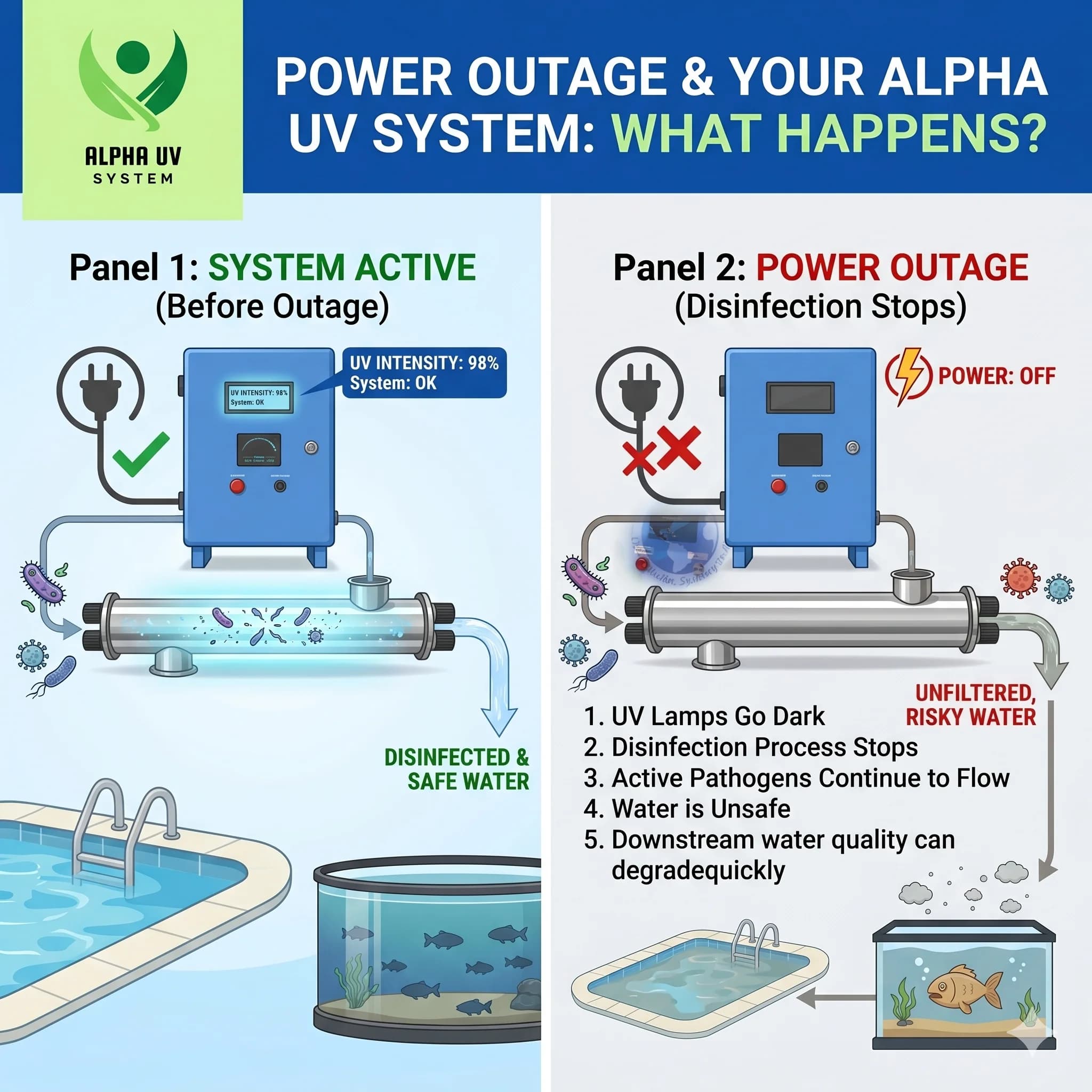
When a UV system loses power, the UV-C lamp switches off immediately and water passing through the chamber receives no disinfection. Quality systems include an electrically-actuated solenoid valve that closes automatically on power loss, preventing untreated water from reaching the tap. Allow 30–60 seconds for lamp stabilisation after power returns, then flush 2–3 litres before resuming use.
What Happens to UV Disinfection When Power Is Lost
The Immediate Effect: Lamp Off, Disinfection Stops
When a UV system loses power — from any cause — the UV-C lamp extinguishes within milliseconds. There is no delay, no fade, no coasting. The photonic output that destroys microbial DNA stops immediately. Any water flowing through the chamber at the moment power is interrupted, or thereafter, receives zero UV-C dose — well below the standard 40 mJ/cm² dose required to inactivate waterborne pathogens including bacteria, viruses, and protozoa such as Cryptosporidium.
The critical point is that water pressure in your plumbing system is generated independently of electricity. Even when a UV system loses power, your overhead tank continues to feed water into pipes under gravity pressure. Unless the UV system includes a solenoid valve that physically blocks flow, untreated water passes through the now-dark chamber and reaches your taps exactly as if the UV system were not installed. Understanding what happens when a UV system loses power is not a theoretical concern — it is a daily operational reality for millions of Indian households and facilities.
Why Power Reliability Matters Especially in India
India's power grid reliability varies dramatically by location. Urban metros in Maharashtra, Karnataka, and Delhi NCR may experience fewer than two outages per month. Semi-urban towns across Bihar, Uttar Pradesh, Madhya Pradesh, and Odisha routinely see 4–8 hours of load shedding per day. Rural areas connected through feeder lines suffer the most: unscheduled cuts, low voltage events, and single-phasing are daily occurrences.
For a UV water treatment system, every one of these outage events is a moment when a UV system loses power and water disinfection ceases. The risk profile for a household in Patna is entirely different from one in Bengaluru. Your power outage protection strategy should reflect the actual grid conditions at your site — not a best-case assumption.
| Region Type | Typical Outage Frequency | Typical Outage Duration | Recommended Protection |
|---|---|---|---|
| Metro cities (Delhi, Mumbai, Bengaluru, Hyderabad) | 1–4 outages per month | 30 minutes to 2 hours | Solenoid valve + manual flush on return |
| Tier-2 cities (state capitals, district headquarters) | 1–4 outages per week | 1–4 hours each | Solenoid valve + UPS (500–1000VA) |
| Semi-urban towns and tehsil level | Daily, often 2–3 cuts per day | 2–6 hours total per day | UPS + solenoid valve; overhead tank buffer |
| Rural areas on feeder lines | Multiple cuts daily; voltage fluctuation | 4–8+ hours per day | Generator or solar UPS + solenoid valve; UV at pump outlet |
| Industrial estates and SEZs | Rare but possible during faults | Variable — minutes to hours | Online UPS + generator interlock for critical process water |
Protection Option 1: Solenoid Valve (Automatic Flow Shut-Off)
How a Solenoid Valve Works in a UV System
A solenoid valve is an electrically-actuated flow control valve wired directly into the UV system's control panel. The configuration used in UV water treatment is "normally closed on power loss" — also called a fail-safe or fail-closed configuration. When electrical power is present and the UV lamp is operating within specification, the solenoid valve is energised to the open position and water flows normally. The instant a UV system loses power, the valve de-energises and a spring mechanism closes the valve seat, physically blocking water flow through the chamber.
The result: when a UV system loses power, no water can pass through the UV chamber. This may mean you have no water from that outlet during the outage — which is an inconvenience — but it is the correct safety outcome. Untreated water cannot reach the tap, the kitchen, or any downstream process.
Solenoid valves also respond to lamp failure events that occur during normal grid power. If the Philips UV-C lamp fails mid-service, the control panel detects the drop in UV intensity and triggers an alarm — and closes the solenoid valve — even though mains power is still present. This makes the solenoid valve protection broader than just outage protection: it guards against any condition that causes UV output to fall below the required threshold.
When a Solenoid Valve Is Essential
Solenoid valve protection is non-negotiable in the following situations: pharmaceutical water systems operating under Schedule M; food and beverage production under HACCP; commercial kitchens serving the public; hospitals, clinics, and healthcare facilities; schools and institutional buildings; and any application where the facility manager cannot guarantee that someone will monitor the UV system alarm during every outage event. Alpha UV commercial and industrial units include solenoid valve as standard. On residential units it is available as an option and is strongly recommended for households in regions with frequent outages or for households with infants, elderly, or immunocompromised members.
| Option | How It Works | Cost Estimate (INR) | Best For | Limitation |
|---|---|---|---|---|
| Solenoid valve (fail-closed) | Blocks water flow the instant UV system loses power; spring-closes automatically | ₹1,500–₹6,000 (included in commercial units) | All applications; mandatory for pharma, food, commercial | No water during outage; must be wired to UV panel |
| UPS (offline/line-interactive) | Battery sustains UV lamp power through short outages; prevents cycling | ₹3,500–₹12,000 + battery replacement ₹2,000–₹4,000 every 2–3 years | Areas with frequent short outages (under 4 hours); reduces lamp cycling | Does not help for extended outages; battery degrades over time |
| Online UPS / inverter | Zero transfer time; UV system never loses power even momentarily | ₹8,000–₹25,000 | Pharmaceutical, critical process water where any interruption is unacceptable | Higher cost; requires maintenance |
| Overhead tank buffer | Pre-treated water stored in tank used during outage; UV treats at pump outlet | No additional cost if tank already present | Residential with short outages; UV must be installed at pump outlet | Re-contamination risk after 12–24 hours in open tanks |
| Generator backup | Diesel or gas generator provides mains-equivalent power to UV system | ₹25,000–₹1,50,000 (generator cost); automatic transfer switch ₹8,000–₹20,000 | Municipal, STP, pharmaceutical, large industrial; extended outage coverage | Fuel cost; noise; transfer delay of 10–30 seconds unless combined with UPS |
| Solar UPS / hybrid inverter | Solar panels charge battery bank; provides power during both day and night outages | ₹30,000–₹1,20,000 (system dependent) | Rural sites with grid unreliability; off-grid applications | High upfront cost; requires solar panel area; cloudy day performance varies |
Protection Option 2: UPS (Uninterruptible Power Supply) Backup
Sizing a UPS for Your UV System
When a UV system loses power briefly and then power is restored, each restart cycle stresses the lamp electrodes — particularly the tungsten filaments in low-pressure mercury lamps like the Philips UV-C lamp used in Alpha UV systems. A UPS prevents the UV system from losing power during short outages, eliminating these damaging start cycles and keeping the lamp at operating temperature continuously. The Philips UV-C lamp is rated for 9,000 hours at 80% UV-C output — unnecessary cycling shortens the effective service life and increases annual lamp replacement costs.
UV lamp wattages are low compared to most electrical appliances, which means a modest UPS provides meaningful backup duration. The key sizing rule: multiply the lamp wattage by 3 to account for UV control panel electronics and inverter efficiency losses, then select a UPS VA rating above that figure.
| UV System Size | Lamp Wattage | UPS Size Needed | Backup Duration (typical) | Cost Estimate (INR) |
|---|---|---|---|---|
| Residential (250–500 LPH) | 8–11W | 500VA offline UPS | 4–6 hours | ₹3,500–₹5,500 |
| Residential-plus / small commercial (1,000 LPH) | 16–25W | 1000VA line-interactive UPS | 4–5 hours | ₹6,000–₹9,000 |
| Commercial (2,000–5,000 LPH) | 40–55W | 1500–2000VA line-interactive UPS | 3–4 hours | ₹10,000–₹18,000 |
| Industrial (10,000–25,000 LPH) | 80–120W | 3000VA online UPS | 2–4 hours | ₹20,000–₹35,000 |
| Large industrial / municipal | Multiple lamps, 200W+ | Online UPS + generator ATS | Unlimited with generator | ₹50,000+ (system dependent) |
For pharmaceutical water systems, an offline or line-interactive UPS is not adequate — the transfer time of 10–20 milliseconds means the UV system technically loses power for a brief moment on each switchover. Online (double-conversion) UPS systems have zero transfer time and are required for Schedule M compliance in applications where any interruption in UV-C output is unacceptable.
UPS batteries require replacement every 2–3 years regardless of use. Schedule battery inspection as part of your annual UV system maintenance. A failed UPS battery provides no protection when a UV system loses power — the system behaves as if no UPS is installed.
Protection Option 3: Overhead Tank Buffer
When the Overhead Tank Strategy Works
Many Indian households install their UV system at the outlet of the borewell or municipal supply pump — before water enters the overhead tank — rather than at the point of use. In this configuration, the overhead tank stores UV-treated water. When the UV system loses power and the pump stops (as pumps typically do during outages), the household can continue to draw from the tank's supply of pre-treated water without risk, because the water was already disinfected before entering the tank.
This strategy provides passive backup without any additional electrical equipment. For a 500-litre overhead tank serving a family of four consuming 80–100 litres per day of drinking and cooking water, the stored treated water represents several hours to over a day of safe supply.
When the Overhead Tank Strategy Does Not Work
The overhead tank buffer strategy has critical limitations that facility managers and homeowners must understand. First, it only works if the UV system is installed upstream of the tank — at the pump outlet. If the UV system is installed at point of use (under the kitchen sink, for example), there is no buffer and the tank plays no protective role when the UV system loses power.
Second, re-contamination of stored treated water is a real concern. An open overhead tank (the most common type in Indian buildings) allows atmospheric exposure, dust, insects, and bird droppings to introduce new contamination. In a quality closed tank, UV-treated water remains safe for 12–24 hours. After that period, treat water from the tank with caution if the UV system has not been operating. The WHO and Bureau of Indian Standards both recommend not storing treated water for more than 24 hours in domestic containers before re-treatment or use.
Third, the strategy provides no protection if the UV system loses power while the pump is still running — water will continue to flow from the pump into the tank via the now-dark UV chamber, re-contaminating the stored supply. A solenoid valve at the UV outlet eliminates this risk by stopping flow the moment the UV system loses power.
Protection Option 4: Generator Backup
For Critical Applications: Pharma, Municipal, STP
For applications where continuous UV disinfection is legally or operationally mandatory, generator backup is the only solution that covers extended outages without limit. When a UV system loses power in a pharmaceutical water treatment plant, the regulatory consequences can include batch rejection, audit findings, and Schedule M non-compliance. In a sewage treatment plant (STP) discharging to a water body, UV system power loss means treated effluent is released without disinfection — a pollution control board violation.
Generator backup systems for UV applications require an automatic transfer switch (ATS) that detects mains power failure and starts the generator within 10–30 seconds. To cover the transfer delay, pair the generator ATS with a UPS — the UPS sustains the UV lamp through the 10–30 second gap while the generator starts up, preventing the UV system from losing power even momentarily during the transfer.
Generator fuel consumption for UV applications alone is minimal — a 10 kVA generator consuming 2–3 litres of diesel per hour is many times the capacity needed for a UV system drawing 80–200W. In practice, the generator serves the entire facility during outages, with the UV system being just one of many loads it supports. The incremental cost of UV power backup in a generator-equipped facility is essentially zero.
What to Do When Power Returns After an Outage
Knowing exactly what happens when a UV system loses power prepares you to respond correctly when power is restored. The steps differ depending on whether your system has a solenoid valve, how long the outage lasted, and the application.
Step-by-Step Restart Protocol
- Wait for the UV lamp to stabilise: After the UV system loses power and mains is restored, do not draw water immediately. The Philips UV-C lamp requires 30–60 seconds to reach full UV-C output. Drawing water during this warm-up period means water receives a reduced UV dose — potentially below the 40 mJ/cm² threshold required for reliable disinfection.
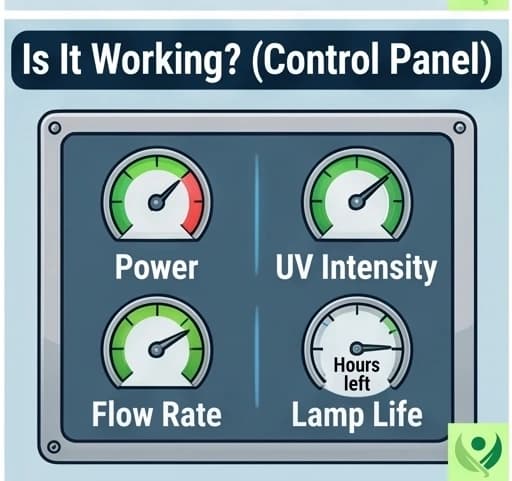
- Check the UV intensity indicator: All quality UV systems include a UV monitor (photodetector or ballast current monitor) that shows real-time lamp output. Confirm the indicator shows normal/green before drawing water. If the indicator shows a fault or alarm after power returns, do not use the water — the lamp may have failed during the outage.
- Flush 2–3 litres to waste: Water that was sitting in the UV chamber during the outage was not being disinfected. This stagnant water should be flushed out before drinking. Run the tap for 15–20 seconds at normal flow to clear the chamber volume and the outlet pipe.
- For solenoid-valve systems: The valve opens automatically once the UV lamp reaches operating intensity. You do not need to manually intervene. Simply confirm the valve has opened (water flows normally from the tap) after the 30–60 second stabilisation period.
- For systems without a solenoid valve: After an extended outage, treat the first draw with extra caution. If the outage lasted more than 4 hours and there is any doubt about downstream contamination in the plumbing, flush more generously — 5–10 litres — before consuming.
- Log the outage (commercial/industrial): Facilities operating under Schedule M, HACCP, or ISO 22000 must log every instance when the UV system loses power, including start and end time, what protective measures were active, and what corrective actions were taken. This documentation is required for regulatory audits.
| Step | Action | Why | Who Does It |
|---|---|---|---|
| 1 | Wait 30–60 seconds after power returns before drawing water | UV-C lamp needs warm-up time to reach full output; water drawn during warm-up receives sub-dose UV | Anyone using the system |
| 2 | Confirm UV intensity indicator shows normal/green | Lamp may have failed during outage; do not consume water if alarm persists after restart | Anyone using the system |
| 3 | Flush 2–3 litres to waste | Stagnant water in chamber during outage was not disinfected; flush it out before drinking | Anyone using the system |
| 4 | Confirm solenoid valve opened (if fitted) | Valve should open automatically when lamp stabilises; if valve stays closed, check alarm status | Facility manager / operator |
| 5 | Log outage duration and corrective actions (commercial) | Required for Schedule M / HACCP / ISO 22000 audit documentation | Facility manager / quality team |
| 6 | Inspect UPS battery status after outage | Deep discharge during long outage may accelerate battery aging; schedule replacement if needed | Facility manager / service technician |
Power Outage Scenarios: What Happens in Each Case
Not all power disruptions that cause a UV system to lose power are identical. The risk profile, required response, and protective measures differ significantly across different outage scenarios.
| Scenario | UV System Response | Water Safety Risk | Recommended Action |
|---|---|---|---|
| Brief grid flicker (under 5 seconds) | UV system loses power momentarily; lamp may restart immediately or go into short warm-up cycle | Low if solenoid valve fitted; minimal flush needed otherwise | Allow 30 second warm-up; flush 1 litre; resume normal use |
| Short grid outage (5 minutes – 2 hours) | UV system loses power; solenoid valve closes (if fitted); or water flows untreated | Moderate without solenoid valve; nil with solenoid valve | Allow 60 second warm-up; flush 2–3 litres; check UV indicator; resume |
| Extended outage (2–8 hours or more) | UV system loses power for extended period; stagnant water in chamber; potential downstream contamination | High without protection; managed with solenoid valve + overhead tank | After restart: 60 second warm-up; flush 5–10 litres; verify UV indicator; log event |
| UV lamp failure (power present, lamp dead) | UV-C output drops; alarm triggers; solenoid valve closes (if fitted); lamp indicator goes red | High if no solenoid valve and alarm is ignored | Stop water use immediately; replace Philips UV-C lamp; verify output before resuming |
| Circuit breaker trip | UV system loses power; identical to grid outage; may indicate wiring fault or overload | Same as short/extended outage depending on duration | Identify and fix the cause of trip before restoring power; do not simply reset breaker repeatedly |
| Voltage fluctuation / brownout (not complete cutoff) | UV system may remain powered but lamp output drops below specification | Moderate to high — lamp appears on but UV dose delivered is below 40 mJ/cm² | Install voltage stabiliser upstream of UV system; treat brownout periods as effective power loss events |
The Hidden Risk: Voltage Fluctuation
One scenario that many users overlook when thinking about what happens when a UV system loses power is low-voltage brownout conditions. During peak load periods or during partial power supply events, grid voltage in many Indian towns drops to 180V or below. The Philips UV-C lamp in a UV system requires stable voltage to produce rated UV-C output. At significantly reduced voltage, the lamp remains illuminated — the UV intensity indicator may appear normal — but the actual UV-C dose delivered to water drops below the 40 mJ/cm² required for reliable pathogen inactivation. A voltage stabiliser (servo or relay type) upstream of the UV system ensures the lamp always receives the correct voltage regardless of grid conditions.
Power Outage Protection Recommendations by Application
| Application | Minimum Protection Needed | Recommended Protection | Regulatory Requirement |
|---|---|---|---|
| Residential (metros, infrequent outages) | Manual flush on power return | Solenoid valve option | None mandatory |
| Residential (frequent long outages) | Solenoid valve | Solenoid valve + UPS + overhead tank buffer with UV at pump outlet | None mandatory |
| Commercial kitchen / restaurant | Solenoid valve | Solenoid valve + UPS (1000VA) | FSSAI good practices; HACCP if certified |
| Hotel / hospitality | Solenoid valve + UPS | Solenoid valve + online UPS + generator ATS | FSSAI; state tourism department guidelines |
| Pharmaceutical water (purified / WFI) | Solenoid valve + online UPS | Solenoid valve + online UPS + generator with ATS; zero-transfer-time protection | Schedule M (mandatory); WHO GMP; US FDA 21 CFR if export |
| Food and beverage manufacturing | Solenoid valve + UPS | Solenoid valve + online UPS + generator ATS | HACCP; FSSC 22000; BIS product certification |
| Hospital / healthcare | Solenoid valve + UPS | Solenoid valve + online UPS + hospital generator integration | NABH guidelines; state health department |
| STP / effluent treatment | Generator backup + solenoid valve | Generator with ATS + UPS bridge + SCADA alarm logging | CPCB / SPCB discharge norms; zero discharge requirements |
| Municipal drinking water | Generator backup | Redundant UV banks + generator with ATS + SCADA monitoring | BIS 10500; state water utility standards |
Does Power Cycling Damage UV Lamps?
Every time a UV system loses power and then restarts, the Philips UV-C lamp goes through a start cycle. During startup, the high-voltage ignition pulse fires through the lamp to initiate the mercury arc discharge. This pulse — and the thermal shock of a cold lamp heating rapidly — stresses the tungsten electrode tips. Over thousands of start cycles, electrode material sputters onto the inner quartz sleeve, darkening it and reducing UV-C transmission. This is a fundamentally different wear mechanism from the gradual UV-C output decay that determines the 9,000-hour rated lamp life at 80% UV-C output.
In practice, residential users who experience 2–3 outages per week accumulate several hundred extra start cycles per year. The cumulative effect on a lamp already near the end of its 9,000-hour service life is a faster-than-expected fall in UV-C output — meaning the lamp may need replacement before the 9,000-hour marker, not after. A UPS prevents the UV system from losing power during short outages, eliminates these extra start cycles, and maximises the effective service life of the Philips UV-C lamp.
Commercial and industrial operators who track lamp hours should also track start cycles if operating in high-outage environments. If start cycle count is elevated, plan for earlier lamp inspection — typically at 7,000–8,000 hours rather than the full 9,000 hours — and verify UV-C output against the 40 mJ/cm² standard dose requirement at rated flow before the scheduled replacement date.
Frequently Asked Questions
Can I drink water from a UV system immediately after power is restored?
No — not immediately. When a UV system loses power and then power returns, the Philips UV-C lamp requires 30–60 seconds to warm up and reach full UV-C output. Water drawn during this warm-up period receives a reduced UV dose, potentially below the 40 mJ/cm² standard required for reliable disinfection. Wait 60 seconds, confirm the UV intensity indicator shows normal/green, flush 2–3 litres to waste to clear water that sat in the chamber during the outage, and then resume normal use. If the system has a solenoid valve, the valve handles this automatically — it opens only after the lamp stabilises.
Does a power cut damage the UV lamp?
A single power cut does not immediately damage the UV lamp, but repeated cycling does cause cumulative wear to the lamp electrodes. Each time the UV system loses power and restarts, the high-voltage ignition pulse stresses the tungsten electrode tips — a phenomenon called electrode sputtering. Over hundreds of additional start cycles (common in areas with frequent outages), this can shorten the effective service life of the Philips UV-C lamp below its rated 9,000 hours. Installing a UPS prevents unnecessary cycling and protects lamp longevity. If you experience frequent outages, inspect lamp output at 7,000–8,000 hours rather than waiting for the full 9,000-hour mark.
Will the UV system restart automatically after power returns?
Yes. All Alpha UV systems are designed to restart automatically when mains power is restored — no manual switch or reset is required. The control panel powers up, the Philips UV-C lamp ignites, and after the 30–60 second warm-up period, the system returns to normal operation. If a solenoid valve is installed, it remains closed during the warm-up period and opens automatically once UV-C output reaches the operating threshold. The only time manual intervention is needed after a UV system loses power is if the lamp failed during the outage and the alarm indicator remains red after restart — in that case, the lamp must be replaced before the system can resume normal operation.
What if the UV lamp fails suddenly during normal operation?
Sudden lamp failure — when the Philips UV-C lamp stops producing UV-C output during normal operation while grid power is still present — triggers the UV intensity alarm on the control panel. A red indicator light activates, and commercial units sound an audible alarm. If a solenoid valve is fitted, it closes automatically, preventing untreated water from reaching the tap. If no solenoid valve is installed, water continues to flow through the dark chamber without disinfection — the alarm is your only alert to stop use. Stop drawing water immediately, arrange for Philips UV-C lamp replacement (Alpha UV service response is within 24–48 hours), and do not resume supply to drinking applications until the replacement lamp is installed and normal UV output is confirmed.
How long does it take for a UV lamp to reach full output after starting?
Low-pressure mercury UV lamps — including the Philips UV-C lamp used in Alpha UV systems — require 30–60 seconds to reach stable UV-C output after startup. During this period, the mercury vapour pressure inside the lamp is still building and the UV-C emission is below rated levels. Medium-pressure lamps used in some high-flow industrial systems have a longer warm-up period of 3–5 minutes. For the purposes of water safety planning, always assume a 60-second stabilisation period after any event where the UV system loses power, regardless of how brief the interruption was.
Is a solenoid valve standard on all UV systems in India?
No — a solenoid valve is not standard on most residential UV systems sold in India. It is standard on commercial and industrial grade UV systems, including Alpha UV commercial units. Many low-cost residential units sold in the Indian market include no solenoid valve, no UV intensity monitor, and no alarm — relying entirely on the user to notice when the UV system loses power and to manually stop water use. For households in areas with frequent outages, or for any application where water safety is critical, specifying a solenoid valve at the time of purchase is strongly recommended. Retrofitting a solenoid valve is possible but requires wiring into the UV control panel — not a DIY task.
Alpha UV System designs power-resilient UV water treatment systems for pharmaceutical, food, and critical infrastructure applications — with solenoid valve as standard on commercial units, UPS compatibility across all models, and generator integration for STP and municipal applications. Response within 24–48 hours.
WhatsApp Us for a Power-Resilient UV SystemStandards, authorities & further reading
External references used to inform this guide. Regulations evolve — check the latest revision on each authority's site before compliance decisions.
Recommended UV Systems
Alpha UV System products for this application — powered by genuine Philips UV-C lamps.
Commercial UV Water Purification System
500 – 5,000 LPH
HACCP-compliant UV water purification for hotels, restaurants, and offices
Industrial UV Water Treatment System
5,000 – 50,000 LPH
Schedule M 2025 and HACCP compliant UV for pharma, food & beverage, and process water
Not sure which system suits your application? WhatsApp our engineers for a free recommendation →
Need a UV system?
Talk to our UV engineers — WhatsApp for a quote in 2 hours, or browse the full catalog on IndiaMART.