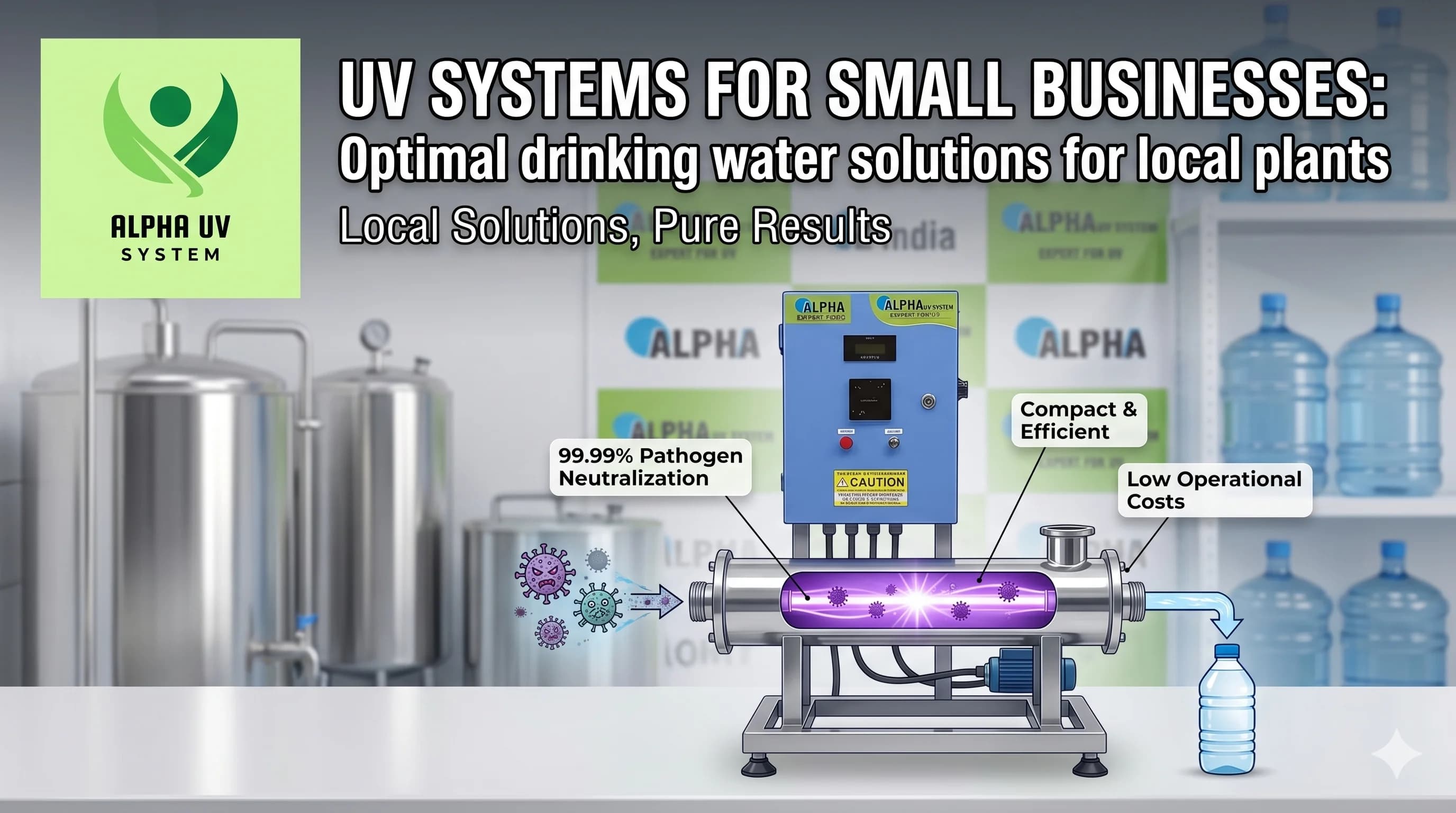
Small businesses in India — restaurants, clinics, offices, bakeries, salons, and guesthouses — typically need a UV system in the 1,000–3,000 LPH range with a genuine Philips UV-C lamp. FSSAI-regulated food businesses need a BIS IS 14962-certified system and a maintenance log. Most small business UV systems cost ₹10,000–30,000 with ₹1,500–3,500 annual running cost.
Why Small Businesses Need UV Water Treatment
A household UV unit is built for a family of five. UV water systems for small businesses in India — restaurants, clinics, offices, and bakeries — face entirely different demands: higher peak flow rates, stricter regulatory scrutiny, and documentation requirements that a domestic system cannot satisfy. Five distinct pressures are pushing small Indian businesses towards UV water treatment in 2026.
Regulatory: FSSAI Requires Potable Water in Every Food Business
The Food Safety and Standards Act 2006 and FSSAI Schedule 4 mandate that all water used in food processing, food preparation, and food contact surface cleaning must meet IS 10500:2012 microbiological standards for potable water. UV disinfection is explicitly listed as an approved treatment technology in FSSAI guidance documents. This is not optional guidance — it is a licence condition. Restaurants, cloud kitchens, bakeries, caterers, and food-service businesses operating without a documented water treatment system are in technical non-compliance at every FSSAI inspection.
Liability: One Contamination Incident Can Close a Restaurant
A single food safety incident traced to contaminated water — waterborne typhoid, cholera, or E. coli — can result in an immediate FSSAI licence suspension, product embargo, and potential criminal liability under Section 59 of the Food Safety and Standards Act. Courts have upheld fines of up to ₹5,00,000 for repeat violations. For a small restaurant or café operating on thin margins, a licence suspension of even two weeks can be commercially fatal. A ₹15,000–25,000 UV system with proper documentation is among the most cost-effective liability mitigation measures available.
Reputation: Water Quality Incidents Go Viral in India
Customer complaints about water quality in restaurants — from a single negative Zomato or Google Maps review mentioning stomach illness — can reduce footfall significantly within days. In Delhi NCR, Mumbai, and Bengaluru, where restaurant discovery is driven heavily by online ratings, reputation protection from water quality incidents has measurable commercial value. UV water systems for small businesses in India address this risk continuously and automatically, without the daily operational overhead that alternatives like boiling or chemical dosing require.
Insurance: Documented Water Treatment Matters
Commercial property and public liability insurers in India are increasingly asking food businesses to demonstrate water quality management as part of underwriting. A food-grade UV system with a documented maintenance log strengthens your position during claims involving food safety incidents. While insurance requirements vary, having documented water treatment is always preferable to having none.
NABH: Clinics and Diagnostic Centres Face a Separate Standard
The National Accreditation Board for Hospitals and Healthcare Providers (NABH) requires documented water quality management for patient-facing areas in clinics, diagnostic centres, and small hospitals. NABH inspectors verify maintenance records, lamp replacement logs, and annual water quality test reports (total coliform, E. coli) during accreditation audits. UV water systems for small businesses in the healthcare category — general practice clinics, dental practices, and physiotherapy centres — must meet this documentation standard, not simply install a system and assume compliance.
UV Requirements by Business Type
Different business types in India face different regulatory requirements, water use patterns, and documentation needs. The table below maps the most common small business categories to the right UV specification.
| Business Type | Water Use | Regulatory Requirement | Recommended UV Size | Key Documentation |
|---|---|---|---|---|
| Restaurant (up to 50 covers) | Cooking, drinking, ice | FSSAI Schedule 4 | 1,000–2,000 LPH | FSSAI licence, UV maintenance log |
| Restaurant (50–200 covers) | Kitchen + multiple taps | FSSAI Schedule 4 | 2,000–5,000 LPH | FSSAI licence, UV maintenance log |
| Clinic / diagnostic centre | Drinking water, equipment rinse | NABH water quality standard | 500–1,000 LPH | NABH audit documentation |
| Dental clinic | Handpiece water, patient drinking | NABH + Dental Council guidelines | 500–1,000 LPH | Dental council documentation |
| Bakery / confectionery | Dough water, washing | FSSAI product standards | 1,000–2,000 LPH | FSSAI product standards log |
| Beauty salon / spa | Treatment water, drinking | Local municipal standard | 500–1,000 LPH | Owner discretion / municipal norms |
| Office (up to 50 employees) | Drinking water | Employee welfare (Factories Act) | 500–1,000 LPH | No mandatory requirement |
| Guesthouse / B&B | Guest drinking water | State tourism norms, FSSAI (if food served) | 1,000–2,000 LPH | Tourism dept requirements |
| Cloud kitchen / catering | All cooking water | FSSAI FLRS compliance | 2,000–3,000 LPH | FSSAI cloud kitchen licence |
FSSAI Compliance: What Small Food Businesses Need to Know
The Food Safety and Standards Act 2006 is the primary regulatory framework governing water use in Indian food businesses. For operators of restaurants, cafes, bakeries, cloud kitchens, and catering units in cities such as Delhi, Mumbai, and Bengaluru, understanding what FSSAI requires — and how a UV system satisfies that requirement — is essential before choosing a system.
What Schedule 4 Says About Water
FSSAI Schedule 4 (Good Manufacturing Practices and Good Hygienic Practices) states that water used in food processing, preparation, and cleaning must be potable, meeting BIS IS 10500:2012 microbiological standards. UV disinfection is explicitly listed as an approved water treatment technology in FSSAI guidance. Installing a BIS IS 14962-certified UV system provides documented proof that your water treatment process meets this standard.
What FSSAI Inspectors Check During Audits
When an FSSAI food safety officer visits your restaurant, café, or food processing unit, they are not testing your water on the spot. They are checking your documentation. Specifically, inspectors look for:
- Evidence that a water treatment system is installed and functional (photographs, installation record)
- A lamp replacement log showing the Philips UV-C lamp has been replaced within the last 12 months
- A recent water quality test certificate from a NABL-accredited laboratory (total coliform and E. coli results)
- The UV system's BIS IS 14962 certificate (confirms the system meets the Indian standard for UV water disinfection equipment)
Minimum Documentation for FSSAI Audit Readiness
The four documents every FSSAI-regulated food business should maintain for their UV water system are:
- Installation record: UV system model, Philips TUV lamp wattage, flow rate specification, and installation date
- Lamp replacement log: Date of each lamp replacement, lamp brand (Philips TUV), and wattage — kept as a running log, not just the most recent entry
- Pre-filter cartridge replacement log: Date of each sediment and carbon filter change
- Annual water quality test: NABL-accredited laboratory certificate confirming total coliform and E. coli are within IS 10500:2012 limits
Risk of Non-Compliance
FSSAI licence suspension is the immediate consequence of a serious water quality finding. Repeat violations attract fines up to ₹5,00,000 under Section 55 of the Act. In 2025–26, FSSAI enforcement activity in food courts and restaurant clusters in Delhi NCR, Mumbai, and Bengaluru has intensified, with water quality documentation now a standard checklist item in scheduled inspections. The cost of compliance — a ₹15,000–25,000 UV system plus ₹2,000–3,500 annual running cost — is negligible compared to the financial exposure of a licence suspension.
Sizing a UV System for Your Small Business
Incorrect sizing is the most common mistake when small businesses purchase UV water systems in India. An undersized system reduces UV dose below the disinfection threshold at peak flow; an oversized system wastes capital. Three steps give you the right size before you contact a supplier.
Step 1: Measure Your Peak Flow Rate
At the kitchen main inlet tap (or the tap closest to your water storage/pump), time how long it takes to fill a 10-litre bucket. Divide 10 by the time in minutes, then multiply by 60. That gives you litres per hour at that tap. Example: 10 litres in 25 seconds = 24 L/min = 1,440 LPH peak flow from one tap.
Step 2: Count Simultaneous Draw Points
In a restaurant kitchen during lunch service, multiple points draw water simultaneously: the main prep sink, the chef's handwash point, the dishwasher inlet, the ice machine, the coffee machine, and the rice boiler. The UV system on the main kitchen supply line must handle the aggregate simultaneous demand, not just one tap. Count your draw points and estimate what fraction are simultaneously active at peak service.
Step 3: Add a 20–25% Safety Margin
UV dose drops as flow rate increases — a 1,000 LPH system running at 900 LPH delivers less UV dose than the same system at 700 LPH. Always size to your calculated peak demand plus 20–25%. For restaurants, peak demand during lunch and dinner service can be 3–4 times your off-peak average — size for peak, not average.
| Business Size | Peak Water Demand | Recommended UV System | Pre-filter |
|---|---|---|---|
| Cafe / chai stall (below 20 covers) | 300–500 LPH | 500 LPH system | 5-micron sediment |
| Small restaurant (20–50 covers) | 500–1,200 LPH | 1,000–1,500 LPH system | 5-micron sediment + carbon |
| Medium restaurant (50–150 covers) | 1,000–3,000 LPH | 2,000–3,000 LPH system | Sediment + carbon |
| Office pantry (up to 50 employees) | 200–500 LPH | 500 LPH system | 5-micron sediment |
| Clinic (general practice, 5 rooms) | 200–400 LPH | 500 LPH system | 5-micron sediment |
| Small hotel (10–20 rooms) | 800–2,000 LPH | 2,000 LPH system | Sediment + consider iron filter if borewell |
UV System Cost for Small Businesses in India 2026
The purchase cost and annual running cost of UV water systems for small businesses in India vary primarily by system flow rate (LPH) and lamp wattage. The table below covers the four most common sizes for restaurants, clinics, and offices.
| System Size | Purchase Cost | Annual Lamp (Philips TUV) | Annual Pre-filter | Total Annual Running Cost |
|---|---|---|---|---|
| 500 LPH (7W) | ₹8,000–15,000 | ₹600–900 | ₹400–800 | ₹1,000–1,700 |
| 1,000 LPH (11W) | ₹10,000–20,000 | ₹900–1,500 | ₹600–1,200 | ₹1,500–2,700 |
| 2,000 LPH (16W) | ₹15,000–30,000 | ₹1,200–2,000 | ₹800–1,600 | ₹2,000–3,600 |
| 3,000 LPH (25W) | ₹20,000–45,000 | ₹1,500–2,500 | ₹1,000–2,000 | ₹2,500–4,500 |
The Philips TUV lamp is the only lamp cost listed above because it is the only lamp that should be used in any commercial UV system for which you are maintaining FSSAI or NABH audit documentation. Generic lamps do not carry certifiable UV output specifications and cannot be used to demonstrate compliance at audit. Keep the lamp packaging and invoice as documentary proof of brand.
Installation in Small Business Premises
UV system installation in commercial premises requires two things a domestic installation does not: correct placement in the treatment train, and a dedicated electrical circuit. Getting either wrong reduces both disinfection performance and compliance documentation value.
Restaurants and Food Service
For restaurants in Delhi NCR, Mumbai, Bengaluru, and other Indian cities, the preferred installation point is on the main kitchen water supply line, upstream of all draw points (prep sinks, dishwasher, ice machine, coffee machine). This single-point installation treats all kitchen water in one pass. For very large kitchens, a supplementary point-of-use UV unit at the chef's prep sink provides additional protection for high-risk applications such as raw produce washing.
Clinics and Diagnostic Centres
Install the UV system on the main drinking water supply and, separately, on any equipment rinse water supply where instrument-grade water quality is required. Do not combine clinical equipment rinse water and patient drinking water on the same UV unit if the flow rates differ significantly — each application should be sized independently.
Offices
Install on the pantry water supply line before the water dispenser or boiler. In a multi-floor office building, install one UV unit per floor pantry rather than a single large central unit with long post-treatment distribution runs. UV provides no residual disinfection — any pipe length after the UV chamber is an untreated zone for recontamination.
Critical: UV Must Be the Last Treatment Stage
Any carbon filter, sediment filter, or iron removal filter must be installed before the UV chamber, never after. Carbon and sediment filters remove particles that reduce UV transmittance — they are essential pre-treatment. Installing a filter after UV wastes the disinfection by reintroducing an unsterilised media contact surface. Professional installation by a licensed plumber and electrician is recommended for all commercial UV installations in India.
What to Tell Your UV Supplier
When contacting a supplier for UV water systems for small businesses in India — whether you are a restaurant owner in Delhi NCR, a clinic manager in Mumbai, or a café operator in Bengaluru — give them these six data points to get an accurate specification:
- Business type and FSSAI licence number: Determines documentation package required (FSSAI, NABH, or general commercial)
- Peak flow rate at your main water supply point: Time to fill a 10L bucket at the main tap, as described in the sizing section above
- Water source: Municipal corporation supply or borewell — determines pre-treatment requirements
- If borewell: iron level: Request an iron test if unknown — iron above 0.3 mg/L requires an iron removal pre-filter before UV
- TDS of your water: TDS above 500 ppm typically requires RO before UV for drinking water applications
- Whether you need BIS IS 14962 certification documentation: Required for FSSAI audit; confirm your supplier can provide the certificate for the specific model supplied
Also ask whether the system includes a UV intensity monitor. For FSSAI-regulated food businesses, a UV intensity monitor (which alerts when lamp output drops below the disinfection threshold) is strongly recommended — it provides real-time evidence that the system is functioning and supports your maintenance log documentation.
UV System for Restaurants: FSSAI Audit Preparation Checklist
This checklist covers the documentation an FSSAI inspector expects to find during a scheduled or surprise audit of a restaurant or food service business using UV water treatment.
| Item | Status | Documentation |
|---|---|---|
| UV system with BIS IS 14962 certificate | Must have | Certificate on file |
| Philips UV-C lamp (brand verified) | Must have | Lamp packaging kept as proof |
| Lamp replacement log | Must have | Date, wattage, brand recorded at each replacement |
| Pre-filter cartridge replacement log | Should have | Date recorded at each change |
| Annual water quality test | Must have | NABL lab certificate for total coliform + E. coli |
| Installation record | Should have | Date, model, flow rate specification |
Alpha UV System provides a ready-to-use FSSAI documentation folder with every commercial UV system supplied — including the BIS IS 14962 certificate, installation record template, lamp replacement log template, and guidance on commissioning a NABL water test in your city.
Frequently Asked Questions
Does my restaurant legally need a UV water treatment system?
FSSAI does not mandate a specific brand or technology — it mandates that water used in food preparation meets IS 10500:2012 potable water standards and that there is documented evidence of water treatment. UV disinfection is the most common and most easily documented water treatment method for restaurants in India. A restaurant operating on municipal supply without any on-site treatment step cannot demonstrate documented compliance at an FSSAI inspection. In practice, a BIS IS 14962-certified UV system with a maintenance log is the standard approach used by FSSAI-compliant restaurants across Delhi NCR, Mumbai, and Bengaluru.
Can I show my UV system during an FSSAI inspection?
Yes — and you should. FSSAI inspectors conducting audits under Schedule 4 will ask to see the water treatment system. What they assess is: Is the system installed and operational? Is the UV lamp within its rated service life (12 months from last replacement)? Is there a lamp replacement log? Is there a recent water quality test certificate? Showing a functioning UV system with organised documentation is one of the most effective ways to pass the water quality section of an FSSAI audit without a corrective action notice.
What is the minimum UV system for a small cafe or chai stall?
A 500 LPH UV system with a 7W Philips UV-C lamp and a 5-micron sediment pre-filter is appropriate for a small cafe or chai stall with below 20 covers on a municipal water supply. The purchase cost is ₹8,000–15,000 with annual running costs of ₹1,000–1,700. This is sufficient to provide documented water treatment for FSSAI basic licence compliance. If the stall operates on borewell water with unknown iron content, request a water test before specifying — iron above 0.3 mg/L will foul the UV lamp sleeve and reduce performance.
Can I use a domestic UV system in my restaurant?
No. Domestic UV systems are designed for 50–100 LPH at kitchen tap flow rates, with plastic housings and domestic-grade lamp specifications. They are not rated for commercial flow rates, do not carry BIS IS 14962 commercial certification, and cannot provide the food-safe material declarations (SS316L chamber, EPDM O-rings) required for FSSAI audit documentation. Using a domestic UV system in a restaurant kitchen creates both a performance gap — the system will be overwhelmed during peak service — and a compliance gap, since the documentation required for FSSAI audit does not exist for domestic systems.
How do I prove to an FSSAI inspector that my UV system is working?
Three forms of evidence are accepted and expected: (1) a lamp replacement log showing the Philips TUV lamp was replaced within the last 12 months, with the packaging retained as proof of brand; (2) a UV intensity monitor reading (if your system has one) showing the lamp is above the minimum intensity threshold; and (3) an annual water quality test certificate from a NABL-accredited laboratory showing total coliform and E. coli within IS 10500:2012 limits. The water quality test certificate is the strongest evidence — it shows the output of the entire treatment system, not just that a component is installed.
How often should a restaurant UV system be serviced?
A restaurant UV system should have its Philips UV-C lamp replaced every 12 months regardless of visible lamp condition — UV output degrades below the disinfection threshold before the lamp visibly fails. The sediment pre-filter cartridge should be replaced every 3–6 months depending on local water turbidity (more frequently during monsoon in cities with surface water supply such as Delhi and Mumbai). The carbon pre-filter (if installed) should be replaced every 6 months. Annual professional servicing by the supplier — with a signed service report — provides the documentation continuity required for FSSAI audit readiness. Alpha UV System offers annual maintenance contracts with 24–48 hour response and full documentation support.
Alpha UV System supplies FSSAI-compliant UV water systems for small businesses across India — restaurants, clinics, offices, bakeries, and cloud kitchens. We provide BIS IS 14962-certified systems, Philips TUV lamps, complete FSSAI documentation packages, and annual maintenance contracts with 24–48 hour response. WhatsApp us with your business type and peak flow rate for a same-day specification.
WhatsApp Us for a Free SpecificationRecommended UV Systems
Alpha UV System products for this application — powered by genuine Philips UV-C lamps.
Commercial UV Water Purification System
500 – 5,000 LPH
HACCP-compliant UV water purification for hotels, restaurants, and offices
Industrial UV Water Treatment System
5,000 – 50,000 LPH
Schedule M 2025 and HACCP compliant UV for pharma, food & beverage, and process water
Not sure which system suits your application? WhatsApp our engineers for a free recommendation →
Related solutions
See how Alpha UV System applies this to your industry or city.
Need a UV system?
Talk to our UV engineers — WhatsApp for a quote in 2 hours, or browse the full catalog on IndiaMART.