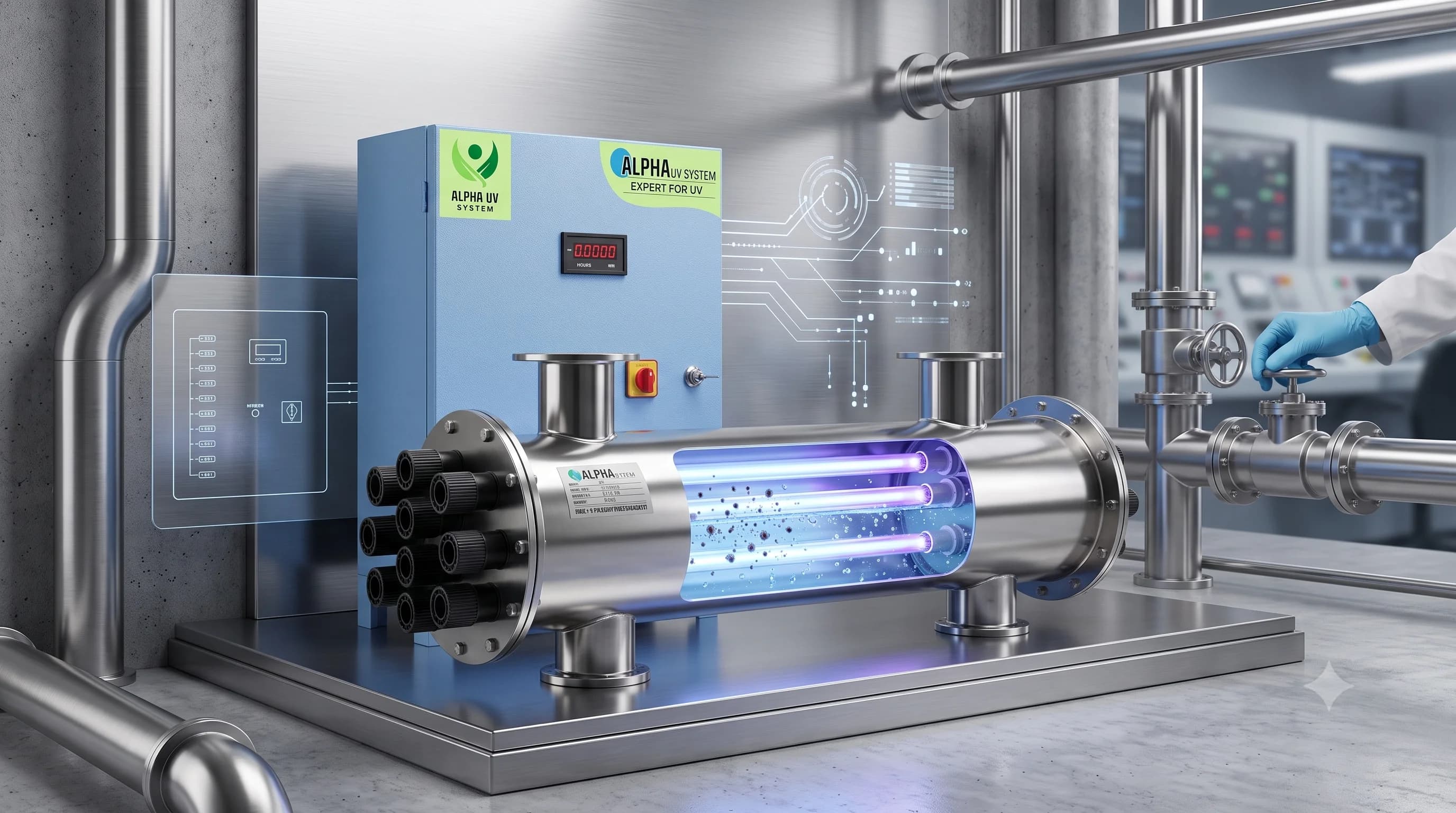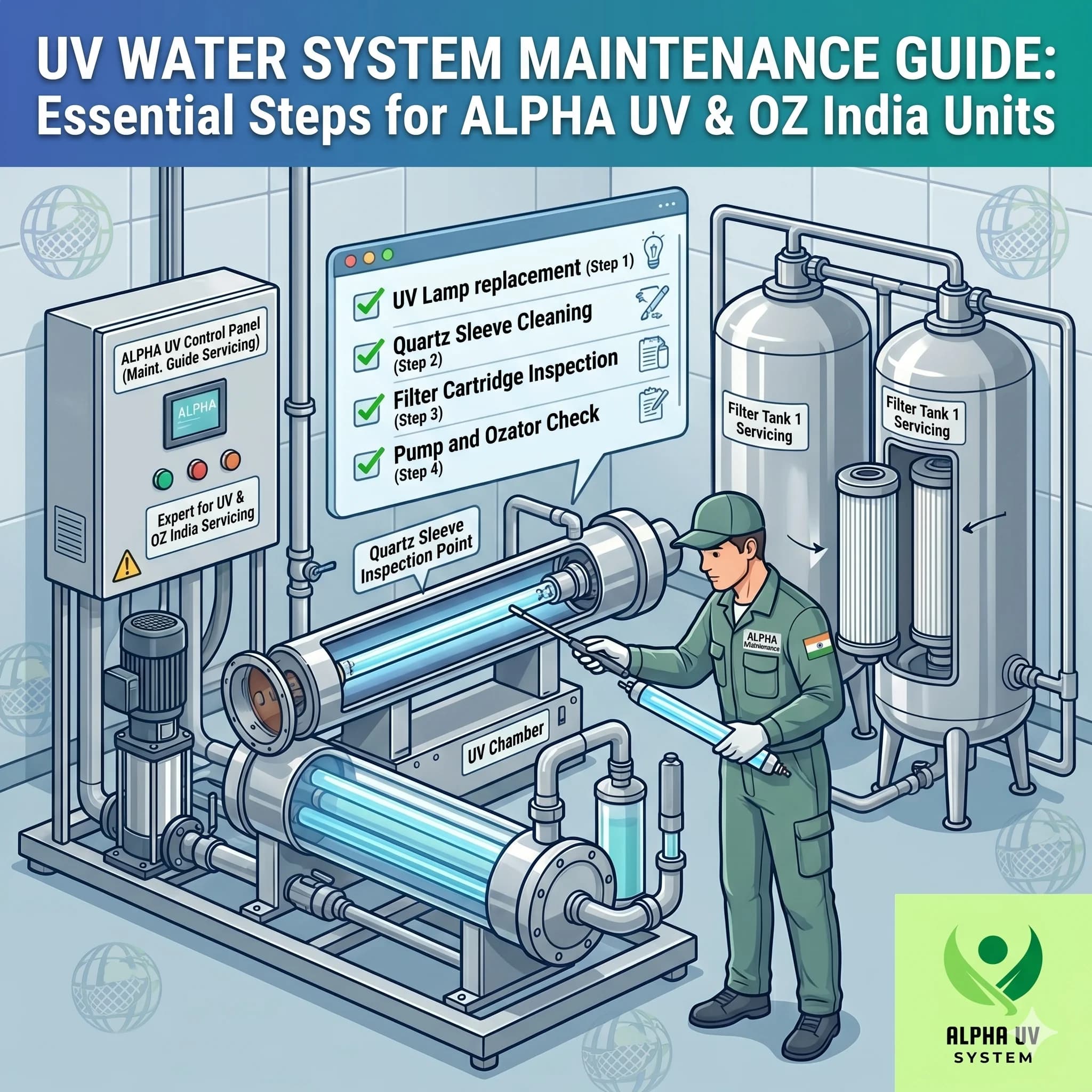
UV water system maintenance requires exactly one annual task: replace the UV lamp. The job takes around 30 minutes per year, needs no specialist tools, and keeps your system delivering the 40 mJ/cm² dose required for safe disinfection. A quartz sleeve inspection and clean adds another 20 minutes and is done at the same time. That is the entire UV purifier maintenance schedule for most residential and light-commercial users.
Why UV System Maintenance Is Simpler Than Chlorination or RO
When plant managers and facility engineers ask about UV water system maintenance — how often to service, what tasks are involved, what it costs — most expect a complex answer. They have dealt with chlorination systems (chemical dosing, residual testing, storage tank cleaning, disinfection by-product monitoring) or RO plants (membrane replacement every 2–3 years, pre-filter cartridge changes every 3–6 months, high-pressure pump servicing, reject water management). Against that backdrop, UV water system servicing is almost surprisingly simple.
A UV system has no chemical consumables, no membranes to foul, no high-pressure components, and no moving parts. The lamp is the only wear item that follows a predictable replacement schedule. The quartz sleeve needs periodic cleaning — especially in India's hard-water geographies — but rarely needs replacement before three to five years of service. The entire UV system annual maintenance routine for a residential or small commercial unit can be completed by a technically capable operator in under an hour, once per year.
This guide covers the complete UV purifier maintenance schedule: every task, every frequency, every cost benchmark, and every compliance consideration for Indian homes, food businesses, pharmaceutical facilities, and industrial water treatment plants.
Complete Annual Maintenance Schedule Overview
The table below summarises every UV water system maintenance task, how often each is needed, and what happens if it is skipped. We have covered UV water system maintenance — how often each task applies — for all common system types in India.
| Task | Frequency | Time Required | Who Can Do It | If Skipped |
|---|---|---|---|---|
| UV lamp replacement | Every 9,000 operating hours (typically annual) | 20–30 min | Operator / in-house technician | Inadequate UV dose; pathogen survival |
| Quartz sleeve inspection | Annual (with lamp change) | 5 min | Operator / in-house technician | Undetected fouling reduces dose |
| UV quartz sleeve cleaning | Annual (hard water: every 6 months) | 20–30 min | Operator / in-house technician | Scale buildup cuts UV-C transmission 20–40% |
| Quartz sleeve replacement | Every 3–5 years | 15–20 min | Technician (recommended) | Permanent UV-C loss through degraded quartz |
| O-ring and seal inspection | Every 3–5 years | 10 min | Technician | Water leakage; lamp failure |
| UV intensity monitor check | Annual (commercial/industrial) | 15 min | Technician with reference sensor | Uncalibrated readings; compliance gap |
| Inlet strainer / pre-filter clean | Every 3–6 months (turbid water) | 10 min | Operator | High turbidity reduces UV penetration |
| Maintenance log update | After every task | 5 min | Operator | Audit failure (FSSAI, Schedule M, CPCB) |
Task 1: UV Lamp Replacement — The Core Annual Task
Why Annual Replacement Is Mandatory, Not Optional
The most important thing to understand about UV water system maintenance — how often the lamp must be changed and why — comes down to physics. A Philips UV-C low-pressure lamp does not fail suddenly. It degrades gradually. The UV-C output at 254 nm decreases continuously from the first hour of operation. Philips TUV lamps are rated for 9,000 hours at 80% of initial UV-C output. That 80% threshold is deliberately chosen: it corresponds to the minimum UV-C dose needed to deliver 40 mJ/cm² at the system's rated flow rate.
Below 80% UV-C output, the system may no longer achieve 40 mJ/cm² — the internationally accepted threshold for 4-log (99.99%) inactivation of bacteria and viruses. The lamp appears to work (it still glows blue-white) but water is not being adequately disinfected. This is the defining danger of deferred UV lamp replacement: no visible failure signal.
Operating hours math for Indian installations:
- Continuous 24/7 operation (STPs, industrial, commercial food): 9,000 ÷ 8,760 = approximately 12.5 months → replace annually without exception
- 16 hours/day (shift-operation food plants, hotels): 9,000 ÷ 5,840 = approximately 18 months → replace every 18 months
- 12 hours/day (commercial, schools, hospitals): 9,000 ÷ 4,380 = approximately 25 months → replace every 2 years
- 8 hours/day (residential, small offices): 9,000 ÷ 2,920 = approximately 37 months → replace every 3 years
If your UV system has an electronic lamp-hours counter — standard on most commercial and industrial Alpha UV System units, and increasingly available on residential models — this is the most reliable guide to UV lamp replacement in India. Never rely solely on calendar date for UV water system maintenance; operating hours are the accurate metric.
| Operating Hours | % UV-C Output | Dose at Rated Flow (mJ/cm²) | Disinfection Status | Action |
|---|---|---|---|---|
| 0 – 1,000 hrs | 100 – 97% | ≥ 55 mJ/cm² | Excellent | No action needed |
| 1,000 – 3,000 hrs | 97 – 93% | 52 – 55 mJ/cm² | Good | No action needed |
| 3,000 – 6,000 hrs | 93 – 88% | 47 – 52 mJ/cm² | Adequate | Monitor UV intensity; order replacement lamp |
| 6,000 – 9,000 hrs | 88 – 80% | 40 – 47 mJ/cm² | Marginal | Replace at 9,000 hrs; do not defer |
| 9,000 – 12,000 hrs | 80 – 70% | 32 – 40 mJ/cm² | Inadequate | Replace immediately; water may not be safe |
| > 12,000 hrs | < 70% | < 32 mJ/cm² | Unsafe | Replace immediately; stop use at rated flow rate |
Step-by-Step UV Lamp Replacement (12 Steps)
UV system lamp replacement in India is designed to be operator-executable with no specialist tools. Follow these steps carefully for safe, correct replacement.
- Switch off power at the wall socket or dedicated isolator for the UV unit. Do not merely turn off the lamp switch — isolate the power completely.
- Allow the lamp to cool for 10–15 minutes. Low-pressure UV-C lamps operate at temperatures up to 40–60°C; removing a warm lamp risks burns and is slightly harder to handle safely.
- Close the inlet valve to stop water flow through the UV chamber. This prevents untreated water from flowing through the system while the lamp is out.
- Relieve pressure if the system runs under mains pressure — open a downstream tap briefly to bleed pressure from the chamber before removing the lamp cap.
- Remove the lamp cap — typically a screw-on or quarter-turn quick-release cap at the top or end of the chamber. Note whether it is threaded or bayonet; do not over-force.
- Disconnect the lamp connector — a two-pin or push-fit connector. Pull by the connector body, not by the cable.
- Slowly slide the old lamp out of the quartz sleeve. UV-C lamps are glass tubes (20–60 cm depending on chamber size). Support the full length as you extract it. Do not drop. Wrap in the original packaging or newspaper for safe disposal.
- Inspect the quartz sleeve while the lamp is out — this is the natural moment for UV quartz sleeve cleaning (see Task 2 below).
- Put on clean cotton gloves before handling the new Philips UV-C lamp. Fingerprints leave oily deposits at 254 nm that absorb UV-C and permanently reduce output from that lamp. If gloves are unavailable, hold the lamp through its protective sleeve until the moment of insertion.
- Slide the new lamp gently into the quartz sleeve. The lamp should move smoothly — do not force or press laterally. Stop if you feel resistance and check alignment.
- Reconnect the lamp connector and replace the lamp cap. Tighten firmly but do not over-torque on plastic-threaded caps.
- Open the inlet valve, restore power, and check the UV intensity indicator. It should show normal (green or full-scale) within 1–2 minutes of startup. Record the replacement date, new lamp batch number, and cumulative operating hours in the maintenance log.
Total time including quartz sleeve inspection: 25–35 minutes. No specialist tools required for most residential and small commercial models.
Where to Buy Genuine Philips UV-C Lamps in India
Purchase genuine Philips TUV UV-C replacement lamps only from the original manufacturer or authorised distributors. Grey-market and counterfeit UV-C lamps are widely sold online — often at 40–60% lower prices — and commonly exhibit the following problems:
- Actual UV-C output 15–30% below labelled specification (verified by independent testing)
- Shorter actual rated life — often 5,000–6,000 hours despite claiming 9,000 hours
- No Certificate of Analysis (COA) documentation for FSSAI, Schedule M, or CPCB compliance audits
- No traceability if a food safety or water quality incident occurs
For Alpha UV System units, we supply genuine Philips UV-C replacement lamps directly, with COA documentation. UV lamp replacement cost India varies by lamp wattage and system size — see the cost guide below for benchmarks.
Task 2: Quartz Sleeve Inspection and Cleaning (Annual)
What Is the Quartz Sleeve?
The quartz sleeve is a transparent tube of high-purity fused silica that surrounds the UV-C lamp inside the water chamber. Ordinary borosilicate glass absorbs UV-C radiation at 254 nm almost completely; fused silica (quartz) transmits it at over 90% efficiency. This is why UV systems use quartz, not glass. The sleeve serves two purposes: it isolates the lamp from direct water contact (which would extinguish a low-pressure lamp instantly) and it forms the inner surface of the annular water flow channel through which water passes and receives the UV-C dose.
Because the outer surface of the quartz sleeve is in continuous contact with the process water, it is the surface most exposed to mineral deposition and fouling — making UV quartz sleeve cleaning one of the most geographically variable maintenance tasks in India.
Why the Quartz Sleeve Fouls — and Why It Matters in India
In hard water regions — which include much of Rajasthan, Gujarat, western UP, Haryana, and parts of Maharashtra — the quartz sleeve is under constant calcium carbonate and magnesium scaling pressure. As water contacts the warm quartz surface, dissolved calcium precipitates as calcite scale. Even a 0.1 mm scale layer can reduce UV-C transmission by 20–30%. A heavier scale layer of 0.3–0.5 mm can reduce transmission by 50–70%, bringing the delivered UV dose well below the 40 mJ/cm² threshold.
Iron fouling is a separate problem common in borewell water across UP, Bihar, and parts of the Deccan. Dissolved ferrous iron oxidises on the quartz surface and deposits as ferric hydroxide — an orange-brown layer that is highly opaque to UV-C. Borewell installations in these regions may need UV quartz sleeve cleaning every 3–4 months rather than annually.
Biofilm is a third fouling mechanism, most relevant in slow-flow or intermittently operated systems where stagnant water contacts the sleeve surface. Biofilm adds both an optical barrier and a microbial reservoir directly on the sleeve.
| Water Type / Region | Fouling Type | Fouling Rate | Cleaning Frequency | Signs of Fouling |
|---|---|---|---|---|
| Municipal soft water (Mumbai, Bengaluru) | Minimal mineral; light biofilm | Low | Every 18–24 months | Light haze; minor UV drop |
| Municipal hard water (Delhi NCR, Hyderabad) | Calcium carbonate scale | Moderate | Every 12 months | White/grey scale; UV monitor drop |
| Very hard water (Rajasthan, Gujarat, western UP) | Heavy calcium / magnesium scale | High | Every 6 months | Visible white crust; significant UV drop |
| Borewell with iron (UP, Bihar, Jharkhand) | Ferric hydroxide deposit | High to very high | Every 3–4 months | Orange-brown staining; rapid UV drop |
| Surface water (rivers, lakes — STP input) | Biofilm + organic fouling | Moderate to high | Every 3–6 months | Brown/grey film; odour near sleeve |
| RO permeate / demineralised water | Negligible (very low TDS) | Very low | Every 24–36 months | None visible; verify by UV monitor |
How to Clean the Quartz Sleeve
- Remove the quartz sleeve from the chamber after removing the lamp. Handle with dry cotton gloves — fingerprints on quartz reduce UV-C transmission permanently at that spot.
- Hold the sleeve up to a light source and inspect for scale, staining, cracking, or permanent discolouration.
- For calcium scale (white/grey): prepare a 1:4 white vinegar to water solution, or a 5–8% citric acid solution. Submerge the sleeve and soak for 20–30 minutes. Citric acid is more effective for heavier scale deposits common in Rajasthan and Gujarat installations.
- For iron deposits (orange-brown): a 10% citric acid solution or a purpose-made descaling agent is more effective than vinegar. Soak for 30–45 minutes.
- Gently wipe with a non-abrasive cloth or soft microfibre sponge. Never use steel wool, scouring pads, or abrasive cleaners — these create microscopic surface scratches that permanently reduce quartz UV-C transmission by 5–15% per cleaning event.
- Rinse thoroughly under clean water to remove all cleaning solution residue.
- Inspect the cleaned sleeve for clarity: it should be visually clear, not hazy or milky. Milky or cloudy areas that remain after cleaning indicate permanent quartz degradation — replace the sleeve.
- Inspect for cracks or chips — a cracked sleeve must be replaced immediately as it will allow water to contact the lamp.
Never use hydrofluoric acid, strong caustic (NaOH) cleaners, or abrasive powders on quartz. These chemically etch the silica surface and destroy UV-C transmission permanently.
Task 3: Quartz Sleeve Replacement (Every 3–5 Years)
Even with meticulous UV quartz sleeve cleaning after every annual service, quartz sleeves gradually lose UV-C transmission over years of service. Surface micro-abrasions accumulate, and the quartz material itself undergoes minor structural changes from long-term UV-C irradiation. These changes are not visually obvious but are measurable: a UV intensity monitor will show progressively lower readings over time even after lamp replacement and sleeve cleaning, indicating the sleeve itself is now limiting dose delivery.
Replace the quartz sleeve when:
- It shows milky, brown, or permanently discoloured areas that do not clear with cleaning
- UV intensity monitor reading is below normal after new lamp installation and clean sleeve
- The sleeve has any visible crack, chip, or mechanical damage
- It has been in service for more than 5 years in continuous operation
Always replace with the sleeve specified for your exact Alpha UV System model. Quartz sleeves differ in outer diameter, wall thickness, end-fitting geometry, and UV-C transmission grade across different system models and flow rates. An incorrectly specified sleeve may fit mechanically but deliver lower UV-C transmission than specified.
Task 4: O-Ring and Seal Inspection (Every 3–5 Years)
O-rings seal the lamp cap to the chamber body and the quartz sleeve to its end-fittings. Alpha UV System units use EPDM or Viton O-rings — both rated for continuous water contact and UV-C exposure. Over 3–5 years, particularly in environments with temperature cycling (common in unventilated equipment rooms and rooftop utility areas in Indian summers where ambient temperatures can reach 45–50°C), O-rings can harden, crack, or permanently deform. A hardened O-ring loses its sealing ability and can cause water ingress into the lamp cavity, causing immediate lamp failure and potential short-circuit.
Inspect O-rings during every lamp replacement: squeeze gently between fingers — they should feel soft and elastic, not hard or brittle. Replace any O-ring that shows cracking, hardening, or flattening. O-rings are inexpensive components (₹50–200 each) and should always be replaced if there is any doubt about condition during a lamp service visit.
Task 5: UV Intensity Monitor Calibration Check (Annual — Commercial and Industrial)
Commercial and industrial UV systems are equipped with UV intensity monitors (also called UV sensors or UVT monitors) that continuously measure UV-C irradiance inside the chamber. These sensors provide the real-time assurance that the system is delivering adequate dose — they are critical process control instruments for FSSAI food production, Schedule M pharmaceutical water, and CPCB sewage treatment compliance.
UV intensity sensors themselves degrade over time: the sensor window fouls with mineral deposits, and the sensor's spectral response drifts with age. An uncalibrated sensor may show "normal" readings even when actual UV-C intensity has dropped below the required threshold — giving a false sense of compliance. Annual calibration verification against a traceable reference sensor (or sensor replacement per manufacturer schedule) is mandatory for commercial UV water system servicing on regulated systems.
For residential systems without UV intensity monitors, the lamp-hours counter or replacement date is the primary maintenance indicator.
Maintenance Schedule by UV System Type
| System Type | Capacity (LPH) | Operating Hrs/Day | Lamp Frequency | Sleeve Cleaning | Sleeve Replacement | O-Ring Replacement | AMC Recommended? |
|---|---|---|---|---|---|---|---|
| Residential | 100 – 500 | 6 – 10 | Every 2–3 years | Annual | Every 5 years | Every 5 years | Optional |
| Small commercial | 500 – 3,000 | 10 – 16 | Every 18 months | Every 6–12 months | Every 4 years | Every 4 years | Recommended |
| Large commercial | 3,000 – 20,000 | 16 – 24 | Every 12 months | Every 6 months | Every 3 years | Every 3 years | Strongly recommended |
| Industrial | 20,000 – 200,000 | 24 | Every 9–12 months | Every 3–6 months (or auto-wiper) | Every 3 years | Every 2–3 years | Essential |
| STP / ETP | > 100,000 | 24 | Every 9 months | Monthly visual; quarterly clean | Every 2–3 years | Every 2 years | Mandatory (CPCB requirement) |
Maintenance Cost Guide for India (2026)
UV lamp replacement cost India varies by lamp wattage, system capacity, and whether you use in-house operators or an AMC provider. The table below gives realistic benchmarks for 2026 across residential, commercial, and industrial categories. All figures are for genuine Philips UV-C lamps and standard UV system servicing.
| Maintenance Task | Residential (₹) | Commercial (₹) | Industrial (₹) | Frequency |
|---|---|---|---|---|
| UV lamp replacement (parts + labour) | ₹ 2,500 – 5,000 | ₹ 5,000 – 18,000 | ₹ 15,000 – 80,000 | Per lamp cycle |
| Quartz sleeve cleaning (labour) | DIY or ₹ 500 – 800 | ₹ 800 – 2,500 | ₹ 2,000 – 8,000 | Annual or per schedule |
| Quartz sleeve replacement (parts + labour) | ₹ 1,500 – 3,500 | ₹ 3,500 – 12,000 | ₹ 10,000 – 45,000 | Every 3–5 years |
| O-ring set replacement | ₹ 200 – 500 | ₹ 500 – 1,500 | ₹ 1,000 – 4,000 | Every 3–5 years |
| UV intensity sensor calibration / replacement | N/A | ₹ 3,000 – 8,000 | ₹ 8,000 – 25,000 | Annual |
| Annual Maintenance Contract (AMC) — all tasks | ₹ 3,000 – 6,000/yr | ₹ 8,000 – 25,000/yr | ₹ 25,000 – 1,50,000/yr | Annual contract |
Maintenance Log: What to Record for Compliance
UV water system maintenance — how often tasks are done and what was found — must be documented for regulated industries. The following records are mandatory for FSSAI-licensed food and beverage businesses (as a Critical Control Point), Schedule M pharmaceutical manufacturing facilities, and CPCB-regulated sewage treatment plants. They are strongly recommended for any commercial installation.
Record the following after every maintenance event:
- Date and time of maintenance
- System identifier (tag number, location, flow rate)
- Task performed (lamp replacement / sleeve cleaning / sleeve replacement / O-ring replacement / sensor calibration)
- Lamp batch number and Philips COA reference (for traceability — mandatory for Schedule M)
- Cumulative operating hours at time of maintenance
- UV intensity monitor reading before and after maintenance (pre/post comparison confirms maintenance effectiveness)
- Quartz sleeve condition (clean / light scale / heavy scale / permanent fouling / replaced)
- O-ring condition (normal / hardened / replaced)
- Any alarms or abnormal readings during the operating period
- Name and signature of technician who performed maintenance
- Next scheduled maintenance date
A simple A4 logbook or spreadsheet is sufficient for most installations. Industrial and pharmaceutical systems increasingly use digital maintenance management systems (CMMS) that generate audit-ready reports automatically. Alpha UV System provides a pre-formatted maintenance log template with every commercial UV system.
What Happens If UV System Maintenance Is Neglected
Unlike a pump failure or pipe leak, UV system degradation from deferred maintenance is silent. Water continues to flow. The system continues to appear operational. Contaminated water passes through undetected. This makes UV water system maintenance — how often it is done — a genuine safety-critical concern, not merely a manufacturer recommendation.
| Neglected Task | What Happens | Time to Failure | Compliance Risk | How to Recover |
|---|---|---|---|---|
| UV lamp not replaced at 9,000 hrs | UV-C dose drops below 40 mJ/cm²; bacteria and viruses survive | Immediate after 9,000 hrs | FSSAI, Schedule M, CPCB CCP failure | Replace lamp; flush system; microbiological test |
| Quartz sleeve not cleaned | Scale cuts UV-C transmission 20–70%; dose below threshold even with new lamp | 6–18 months (hard water) | Compliance gap; product recall risk (food) | Clean or replace sleeve; verify UV intensity |
| O-ring not inspected | Water ingress into lamp cavity; lamp failure or short-circuit | 3–7 years (temperature cycling) | Electrical safety risk; system downtime | Replace O-rings, lamp, and ballast if water damaged |
| UV intensity sensor not calibrated | Sensor gives false-normal reading; compliance records invalid | 2–4 years drift | Audit failure; invalid CCP records | Replace sensor; re-validate CCP records |
| Maintenance log not maintained | No evidence of maintenance for regulatory audit | First audit | FSSAI licence risk; Schedule M observation; CPCB penalty | Reconstruct records from supplier invoices; implement log immediately |
AMC vs DIY Maintenance: When to Use Each
For residential users and small commercial systems (up to 2,000 LPH) where the operator is reasonably technical and water quality is stable municipal supply, DIY UV system maintenance is practical. The lamp replacement procedure is simple, the tools required are minimal (a screwdriver and clean gloves), and genuine Philips replacement lamps can be supplied directly with clear fitting instructions.
An Annual Maintenance Contract (AMC) is the right choice when:
- The system is operated continuously (16–24 hours/day) and lamp hours accumulate rapidly
- The installation is in a regulated environment — FSSAI food production, Schedule M pharmaceutical, CPCB-regulated STP — where maintenance records must be auditable
- Water quality is challenging (high TDS, iron, turbidity) and sleeve fouling requires frequent expert assessment
- Multiple UV systems are installed across a facility and coordinated maintenance scheduling adds value
- The facility does not have trained technical personnel available for UV system servicing
- The system has UV intensity monitors, PLC controls, or auto-wiper systems requiring calibration
Alpha UV System AMCs cover scheduled lamp replacement with genuine Philips UV-C lamps, quartz sleeve inspection and cleaning, UV intensity monitor check, O-ring inspection, maintenance log documentation, and a written system performance report. Nationwide coverage with 24–48 hour response for commercial and industrial systems across Delhi NCR, Mumbai, Pune, Hyderabad, Ahmedabad, Jaipur, Lucknow, and other major centres.
How to Tell If Your UV System Needs Immediate Attention
Between scheduled UV water system maintenance intervals, watch for these indicators that something may be wrong and immediate inspection is required:
- Alarm light or alarm beeper: Modern UV systems trigger an alarm when lamp hours exceed the replacement threshold, when UV intensity drops below the set point, or when the lamp fails completely. Never silence an alarm and continue operation — investigate immediately.
- UV intensity monitor reading below normal: If your system has a UV intensity display and the reading has dropped by more than 10–15% from the previous reading, inspect the sleeve and confirm lamp hours.
- Lamp glow colour change: A healthy low-pressure UV-C lamp glows blue-white. A pinkish, orange, or dim glow indicates the lamp is failing and should be replaced.
- Visible water near the lamp cap or fitting: Any water weeping from the lamp cap end indicates an O-ring failure — switch off power immediately and inspect before continuing operation.
- Visible orange-brown deposits on the sleeve observable through the lamp access port: Iron fouling is progressing rapidly and a sleeve clean is needed before the next scheduled service.
- Drop in downstream water quality: If post-UV microbiological test results show total coliforms or heterotrophic plate counts above acceptable limits, this is evidence that the UV dose is insufficient — inspect lamp hours, sleeve condition, and UV intensity immediately.
Frequently Asked Questions
What happens if I don't replace the UV lamp on time?
The UV system will continue to appear fully operational — the lamp will still illuminate with a blue-white glow, the ballast will still power it, and water will still flow through. But UV-C output at 254 nm will have degraded below the 80% threshold needed to deliver 40 mJ/cm² at your system's rated flow rate. Bacteria and viruses including E. coli, Salmonella, Cryptosporidium, and enteric viruses can survive the inadequate UV exposure and pass through to your distribution system. This creates a serious public health risk — one that is entirely invisible without a UV intensity monitor. UV water system maintenance — specifically how often the lamp is replaced — is the single most important factor in ensuring continuous safe performance. Replace at 9,000 hours without exception.
Can I buy generic UV replacement lamps to save cost?
Generic and unbranded UV-C replacement lamps are widely sold on Indian e-commerce platforms at 40–60% below genuine Philips TUV pricing. The risks are significant: actual UV-C output at 254 nm is typically 15–30% below the labelled specification (based on independent testing), rated lamp life is often 5,000–6,000 hours rather than the claimed 9,000 hours, and no Certificate of Analysis documentation is provided — which means you cannot demonstrate compliance at a FSSAI, Schedule M, or CPCB audit. For regulated facilities, generic lamps invalidate your compliance records. For any installation, they create an invisible safety gap. UV lamp replacement cost India using genuine Philips lamps is reasonable relative to the safety assurance they provide — and relative to the cost of a food safety incident or regulatory penalty.
How do I know if my quartz sleeve needs cleaning?
Several indicators suggest the sleeve needs cleaning before the scheduled annual service visit. A UV intensity monitor reading that has dropped 10% or more from the previous baseline is the most reliable technical indicator. Visually: if you can observe the sleeve through the lamp access port (or after removing the lamp cap), look for white or grey scale deposits (calcium fouling), orange-brown staining (iron fouling), or a general greyish haze. In hard water areas like Rajasthan, Gujarat, and western UP, scale deposits can be visible as a rough white crust within 6–9 months of the last clean. In borewell iron installations across UP, the sleeve can develop a visible orange coating within 2–3 months. Do not wait for the annual service if any of these signs are present — clean the sleeve promptly to restore UV-C transmission.
Is UV system maintenance expensive?
UV purifier maintenance schedule costs are modest compared to alternative water treatment technologies. A residential UV system costs ₹2,500–5,000 per lamp replacement cycle — which occurs every 2–3 years for a residential installation running 8 hours per day. That is ₹800–2,500 per year, including labour. A commercial FSSAI food business running a 5,000 LPH UV system on an AMC pays ₹12,000–20,000 per year, covering all UV system annual maintenance tasks with documentation — a fraction of the cost of an equivalent chlorination system's chemical consumables, safety compliance, and skilled chemical handling. The UV lamp replacement cost India has remained stable relative to inflation, and for commercial operators the AMC model provides predictable annual budgeting.
Does Alpha UV System provide maintenance service across India?
Yes. Alpha UV System provides AMC (Annual Maintenance Contract) and per-visit UV system servicing for residential, commercial, industrial, and STP/ETP installations across India. Our service network covers Delhi NCR (Greater Noida, Delhi, Noida, Gurgaon, Faridabad), Rajasthan (Jaipur, Jodhpur, Udaipur), Gujarat (Ahmedabad, Surat, Vadodara), Maharashtra (Mumbai, Pune, Nagpur), Uttar Pradesh, and other states. For commercial and industrial systems, we commit to 24–48 hour response from your service request. Our AMC includes scheduled lamp replacement with genuine Philips UV-C lamps and COA documentation, quartz sleeve inspection and cleaning, UV intensity monitor check, O-ring inspection, and a written maintenance record suitable for FSSAI, Schedule M, and CPCB audits. Contact us via WhatsApp or phone to discuss AMC pricing for your system capacity and location.
How long does a UV system last with proper maintenance?
A well-maintained UV system from a quality manufacturer has a service life of 10–20 years. The stainless steel chamber body — the core structural component — is essentially indefinite in service life if made from 304 or 316L stainless steel. The ballast (electronic controller) typically lasts 8–15 years. The quartz sleeve needs replacement every 3–5 years. The lamp is replaced on its rated 9,000-hour cycle. The O-rings are replaced every 3–5 years. With this UV purifier maintenance schedule followed rigorously, the capital investment in a UV system is amortised over a very long service life — making the true cost of ownership exceptionally competitive against RO membranes (2–3 year replacement) or chlorination equipment (pump, chemical storage, dosing system maintenance). The most common cause of premature UV system retirement is deferred maintenance — particularly neglected lamp replacement leading to lamp failure and associated ballast damage — not inherent system wear.
Alpha UV System supplies genuine Philips UV-C replacement lamps and provides AMC servicing for commercial and industrial UV systems across India. 24–48 hour response. FSSAI, Schedule M, and CPCB-compliant maintenance documentation included.
Standards, authorities & further reading
External references used to inform this guide. Regulations evolve — check the latest revision on each authority's site before compliance decisions.
Recommended UV Systems
Alpha UV System products for this application — powered by genuine Philips UV-C lamps.
Commercial UV Water Purification System
500 – 5,000 LPH
HACCP-compliant UV water purification for hotels, restaurants, and offices
Industrial UV Water Treatment System
5,000 – 50,000 LPH
Schedule M 2025 and HACCP compliant UV for pharma, food & beverage, and process water
Not sure which system suits your application? WhatsApp our engineers for a free recommendation →
Need a UV system?
Talk to our UV engineers — WhatsApp for a quote in 2 hours, or browse the full catalog on IndiaMART.