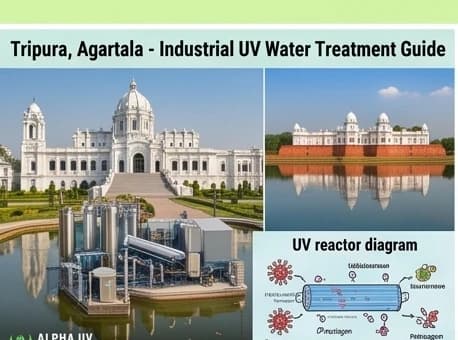
UV water treatment in Agartala addresses 5 key needs: (1) rubber plantation processing industry — latex processing wastewater with high BOD requires TPCB-compliant ETP with UV final disinfection; (2) Bangladesh Akhaura–Agartala Integrated Check Post (ICP) food and beverage trade — FSSAI import-export water quality compliance; (3) ONGC natural gas processing facilities (Agartala and Rokhia gas plants) worker camp water safety; (4) Agartala Government Medical College (AGMC) and IGM Hospital NABH water quality compliance; and (5) Haora River basin residential and commercial water treatment at building level. Tripura's low TDS groundwater (100–300 mg/L) makes UV without RO appropriate for most applications.
Why UV Water Treatment Matters in Agartala
Agartala, the capital of Tripura, is geographically unique — it is almost entirely surrounded by Bangladesh on three sides (only 2 km from the Bangladesh border at Akhaura), making it India's second-most-internationally-bordered state capital after Gangtok. This geographic context gives Agartala's water treatment challenges a distinct character: the border trade economy with Bangladesh creates a significant food processing and beverage sector requiring FSSAI and export-quality water systems; the Haora River receives urban wastewater from both sides of the border catchment; and Tripura's predominantly hilly terrain with rubber and bamboo plantation agriculture creates specific industrial wastewater challenges.
UV water treatment in Agartala benefits from Tripura's generally favourable groundwater profile: alluvial valley soils below the hill ranges produce borewell water with TDS 100–300 mg/L, low iron in most zones (0.1–0.5 mg/L), and no significant fluoride problem. Municipal supply from the Haora River and PHED tubewells is moderate quality but susceptible to monsoon turbidity. The water treatment imperative in Agartala is primarily biological — coliform from urban sewage, rubber processing organic load in the Haora River catchment, and the unique public health challenge of border-city water supply where cross-border water table dynamics affect shallow groundwater quality.
Agartala's Water Sources and Quality Profile
Municipal water supply in Agartala is provided by the PHED Tripura from the Haora River (surface source), the Katakhal River, and a network of deep tubewells. The Haora River carries significant urban pollutant load — BOD 15–45 mg/L during dry season, coliform 500–5,000 MPN/100 mL — from Agartala city's partially sewered urban core and drainage from rubber processing areas in the Haora catchment. After conventional WTP treatment, Agartala municipal water has manageable quality at the WTP outlet, but last-mile pipe contamination is a known issue given the extensive use of aging AC (asbestos cement) and GI pipes in Agartala's distribution network.
Groundwater in the Agartala valley shows TDS 100–300 mg/L, generally low iron (0.1–0.8 mg/L in most zones), and low fluoride (<0.3 mg/L). This profile is suitable for UV-only treatment (after sediment + iron removal if needed) without RO. Iron removal before UV is necessary in laterite-horizon borewells showing reddish-orange water, particularly in the hill fringe areas around Agartala.
Water Quality by Zone — Agartala
| Zone / Source | TDS (mg/L) | Iron (mg/L) | Coliform Risk | Pre-treatment Required |
|---|---|---|---|---|
| PHED municipal (Haora River / tubewells) | 100–250 | <0.2 | Moderate–high | 5µ sediment + UV |
| Valley alluvial borewell | 100–300 | 0.1–0.8 | Moderate | Iron filter (if >0.3) + UV |
| Hill fringe laterite borewell | 150–400 | 0.5–2.0 | Moderate | Iron removal unit + 5µ + UV |
| Akhaura border ICP / trade zone | 150–350 | <0.5 | High (cross-border activity) | 5µ + UV (municipal connection) |
| Rubber processing / TIDCO estate | 200–500 | 0.2–1.0 | High (process water) | ETP + UV final stage |
Rubber Plantation Processing — ETP UV Compliance
Tripura is India's second-largest rubber-producing state (after Kerala), with rubber plantations covering over 70,000 hectares primarily in the hill districts. Agartala's TIDCO (Tripura Industrial Development Corporation) industrial estates and private rubber processing units (ribbed smoked sheet, latex concentrate) generate high-BOD latex processing wastewater. Raw latex serum has BOD 15,000–30,000 mg/L — among the highest BOD loads of any agricultural processing effluent. TPCB (Tripura Pollution Control Board) requires rubber processing ETP to achieve BOD <30 mg/L, COD <250 mg/L, and coliform <1,000 MPN/100 mL before Haora River discharge.
UV water treatment in Agartala rubber processing ETPs provides the final coliform kill after biological treatment (anaerobic + aerobic stages to handle the extreme BOD load). Rubber latex effluent has high organic colour (brown/yellow from latex serum) that reduces UVT to 40–60% — requiring auto-wiper UV chambers or medium-pressure UV for effective coliform control at the required dose. TPCB requires online monitoring of coliform at ETP outlet for Red Category rubber processors — UV systems with calibrated intensity meters providing 4–20 mA outputs to the online monitoring panel satisfy this requirement.
Bangladesh Akhaura–Agartala Border Trade
The Akhaura–Agartala Integrated Check Post (ICP) is one of India's busiest land border crossings with Bangladesh, handling agricultural produce, food commodities, and manufactured goods. Food and beverage processing units on the Indian side serving the Bangladesh export market must comply with FSSAI export standards and, for direct Bangladesh-export food products, Bangladesh Food Safety Authority (BFSA) standards. Both require zero coliform in process water.
UV water treatment at Akhaura ICP area food processing and packaging units ensures FSSAI and BFSA-compatible water quality documentation. The Bangladesh export market is particularly sensitive to food safety certifications following Bangladesh's adoption of stricter food import standards under BFSA's Codex-aligned framework (2015 onwards). UV system maintenance records, UV intensity logs, and microbiological water test certificates are part of the export compliance documentation package.
ONGC Natural Gas Processing — Worker Camp Water
ONGC operates the Agartala Gas Project and Rokhia Gas Field in Tripura — Tripura has significant natural gas reserves (estimated 45 billion cubic meters). ONGC's upstream and midstream operations include worker camps, gas processing stations, and pipeline maintenance bases that require drinking water compliant with OISD-STD-117 (Oil Industry Safety Directorate water quality standards). UV at 40 mJ/cm² at ONGC worker camp water supply points ensures zero-coliform compliance for the remote gas field worker population.
UV System Sizing — Agartala Applications
| Application | Flow Rate | UV Dose | Recommended System | Notes |
|---|---|---|---|---|
| Household (Agartala municipal) | 15–25 LPH | 40 mJ/cm² | Philips TUV 16W | Voltage stabilizer recommended |
| Border ICP food processing unit | 500–2,000 LPH | 40 mJ/cm² | Philips TUV 36W–55W | FSSAI + BFSA documentation |
| ONGC gas plant worker camp | 500–2,000 LPH | 40 mJ/cm² | Philips TUV 36W–55W | OISD-STD-117 compliance |
| AGMC / IGM hospital ICU / OT | 300–1,000 LPH | 80 mJ/cm² | Philips TUV 95W (high-dose) | NABH IPSG-8 compliance |
| Rubber processing ETP final stage | 2,000–10,000 LPH | 40 mJ/cm² | TUV 95W × 3–8 bank (auto-wiper) | Low UVT — auto-wiper mandatory |
| TIDCO food processing estate | 500–3,000 LPH | 40 mJ/cm² | Philips TUV 55W | FSSAI State/Central License |
Philips TUV Product Recommendations — Agartala
| Philips TUV Model | Wattage | Flow Capacity | Best For | Lamp Life |
|---|---|---|---|---|
| Philips TUV 16W | 16W | Up to 1,500 LPH | Household, small ICP food stall | 9,000 hours |
| Philips TUV 36W | 36W | Up to 3,000 LPH | ONGC camp, restaurant, hotel | 9,000 hours |
| Philips TUV 55W | 55W | Up to 5,000 LPH | Border food processor, TIDCO estate | 12,000 hours |
| Philips TUV 95W | 95W | Up to 9,000 LPH | Hospital ICU/OT (80 mJ/cm²) | 12,000 hours |
| TUV 95W × 3–8 bank (auto-wiper) | 285W–760W | 2,000–10,000 LPH | Rubber processing ETP, TPCB compliance | 12,000 hours |
Frequently Asked Questions — UV Water Treatment Agartala
Q1: Is Agartala borewell water safe for UV-only treatment without RO?
In most Agartala valley areas, yes. Tripura's alluvial valley groundwater has TDS 100–300 mg/L — well within the range where UV-only treatment after sediment filtration is appropriate. Test for iron first: if borewell water shows reddish-orange tinge or iron >0.3 mg/L (common in laterite hill fringe areas around Agartala), add an iron removal unit before UV. If TDS <500 mg/L and iron <0.3 mg/L, a simple 5-micron sediment filter followed by UV at 40 mJ/cm² is sufficient for safe potable water meeting IS 10500:2012. RO is not required for typical Agartala valley groundwater.
Q2: Why does rubber latex processing ETP need UV with auto-wipers in Agartala?
Rubber latex wastewater contains high concentrations of natural rubber proteins (sericin-equivalent organic load) and suspended latex particles. Even after biological treatment, residual dissolved organics in the treated effluent can deposit on UV quartz sleeves within 24–48 hours, reducing UV transmittance and effective dose. Without auto-wipers, UV intensity degrades rapidly while the control panel shows nominal lamp operation — a false compliance situation that TPCB inspectors catch during audit sampling. Auto-wipers (electromechanical or chemical wiper systems cleaning every 2–4 hours) maintain sleeve clarity and ensure consistent UV intensity for reliable TPCB compliance monitoring.
Q3: Does the Akhaura ICP food trade require Bangladesh BFSA certification for water quality?
Yes, for products exported to Bangladesh. The Bangladesh Food Safety Authority (BFSA) under the Safe Food Act 2013 requires imported food products to meet Codex Alimentarius standards for water used in food processing — zero E. coli (Codex CACGL 33-1999 food safety water standard). FSSAI's Indian standards (IS 10500:2012 for process water, zero E. coli) are largely Codex-aligned and are generally accepted by BFSA with a FSSAI certificate of analysis. UV treatment at the water inlet of ICP-area food processing units, with monthly water quality test certificates, satisfies both FSSAI and BFSA requirements for export compliance documentation.
Q4: What should AGMC hospital document for NABH water quality compliance?
Agartala Government Medical College (AGMC) and IGM Hospital seeking NABH accreditation must document under IPSG-8 (Infection Prevention and Control): (1) Monthly microbiological water test reports for ICU, OT, NICU, CSSD, and dialysis unit water sampling points — showing zero total coliform, zero E. coli; (2) UV system maintenance log — lamp installation date, brand and model, monthly UV intensity readings; (3) UV lamp replacement records at 9,000/12,000-hour intervals; (4) UV system calibration certificate from the manufacturer. These four document types constitute the minimum NABH water quality file for a Northeast India public hospital seeking accreditation.
Q5: Does Tripura's power supply variability affect UV system performance in Agartala?
Tripura has improved grid reliability significantly with NEEPCO hydro generation, but voltage fluctuations persist in some Agartala distribution zones and in remote areas. For commercial and industrial UV installations in Agartala, include a voltage stabilizer (AVR) rated at 120% of UV system wattage. For rubber processing ETP UV banks (high-wattage multi-lamp systems), three-phase power supply with phase-balanced loading is recommended. For residential UV systems, a simple single-phase AVR (1–2 kVA) protecting the UV unit suffices. UV lamps do not restart automatically after power interruption without a suitable controller — ensure UV controllers with auto-restart on power restoration are specified for all critical applications.
Alpha UV Systems supplies Philips TUV-based UV systems to rubber processing ETPs, Bangladesh border trade food units, ONGC gas plant camps, hospitals, and residential projects across Agartala and Tripura. We include TPCB ETP compliance documentation, FSSAI audit support, and voltage stabilizer specifications for Northeast India grid conditions.
WhatsApp Us for Agartala QuoteStandards, authorities & further reading
External references used to inform this guide. Regulations evolve — check the latest revision on each authority's site before compliance decisions.
Recommended UV Systems
Alpha UV System products for this application — powered by genuine Philips UV-C lamps.
Commercial UV Water Purification System
500 – 5,000 LPH
HACCP-compliant UV water purification for hotels, restaurants, and offices
Industrial UV Water Treatment System
5,000 – 50,000 LPH
Schedule M 2025 and HACCP compliant UV for pharma, food & beverage, and process water
Not sure which system suits your application? WhatsApp our engineers for a free recommendation →
Related solutions
See how Alpha UV System applies this to your industry or city.
Need a UV system?
Talk to our UV engineers — WhatsApp for a quote in 2 hours, or browse the full catalog on IndiaMART.