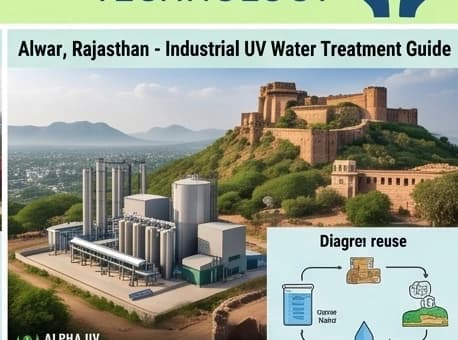
UV water treatment in Alwar addresses 5 key needs: RIICO industrial zone auto components ETP RPCB compliance (NCR satellite zone), Japanese Investment Zone Neemrana-Bhiwadi process water purity, Aravalli foothills borewell disinfection (post-fluoride treatment), Sariska Tiger Reserve eco-tourism hospitality water, and residential building water safety in this fast-growing NCR periphery city. CRITICAL: Alwar-Aravalli borewell water contains fluoride 1.0–3.0 mg/L — RO or defluoridation BEFORE UV is mandatory for drinking water. Alpha UV System supplies Philips TUV systems from ₹8,000 with RPCB documentation.
The Aravalli range geology in Alwar district releases fluoride into groundwater at 1.0–3.0 mg/L. The IS 10500 drinking water standard limits fluoride to 1.0 mg/L. UV water treatment CANNOT remove fluoride — UV only kills microorganisms. If you use borewell water in Alwar for drinking, cooking, or food processing, install RO or activated alumina defluoridation FIRST, then UV as the final disinfection step. Using UV alone on fluoride-laden Alwar borewell water provides microbiological safety but will NOT prevent the health effects of fluoride ingestion including dental and skeletal fluorosis.
Why UV Water Treatment Matters in Alwar
UV water treatment in Alwar serves one of Rajasthan's fastest-growing industrial zones — a city that straddles the border between traditional Rajasthan and the NCR (National Capital Region) economic sphere. Alwar's proximity to Delhi (160 km via NH-248) and the Delhi-Mumbai Industrial Corridor (DMIC) has transformed it from a heritage tourism destination into a major industrial hub, with RIICO (Rajasthan State Industrial Development and Investment Corporation) industrial areas hosting auto components manufacturers, Japanese investment zone at Neemrana-Bhiwadi, electronics assembly, and chemical units.
RPCB (Rajasthan Pollution Control Board) enforces industrial water compliance in Alwar under the Aravalli Protection and NCR environmental zone regulations. Industries in Alwar's Bhiwadi-Neemrana-Tapukara industrial zone face dual compliance requirements: RPCB's standard Consent to Operate conditions, and the NCR's enhanced environmental standards as part of the NCRPB (National Capital Region Planning Board) environmental management plan.
Alwar also hosts Sariska Tiger Reserve — a major eco-tourism destination where hospitality resorts, forest rest houses, and tourist facilities require safe drinking water. The combination of remote location, Aravalli borewell dependence, and high-end tourist expectations makes UV water treatment a necessity for Sariska hospitality. The historic Alwar city itself — with City Palace, Bala Quila fort, Siliserh Lake — attracts heritage tourism, and hotels and restaurants serving international tourists require FSSAI-compliant water with zero coliforms.
Alwar Water Quality by Zone
| Zone | Fluoride Level | TDS | Key Challenge | UV Treatment Strategy |
|---|---|---|---|---|
| Alwar city borewell | 1.0–2.5 mg/L | 400–900 mg/L | Fluoride, coliforms, seasonal turbidity | RO (fluoride + TDS) → UV |
| Bhiwadi RIICO industrial zone | 0.8–1.5 mg/L | 350–700 mg/L | Process water purity, ETP RPCB compliance | ETP UV + process UV (post softener/RO) |
| Neemrana Japanese Investment Zone | 0.8–1.2 mg/L | 350–600 mg/L | Japanese manufacturing quality standards, pure process water | Post-softener / RO UV |
| Sariska Tiger Reserve eco-resort | 1.5–3.0 mg/L | 500–1,200 mg/L | Remote borewell, high tourist expectations, no municipal supply | RO (mandatory) → UV |
| Tapukara industrial area | 1.0–2.0 mg/L | 400–800 mg/L | ETP auto components, RPCB NCR zone compliance | ETP UV for RPCB |
Neemrana Japanese Investment Zone: Process Water Requirements
UV water treatment in Alwar's Japanese Investment Zone at Neemrana is driven by Japanese manufacturing quality standards that exceed typical Indian industrial norms. Japanese manufacturers of automotive components (Honda Motorcycle & Scooter India, Minda Group, Marelli, and others) at Neemrana require:
- Process water purity: zero coliforms in coolant water, wash water, and CNC cutting fluid make-up water
- No biofilm in cooling circuits: Japanese quality standards (IATF 16949 / JAMA standards) require zero biological contamination in closed cooling loops
- Consistent water quality for metalworking fluids: coliforms and fungi contaminate metalworking emulsions, reducing tool life and surface finish quality
- RPCB ETP compliance: coolant waste, cutting oil wastewater, and plating rinse water must be treated to RPCB standards before discharge
UV water treatment for Neemrana Japanese units typically handles process cooling water at 3–15 m³/h with TUV 55W or TUV 95W systems, downstream of water softeners that reduce hardness (which would otherwise scale UV quartz sleeves in Rajasthan's hard water). UV ensures microbiological safety of water entering closed cooling loops, preventing biofilm that causes corrosion and quality failures in Japanese automotive manufacturing.
RIICO Auto Components: RPCB ETP Compliance
UV water treatment in Alwar's RIICO zones (Bhiwadi, Tapukara, Alwar Phase-I/II) is mandatory for auto components manufacturers under RPCB's Consent to Operate. Auto components manufacturing generates:
- Metalworking fluid wastewater: high BOD, emulsified oils, surfactants
- Plating and surface treatment effluent: chromium, zinc, nickel — heavy metals that UV CANNOT remove (chemical precipitation mandatory before UV)
- Cooling tower blowdown: high TDS, biocide residuals, scale inhibitors
- General sanitary wastewater: high coliform — requires UV at STP outlet
RPCB's Alwar circle conducts quarterly inspections of RIICO industrial ETPs, specifically reviewing UV lamp hour logs (>9,000 hours = non-compliant), intensity monitoring records, and coliform count at ETP outlet. The NCR-adjacent location means Alwar's industrial compliance is subject to additional scrutiny from NCRPB, making UV maintenance records a significant compliance risk management tool.
Sariska Tiger Reserve: Eco-Tourism UV Requirements
UV water treatment at Sariska Tiger Reserve resorts and forest rest houses must address a dual challenge: high Aravalli borewell fluoride (1.5–3.0 mg/L) and no municipal piped supply within the reserve buffer zone. International tourists expecting 4-star hospitality water quality require both TDS control (RO) and microbiological safety (UV). A complete Sariska resort water system includes: borewell → iron filter (if iron >0.3 mg/L) → multimedia filter → RO (TDS and fluoride reduction to <200 mg/L) → UV (zero coliforms) → storage tank → drinking points.
UV System Sizing for Alwar
| Application | Flow Rate | UV Dose | Config | Notes |
|---|---|---|---|---|
| Sariska eco-resort (post-RO) | 0.5–3 m³/h | 40 mJ/cm² | TUV 16W post-RO | RO mandatory for fluoride; UV final step |
| Neemrana Japanese unit process water | 3–15 m³/h | 40 mJ/cm² | TUV 55W or TUV 95W | Post water softener; IATF 16949 quality |
| RIICO auto components ETP (RPCB) | 25–150 KLD | 40 mJ/cm² | TUV 55W to TUV 95W×2 | RPCB NCR zone compliance |
| Alwar city hospital | 0.5–3 m³/h | 80 mJ/cm² | TUV 36W high-dose | NABH hospital water safety |
| Residential building (post-RO) | 1–5 m³/h | 40 mJ/cm² | TUV 16W or TUV 36W post-RO | RO for fluoride reduction mandatory |
Philips TUV Product Recommendations for Alwar
| Philips TUV Model | UV Output | Max Flow (40 mJ/cm²) | Best Alwar Application | Annual Lamp Cost |
|---|---|---|---|---|
| Philips TUV 16W | 4.8 W UV | ~1.5 m³/h | Sariska eco-resort (post-RO), small hotel, clinic | ₹1,200–₹1,800 |
| Philips TUV 36W | 10.8 W UV | ~3 m³/h | Hospital OT, residential township, Alwar heritage hotel | ₹2,200–₹3,000 |
| Philips TUV 55W | 16.5 W UV | ~5 m³/h | Neemrana Japanese unit, mid-size RIICO ETP, Alwar hotel supply | ₹3,500–₹4,500 |
| Philips TUV 95W | 28.5 W UV | ~9 m³/h | Large auto components ETP, Bhiwadi CETP, Alwar city STP | ₹5,500–₹7,000 |
| Philips TUV 95W × 4 bank | 114 W UV | ~36 m³/h | Alwar/Bhiwadi RIICO CETP, Tapukara STP, large industrial zone | ₹22,000–₹28,000 (bank) |
Regulatory Compliance Matrix
| Regulation | Sector | UV Requirement | Documentation |
|---|---|---|---|
| RPCB Consent to Operate | RIICO auto components, chemical units | UV at ETP outlet; zero coliforms for discharge | 30-day intensity log, coliform test, lamp log |
| NCRPB Environmental Standards | All NCR-adjacent industries (Bhiwadi, Tapukara, Neemrana) | Enhanced ETP standards; UV as primary disinfection | RPCB consent certificate, ETP compliance report |
| FSSAI IS 10500 | Hotels, restaurants, eco-resorts (Sariska) | Zero coliforms; fluoride ≤1 mg/L in food water | Water quality test, RO + UV maintenance log |
| IATF 16949 / Japanese Quality Standards | Neemrana Japanese investment zone manufacturers | Zero coliforms in process cooling water, metalworking fluid | Process water quality log, UV maintenance records for QMS audit |
Frequently Asked Questions
Why is fluoride from Aravalli geology specifically dangerous and UV cannot help?
UV water treatment in Alwar addresses microbiological contamination only — it cannot touch fluoride. Aravalli range rocks (charnockite, quartzite, marble) contain fluorite (CaF₂) and apatite minerals that slowly release fluoride into groundwater as water percolates through fractures. Unlike the Deccan trap fluoride of Maharashtra and Karnataka (which is related to volcanic rock weathering), Aravalli fluoride results from ancient geological fluorite deposits — some of India's oldest at 1.6–2.5 billion years old. Alwar's fluoride typically ranges 1.0–3.0 mg/L, well above the IS 10500 limit. Dental fluorosis (white/brown mottling of teeth) and skeletal fluorosis (joint pain, spinal deformity in severe cases) are documented health outcomes in Alwar district villages dependent on borewell water. Reverse osmosis reduces fluoride to below IS 10500 limits effectively. Activated alumina filter is an alternative for point-of-use defluoridation. After fluoride removal by RO, UV provides the final microbial safety step — this two-stage treatment (RO + UV) is the complete solution for safe drinking water in Alwar.
What do Japanese manufacturers in Neemrana specifically check for in UV water treatment systems?
UV water treatment in Neemrana's Japanese Investment Zone is subject to Japanese manufacturing quality system requirements — stricter than typical RPCB compliance. Japanese automotive and electronics manufacturers audit their water treatment systems as part of their Quality Management System (QMS) under IATF 16949 or equivalent standards. They specifically verify: (1) UV system validation — flow rate vs. dose charts demonstrating 40 mJ/cm² at rated flow; (2) Continuous UV intensity monitoring with alarm capability and data logging (Japanese QMS requires electronic records); (3) Preventive maintenance schedule — Philips TUV lamp replacement at 9,000 hours, quartz sleeve cleaning quarterly, calibration of UV sensor annually; (4) Supplier qualification certificate for UV lamps — Philips TUV is an internationally qualified brand accepted by Japanese manufacturers globally; (5) Water quality test results at process water points — microbiological tests monthly, chemical tests quarterly. Alpha UV System's documentation package is designed to meet Japanese QMS audit requirements for Neemrana clients.
Is Sariska Tiger Reserve area covered by any special environmental rules affecting UV systems?
UV water treatment systems at Sariska Tiger Reserve eco-resorts must comply with National Tiger Conservation Authority (NTCA) environmental guidelines for tourism zones within and adjacent to tiger reserves. NTCA prohibits chemical discharge (including chlorination waste) within the eco-sensitive zone. This makes UV water treatment — which produces zero chemical waste or residuals — the only NTCA-compatible disinfection technology for Sariska area resorts. RPCB also restricts chemical use in eco-sensitive zones, further supporting UV over chlorination. Resorts within the Sariska buffer zone using UV water treatment are fully compliant with NTCA and RPCB environmental guidelines, provided the complete system (RO permeate + UV) achieves IS 10500 parameters. Borewell extraction permits in Sariska zone require CGWB (Central Ground Water Board) no-objection certificates, and water quality reports are part of that permit renewal process.
How does Alwar's proximity to NCR affect RPCB enforcement compared to other Rajasthan cities?
UV water treatment compliance enforcement in Alwar is notably stricter than in most Rajasthan cities because RPCB operates under NCRPB (National Capital Region Planning Board) environmental oversight for Alwar district — which is part of the NCR as defined under the NCR Planning Board Act. Industries in NCRPB-covered areas face enhanced scrutiny from both RPCB and periodic National Green Tribunal (NGT) monitoring. The Bhiwadi-Tapukara-Neemrana-Alwar industrial corridor is specifically monitored by NGT as part of the NCR air and water quality management program. RPCB Alwar circle inspection frequency is typically 4–6 times per year for Red Category industries — significantly higher than 2–3 times in non-NCR Rajasthan districts. Non-compliant ETP UV systems in Alwar's RIICO zones face faster escalation to closure directions compared to equivalent units in Jodhpur or Kota. Maintaining continuously updated UV intensity logs, current lamp hour records, and recent coliform test results is essential for NCR-zone industrial compliance.
Whether you need RPCB-compliant ETP UV for RIICO auto components, RO + UV for Sariska eco-resort fluoride-safe water, Japanese QMS-documented process water UV for Neemrana, or hospital-grade UV for Alwar district hospital — Alpha UV System supplies Philips TUV lamp systems with RPCB intensity logs, FSSAI documentation, and on-site installation across Alwar, Bhiwadi, Neemrana, Tapukara, and the Aravalli NCR corridor.
WhatsApp Us for Alwar UV QuoteStandards, authorities & further reading
External references used to inform this guide. Regulations evolve — check the latest revision on each authority's site before compliance decisions.
Recommended UV Systems
Alpha UV System products for this application — powered by genuine Philips UV-C lamps.
Commercial UV Water Purification System
500 – 5,000 LPH
HACCP-compliant UV water purification for hotels, restaurants, and offices
Industrial UV Water Treatment System
5,000 – 50,000 LPH
Schedule M 2025 and HACCP compliant UV for pharma, food & beverage, and process water
Not sure which system suits your application? WhatsApp our engineers for a free recommendation →
Related solutions
See how Alpha UV System applies this to your industry or city.
Need a UV system?
Talk to our UV engineers — WhatsApp for a quote in 2 hours, or browse the full catalog on IndiaMART.