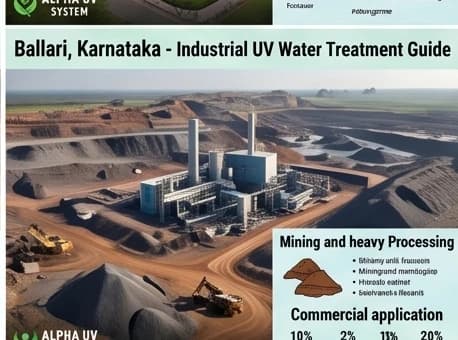
UV water treatment in Ballari addresses 5 critical needs: JSPL Vijayanagar Steel Plant cooling tower Legionella control (ASHRAE 188), NMDC iron ore mine worker colony water safety, KSPCB ETP compliance for mining and steel operations discharging to Tungabhadra basin, hospital water at VIMS Medical College, and residential water safety in India's iron ore capital. MANDATORY WARNING: Ballari borewell water and iron ore mine drainage carry iron at 2–10 mg/L — remove iron BEFORE UV installation. Alpha UV System supplies Philips TUV systems with iron pre-treatment design and KSPCB documentation.
Ballari sits on one of India's largest iron ore deposits — the Bellary-Hospet iron ore mining cluster. Iron leaches naturally into groundwater across this district at 2–10 mg/L (safe limit: 0.3 mg/L). Mine drainage from NMDC and private iron ore mines carries iron and manganese at even higher concentrations. Installing UV water treatment without prior iron removal in Ballari causes quartz sleeve fouling within weeks — orange iron deposits block UV light, UV dose drops, and coliforms survive. Install aeration + greensand filter (Birm) before UV in all Ballari borewell and mine drainage applications.
Why UV Water Treatment Matters in Ballari
UV water treatment in Ballari (formerly Bellary) operates at the intersection of Karnataka's heaviest industrial zone and a rapidly developing urban-residential area. Ballari hosts the Jindal Steel and Power Limited (JSPL) Vijayanagar Steel Plant — one of India's largest single-location steel complexes — alongside NMDC (National Mineral Development Corporation) iron ore mining operations, multiple private iron ore mines, sponge iron plants, and ferro-alloy units. The combined industrial footprint in Ballari is among the largest in peninsular India outside Maharashtra and Gujarat.
The Tungabhadra Reservoir — located 15 km from Ballari at Hospet — is the water lifeline for Ballari district's municipal and industrial supply. KSPCB (Karnataka State Pollution Control Board) enforces strict ETP and STP discharge standards to protect the Tungabhadra, which is critical for irrigation across northern Karnataka and the Krishna River system. All industrial discharge in Ballari must meet Tungabhadra protection standards, and UV water treatment at ETP outlets is the final compliance step.
JSPL Vijayanagar Steel Plant — with cooling towers, blast furnace water circuits, and worker townships housing 25,000+ people — requires UV water treatment for multiple applications: Legionella control in cooling towers (ASHRAE 188), drinking water for worker townships, and ETP discharge compliance. VIMS (Vijayanagara Institute of Medical Sciences) in Ballari serves as a regional tertiary care centre for the iron belt districts and requires UV for hospital water safety.
Ballari Water Quality by Zone
| Zone / Source | Iron Level | Key Contamination | Pre-Treatment | UV Priority |
|---|---|---|---|---|
| Iron ore mine zone borewell | 5–10 mg/L | Iron, manganese, mine runoff turbidity | Aeration + greensand MANDATORY | Critical — NMDC colony supply |
| JSPL Vijayanagar Steel Township | 0.5–2 mg/L (Tungabhadra supply) | Turbidity (monsoon), coliforms, Legionella in cooling towers | Iron filter if borewell; cartridge filter for mains | Township drinking + cooling tower UV |
| Ballari city municipal (BUDA supply) | 0.3–0.8 mg/L | Chlorine dissipation in distribution network, coliforms | Cartridge filter before UV | Building-level UV polishing |
| VIMS Hospital / Medical campus | 0.2–0.5 mg/L (mains supply) | Biological: nosocomial pathogens, Pseudomonas in plumbing | Cartridge 5 µm before UV | High-dose UV for OT/ICU/dialysis |
| Tungabhadra basin ETP discharge | Variable (industrial) | High BOD, suspended solids, iron from mine runoff | Full biological ETP before UV | KSPCB compliance |
JSPL Vijayanagar Steel Plant: ASHRAE 188 Legionella Control
UV water treatment in Ballari's largest industrial facility — JSPL Vijayanagar — addresses Legionella risk in cooling towers as a primary application. Steel plants operate large cooling tower arrays for blast furnace and rolling mill cooling. Cooling tower water circulates at 25–35°C — ideal temperatures for Legionella pneumophila growth. JSPL's Health, Safety and Environment (HSE) team follows ASHRAE 188 (Legionella Water Management Plan) standards, which require UV sidestream treatment at cooling tower basins.
ASHRAE 188 compliance for JSPL Vijayanagar cooling towers requires: UV dose of 40–80 mJ/cm² for Legionella inactivation (Legionella is relatively UV-sensitive at 6–10 mJ/cm²; 40 mJ/cm² provides adequate safety margin), sidestream treatment flow of 10–25% of total circulation volume continuously, UV intensity monitoring and alarm for compliance documentation, and quarterly Legionella culture testing at cooling tower outlet with results below 10³ CFU/L.
NMDC Iron Ore Mining: Worker Colony UV Treatment
UV water treatment in Ballari's NMDC mining zone — particularly at Donimalai, Kumaraswamy, and Chitradurga iron ore mines — is critical for worker colony drinking water. NMDC operations provide piped water to worker colonies from surface water or borewell sources. Iron ore zone groundwater routinely contains 5–10 mg/L iron — far above the 0.3 mg/L limit for drinking water. The iron pre-treatment train (aeration → greensand filter → cartridge filter) must precede UV to achieve effective disinfection.
NMDC's Corporate Social Responsibility (CSR) programs include providing safe drinking water to nearby villages in the mining influence zone. UV water treatment systems installed at NMDC CSR village water supply points must be low-maintenance and capable of operating under intermittent power conditions — making solar-powered UV systems appropriate for remote village installations in the Ballari-Sandur-Hospet mining corridor.
UV System Sizing for Ballari
| Application | Flow Rate | UV Dose | Config | Notes |
|---|---|---|---|---|
| NMDC mine worker colony | 3–10 m³/h | 40 mJ/cm² | TUV 55W (post iron filter) | Iron removal MANDATORY first |
| JSPL Township drinking water | 10–50 m³/h | 40 mJ/cm² | TUV 95W×2 to ×4 | Large township supply system |
| JSPL Cooling Tower sidestream | 5–25 m³/h | 40–80 mJ/cm² | TUV 95W×2 to ×4 (ASHRAE 188) | 10–25% sidestream flow |
| VIMS Hospital OT/ICU/dialysis | 0.5–3 m³/h | 80 mJ/cm² | TUV 36W high-dose | NABH accreditation water safety |
| Industrial ETP outlet (KSPCB) | 50–300 KLD | 40 mJ/cm² | TUV 95W×2 to ×6 | Tungabhadra discharge compliance |
| NMDC CSR village supply | 0.5–2 m³/h | 40 mJ/cm² | TUV 16W (post iron filter) | Solar UV option for off-grid villages |
Philips TUV Product Recommendations for Ballari
| Philips TUV Model | UV Output | Max Flow (40 mJ/cm²) | Best Ballari Application | Annual Lamp Cost |
|---|---|---|---|---|
| Philips TUV 16W | 4.8 W UV | ~1.5 m³/h | NMDC CSR village point, small hospital clinic | ₹1,200–₹1,800 |
| Philips TUV 36W | 10.8 W UV | ~3 m³/h | VIMS hospital OT water, residential building | ₹2,200–₹3,000 |
| Philips TUV 55W | 16.5 W UV | ~5 m³/h | NMDC colliery colony (post iron filter), mid-size ETP | ₹3,500–₹4,500 |
| Philips TUV 95W | 28.5 W UV | ~9 m³/h | JSPL township supply, large mine ETP, cooling tower sidestream | ₹5,500–₹7,000 |
| Philips TUV 95W × 4–6 bank | 114–171 W UV | 36–54 m³/h | JSPL large ETP, major cooling tower bank, Ballari Municipal STP | ₹22,000–₹42,000 (bank total) |
Regulatory Compliance Matrix
| Regulation | Sector | UV Requirement | Documentation |
|---|---|---|---|
| KSPCB CTO / Consent to Operate | JSPL, NMDC, iron ore mines, sponge iron | UV at ETP outlet; zero coliforms for reuse; iron ≤3 mg/L at discharge | 30-day intensity log, coliform test, iron test report |
| ASHRAE 188 | JSPL Vijayanagar cooling towers | UV sidestream, Legionella risk assessment, LWM plan | LWMP document, quarterly Legionella culture results |
| NABH Accreditation | VIMS Medical College Hospital | UV for OT/ICU/dialysis water; zero coliforms | Microbial monitoring log, UV maintenance records |
| FSSAI IS 10500 | Township canteens, food businesses | Zero coliforms in food contact water | Water quality test report, UV maintenance log |
Frequently Asked Questions
Why does iron ore mining near Ballari cause UV water treatment to fail without pre-treatment?
UV water treatment in Ballari fails without iron pre-treatment because the iron ore geology — haematite (Fe₂O₃) and magnetite (Fe₃O₄) deposits — releases ferrous iron (Fe²⁺) into groundwater through contact with oxygenated recharge water. At concentrations of 5–10 mg/L, dissolved iron precipitates as ferric hydroxide (Fe(OH)₃) when exposed to UV light and oxygen in the UV chamber — forming a rust-coloured coating on the quartz sleeve within 2–6 weeks. This coating absorbs and scatters UV light, reducing the effective UV dose from 40 mJ/cm² to as low as 5–10 mJ/cm² — insufficient to inactivate E. coli, Giardia, or Cryptosporidium. The system appears to be running but is not disinfecting. Aeration converts soluble Fe²⁺ to insoluble Fe³⁺, which a greensand/Birm filter then removes to below 0.3 mg/L, allowing UV to function as designed.
Does JSPL Vijayanagar actually use UV for cooling tower Legionella control, or just biocides?
Large industrial plants like JSPL Vijayanagar use both UV and biocides as part of an ASHRAE 188-compliant Legionella Water Management Plan (LWM Plan). UV sidestream treatment handles continuous biological control — treating 10–25% of the cooling tower circulation volume continuously at 40–80 mJ/cm² — reducing the Legionella bioburden in the bulk water. Oxidising biocides (chlorine, bromine) handle supplemental control and biofilm in the tower fill and basin. UV is preferred for sidestream treatment because it avoids biocide resistance development and reduces chemical consumption. For plants where workers are in proximity to cooling tower drift (e.g., near air intakes), JSPL's HSE team follows ASHRAE 188 documentation including quarterly Legionella culture testing and annual risk assessment review. UV water treatment is specifically cited in ASHRAE 188 as a physical control measure for Legionella.
What is KSPCB's enforcement stance for iron ore mines and ETPs in Ballari?
KSPCB's enforcement in Ballari has been historically significant — the 2011 Lokayukta report on Ballari illegal mining resulted in a complete mining moratorium for 2 years. Post-2013, legal mining resumed under a Supreme Court-monitored Environment Management Plan (EMP), which includes ETP requirements for all mining operations. UV water treatment at Ballari mine ETPs is now mandated as part of EMP compliance. KSPCB Ballari circle conducts quarterly ETP inspections at NMDC and private mine ETPs, checking UV lamp function, coliform count in effluent, and turbidity at discharge points. Non-compliance with ETP conditions — including non-functional UV — triggers Environment Compensation notices under the NGT-mandated EMP framework, which can escalate to mining license suspension.
Can UV water treatment serve the JSPL worker township population of 25,000+ people?
Yes — UV water treatment in Ballari's JSPL Vijayanagar township can be scaled to serve large populations. JSPL's township water supply from the Tungabhadra-based supply system (after primary treatment at the intake) requires UV polishing for the last-mile assurance in the distribution network. For 25,000 people at 150 LPCD, the total supply demand is approximately 3,750 m³/day (≈156 m³/h). This requires a UV bank of Philips TUV 95W × 12–16 lamps in parallel stainless steel reactors providing 40 mJ/cm² dose at the full flow rate. The system operates with duty + standby lamp banks, UV intensity monitoring alarms, and automated lamp hour counters. Alpha UV System designs and supplies large township UV treatment systems with complete JSPCB and KSPCB compliance documentation.
Whether you need iron pre-treatment + UV for NMDC mine worker colony water, ASHRAE 188 cooling tower UV for JSPL Vijayanagar, KSPCB-compliant ETP UV for Tungabhadra discharge, or hospital-grade UV for VIMS — Alpha UV System supplies Philips TUV systems with iron removal design, KSPCB intensity logs, and on-site installation across Ballari, Hospet, Sandur, Toranagallu, and the Bellary iron belt.
WhatsApp Us for Ballari UV + Iron Treatment QuoteStandards, authorities & further reading
External references used to inform this guide. Regulations evolve — check the latest revision on each authority's site before compliance decisions.
Recommended UV Systems
Alpha UV System products for this application — powered by genuine Philips UV-C lamps.
Commercial UV Water Purification System
500 – 5,000 LPH
HACCP-compliant UV water purification for hotels, restaurants, and offices
Industrial UV Water Treatment System
5,000 – 50,000 LPH
Schedule M 2025 and HACCP compliant UV for pharma, food & beverage, and process water
Not sure which system suits your application? WhatsApp our engineers for a free recommendation →
Related solutions
See how Alpha UV System applies this to your industry or city.
Need a UV system?
Talk to our UV engineers — WhatsApp for a quote in 2 hours, or browse the full catalog on IndiaMART.