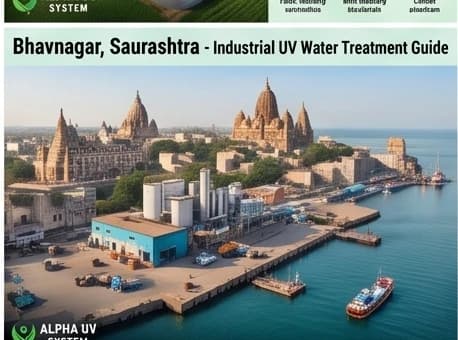
UV water treatment in Bhavnagar and the wider Saurashtra region requires understanding the region's fundamental water challenge: Saurashtra is a semi-arid peninsula with no perennial rivers and borewell groundwater TDS of 800–3,000 mg/L across much of the region. UV alone is insufficient for drinking water from Saurashtra boreholes — RO is mandatory before UV for potable use in almost all areas. Key UV applications in Saurashtra: (1) RO + UV systems for all residential and industrial potable water from high-TDS boreholes; (2) Alang ship recycling complex — the world's largest ship dismantling yard at Alang near Bhavnagar requires process water UV for cutting and cleaning operations; (3) Jamnagar refinery complex — Reliance Industries and Nayara Energy's massive refineries at Jamnagar require cooling tower Legionella management UV; (4) Gandhidham-Kandla port zone UV for port operations and the industrial corridor; and (5) GPCB STP compliance for the region. Alpha UV System supplies Philips UV-C lamp UV systems to Saurashtra with 5–7 day delivery and GPCB documentation support.
Saurashtra — the Kathiawar Peninsula of Gujarat, extending into the Arabian Sea between the Gulf of Khambhat and the Gulf of Kutch — is a region of remarkable industrial importance despite its semi-arid geography. The region hosts: the world's largest ship recycling yard (Alang, near Bhavnagar), India's largest petroleum refinery complex (Jamnagar — Reliance Industries' twin refineries have a combined capacity of 1.24 million barrels per day, making the Jamnagar complex the world's largest refining hub at a single location), and one of India's busiest commercial ports (Kandla, in Kutch).
Saurashtra's fundamental water challenge is more acute than almost any other Indian region: the peninsula has no perennial rivers, depends entirely on monsoon-fed reservoirs that fill once a year (July–September), and has groundwater in basalt and limestone geology that results in TDS of 800–3,000 mg/L across most of the peninsula. RO desalination of borewell water before UV is not optional in Saurashtra — it is the only way to produce potable water from local groundwater sources in most areas.
Saurashtra borewell TDS of 800–3,000 mg/L far exceeds the IS 10500 acceptable limit of 500 mg/L. UV treatment alone does not reduce TDS, hardness, chloride, or sulphate. Install RO (reverse osmosis) first to reduce TDS to acceptable levels, then UV after the RO permeate storage tank for microbiological safety. Never install UV-only on Saurashtra borewell water and present it as potable treatment — it will not make the water safe for long-term consumption.
Saurashtra Water Quality by Zone
| Zone / Area | Supply Type | Key Water Issue | UV Solution |
|---|---|---|---|
| Bhavnagar city (Ghogha Road, Kumbharwada) | BMC piped supply (Shetrunji reservoir) + borewell | Shetrunji dam supply seasonal (fills only in monsoon); borewell TDS 800–2,000 mg/L in many zones; summer supply scarcity | RO + UV for borewell; post-tank UV for piped supply; drought-season tanker RO + UV |
| Alang ship recycling (Bhavnagar coast) | Borewell + tanker | Ship dismantling — cutting and grinding process water; worker drinking water; GPCB hazardous waste water compliance | RO + UV for worker potable water; process water UV; GPCB hazardous site STP UV |
| Jamnagar (refinery city) | JVVNL supply (Aji river, low flow) + RIL internal supply | Reliance/Nayara refinery cooling towers — world's largest refinery Legionella WMP; refinery township potable water | Refinery cooling tower UV (40–80 mJ/cm²); Legionella WMP; township potable UV; RO + UV for borewell |
| Gandhidham / Kandla (port city) | Port trust supply + borewell | Kandla Port — ship potable water; port zone industrial UV; high-TDS borewell (Kutch TDS 1,000–3,000 mg/L) | Ship chandlery potable UV; port industrial UV; RO + UV mandatory for Kutch borewell |
| Kutch / Bhuj (desert zone) | NWRWS (Narmada canal) + borewell (extremely high TDS) | Narmada canal supply (seasonal); borewell TDS 2,000–5,000 mg/L in Kutch desert; GPCB STP compliance for new industrial clusters | Narmada supply: post-tank UV. Borewell: RO mandatory (multi-pass) + UV. GPCB STP UV |
UV for Jamnagar's Refinery Complex
The Jamnagar refinery complex — comprising Reliance Industries Limited's Jamnagar refinery (the world's largest single-site refinery at 660,000 bpd) and the adjacent Export Oriented Unit (EOE) refinery, plus Nayara Energy's Vadinar refinery (formerly Essar Oil, also near Jamnagar at 405,000 bpd) — is a water treatment challenge of extraordinary scale. The Jamnada complex's combined cooling water circulation, combined heat and power plant, and residential township water needs make Jamnagar the largest single site UV market in India by volume.
Refinery cooling tower Legionella management at Jamnagar follows Reliance Industries' global EHS standards and industry guidelines from OSHA and ASHRAE 188. UV at 40–80 mJ/cm² on cooling tower make-up water is the primary Legionella control measure specified in Reliance Industries' water treatment protocols for its refinery complexes. The scale of cooling tower UV at Jamnagar — with dozens of cooling tower cells, each with make-up water flows of 50–500 m³/h — makes this one of the largest UV installations in India's private sector.
| Application | Flow Rate | UV Dose | Notes |
|---|---|---|---|
| Residential (Bhavnagar — borewell, post RO) | 0.5–2 m³/h after RO | 40 mJ/cm² | RO mandatory first (TDS 800–2,000 mg/L); UV after RO permeate tank; GPCB documentation |
| Alang ship dismantling worker potable | 2–10 m³/h | 40 mJ/cm² | RO + UV for high-TDS borewell; worker safety; GPCB hazardous site compliance |
| Jamnagar refinery cooling tower | 100–500 m³/h | 40–80 mJ/cm² | Reliance / Nayara EHS Legionella WMP; ASHRAE 188; monthly Legionella testing at all risk points |
| Kandla port ship potable water | 5–20 m³/h | 40 mJ/cm² | Ship chandlery WHO potable water; RO desalination + UV for port zone supply |
| Kutch industrial (post Narmada supply) | 2–10 m³/h | 40 mJ/cm² | Narmada canal supply: post-tank UV; borewell: RO (multi-pass) mandatory before UV |
| STP outlet — 300 KLD (Bhavnagar residential) | 20–30 m³/h | 40 mJ/cm² | Philips TUV 95W; GPCB consent documentation; Gulf of Khambhat coastal zone compliance |
We receive Narmada canal water in Saurashtra — do we still need RO before UV?
Saurashtra Narmada Avtaran Irrigation (SAUNI) Yojana brings Narmada canal water to Saurashtra's reservoirs, supplementing the peninsula's limited local water resources. Narmada water has significantly lower TDS than Saurashtra's native borewell water — Narmada canal water in the Saurashtra delivery points typically has TDS of 100–250 mg/L, well within IS 10500 limits. For areas receiving Narmada canal-supplied reservoir water (treated by Gujarat Water Supply and Sewerage Board at WTPs), RO is NOT required — post-overhead-tank UV at 40 mJ/cm² is sufficient for the microbiological safety of treated Narmada canal supply.
The important caveat: Narmada supply to Saurashtra reservoirs is seasonal and subject to annual water allocation negotiations between Gujarat and the Narmada Control Authority. In years of lower Narmada flow or allocation disputes, supply is reduced and buildings in Saurashtra fall back on borewell water. When falling back on borewell water, RO before UV is mandatory — do not assume that because Narmada supply was adequate, the backup borewell water also meets IS 10500 limits. Test the borewell at NABL before using as backup supply for drinking. Alpha UV System can supply building-level RO + UV systems that treat borewell backup supply alongside UV-only systems for the Narmada piped supply.
Alpha UV System supplies UV disinfection systems (with RO pre-treatment for Saurashtra's high-TDS borewell) to refineries, ship recycling, port operations, residential complexes, and STP operators across Bhavnagar, Alang, Jamnagar, Gandhidham, Kutch, and the wider Saurashtra-Kutch region. GPCB STP documentation. Reliance/refinery Legionella WMP UV. Philips UV-C lamps. 5–7 day delivery to Saurashtra.
WhatsApp Us for Saurashtra UV System SupplyStandards, authorities & further reading
External references used to inform this guide. Regulations evolve — check the latest revision on each authority's site before compliance decisions.
Recommended UV Systems
Alpha UV System products for this application — powered by genuine Philips UV-C lamps.
Commercial UV Water Purification System
500 – 5,000 LPH
HACCP-compliant UV water purification for hotels, restaurants, and offices
Industrial UV Water Treatment System
5,000 – 50,000 LPH
Schedule M 2025 and HACCP compliant UV for pharma, food & beverage, and process water
Not sure which system suits your application? WhatsApp our engineers for a free recommendation →
Related solutions
See how Alpha UV System applies this to your industry or city.
Need a UV system?
Talk to our UV engineers — WhatsApp for a quote in 2 hours, or browse the full catalog on IndiaMART.