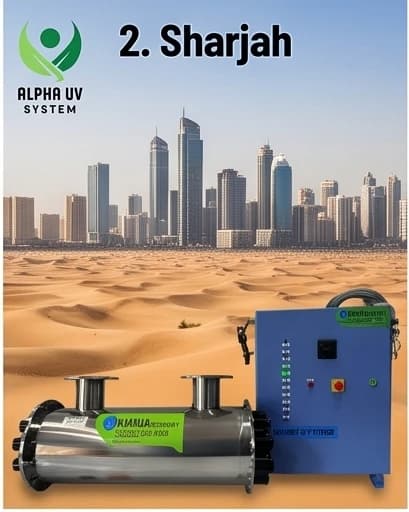
Quick Answer: Sharjah — the UAE's third emirate by population (1.8 million) and the GCC's most affordable large industrial hub — presents a UV water treatment system Sharjah market anchored by: SEWA (Sharjah Electricity and Water Authority) 100% desalinated water supply (UVT 87–93% at plant outlet, MSFD + SWRO capacity at Layyah and Hamriyah WTDs); Hamriyah Free Zone (HFZA — 6,000+ companies, Gulf's largest steel, chemicals, and engineering cluster); Sharjah Airport International Free Zone (SAIF Zone — 7,500+ companies, food and pharmaceutical manufacturing); Sajaa Industrial Area (600+ factories, FMCG, food, construction materials); and Al Saja'a and Juwaiza industrial estates with mid-size food, packaging, and chemical manufacturing. Sharjah is UAE's manufacturing heartland due to lower real estate costs vs. Dubai — thousands of factories that export to Dubai and Abu Dhabi markets must comply with Dubai Municipality and ADAFSA food safety standards, which mandate UV water treatment as part of HACCP prerequisite programmes. Sharjah Chamber of Commerce and HFZA apply SFDA (Sharjah Food and Drug Authority — effectively UAE.S GSO 149 and MoHAP guidelines) standards. NSF/ANSI 55 Class A at 40 mJ/cm² is universal. Alpha UV ships to Hamriyah Port (10–14 days) or Sharjah International Airport (48 hours).
Sharjah's UV Water Treatment System Landscape
Sharjah — unique among UAE emirates in having territory on both the Arabian Gulf and the Gulf of Oman (Khor Fakkan, Dibba, Kalba on the east coast) — is the UAE's manufacturing capital in terms of factory density. The emirate has deliberately positioned itself as the GCC's affordable industrial base: Sharjah free zone and industrial land lease rates are typically 40–60% below equivalent Dubai rates, attracting thousands of mid-size manufacturers that supply Dubai retail markets, export through Jebel Ali or Hamriyah Port, and operate in the food, FMCG, pharmaceutical, chemical, and light engineering sectors.
SEWA (Sharjah Electricity and Water Authority) supplies all of Sharjah emirate — including Khor Fakkan and east coast territories — with 100% desalinated water from its Layyah and Hamriyah Water Treatment and Desalination facilities. Sharjah also interconnects with FEWA (Federal Electricity and Water Authority) grid for northern emirates areas. SEWA water quality at plant outlet: UVT 87–93%, zero coliforms, conductivity 250–450 µS/cm (post-remineralisation), pH 7.5–8.0, free chlorine 0.2–0.5 mg/L maintained in distribution.
The UV water treatment system Sharjah market is driven by the same post-distribution re-contamination factors as Dubai and Abu Dhabi — rooftop tank biofilm, aging building plumbing in Sharjah's older industrial estates (Al Juwaiza, Industrial Area 1–18, Sajaa), and post-softener/RO supply lines in food and pharmaceutical factories. The additional Sharjah-specific driver is the need to supply Dubai and Abu Dhabi retail markets: factories based in Sharjah whose products are sold in UAE hypermarkets (Carrefour, LuLu, Geant, Spinneys, Union Coop) must meet the same HACCP standards that Dubai Municipality food safety inspectors apply to Dubai-based facilities.
Hamriyah Free Zone (HFZA) — Industrial Water Requirements
| Industrial Sector | HFZA Zone | Water Requirement | Alpha UV System |
|---|---|---|---|
| Steel fabrication and re-rolling (HFZA Steel Cluster) | Hamriyah Phase 1/2 | Worker potable water (BSSE/HFZA worker welfare); cooling tower Legionella control | AU-M 25 (potable); AU-M 30/40 (cooling tower make-up) |
| Petrochemical and chemical storage/blending | Hamriyah petrochemical zone | Emergency shower / eyewash potable water; deionised water for blending | AU-S 15 (emergency water); AU-M 25 (deionised water post-RO UV) |
| Food manufacturing in HFZA Food Zone | Hamriyah Food Zone | HACCP prerequisite: potable food contact water; NSF/ANSI 55 Class A; DM-compatible for Dubai retail | AU-M 25/30, zero Cl, 40 mJ/cm², MODBUS logging |
| Pharmaceutical and healthcare manufacturing | HFZA Pharma Zone | WHO GMP / MoHAP; USP Purified Water; UV mandatory in qualification | AU-M 25, tri-clamp SS, 21 CFR Part 11 MODBUS logging |
| Marine and port services (Hamriyah Port) | Hamriyah Port anchorage | Vessel potable water bunkering — IHR 2005, WHO standards | AU-M 25/30 at bunkering supply point |
HFZA's unique regulatory structure — as a UAE Federal Free Zone under the Ministry of Economy, with HFZA Authority as the approving body — means that HFZA food manufacturers must technically comply with UAE Federal food law (Federal Law No. 10 of 2015 on Food Safety) and the UAE.S GSO 149 drinking water standard. However, in practice, HFZA food manufacturers targeting the Dubai retail market also undergo DM Food Safety Department audits, making DM Technical Guideline TG-W-001 water quality standards the effective benchmark. UV at 40 mJ/cm² (NSF/ANSI 55 Class A) satisfies both HFZA and DM audit requirements.
Sajaa Industrial Area and SAIF Zone
Sharjah's Sajaa Industrial Area — the emirate's largest inland manufacturing zone, spanning 12 km² with 600+ factories — hosts a diverse manufacturing base: food and beverage production (fruit juices, dairy, bakery, confectionery), packaging (glass, plastic, carton), chemicals, and FMCG assembly. SAIF Zone (Sharjah Airport International Free Zone, adjacent to Sharjah International Airport) adds 7,500+ companies in lighter manufacturing, food distribution, and pharmaceutical cold chain.
The UV water treatment system Sharjah Sajaa/SAIF Zone demand profile:
- Juice and beverage manufacturers: HACCP-compliant process water — UV at 40 mJ/cm² for all food-contact water; zero Cl residual required to prevent flavour taint in juice processing; AU-M 25/30 with MODBUS logging for DM audit compliance.
- Dairy producers: Pasteurisation water — zero Cl to prevent organoleptic tainting; UV at 40 mJ/cm² post-RO softened water for CIP final rinse and product contact water; AU-M 25 standard specification.
- Pharmaceutical cold chain (SAIF Zone): Potable water for cold room cleaning and workers; DHA/MoHAP standards apply; AU-S 15 point-of-use UV at worker welfare facilities.
- Packaging manufacturers: Wash water for glass/PET container rinsing before filling — EU and US retailer food contact compliance requires zero microbial contamination in rinsing water; AU-M 25 for packaging wash water UV treatment.
SEWA Water System and End-User Treatment
| Application | SEWA Supply Quality | End-Use Risk | UV Specification |
|---|---|---|---|
| Sharjah residential building (rooftop GRP tank) | UVT 87–93% at inlet; Cl 0.2–0.4 mg/L | Biofilm in GRP tank; chloramine decay in summer (>50°C tank temp); E. coli re-contamination | AU-S 8/15 at tank outlet, 40 mJ/cm², NSF/ANSI 55 |
| Industrial factory — post-softener | SEWA inlet + zeolite softener | Ion exchange resin Pseudomonas colonisation; chloramine removal by resin | AU-M 25 post-softener, 40 mJ/cm², zero Cl |
| RO permeate (pharmaceutical / food) | SEWA → RO → permeate (UVT 96–99%) | RO permeate storage tank biofilm; no residual chlorine post-membrane | AU-M 25, post-RO UV, 40 mJ/cm², MODBUS logging |
| Cooling tower make-up (industrial estates) | SEWA mains or softened water | Legionella in recirculated cooling; extreme summer ambient temperature in Sharjah industrial areas | AU-M 30, continuous UV at cooling tower basin, 40 mJ/cm² |
Sharjah's industrial areas — particularly Sajaa, Industrial Areas 1–18, and Al Juwaiza — contain many pre-2000 buildings and factory units with GI (galvanised iron) plumbing that develops iron scale and biofilm over decades. SEWA's chloramine residual (0.2–0.4 mg/L) may be completely depleted by the time water reaches point of use in older factory plumbing. Point-of-use UV at 40 mJ/cm² is the most cost-effective retrofit solution for these older facilities — more economical than full plumbing replacement and more reliable than chemical supplementation in intermittent-use factory environments.
Sharjah's East Coast Facilities — Khor Fakkan and Kalba
Sharjah's east coast territories (Khor Fakkan, Dibba Al Hisn, Kalba) — separated from the main emirate by Fujairah — receive desalinated water from SEWA east coast facilities and from FEWA. These areas host Khor Fakkan Container Terminal (third-busiest UAE port), Kalba free zone industrial activities, and Dibba's tourism and fishing sectors. The UV water treatment system Sharjah east coast market includes:
Khor Fakkan Port bunkering: Vessel potable water supply compliant with IHR 2005 and WHO Guidelines — AU-M 25 at bunkering supply points.
Kalba industrial zone food manufacturing: Small-to-medium food producers (fish processing, dried fruits, spice blending) — AU-S 15 or AU-M 25, UAE.S GSO 149 compliant.
East coast hotel and tourism water: Khor Fakkan and Dibba beach resorts — HACCP kitchen water (AU-M 25), spa/pool UV (medium-pressure, Cryptosporidium control), Legionella management in hot water systems.
Regulatory Compliance Summary
- UAE.S GSO 149:2021 — UAE National drinking water standard (GCC unified, WHO 4th ed.); E. coli 0 CFU/100 mL; applicable to SEWA supply and end-user treatment
- Federal Law No. 10 of 2015 on Food Safety — food manufacturers (HFZA, SAIF Zone, Sajaa) must use potable water in food contact; HACCP prerequisite; UV validated as CCP method
- Sharjah Municipality food safety inspections — aligned to DM Food Safety Regulation No. 4 for facilities selling into Dubai retail market; NSF/ANSI 55 Class A accepted
- MoHAP GMP Guidelines — pharmaceutical manufacturers in HFZA Pharma Zone and SAIF Zone; USP Purified Water; UV in qualified water system
- HFZA Authority Company Setup Compliance — HFZA requires environmental compliance documentation; UV water system documentation included in facility setup compliance
- NSF/ANSI 55 Class A — 40 mJ/cm² — universal commercial specification for all Sharjah industrial and food sector UV installations
FAQ
Why is UV water treatment relevant in Sharjah when SEWA supplies clean desalinated water?
SEWA's desalinated water at the distribution inlet to factory and commercial buildings is high quality — but Sharjah's industrial areas have a high concentration of older factory buildings (pre-2000) with aging GI plumbing, large GRP rooftop storage tanks, and post-softener supply lines where SEWA's chloramine residual is depleted before reaching production equipment. UV at 40 mJ/cm² installed at the factory main inlet or post-softener provides final disinfection coverage regardless of upstream residual chloramine status — a critical distinction for HACCP and DM food safety audit compliance.
Can Sharjah-based factories get DM Food Safety certification with UV water treatment?
Yes. Dubai Municipality Food Safety Department audits food manufacturers selling into Dubai retail channels regardless of where the factory is located. Sharjah factories audited by DM must meet the same HACCP water quality standards as Dubai-based facilities — water treatment with continuous monitoring (UV at 40 mJ/cm² with UVI sensor and MODBUS logging) is the compliant configuration. Alpha UV's NSF/ANSI 55 Class A certificate and MODBUS data log export are accepted by DM Food Safety inspectors as HACCP CCP evidence.
What is the delivery route for Alpha UV systems to Hamriyah Free Zone?
Sea freight to Hamriyah Port (10–14 days from India; HFZA has its own port berths adjacent to the free zone). Air freight to Sharjah International Airport (SHJ, 48 hours from India). HFZA registered companies can import through the free zone customs gate with simplified documentation (HFZA customs registration, no UAE standard import duties apply within HFZA). For Sajaa and mainstream Sharjah industrial areas, air freight to Sharjah Airport or sea freight to Jebel Ali Port (Dubai, 40 minutes road transport to Sharjah) are both practical options.
How does the UV water treatment system Sharjah requirement differ for SAIF Zone pharmaceutical companies vs. HFZA food companies?
SAIF Zone pharmaceutical manufacturers require pharmaceutical-grade UV (316L SS electropolished chamber, tri-clamp connections, 21 CFR Part 11 MODBUS logging, CFD dose validation, IQ/OQ qualification protocols) aligned to MoHAP GMP and WHO TRS 986. HFZA food manufacturers require food-grade UV (304/316 SS chamber, standard NPT connections acceptable, NSF/ANSI 55 Class A, MODBUS logging for HACCP audit) aligned to Federal Law 10/2015 and DM Food Safety Regulation. The UV dose (40 mJ/cm²) is identical, but chamber specification, documentation depth, and qualification requirements differ significantly.
What UV system handles Sharjah's cooling tower Legionella risk in industrial estates?
Alpha UV AU-M 30 for cooling tower make-up water continuous UV treatment — 40 mJ/cm² at rated flow (30 m³/hour), suitable for industrial cooling towers of 100–500 RT (refrigeration ton) capacity typical in Sharjah industrial estate HVAC systems. For larger cooling towers (Hamriyah industrial steel facilities, 500–2,000 RT), AU-M 40 or AU-L 80 is sized against actual make-up water flow rate. UAE EAD Legionella Control Guideline (2021) and DM HSE Circular (2019) are the applicable regulatory frameworks — both accept UV as a primary biocide method for cooling tower Legionella control.
Is Sharjah the right location for manufacturing destined for GCC-wide distribution?
Sharjah is one of the UAE's most strategically located manufacturing hubs for GCC distribution — Hamriyah Port provides direct access to GCC sea lanes; Sharjah Airport handles significant regional air freight; and road connections to Dubai (40 minutes to Jebel Ali Port) enable access to the UAE's primary deep-water export gateway. For water treatment compliance, Sharjah-manufactured goods destined for GCC markets must meet UAE.S GSO 149 (unified GCC standard) water quality requirements in production — UV at 40 mJ/cm² satisfies GSO 149 and the equivalent national standards across Saudi Arabia (SASO), Kuwait (KUCAS), and Qatar (QSTS).
Standards, authorities & further reading
External references used to inform this guide. Regulations evolve — check the latest revision on each authority's site before compliance decisions.
Recommended UV Systems
Alpha UV System products for this application — powered by genuine Philips UV-C lamps.
Commercial UV Water Purification System
500 – 5,000 LPH
HACCP-compliant UV water purification for hotels, restaurants, and offices
Industrial UV Water Treatment System
5,000 – 50,000 LPH
Schedule M 2025 and HACCP compliant UV for pharma, food & beverage, and process water
Not sure which system suits your application? WhatsApp our engineers for a free recommendation →
Related solutions
See how Alpha UV System applies this to your industry or city.
Need a UV system?
Talk to our UV engineers — WhatsApp for a quote in 2 hours, or browse the full catalog on IndiaMART.