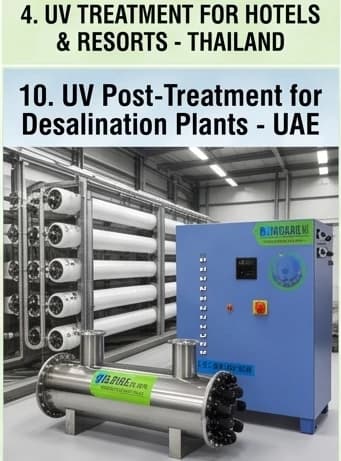
Quick Answer: UV post-treatment desalination UAE is a critical safety barrier in the world's most desalination-dependent nation — UAE produces 3,000+ MLD of desalinated water, making it the world's fourth-largest desalination market by capacity (behind Saudi Arabia, USA, and China) and supplying 98%+ of its total freshwater from seawater. DEWA (Dubai), ADWEA (Abu Dhabi), SEWA (Sharjah), and FEWA (Northern Emirates) all operate SWRO (Seawater Reverse Osmosis) and MSFD (Multi-Stage Flash Distillation) plants whose treated water requires UV post-treatment at two critical stages: (1) post-SWRO membrane UV — RO permeate (UVT 95–99%) has zero chlorine residual and is biologically vulnerable to Legionella and Pseudomonas recontamination from permeate storage tanks and transfer pipework before chloramine addition; (2) building and industrial end-point UV — post-distribution network, after chloramine residual depletion. Amalgam UV lamp technology (producing 3–5× higher UV intensity per lamp than standard low-pressure lamps) is preferred for large-flow desalination post-treatment applications. NSF/ANSI 55 Class A at 40 mJ/cm² applies to all UAE utility-scale UV applications. CFD (computational fluid dynamics) validation of UV reactor dose distribution is required for utility-grade qualification. Alpha UV ships to Jebel Ali Port, Khalifa Port (Abu Dhabi), and Hamriyah Port.
UAE Desalination Sector — Scale and UV Post-Treatment Context
The UAE's desalination industry — established in the 1970s with Abu Dhabi's first MSFD plant at Umm Al Nar and expanded dramatically through the 1990s–2020s in parallel with the UAE's population and economic growth — now produces water at a scale and cost efficiency that was considered technically impossible a generation ago. DEWA's Mohammed bin Rashid Al Maktoum Solar Park integrated desalination (2022 onwards) produces SWRO at under USD 0.25/m³ using solar power — the world's lowest-cost desalinated water.
Despite the extraordinary technical achievement of UAE desalination, the biological safety challenge remains: SWRO membranes reject 99.0–99.9% of bacteria and viruses through physical exclusion, but permeate is not sterile — Mycobacterium spp., small viruses (Norovirus GII.4, MS2 phage, at <25 nm diameter), and Pseudomonas aeruginosa can be detected at low concentrations in SWRO permeate under operational conditions. Post-RO UV treatment at 40 mJ/cm² provides the definitive biological safety barrier before chloramine addition — eliminating organisms that survived membrane passage before water enters the distribution network.
The UV post-treatment desalination UAE market spans two distinct scales: (1) utility-scale UV at SWRO/MSFD plant outlets (AU-XL 200 to custom large-array systems, 500–5,000 m³/hour per train) operated by DEWA, ADWEA, SEWA, and FEWA; (2) building and industrial end-point UV post-distribution (AU-S 8 to AU-M 40) where distribution network chloramine residual has been depleted.
SWRO Post-Treatment UV — Technology and Application
| Desalination Plant | Operator | Capacity (MLD) | UV Application Point | Alpha UV Configuration |
|---|---|---|---|---|
| Hassyan SWRO (Phase 1–4) | DEWA (Dubai) | 900 MLD (total 4-phase) | Post-RO permeate main, pre-chloramination mixing chamber | AU-XL 200+ custom array, amalgam lamp technology, NSF/ANSI 55 Class A, CFD validated |
| Al Taweelah SWRO (Taweelah A1, A2) | ADWEA / Tabreed (Abu Dhabi) | 400 MLD (A1 + A2) | Post-RO permeate UV; pre-product water storage UV | Large-array amalgam UV, 40 mJ/cm², utility-grade qualification |
| Mirfa IWP (SWRO) | ADWEA (Abu Dhabi Western Region) | 60 MLD (phase 1) | Post-membrane UV before remineralisation and chloramine addition | AU-L 80 / AU-XL 200, amalgam lamps, NSF/ANSI 55 |
| Hamriyah WTD (SEWA, Sharjah) | SEWA | 50 MLD | Post-SWRO permeate UV and MSFD distillate UV before blending | AU-M 40 / AU-L 80 per train, LP or amalgam, NSF/ANSI 55 |
| Fujairah F2 (MSFD + SWRO hybrid) | FEWA (federal) | 591 MLD | SWRO permeate UV before blend with MSFD distillate | Large custom UV array, amalgam technology, CFD validated |
UAE utility-scale UV post-treatment desalination installations specify amalgam (high-output amalgam mercury vapour) lamps rather than standard low-pressure mercury lamps for the following engineering reasons:
1. Flow rate capacity: Standard LP lamps produce 30–50 mW/cm effective UV output per lamp — requiring dozens of lamps for flows above 100 m³/hour. Amalgam lamps produce 100–200 mW/cm output per lamp — reducing the lamp count and chamber size required for the same dose delivery at large utility flows.
2. Temperature stability: UAE desalination plant water temperatures (26–32°C at SWRO permeate outlet during summer) are above the standard LP lamp optimal output temperature (40°C water correlates to 30–35°C lamp wall, optimal for LP Hg at 2537 Å). Amalgam lamps are temperature-stable across 15–45°C water temperatures — maintaining output within ±5% of rated value across the full UAE seasonal range.
3. Reduced mercury content: UAE waste management regulations (Ministerial Decision No. 8 of 2014 on hazardous waste) restrict mercury content in electrical equipment. Amalgam lamps contain lower total mercury (<5 mg vs. 8–15 mg in standard LP lamps) in a solid amalgam alloy form — safer for UAE hazardous waste handling and disposal.
CFD Reactor Validation for UAE Utility-Grade UV
Computational fluid dynamics (CFD) validation of UV reactor dose distribution is a mandatory component of utility-grade UV post-treatment desalination UAE qualification — required by DEWA, ADWEA, SEWA, and FEWA technical specifications for plant-scale UV installations. CFD validation confirms:
- Minimum dose delivery: Every fluid element passing through the UV chamber receives at least the specified minimum dose (40 mJ/cm²) at maximum rated flow — no short-circuit flow paths that allow under-dosed water to bypass UV exposure.
- Flow uniformity: Turbulent flow profile (Reynolds number >4,000 in annular flow chamber) ensuring uniform photon exposure across the cross-section of the chamber — critical in large-diameter chambers (>200 mm) where laminar flow creates radial dose variation.
- Lamp shielding: CFD verifies that the quartz sleeve annular gap geometry delivers the optimal combination of UV transmission and hydrodynamic mixing — avoiding "shadow zones" at lamp end caps and flow entry points.
- Dose distribution histogram: The CFD analysis produces a fluence rate distribution (RED — Reduction Equivalent Dose) histogram showing the statistical distribution of dose across all fluid parcels — confirming that the 5th percentile dose is above the minimum specification.
Alpha UV provides CFD reactor validation reports as a standard deliverable for all utility-scale and large-industrial UV post-treatment desalination UAE projects (flows above 50 m³/hour). CFD analysis is performed using ANSYS Fluent or OpenFOAM with a validated photon transport model benchmarked against bioassay data (MS2 phage collimated beam vs. reactor challenge testing). The CFD report forms part of the UV system Design Qualification (DQ) documentation submitted to DEWA/ADWEA/SEWA engineering departments for plant-level technical approval.
Industrial End-User Post-Desalination UV — Buildings and Process
| Application | Water Quality at Inlet | Key Issue | Alpha UV System |
|---|---|---|---|
| Hotel and commercial building post-tank UV (DEWA supply) | UVT 84–90% after rooftop GRP tank storage; residual Cl 0–0.3 mg/L (chloramine depleted in tank) | Biofilm in GRP tank; Legionella in dead legs; zero Cl at point of use | AU-S 15/AU-M 25, 40 mJ/cm², NSF/ANSI 55 Class A at tank outlet |
| Post-RO permeate for food and pharmaceutical production | UVT 95–99% (DEWA/ADWEA → RO); zero Cl post-membrane; low TOC | RO permeate storage biofilm; Pseudomonas colonisation in zero-chlorine water | AU-M 25, post-RO UV, 316L SS, 40 mJ/cm², MODBUS logging |
| Cooling tower make-up from DEWA/ADWEA desalinated supply | UVT 85–92%; low TDS (200–400 mg/L); low hardness (post-remineralisation) | Legionella in cooling tower basin; low TDS means low natural biocide buffering; 40–48°C ambient accelerates growth | AU-M 30, continuous cooling tower UV, 40 mJ/cm², bypass or inline installation |
| Seawater intake pre-treatment (for industrial cooling, not RO) | Raw Gulf seawater: UVT 60–75%; TSS variable; salinity 38–42 ppt | Biofouling control at industrial cooling water intake — replacing hypochlorite shock dosing in ADNOC/DEWA coastal industrial plants | AU-L 80 / AU-XL 200, 316L SS corrosion-resistant, high salinity rated; 20–40 mJ/cm² antifouling dose |
The seawater intake UV antifouling application — a specialist variant of UV post-treatment desalination UAE — is growing as UAE industrial plants seek to reduce hypochlorite use at coastal cooling water intakes. Conventional practice at DEWA, ADNOC, and EMAL coastal facilities uses periodic hypochlorite shock dosing (>0.5 mg/L for 20–60 minutes) to control biofouling on cooling water screens, heat exchanger tubes, and piping. UV at 20–40 mJ/cm² applied continuously to the cooling water intake stream reduces biofilm formation rate, extending hypochlorite shock dosing intervals from weekly to monthly — reducing environmental chlorine discharge and chemical handling costs.
UAE Water Security Strategy 2036 and UV's Role
UAE's National Water Security Strategy 2036 — developed by Ministry of Energy and Infrastructure — establishes strategic goals including: 100% desalinated water supply, strategic reserve for 90 days, groundwater recharge, and water quality assurance throughout the supply chain. UV post-treatment is identified in the UAE Water Policy Framework as a key technology for the "quality assurance" pillar — ensuring that treated desalinated water maintains biological safety from plant outlet to point of use without relying solely on chemical (chloramine) residual that degrades over distance.
The Strategy's goal of expanding UAE desalination capacity to 4,000+ MLD by 2030 (driven by population growth from 9.8 million in 2023 towards 15+ million by 2040) will require corresponding UV post-treatment capacity at new SWRO plants — creating a substantial procurement pipeline for utility-scale UV post-treatment desalination UAE systems.
UAE Water Regulations and Standards
- UAE.S GSO 149:2021 — GCC/UAE unified drinking water standard; WHO 4th ed. aligned; E. coli 0 CFU/100 mL; turbidity <1 NTU; free chlorine 0.2–0.5 mg/L or equivalent validated treatment
- DEWA Technical Specification for Desalination Plant UV Systems — NSF/ANSI 55 Class A minimum; amalgam lamp technology for flows >200 m³/hour; CFD dose validation mandatory; continuous UVI monitoring with SCADA integration
- ADWEA/ADDC Water Quality Guidelines — aligned to UAE.S GSO 149; UV post-treatment documented in Abu Dhabi Water Sector Regulatory Framework
- Ministerial Decision No. 8 of 2014 — hazardous waste (including UV lamps with mercury); amalgam lamps preferred for lower mercury content; disposal through UAE-licensed hazardous waste contractors
- NSF/ANSI 55 Class A — 40 mJ/cm² — universal UV performance specification for all UAE water utility applications
- WHO Guidelines for Drinking Water Quality (4th ed.) — WHO health-based targets for E. coli (0 CFU/100 mL), Legionella, Cryptosporidium — foundation for UAE.S GSO 149
FAQ
Why is UV needed after SWRO membranes that already remove 99.9% of bacteria?
SWRO membranes achieve >99.9% bacterial rejection by size exclusion — but 0.1% breakthrough is not zero. At DEWA's Hassyan SWRO capacity of 900 MLD, 0.1% breakthrough represents 900,000 litres per day of water containing viable organisms. Additionally, permeate storage tanks and transfer pipework between the RO membrane bank and the chloramine dosing point provide a dwell time (typically 10–60 minutes) during which Pseudomonas aeruginosa (which can penetrate intact RO membranes at low levels) can multiply rapidly in zero-chlorine, warm (26–32°C) permeate. UV at 40 mJ/cm² immediately post-membrane eliminates this risk before chloramine addition.
What is the difference between amalgam and standard low-pressure UV lamps for desalination post-treatment?
Standard LP (low-pressure mercury vapour) lamps produce 30–50 mW/cm UV output at 254 nm, optimised for 40°C lamp wall temperature. Amalgam lamps produce 100–200 mW/cm UV output — 3–5× higher intensity — while remaining temperature-stable from 15°C to 45°C lamp wall. For UAE desalination post-treatment (large flows, warm water temperatures), amalgam provides: fewer lamps per chamber (lower capital cost and maintenance frequency), stable output across UAE's seasonal water temperature range (Gulf winter 18°C vs. summer 32°C), lower mercury content per lamp (safer for UAE waste regulations), and longer lamp life (16,000–20,000 hours vs. 12,000 hours for standard LP).
Does UV remove TDS or dissolved minerals from desalinated water?
No. UV disinfection operates by photolysis of microbial DNA — it does not affect dissolved minerals, TDS, hardness, conductivity, pH, or any chemical water quality parameter. UV is purely a biological disinfection technology. For TDS removal in UAE applications, the technology sequence is SWRO → post-RO UV → remineralisation (limestone/dolomite contactors to add calcium and magnesium) → chloramine addition → distribution. UV is inserted between the RO membrane and the remineralisation stage to treat the biologically vulnerable zero-chlorine permeate before any downstream conditioning.
Can Alpha UV provide utility-scale systems for DEWA or ADWEA tenders?
Yes. Alpha UV participates in UAE utility-scale UV post-treatment desalination tenders through its UAE-registered distribution partners and provides the full technical submission package: NSF/ANSI 55 Class A product certification, amalgam lamp specifications, CFD reactor dose validation report, SCADA/MODBUS TCP integration specification, utility-grade IQ/OQ qualification protocols, and UAE Customs/CE certification documentation. For DEWA and ADWEA tenders, Alpha UV works with UAE-registered EPC contractors (project submission requires UAE-registered entity) and provides technical specifications and system design support.
How does UV post-treatment integrate with the chloramination step in UAE desalination plants?
In UAE SWRO post-treatment design, the sequence is: RO permeate → UV reactor (40 mJ/cm²) → remineralisation contactor → sodium hypochlorite dosing point → ammonia dosing point (monochloramination) → blending/storage → distribution. UV precedes chloramination because: (1) chloramine at the SWRO permeate dosing concentration (1–2 mg/L) is partially photolysed by UV, reducing UV efficiency if applied post-chloramination; (2) UV in zero-chlorine permeate operates at maximum efficiency (no photon competition with residual oxidants); (3) UV pre-treatment reduces the chloramine dose required to maintain distribution network residual (typically 15–25% reduction in chloramine dose at plants with UV post-treatment).
What is the maintenance requirement for large UV systems in UAE desalination plants?
Utility-scale UAE desalination UV systems require: (1) online UVI sensor monitoring with SCADA alarm integration — DEWA/ADWEA SCADA systems receive 4–20 mA UVI signal and trigger alert at 70% of commissioning intensity; (2) amalgam lamp replacement every 16,000–20,000 hours (approximately 22–27 months at 24/7 operation) — scheduled during planned maintenance outage; (3) quartz sleeve inspection every 6 months — UAE Gulf seawater-derived SWRO permeate has low scale potential but silica (SiO₂ 8–15 mg/L) can deposit on quartz sleeves; citric acid sleeve cleaning is the standard maintenance procedure; (4) annual UV sensor calibration (NIST-traceable or UAE NML-traceable calibration service provided by Alpha UV upon request).
Standards, authorities & further reading
External references used to inform this guide. Regulations evolve — check the latest revision on each authority's site before compliance decisions.
Recommended UV Systems
Alpha UV System products for this application — powered by genuine Philips UV-C lamps.
Commercial UV Water Purification System
500 – 5,000 LPH
HACCP-compliant UV water purification for hotels, restaurants, and offices
Industrial UV Water Treatment System
5,000 – 50,000 LPH
Schedule M 2025 and HACCP compliant UV for pharma, food & beverage, and process water
Not sure which system suits your application? WhatsApp our engineers for a free recommendation →
Need a UV system?
Talk to our UV engineers — WhatsApp for a quote in 2 hours, or browse the full catalog on IndiaMART.