Manufactured in Greater NoidaGenuine Philips UV-C LampsIIT Patna Alumni on Our TeamExporting to 20+ Countries
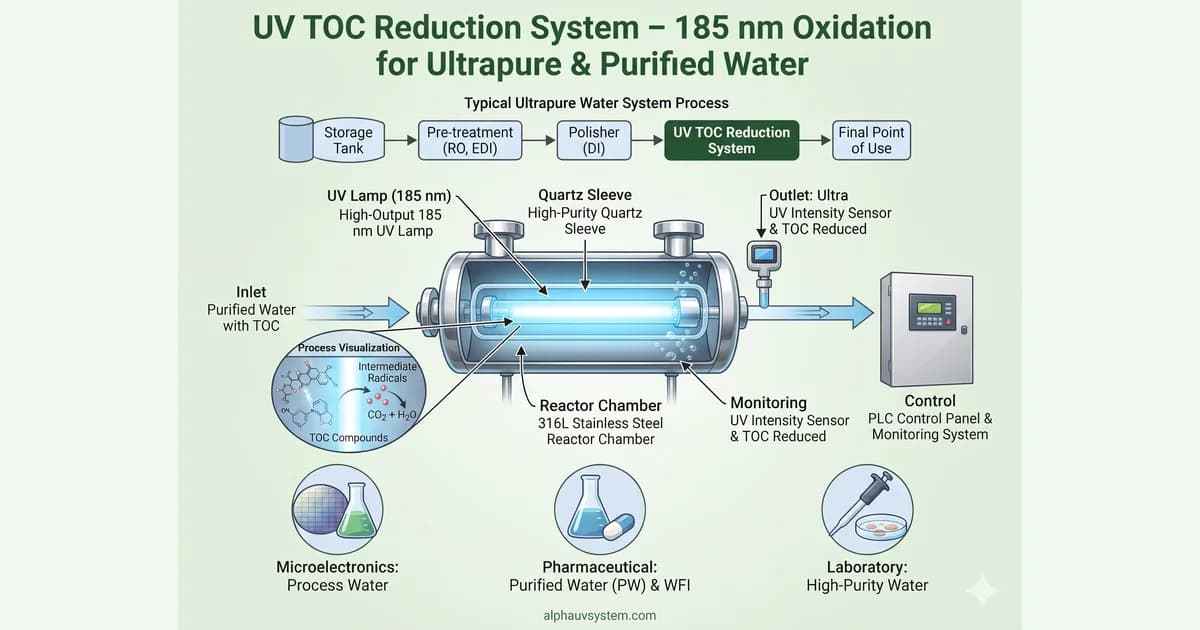
Total Organic Carbon (TOC) control in purified water and ultrapure water systems is a regulatory requirement in pharmaceutical manufacturing (USP <643>, EP 2.2.44, Schedule M 2025), semiconductor fabrication (SEMI F63), and high- pressure boiler feedwater. 185 nm UV photolysis is the most reliable, chemical- free method to oxidise TOC from inlet concentrations of 200–500 ppb down to the sub-50 ppb levels required by USP and EP pharmacopoeial standards — without activated carbon beds, without regeneration downtime, and without introducing chemical extractables into the water system. Alpha UV System 185 nm UV TOC reduction systems are engineered to USP <643> compliance by IIT Patna-trained specialists.
UV Dose
100–400 mJ/cm² (185 nm oxidation dose)
Capacity
100 – 10,000 LPH
Total Organic Carbon (TOC) is a measure of the total carbon content of organic compounds dissolved in water. In pharmaceutical manufacturing, semiconductor fabrication, and high-pressure boiler systems, TOC in process water is a critical quality parameter because even trace organic contaminants cause product failures, process disruptions, and regulatory non-compliance.
In pharmaceutical purified water (PW), USP Chapter <643> limits TOC to 500 ppb (0.5 mg/L) — the threshold above which dissolved organics may interfere with API assays, cell culture media formulations, and parenteral preparations. For Water for Injection (WFI), the limit is 10 ppb. India's Schedule M (Revised) 2025 adopts the USP/EP TOC limits as mandatory for all pharmaceutical water systems subject to GMP inspection. FSSAI's food-grade water standards require TOC below 500 ppb for direct food-contact water in beverage manufacturing.
In semiconductor ultrapure water (UPW), organic contamination causes catastrophic yield loss. Silicon wafer surfaces cleaned with water containing TOC above 1–2 ppb retain organic film residues that cause transistor failures, gate oxide defects, and yield loss in advanced node fabrication. The SEMI F63 Guide for Ultrapure Water specifies TOC <1 ppb for leading-edge fabrication.
In high-pressure steam generators (above 15 kg/cm²), organic carbon decomposes under heat to form organic acids — primarily acetic acid and formic acid — that attack boiler tubes through underdeposit corrosion. ASTM D5173 specifies TOC limits for boiler feedwater that range from <200 ppb (industrial boilers) to <50 ppb (high-pressure power plant boilers).
Conventional UV disinfection uses 254 nm UV-C light, which targets the DNA absorption peak of pathogens. For TOC reduction, a different mechanism is needed — one that breaks down dissolved organic molecules rather than inactivating biological cells.
185 nm UV provides this mechanism through Advanced Oxidation (AOP). When 185 nm photons strike water molecules, they photolyse the O-H bond to produce hydroxyl radicals (OH·). The hydroxyl radical is one of the most powerful oxidising species known in aqueous chemistry — with an oxidation potential of 2.80 V, second only to fluorine. These radicals react with organic molecules at near-diffusion-controlled rates (k ≈ 10⁸–10¹⁰ M⁻¹s⁻¹), breaking C-H and C-C bonds and mineralising organic carbon to CO₂ and water.
The 185 nm photon energy (6.7 eV) is sufficient to photolyse water directly — which 254 nm photons (4.9 eV) cannot do. This is why standard 254 nm UV disinfection systems have no meaningful TOC reduction capability, and why dedicated 185 nm lamps are required for TOC control.
Alpha UV System uses low-pressure amalgam lamps with both 185 nm and 254 nm emission for TOC reduction systems. The 185 nm component oxidises TOC; the 254 nm component simultaneously provides microbial inactivation. This dual-wavelength approach means the UV TOC unit serves as both a TOC polishing stage and a final bioburden control stage in pharmaceutical and ultrapure water systems.
Pharmaceutical water systems produce Purified Water through a treatment train of reverse osmosis → ion exchange → polishing. The final stages before the storage and distribution loop must achieve the USP/EP TOC target. 185 nm UV is installed as the last polishing step, treating water from the ion exchange unit before it enters the storage tank.
The distribution loop itself is a source of TOC from two origins: extractables from elastomeric seals and gaskets; and microbial metabolites from any biofilm growth on distribution piping surfaces. A recirculating UV unit in the distribution loop — operating continuously — controls both TOC and bioburden simultaneously.
For Schedule M (Revised) 2025 compliance in India, the pharmaceutical water system validation protocol requires TOC monitoring as a critical process parameter (CPP). Alpha UV System's pharmaceutical TOC UV units include an integrated inline TOC analyser with 4–20 mA output, alarm relay at the USP limit, and a data logger providing the continuous TOC trending data required for validation master plan (VMP) documentation and routine GMP monitoring records.
IQ/OQ validation protocols for the UV TOC unit are provided as standard — formatted to ICH Q2 and WHO GMP requirements, covering instrument qualification, dose verification, TOC reduction performance testing, and alarm function testing.
Semiconductor ultrapure water (UPW) systems produce water with TOC below 1–2 ppb — a requirement that is 250–500× more stringent than pharmaceutical purified water. 185 nm UV is used at multiple points in the UPW loop: in the primary treatment train after mixed-bed ion exchange, and in point-of-use polishing loops serving individual process tools.
The challenge at <1 ppb TOC is that conventional organic compounds are entirely absent — the residual TOC comes from dissolved CO₂ (which counts as inorganic carbon and is excluded from TOC measurement), and from trace UV lamp extractables and system piping extractables. Alpha UV System's semiconductor-grade 185 nm UV units use quartz components with certified extractable profiles and operate in continuous recirculation loops with inline TOC monitoring at SEMI F63 measurement intervals.
TOC reduction by 185 nm UV is a dose-dependent process: higher UV dose → more OH· generation → more organic oxidation → lower outlet TOC. The dose required depends on:
Inlet TOC concentration: higher inlet TOC requires proportionally higher dose for the same outlet target. At inlet TOC of 200 ppb (typical RO permeate), a dose of 300 mJ/cm² achieves approximately 50 ppb outlet — well below the USP 500 ppb limit.
Target outlet TOC: the USP WFI target of 10 ppb requires substantially higher dose than the PW target of 500 ppb. For WFI TOC control, recirculation through the UV unit (accumulating dose over multiple passes) is the standard engineering approach.
Flow rate: the UV reactor must be sized to deliver the target dose at the system peak flow rate. For pharmaceutical PW loops, this is the maximum distribution loop recirculation flow — typically 1–5 LPM for small to medium pharmaceutical plants.
Water UV transmittance at 185 nm: dissolved anions (particularly sulfate, nitrate, and bicarbonate) absorb at 185 nm, reducing dose delivery. Ion-exchanged water has very high UVT at 185 nm (>95%), making it ideal for 185 nm UV. Municipal tap water has much lower 185 nm UVT due to dissolved anions — another reason 185 nm UV is effective only as a polishing stage after demineralisation.
Alpha UV System's IIT Patna-trained engineers perform TOC reduction calculations using validated UV photonic models before specifying any system. Contact us on WhatsApp at 9318305878 with your water flow rate, inlet TOC analysis, and target outlet TOC for an engineered specification and quotation within 24–48 hours.
Recommended Products
IIT Patna engineers recommend these systems for toc reduction uv applications based on flow rate, required UV dose, and compliance standard. Both systems use genuine Philips UV-C lamps and ship with complete compliance documentation.
IIT Patna Engineering
Alpha UV System IIT Patna engineers calculate UV dose from your actual water quality parameters — measured UVT, flow rate, target log reduction, and the specific compliance standard that governs your facility. Not from catalogue sizing tables or generic assumptions. Every system ships with a signed UV dose calculation report, a Philips certificate of authenticity, and compliance documentation prepared for the regulatory framework applicable to toc reduction uv operations.
From measured UVT, flow rate, and target log-reduction. Signed by IIT Patna engineer.
USP Chapter 643 (TOC Testing) · EP 2.2.44 (TOC in Water) · WHO GMP Schedule M 2025 · SEMI F63 (Ultrapure Water) · ASTM D5173 (TOC in High-Purity Water) — documentation prepared to the audit checklist, not generic templates.
WhatsApp your flow rate, water quality, and compliance requirement — engineering-backed quote in 2 hours.
Mon–Sat · 9 AM–6 PM IST · IIT Patna alumni on call
Send us your flow rate and compliance requirement — quote with engineering rationale in 2 hours.
+91 93183 05878
Get Quote →
Call Direct
+91 95995 00580
Tap to Call →
Send Enquiry
Detailed specifications form
Open Form →