Quick Answer
The best UV water system for an Indian family is one sized to match your peak flow demand (not just average), fitted with a genuine Philips UV-C lamp, and installed with a 5-micron sediment pre-filter. For a family of 4–6 on municipal supply, a 1,000 LPH system with 11W Philips UV-C lamp is typically ideal. For borewell water with iron, add an iron removal pre-filter. Priority: Philips UV-C lamp > correct sizing > stainless steel chamber > BIS IS 14962 certification.
Finding the best UV water system for families in India is harder than it looks. The market is flooded with systems priced anywhere from ₹2,500 to ₹50,000 — and the price difference does not always reflect quality. This guide walks through every selection decision in order of importance, so your family gets water that is actually disinfected, not just water that flows past a glowing lamp.
Why Family UV System Selection Goes Wrong
Most families buying a UV water purifier in India focus primarily on price. This is the root cause of most poor outcomes. A ₹3,500 system with a generic OEM lamp may deliver only 15 mJ/cm² of UV dose at rated flow — compared to the 40 mJ/cm² required for 4-log (99.99%) pathogen reduction. The lamp appears lit, the indicator light is on, but the water is not adequately disinfected. There is no alarm, no warning, and no visible sign that the system is failing.
The second most common error is undersizing. A household with a borewell pump delivering 1,500 LPH buys a system rated 1,000 LPH. At 1,500 LPH actual flow, the water passes through the chamber 50% faster than the rated exposure time. The UV dose drops below 40 mJ/cm² — often to 20 mJ/cm² or lower — and disinfection fails silently.
The physics is straightforward: UV dose (mJ/cm²) = UV lamp irradiance (mW/cm²) × exposure time (seconds). Exposure time is determined by chamber volume divided by flow rate. When flow exceeds the rated design flow, exposure time drops, dose drops, and the system underperforms — with no visible indication to the user.
Understanding this principle is the first step to choosing the best UV water system for families India-wide, regardless of water source or household size.
Step 1 — Measure Your Peak Flow Rate
The most important specification when sizing a UV system is not daily water consumption — it is peak flow rate in litres per hour (LPH). This is the maximum rate at which water flows through your tap at full pressure during normal use.
Measuring your peak flow rate takes under two minutes:
- Open your main kitchen tap to full flow
- Time how many seconds it takes to fill a 10-litre bucket
- Calculate: 10 ÷ time in seconds × 3,600 = LPH
- Add a 20% safety margin to the result — this is your minimum UV system rating
For example: if your 10L bucket fills in 72 seconds, your peak flow is 10 ÷ 72 × 3,600 = 500 LPH. Add 20%: you need a UV system rated at minimum 600 LPH. A 750 LPH or 1,000 LPH system is the practical next step up.
Borewell users: do not measure at the kitchen tap — measure at the borewell pump's delivery point at full pump output. This is the worst-case flow the UV system must handle. If the pump delivers 1,200 LPH and your UV system is rated 1,000 LPH, you are undersized by 20% and your disinfection dose is inadequate whenever the pump runs at full capacity.
| Family Size | Water Habits | Typical Peak Demand | Recommended UV Size |
|---|---|---|---|
| 1–2 persons (flat) | Tap only | 250–400 LPH | 500 LPH system |
| 3–4 persons (municipal) | Normal Indian family | 400–700 LPH | 750–1,000 LPH system |
| 4–6 persons (municipal) | Larger family | 600–900 LPH | 1,000 LPH system |
| 5–8 persons (borewell) | Borewell pump supply | 800–1,500 LPH | 1,500–2,000 LPH system |
| Joint family / 10+ persons | High demand, multiple taps | 1,500–3,000 LPH | 2,000–3,000 LPH system |
Step 2 — Choose the Right Lamp Brand
If there is one factor that separates a safe, effective UV water system from a health risk, it is the UV lamp. The lamp is not a commodity component — it is the disinfection engine of the entire system. Yet it is the component most frequently compromised in low-cost systems sold to Indian families.
The Philips UV-C lamp (manufactured under the Philips TUV product range) is the global benchmark for UV water disinfection lamps. Philips UV-C lamps maintain above 80% rated UV-C output at 9,000 operating hours — independently validated and backed by batch-level documentation. When you buy a system using a genuine Philips UV-C lamp, you know the dose calculation on the nameplate was engineered around a lamp whose output behaviour is accurately characterised.
Generic OEM lamps — the lamps found in most systems priced under ₹5,000 — have actual UV-C output that is commonly 30–60% lower than the lamp manufacturer's claim. They also degrade faster: real service life is often 3,000–5,000 hours rather than the 6,000–8,000 hours claimed on the packaging. This means more frequent lamp replacements, higher total cost over time, and — most critically — periods of inadequate disinfection between replacement intervals.
How to verify lamp genuineness: ask the supplier specifically, "Is this a Philips UV-C lamp, and can you share the lamp batch documentation?" A supplier using a genuine Philips lamp will be able to answer clearly. A supplier who is vague, who says "same quality as Philips", or who cannot provide documentation is almost certainly supplying a generic lamp.
Red flag: any 1,000 LPH system priced under ₹5,000 almost certainly uses a generic lamp. The Philips UV-C lamp alone costs ₹800–2,500 depending on wattage. A genuine Philips-lamp system cannot be priced at ₹3,500–4,000 total without a loss.
| Parameter | Philips UV-C Lamp | Generic OEM Lamp |
|---|---|---|
| Claimed rated life | 9,000 hours | 6,000–8,000 hours (overstated) |
| Actual real-world life | 9,000 hours | 3,000–5,000 hours |
| Annual replacements (continuous use) | 1 per year | 2–3 per year |
| Cost per lamp | ₹800–2,500 | ₹300–800 |
| 5-year lamp cost | ₹4,000–12,500 | ₹6,000–24,000 (more replacements) |
| UV-C output accuracy | ±5% of rated output | ±20–40% (often over-claimed) |
Step 3 — Chamber Material
The UV chamber is the vessel through which your family's water flows while being irradiated. The material must be corrosion-resistant, food-grade, and non-reactive with UV-C radiation. There are three practical options in the Indian market, and one to actively avoid.
SS 304 stainless steel is the minimum acceptable standard for household UV systems in India. It is corrosion-resistant under normal municipal water conditions, food-grade, and dimensionally stable over years of use. Most quality household systems use SS 304 chambers.
SS 316 stainless steel contains molybdenum, which gives it significantly better resistance to chloride corrosion and pitting. It is recommended for coastal Indian households (Mumbai, Chennai, Kochi, Goa), homes supplied with water that has higher chloride content, and borewell installations where the water is aggressive. If you are in a coastal city or have hard, mineral-rich borewell water, specify SS 316 explicitly.
Plastic chambers should be avoided entirely. UV-C radiation degrades most polymers over time, and degraded plastic can leach chemical compounds into treated water. Plastic chambers are a cost-cutting measure with no legitimate benefit for households.
Chrome-plated steel chambers are the most misleading option on the market. They look identical to stainless steel at the point of sale. A simple magnet test distinguishes them: genuine stainless steel (SS 304 or SS 316) is slightly magnetic or non-magnetic; chrome-plated mild steel is strongly magnetic and will rust once the plating wears or chips.
Step 4 — Water Source Type Determines Pre-Treatment
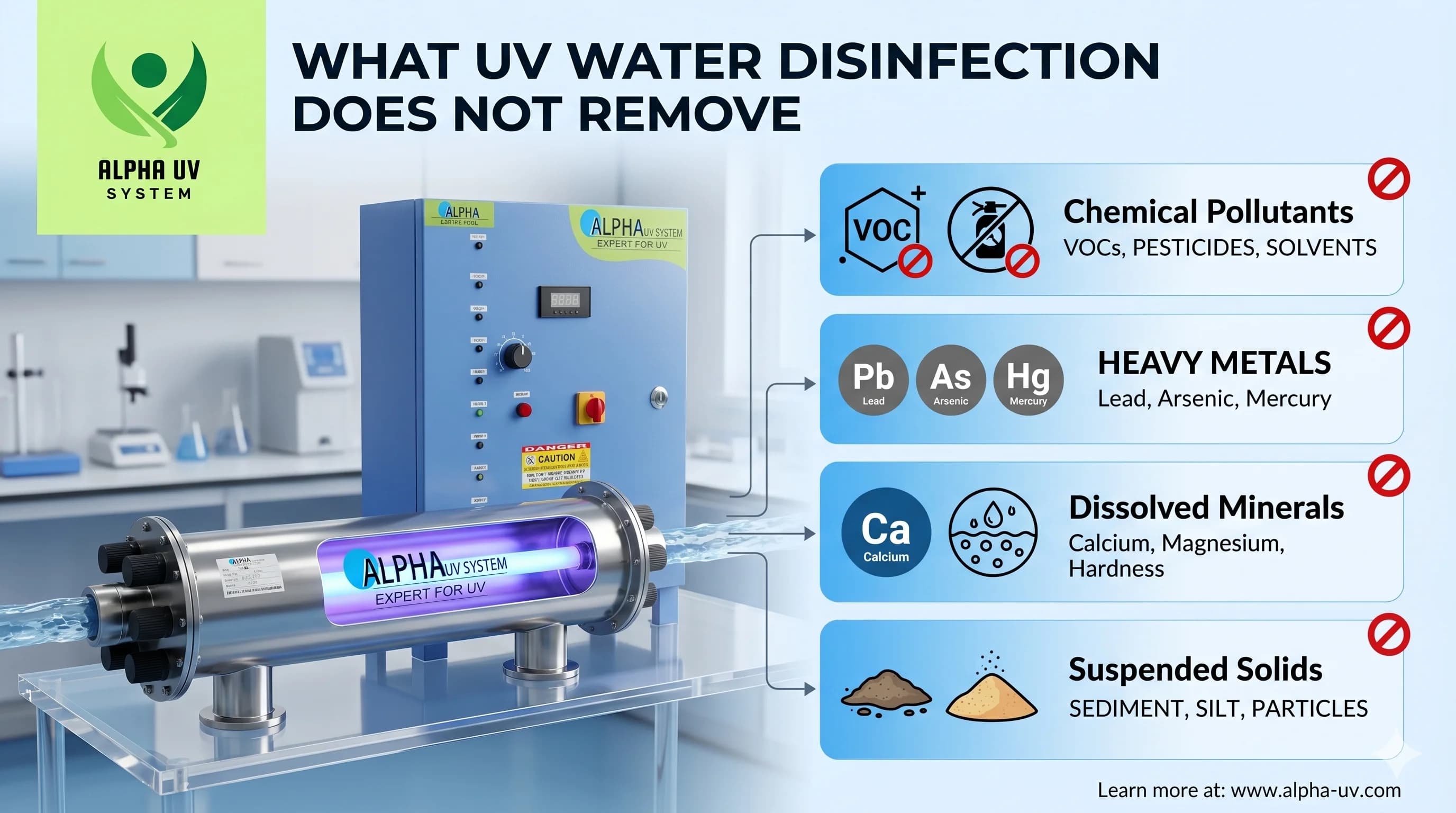
UV disinfection is a physical process — UV-C light destroys pathogen DNA. It does not remove dissolved chemicals, heavy metals, TDS, or turbidity. Pre-treatment is required to prepare the water so that UV disinfection can work effectively. Turbidity above 1 NTU significantly reduces UV transmittance and the actual dose delivered at rated flow.
| Water Source | Pre-Treatment Needed | UV Sizing Note |
|---|---|---|
| Municipal (clear — Delhi, Mumbai, Bangalore) | 5-micron sediment cartridge | Standard sizing per family size table |
| Municipal (with iron taste or discolouration) | Carbon filter + sediment cartridge | Check iron level before sizing |
| North India borewell (iron above 0.3 mg/L) | Iron removal filter + sediment | Size UV to pump full output flow |
| Rajasthan / Gujarat (high TDS, fluoride) | RO system → UV (UV after RO) | RO product water has near-100% UV transmittance |
| South India coastal (high TDS) | RO system → UV (UV after RO) | Specify SS 316 chamber for coastal conditions |
| Water tanker supply | Sediment + carbon | Check turbidity — tanker water varies widely |
Step 5 — UV Dose Verification
A UV system is only as good as the dose it actually delivers at your operating flow rate. The required UV dose for 4-log (99.99%) inactivation of bacteria, viruses, and protozoa is 40 mJ/cm² at rated flow. This is the figure that BIS IS 14962 requires manufacturers to independently verify.
When evaluating any UV system for your family, ask the supplier one specific question: "What is the guaranteed UV dose in mJ/cm² at rated flow?" A manufacturer using a genuine Philips UV-C lamp and a properly engineered chamber will answer with a number of 40 mJ/cm² or above. A manufacturer who cannot or will not answer this question is not guaranteeing adequate disinfection.
BIS IS 14962 certification means the system's dose delivery has been independently tested and verified by a BIS-authorised laboratory. For families with infants, elderly members, immunocompromised individuals, or those on borewell water with high microbial load, IS 14962 certification is not optional — it is the minimum acceptable standard.
What to avoid: marketing claims stating "99.9% bacteria kill" or "kills all bacteria" without a mJ/cm² specification. These claims are meaningless without the dose figure and the flow rate at which that dose is delivered. At a flow rate above the system's rated capacity, even a quality UV system will deliver far below 40 mJ/cm².
For households with immunocompromised family members, elderly residents, or infants under 12 months, consider a system with a UV intensity monitor — a sensor that continuously measures actual UV-C output inside the chamber and alerts when output falls below the dose threshold. This provides real-time verification rather than relying only on the lamp-on indicator.
Installation and Maintenance Overview
A household UV system is a straightforward installation for most Indian homes. The system connects inline to your existing water supply line using standard plumbing fittings. Typical installation time is 30–60 minutes and requires a T-junction fitting, PTFE thread tape, and a standard screwdriver — no specialist tools.
Correct installation point: install the UV system after your overhead tank outlet or under the kitchen sink at point of use — not at the mains water entry point. Installing at the mains causes the lamp to run continuously for the entire household supply including toilet and garden use, which unnecessarily shortens lamp life and increases electricity consumption.
Annual maintenance for a family UV system is straightforward:
- Philips UV-C lamp replacement: annually, at approximately 9,000 hours of use (or sooner if an intensity monitor indicates output drop)
- Sediment pre-filter cartridge: every 3 months in normal municipal supply conditions; more frequently if source water has visible turbidity
- Quartz sleeve inspection and cleaning: every 6 months; in hard water areas (Rajasthan, UP, Haryana) every 2–3 months, as scale deposits on the quartz sleeve reduce UV transmittance
Total annual maintenance cost for a household UV system is approximately ₹1,200–3,000 depending on system size, lamp wattage, and pre-filter cartridge replacement frequency.
UV System Cost Guide for Indian Families 2026
The following cost guide reflects 2026 market prices for quality UV systems with genuine Philips UV-C lamps and SS 304 chambers, meeting BIS IS 14962. Systems at the lower end of each range are basic configurations without UV intensity monitors; systems at the upper end include monitors, SS 316 chambers, and additional pre-filtration stages.
| Family Size | Recommended System | Approximate Purchase Price | Annual Running Cost |
|---|---|---|---|
| 1–2 persons | 500 LPH, 7W Philips UV-C lamp | ₹8,000–15,000 | ₹1,200–2,000 |
| 3–5 persons | 1,000 LPH, 11W Philips UV-C lamp | ₹10,000–20,000 | ₹1,500–2,500 |
| 5–8 persons | 2,000 LPH, 16W Philips UV-C lamp | ₹15,000–30,000 | ₹1,800–3,000 |
| Joint family or borewell | 3,000 LPH, 25W Philips UV-C lamp | ₹20,000–45,000 | ₹2,500–4,000 |
Special Considerations for Indian Families
Several family situations require specific attention when choosing the best UV water system for families in India. The following covers the most common scenarios across Indian households.
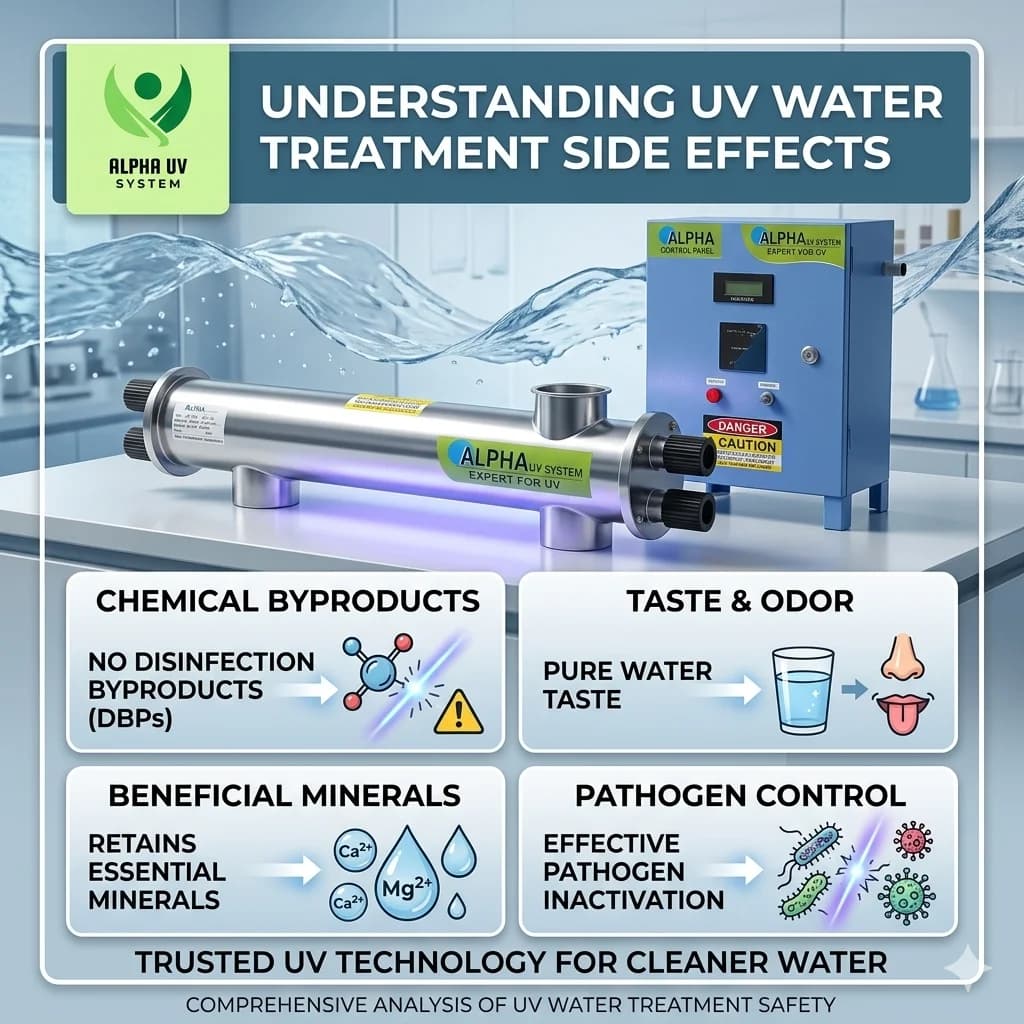
Infants and young children: UV-treated water is safe for infants and young children. UV disinfection leaves no chemical residual — no chlorine, no trihalomethanes (THMs), no chloramines. The only requirement is that the system delivers the correct dose at the flow rate in use.
Pregnant women: UV-treated water is specifically recommended during pregnancy. The absence of THMs and chloramines — byproducts of chemical disinfection that have been associated with health concerns in some studies — makes UV-treated water a preferable choice over municipally chlorinated supply used directly.
Elderly and immunocompromised family members: for households that include elderly residents, individuals with compromised immune systems, or patients undergoing chemotherapy or immunosuppressive treatment, a UV system with a real-time UV intensity monitor is recommended. The monitor provides continuous, verifiable confirmation that dose delivery is adequate — not just that the lamp is on.
Power cuts (common across India): UV disinfection stops completely during a power cut. Water that flows through the chamber during a power outage receives zero UV dose. For households in areas with frequent power cuts — common in UP, Bihar, rural Rajasthan, and parts of Madhya Pradesh — two practical solutions exist: (1) fit a solenoid valve that closes the water supply line automatically when power is cut, preventing untreated water from flowing; or (2) use a small UPS or battery backup dedicated to the UV system (the power requirement is low, typically 7–25 watts).
Hard water areas (Rajasthan, UP, Haryana, parts of Gujarat): hard water deposits calcium carbonate scale on the quartz sleeve surrounding the UV lamp. Scale significantly reduces UV-C transmittance and the actual dose delivered. In hard water areas, plan for quartz sleeve cleaning every 2–3 months rather than the standard 6-month interval. Use a citric acid solution for cleaning — do not use abrasive materials that can scratch the quartz surface.
Frequently Asked Questions
What is the best UV system for a 4-person family on municipal water in Delhi?
For a family of four in Delhi on DJB (Delhi Jal Board) municipal supply, a 750 LPH to 1,000 LPH UV system with a genuine Philips UV-C lamp, SS 304 stainless steel chamber, and a 5-micron sediment pre-filter is the right specification. Delhi municipal water is pre-treated with coagulation and chlorination, so UV alone (with sediment pre-filter) is sufficient — no RO is required unless TDS at your specific address is above 500 mg/L or taste is an issue. BIS IS 14962 certification should be confirmed before purchase. Budget: ₹10,000–20,000 for a quality system that will last 10+ years with annual lamp replacement.
Do I need a UV system if I already boil my water?
Boiling kills pathogens effectively, but it has practical limitations for Indian families. Boiling consumes LPG or electricity, requires cooling time before use, does not prevent recontamination in storage, and is inconvenient at scale for a household of 4–6 people. A UV system treats water continuously at the tap, requires no heating or cooling time, leaves no thermal energy waste, and costs less per litre treated than boiling. For families using bottled water as a boiling alternative, the per-litre cost of UV treatment is substantially lower over a 12-month period.
How do I know if my UV system is working?
A lit indicator lamp alone does not confirm adequate disinfection — it only confirms the lamp has electrical power. To confirm the system is working correctly: (1) verify the lamp was replaced within the last 12 months (9,000-hour rated life for Philips UV-C lamp); (2) check that flow rate through the system does not exceed the rated LPH (if you have added additional household taps or a pump since installation, remeasure your peak flow); (3) for critical applications, use a system with a UV intensity monitor that continuously measures actual UV-C output in the chamber. Annual water quality testing from a NABL-accredited laboratory provides the most definitive confirmation.
Can I use a UV system with an overhead tank?
Yes, and this is the most common installation configuration in Indian homes. The UV system is installed on the outlet pipe of the overhead tank, treating water as it flows from the tank to the kitchen tap. Important: install the UV system at the tank outlet, not at the tank inlet. Water treated at the inlet would sit in the tank for hours and risk recontamination from tank walls. If your overhead tank is concrete or old and prone to algae or sedimentation, a sediment pre-filter before the UV is especially important. Also ensure the UV system is not installed in direct sunlight, as UV-C lamps are sensitive to ambient temperature extremes.
Is a ₹4,000 UV system safe to use?
A UV system priced at ₹4,000 for a 1,000 LPH unit cannot include a genuine Philips UV-C lamp and still be profitable. At that price point, the lamp is almost certainly a generic OEM lamp whose actual UV-C output may be 30–60% lower than claimed, with a real service life of 3,000–5,000 hours. The chamber material is likely not food-grade stainless steel. BIS IS 14962 certification is unlikely to be present. For a household with children, elderly members, or borewell water, this is not a safe specification. The most cost-effective UV system is not the lowest purchase-price system — it is the system with the lowest total cost per litre of safely disinfected water over its full service life.
How often do I need to replace the UV lamp?
For a genuine Philips UV-C lamp, the replacement interval is once per year for continuous use (approximately 8,000–9,000 hours). If your system runs intermittently — only when a tap is open — total operating hours will be lower, but annual replacement is still recommended as a precaution, since UV-C output can degrade with age independently of operating hours. Generic OEM lamps should be replaced every 4–6 months based on real-world performance data, making their effective annual cost higher than a Philips lamp despite the lower per-unit price. Always replace the quartz sleeve inspection and cleaning at the same time as lamp replacement.
Get a Free UV System Recommendation for Your Family
Tell us your family size, water source (municipal or borewell), and location — and our team will specify the correct system, lamp wattage, pre-filter combination, and installation configuration. We respond within 24–48 hours.
WhatsApp Us for a Free Recommendation
Standards, authorities & further reading
External references used to inform this guide. Regulations evolve — check the latest revision on each authority's site before compliance decisions.
Recommended UV Systems
Alpha UV System products for this application — powered by genuine Philips UV-C lamps.
UV System for Drinking Water
100 – 50,000 LPH
Chemical-free UV drinking water disinfection — from homes to municipalities
Residential UV Disinfection System
100 – 500 LPH
Safe drinking water for homes and villas — no chemicals, no taste change
Not sure which system suits your application? WhatsApp our engineers for a free recommendation →
Need a UV system?
Talk to our UV engineers — WhatsApp for a quote in 2 hours, or browse the full catalog on IndiaMART.