Quick Answer
For point-of-use drinking water — home, restaurant, office, hospital — UV completely replaces chlorine and is superior in every practical dimension. For municipal distribution systems, UV replaces chlorine as the primary disinfection step, but a minimal chlorine residual (0.2 mg/L) is typically maintained to protect the distribution network, not the treatment process itself. For Indian homes on municipal supply, UV eliminates the need to add any additional chlorine. This article answers the full question of whether can UV disinfection replace chlorine completely — and the answer depends entirely on which part of the water supply chain you are asking about.
Two Different Questions: Point-of-Use vs. Municipal Distribution
The debate over whether can UV disinfection replace chlorine completely is really two separate debates that have been incorrectly merged. The correct answer requires separating two fundamentally different scenarios that have very different engineering realities.
Scenario 1 — Point-of-Use: Home, Office, Restaurant
Point-of-use treatment means water is treated immediately before consumption. There is no pipe network between the UV unit and the glass of water. This is the scenario for every household UV purifier, every under-sink UV system, every restaurant water station, and every office water dispenser in Delhi, Mumbai, Pune, Bengaluru, or anywhere else in India.
In this scenario, the answer to whether can UV disinfection replace chlorine completely is an unambiguous yes. UV inactivates all waterborne pathogens at point of use — bacteria, viruses, protozoa, including pathogens chlorine cannot touch. No chlorine needs to be added before or after UV. No residual is required because the water is consumed immediately after treatment, leaving no opportunity for re-contamination.
Scenario 2 — Municipal Distribution: Water Travelling Kilometres Through Pipes
Municipal water treatment plants in Delhi, Mumbai, and Maharashtra serve millions of people through networks of pipes, intermediate storage reservoirs, and overhead tanks. Water treated at a central plant may take 12 to 36 hours to reach the end consumer. During this transit, several risks emerge:
- Biofilm on aging pipe walls harbours bacteria that can re-seed treated water
- Cross-connections and pipe pressure drops allow contamination ingress
- Intermediate storage reservoirs can be contaminated by birds, maintenance activities, or structural failures
UV treats water at a single point in time. It leaves no residual protective agent in the water. If re-contamination occurs 5 km downstream of the UV unit, the water arriving at the consumer's tap is untreated. A low chlorine residual of 0.2 mg/L provides ongoing protection through this network — this is why even UV-equipped municipal plants in the US, Canada, and the Netherlands maintain a small chlorine residual.
The important clarification for Indian homeowners: if you are on municipal supply with chlorine already present, installing a UV system at your tap makes the question of UV versus chlorine irrelevant. The municipal plant uses chlorine for distribution network protection. Your UV system handles point-of-use pathogen kill — including pathogens that survived the municipal chlorine. These two systems serve different functions and work together, not in competition.
How UV Compares to Chlorine: Pathogen Kill Performance
Before examining whether can UV disinfection replace chlorine completely from a microbiological standpoint, the pathogen-by-pathogen comparison matters. The data below is based on a UV dose of 40 mJ/cm² — the standard dose delivered by a correctly sized Philips UV-C lamp system — and standard chlorination at practical municipal doses.
| Pathogen | UV at 40 mJ/cm² | Chlorination (standard dose) | Winner |
|---|---|---|---|
| E. coli | 4-log kill | 4-log kill | Equal |
| Salmonella | 4-log kill | 4-log kill | Equal |
| Giardia | 3-log kill | Poor — requires very high dose | UV wins |
| Cryptosporidium | 3-log kill | No effect at practical doses | UV wins decisively |
| Rotavirus | 3-log kill | 3-log kill | Equal |
| Hepatitis A | 3-log kill | 3-log kill | Equal |
| Legionella | 4-log kill | 4-log kill | Equal |
| Adenovirus | 3-log kill (high dose) | 2-log kill | UV wins at high dose |
The Cryptosporidium row is the single most important data point in this entire table. Chlorine — at any concentration that is safe for drinking water — provides essentially no inactivation of Cryptosporidium oocysts. UV at 40 mJ/cm² (delivered by a properly sized Philips TUV lamp system) achieves 3-log reduction. In India, where surface water contamination with Cryptosporidium is documented in major cities including Delhi, Mumbai, and parts of Maharashtra, this difference is not academic.
What Chlorine Can Do That UV Cannot
A technically honest analysis of whether can UV disinfection replace chlorine completely requires acknowledging the one genuine advantage chlorine holds.
Distribution Network Residual Protection
Chlorine persists in water for hours. When water leaves a treatment plant in Delhi or Mumbai with 0.5 mg/L of free chlorine, a measurable residual typically remains at the consumer's tap hours or days later. This residual continuously suppresses bacterial growth throughout the pipe network, in overhead storage tanks, and in building plumbing. UV cannot do this — UV treats water at a single point and provides zero residual protection downstream.
This is a real limitation in India's context. India's water distribution infrastructure includes a significant proportion of aging CI and AC pipes. Overhead tanks in apartment buildings are sometimes poorly maintained. In this environment, chlorine residual provides a genuine safety net for distribution.
The Solution for Indian Homes With Overhead Tanks
If your home or apartment building has an overhead water tank — as most do in Delhi, Mumbai, and across urban India — the correct placement for a UV system is at the tank outlet, not the tank inlet. Placing UV at the inlet treats water before it enters the tank, which then potentially becomes re-contaminated by the tank environment. Placing UV at the outlet (the last point before water reaches the tap) ensures that water is treated immediately before consumption, eliminating the tank re-contamination risk entirely. At this point-of-use installation, UV completely replaces the need for any additional chlorination.
What UV Does That Chlorine Cannot
The list of advantages UV holds over chlorine is substantially longer than the single advantage chlorine holds over UV.
| Category | UV | Chlorine |
|---|---|---|
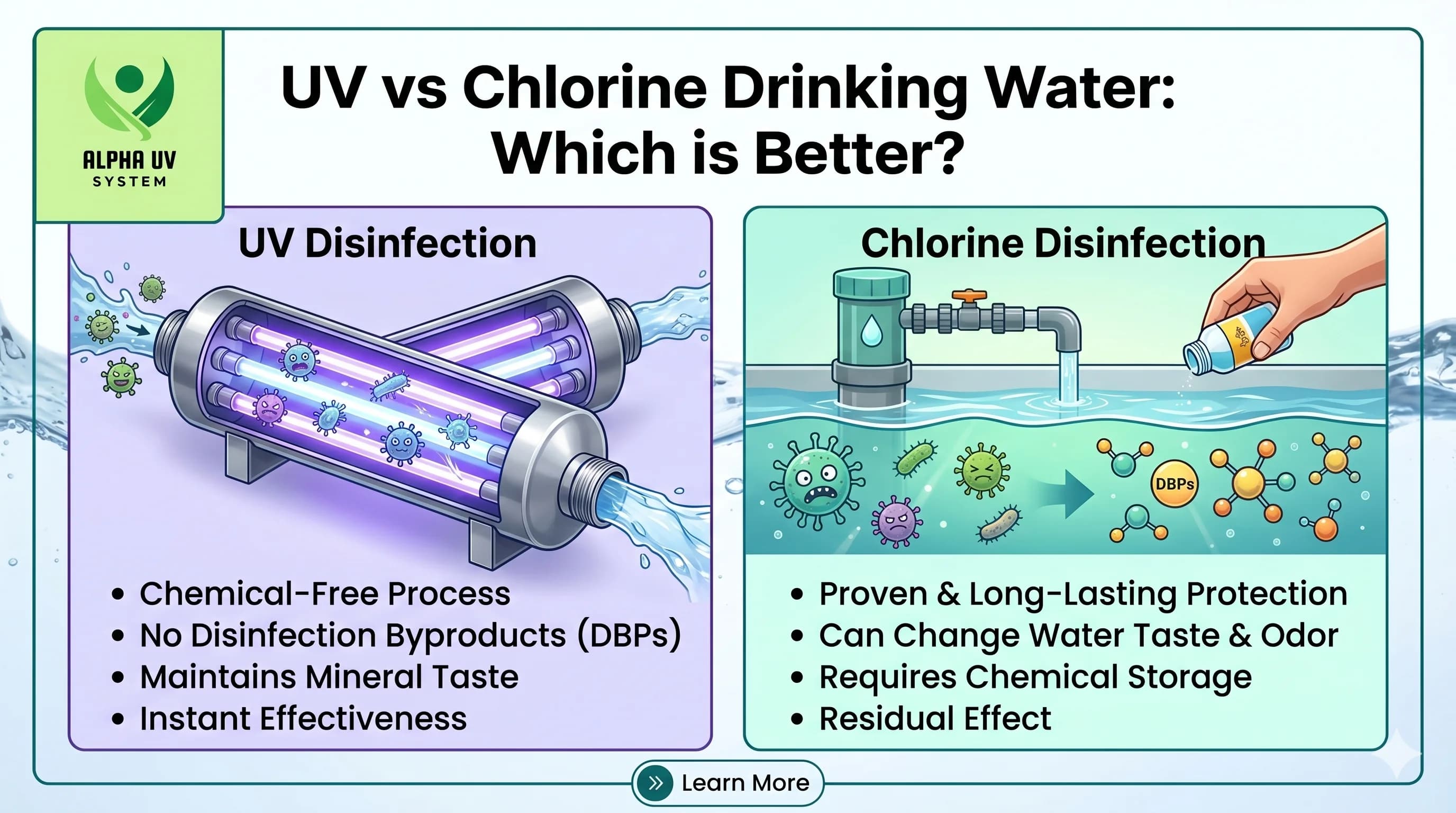
| Cryptosporidium kill | 3-log at 40 mJ/cm² | No effect at drinking water doses |
| Disinfection byproducts | None | THMs, HAAs, chloramines |
| Taste and odour impact | None — water tastes identical to source | Chlorine taste and smell |
| Contact time required | None — instantaneous | 30+ minutes at standard doses |
| Chemical storage/handling | None required | Corrosive chemical — safety protocols required |
| Regulatory permits | None for household use | Chemical handling requirements at scale |
| Distribution residual | None | Yes — persists in pipes |
The taste and odour advantage matters enormously in India. A consistent complaint about municipal water in Delhi and Mumbai is the chlorine taste from already-chlorinated supply. UV-treated water — using a Philips UV-C lamp operating at 254 nm — is organoleptically identical to the source water. No chemical taste, no odour, no aftertaste. This is why premium hotels, food-service businesses, and hospitals increasingly specify UV as their final treatment step even when municipal water is already chlorinated.
The Disinfection Byproduct Case for UV
Disinfection byproducts (DBPs) are the compounds formed when chlorine reacts with natural organic matter present in source water. THMs (trihalomethanes) and HAAs (haloacetic acids) are the two primary families of concern. Chloroform — the dominant THM — is classified by IARC as a Group 2B possible human carcinogen. Long-term exposure to elevated THM levels in drinking water is associated with bladder cancer risk in epidemiological studies.
India's BIS IS 10500:2012 drinking water standard sets a limit of 0.1 mg/L for total THMs. Some Indian municipal water supplies — particularly those drawing from highly organic river water during the monsoon — approach this limit after chlorination. UV produces no THMs, no HAAs, and no chloramines under any operating conditions. This zero-DBP performance is the primary driver for UV adoption in Indian pharmaceutical facilities, hospitals, and premium food and beverage manufacturing.
| Disinfection Byproduct | UV | Chlorination | Boiling |
|---|---|---|---|
| THMs (chloroform, etc.) | None | Yes — up to 0.15 mg/L in some Indian municipal water | THMs concentrate as water volume reduces |
| HAAs (haloacetic acids) | None | Yes | Minimal |
| Chloramines | None | Yes — in chloramination systems | None |
| Chlorophenols | None | Yes — when phenols present in source water | None |
| Bromate | None | None (only with ozone + bromide) | None |
The boiling comparison is important for Indian households. Boiling is the traditional fallback for water safety, but boiling chlorinated municipal water concentrates existing THMs as water volume decreases. Boiling also does not kill Cryptosporidium oocysts consistently at typical Indian household boiling times. UV + a basic sediment pre-filter provides superior microbiological protection with zero DBPs and none of the fuel cost or time commitment of boiling.
Indian Regulatory Position on UV vs. Chlorine
The regulatory question of whether can UV disinfection replace chlorine completely in Indian contexts is straightforward — no Indian regulation mandates chlorine at the point of use.
- BIS IS 10500:2012 (India's national drinking water standard): Does not mandate chlorine as the disinfection method. UV is a fully compliant treatment technology.
- CPHEEO Manual on Water Supply and Treatment: Lists UV as a recommended disinfection technology for water treatment systems, including at the household and community level.
- FSSAI (Food Safety and Standards Authority of India): Accepts UV as an approved water treatment method for food businesses. Food manufacturers in India using UV-treated process water are in full FSSAI compliance.
- Schedule M 2025 (revised pharmaceutical GMP guidelines for India): Accepts UV as a primary disinfection method for pharmaceutical purified water systems. No chlorine required in pharma-grade water production.
- Delhi Jal Board and Maharashtra Jeevan Pradhikaran: Both have operational UV installations within their treatment systems, validating UV as an accepted technology in India's largest water utilities.
The practical regulatory conclusion: there is no legal requirement for chlorine at point-of-use anywhere in India. UV is fully legal, recommended by multiple Indian regulatory bodies, and is the preferred disinfection method in high-scrutiny applications including pharmaceutical, healthcare, and food processing.
Practical Guide: Replacing Chlorine With UV in Indian Homes
For Indian households considering whether can UV disinfection replace chlorine completely for their specific water supply situation, the answer varies slightly by source water type — but the conclusion is always that additional household chlorination is unnecessary.
| Water Source | Chlorine Present? | UV Role | Need for Additional Chlorine? |
|---|---|---|---|
| Municipal supply (Delhi, Mumbai) | Yes — residual from treatment plant | UV destroys residual chlorine + kills all pathogens including Cryptosporidium | No — UV at point of use is sufficient |
| Borewell or open well | No | UV provides complete disinfection — sole treatment | No |
| Water tanker delivery | Unknown / unreliable | UV is essential — handles all biological risk | No — UV handles biological risk completely |
| Apartment with central overhead tank (municipal) | Yes (from municipal) — but reduced by tank storage | UV at tap outlet — installed after tank, not before | No |
| Rural groundwater | No | UV essential + pre-filtration for turbidity | No |
The one installation detail that matters most in India: if you have an overhead storage tank, install the UV unit at the outlet of the tank (the pipe feeding your taps), not at the inlet (the pipe filling the tank). This ensures UV treatment occurs at the last possible point before consumption, eliminating any re-contamination that occurs inside the tank. This single placement decision determines whether UV truly replaces all other disinfection at point of use.
5-Year Cost Comparison: UV vs. Chlorination
For households and businesses evaluating whether can UV disinfection replace chlorine completely from a cost perspective, UV is substantially more cost-effective over a 5-year horizon — primarily because UV has zero ongoing chemical cost.
| Cost Element | UV System | Chlorination (sodium hypochlorite dosing) |
|---|---|---|
| Initial equipment cost | Rs 8,000–45,000 | Rs 5,000–20,000 (dosing pump + chemical tank) |
| Annual chemical cost | None | Rs 3,000–12,000 (sodium hypochlorite) |
| Annual maintenance | Rs 1,200–3,000 (lamp + quartz sleeve replacement) | Rs 2,000–5,000 (dosing pump servicing + calibration) |
| 5-year total cost | Rs 14,000–60,000 | Rs 30,000–85,000 |
| DBPs produced | None | THMs and HAAs |
| Cryptosporidium inactivation | Yes — 3-log at 40 mJ/cm² | No |
The UV system's cost advantage becomes even more pronounced when you factor in the health cost avoided by eliminating DBP exposure and the Cryptosporidium protection not available from any dose of sodium hypochlorite. For a family in Delhi or Mumbai consuming roughly 5 litres of drinking water per day, switching from home chlorination to UV is both the more cost-effective and the more protective choice.
Frequently Asked Questions
If I use UV, do I need to add chlorine to my water at home?
No. For household drinking water, a properly sized UV system with a Philips UV-C lamp provides complete pathogen inactivation. You do not need to add any chlorine before or after the UV unit. The water is consumed immediately after treatment, so there is no need for a residual disinfectant. Adding chlorine to UV-treated water would only reintroduce taste and DBP concerns that UV eliminates.
Does UV destroy the chlorine already in my municipal water?
Yes. UV light at 254 nm photodegrades free chlorine and chloramines present in water as it passes through the UV chamber. If you are on municipal supply in Delhi or Mumbai, the residual chlorine arriving at your tap will be destroyed as it passes through the UV unit. This is safe — the chlorine has already served its function in protecting the distribution network, and the water is consumed immediately after UV treatment, so no residual is needed.
Why do municipal plants still use chlorine if UV kills everything?
Because UV provides no residual protection in the distribution network. Water treated at a municipal plant in Delhi travels through hundreds of kilometres of pipes, intermediate pumping stations, and storage tanks before reaching a consumer's tap. During this transit, re-contamination can occur. A low chlorine residual (0.2 mg/L at the tap) provides ongoing protection through the distribution system. UV cannot do this — it treats water at a single point and provides zero downstream protection. This is why even UV-equipped municipal plants like those operated by Maharashtra Jeevan Pradhikaran maintain a small chlorine residual for distribution. At the point-of-use level — your home tap — this distribution-network argument does not apply, and UV can replace chlorine completely.
Is it safe to drink UV-treated water without any chlorine?
Yes — for water consumed directly from a UV system. UV inactivates all medically significant waterborne pathogens. The WHO, USEPA, BIS, and CPHEEO all recognise UV as a complete disinfection method for drinking water. The only caveat: UV-treated water stored in an open or poorly sealed container can be re-contaminated by ambient bacteria over time. Store UV-treated water in a clean, sealed container and consume within a few hours if not drinking directly from the UV tap. For apartments with overhead tanks, install the UV unit at the tank outlet rather than the inlet — this eliminates the storage re-contamination concern entirely.
Can I switch from chlorination to UV in my apartment building?
Yes. For an apartment building on municipal supply, the most effective configuration is a UV system installed on the main supply line after the overhead tank, treating water as it feeds each flat's plumbing. This replaces any chlorine dosing that may have been done at the tank. Each flat receives UV-treated water at the tap. If the building also has in-flat point-of-use UV units in kitchens, you have a multi-barrier system that provides excellent protection with zero DBPs and no chemical handling. Our engineering team can assess your building's specific flow rates and recommend the correct system size within 24–48 hours of your inquiry.
Does UV work without chlorine in areas with very contaminated water?
UV's effectiveness depends on water clarity (turbidity and colour), not on the initial pathogen load. A Philips TUV lamp operating at 40 mJ/cm² achieves 4-log reduction of bacteria, 3-log reduction of viruses, and 3-log reduction of Cryptosporidium regardless of whether chlorine is or is not present. However, if source water has very high turbidity (above 1 NTU for drinking water applications), UV dose delivery is reduced because suspended particles shield pathogens from UV light. For highly turbid borewell water or surface water, a sediment pre-filter and optionally an activated carbon filter should precede the UV unit. With appropriate pre-filtration, UV completely replaces chlorine as the disinfection method even in areas with high baseline contamination.
Switch to UV — Talk to Our Team
Whether you are replacing an old chlorination setup at home or specifying UV for a commercial or industrial facility, our team can confirm whether UV disinfection can replace chlorine completely for your specific application and recommend the right system. We respond within 24–48 hours.
WhatsApp Us: +91 95995 00580
Standards, authorities & further reading
External references used to inform this guide. Regulations evolve — check the latest revision on each authority's site before compliance decisions.
Recommended UV Systems
Alpha UV System products for this application — powered by genuine Philips UV-C lamps.
UV System for Drinking Water
100 – 50,000 LPH
Chemical-free UV drinking water disinfection — from homes to municipalities
Residential UV Disinfection System
100 – 500 LPH
Safe drinking water for homes and villas — no chemicals, no taste change
Not sure which system suits your application? WhatsApp our engineers for a free recommendation →
Related solutions
See how Alpha UV System applies this to your industry or city.
Need a UV system?
Talk to our UV engineers — WhatsApp for a quote in 2 hours, or browse the full catalog on IndiaMART.