Quick Answer: Is UV Water Disinfection Safe for Home Use?
Yes — UV water disinfection is completely safe for home use. The World Health Organization (WHO), Bureau of Indian Standards (BIS IS 10500:2012), and the US EPA all endorse UV-C at 254 nm as a proven, chemical-free method for drinking water disinfection. UV adds nothing to your water — no chlorine, no chemicals, no taste change — and removes nothing except disease-causing microorganisms. For Indian families in Delhi NCR, Mumbai, and across the country, UV water disinfection is not only safe but is increasingly the recommended choice over chemical treatment, particularly for infants, pregnant women, and immunocompromised family members.
How UV-C Light Works Inside the Disinfection Chamber
Understanding whether UV water disinfection is safe for home begins with understanding exactly what happens inside the UV chamber — and critically, what does not happen outside it.
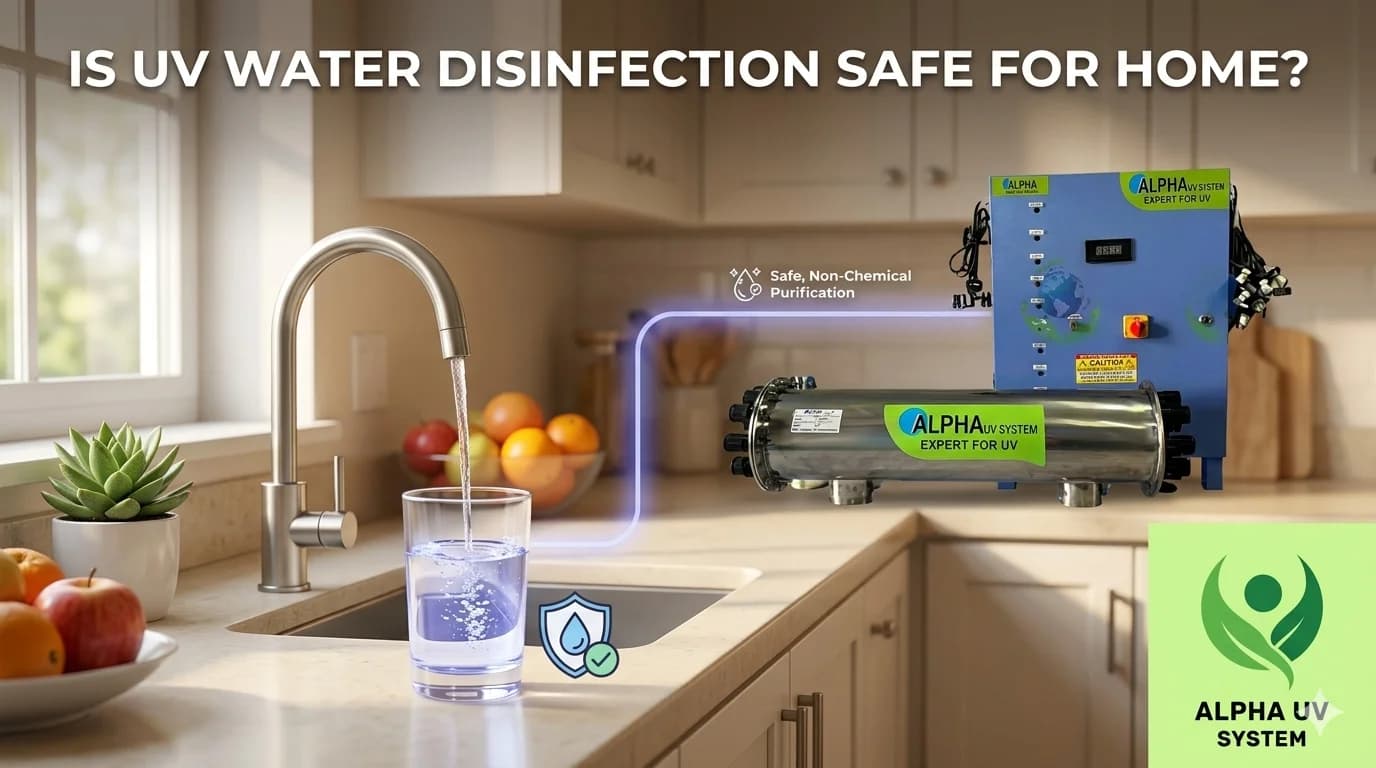
A UV water disinfection system consists of a sealed stainless steel chamber with a low-pressure mercury vapour lamp running along its central axis, enclosed within a quartz glass sleeve. Water flows through the annular space between the quartz sleeve and the chamber wall. As water passes through, UV-C light at 254 nm penetrates each water molecule's path and strikes bacteria, viruses, and protozoa. At this wavelength, UV-C energy is absorbed by the nucleic acids (DNA and RNA) of pathogens, causing thymine dimer formation — a structural break that prevents the pathogen from replicating. A microorganism that cannot replicate cannot cause infection.
The quartz sleeve transmits UV-C light efficiently into the water column while also acting as a containment barrier. The stainless steel outer wall is opaque to UV-C. The result: every photon of UV-C light remains inside the chamber during normal operation. No UV-C exits into the room, the pipe network, or the water that comes out. When you ask whether UV water treatment safety home systems are designed correctly, the answer is yes — containment of the UV-C source is a fundamental design requirement, not an afterthought.
The only moment when UV-C light could potentially be a hazard to a person is during lamp replacement, when the chamber is open and the lamp is exposed. The safe practice is simple: always switch off power to the UV system before opening the chamber for any maintenance. Alpha UV System units include a power interlock recommendation label on the chamber for exactly this reason.
What UV Adds to Water: Nothing
The most important safety fact about UV water disinfection for home use is also the simplest: UV adds nothing to your water. The water that enters the UV chamber and the water that exits are chemically identical. This stands in direct contrast to chemical disinfection, where chlorine or chloramines are deliberately introduced into the water supply and remain present at the tap.
Specifically, UV water treatment does not introduce:
- No chlorine or chloramines — chlorinated water, while effective against bacteria, generates trihalomethanes (THMs) and haloacetic acids (HAAs) during reaction with natural organic matter. The International Agency for Research on Cancer (IARC) classifies several THMs as possible human carcinogens. UV produces none of these disinfection byproducts (DBPs).
- No taste or odour change — water after UV treatment is organoleptically identical to the source water. The "chemical" or "chlorine" taste common in municipal supplies is entirely absent.
- No pH change — the acid-base chemistry of water is unaffected by UV-C exposure at any practical dose.
- No hardness or softness change — calcium, magnesium, and other dissolved minerals remain at exactly the same concentration after UV treatment.
- No TDS change — UV is not a filtration or membrane process; it does not remove dissolved solids of any kind.
- No residual chemical — unlike chlorine (which persists in distribution systems intentionally), UV leaves no residual. The water is disinfected at the point of treatment and immediately safe to consume.
For Indian families evaluating whether UV water is safe for drinking, this chemical neutrality is significant. UV disinfected water is what your source water already is — municipal supply or filtered borewell water — minus the pathogens.
UV Water Disinfection — What Changes vs What Stays the Same
| Water Parameter | Before UV Treatment | After UV Treatment | Does UV Change It? |
|---|---|---|---|
| Bacteria (E. coli, Salmonella, etc.) | May be present | Inactivated (4-log at 40 mJ/cm²) | Yes — eliminated |
| Viruses (Rotavirus, Hepatitis A, etc.) | May be present | Inactivated (4-log at 40 mJ/cm²) | Yes — eliminated |
| Protozoa (Cryptosporidium, Giardia) | May be present | Inactivated (3 mJ/cm² sufficient) | Yes — eliminated |
| pH | Source value (e.g., 7.2) | Same (7.2) | No change |
| TDS (Total Dissolved Solids) | Source value (e.g., 280 mg/L) | Same (280 mg/L) | No change |
| Hardness (Calcium, Magnesium) | Source value | Same | No change |
| Iron content | Source value | Same | No change |
| Chlorine residual | May be present (municipal) | Slightly reduced (UV can degrade chlorine) | Minor reduction only |
| Taste and odour | Source character | Same | No change |
| Turbidity | Source value | Same | No change (pre-filter required if >1 NTU) |
| Disinfection byproducts (THMs, HAAs) | None introduced | None introduced | No change — UV produces zero DBPs |
| Radioactivity | None | None | No change — UV-C is non-ionising radiation |
WHO, BIS, and USEPA Standards Endorsing UV for Drinking Water
For any Indian household asking whether UV water disinfection is safe for home use, the clearest answer comes from the regulatory and scientific bodies that govern drinking water quality. UV water disinfection health safe India status is not a marketing claim — it is encoded in formal standards adopted by national and international authorities.
The WHO Guidelines for Drinking Water Quality (4th Edition, 2017) explicitly recognise UV as an effective primary disinfection barrier and specify 40 mJ/cm² as the validated minimum dose for 4-log pathogen inactivation. The BIS IS 10500:2012 — India's primary drinking water quality standard — permits UV as a standalone disinfection method for domestic water treatment. The FSSAI regulations that govern food businesses including packaged drinking water production recognise UV as a certified treatment step. This is why restaurants, NABH-accredited hospitals, and pharmaceutical clean rooms across India use UV water purification as a core safety measure.
International and Indian Standards for UV Drinking Water Safety
| Standard | Issuing Body | UV Dose Requirement | What It Covers |
|---|---|---|---|
| Guidelines for Drinking Water Quality (4th Ed., 2017) | WHO (World Health Organization) | 40 mJ/cm² minimum | Global drinking water disinfection; UV endorsed as primary treatment barrier |
| BIS IS 10500:2012 | Bureau of Indian Standards | Pathogens absent in 100 mL (outcome-based); UV permitted as method | Indian drinking water quality — physical, chemical, and microbiological parameters |
| UV Disinfection Guidance Manual (2006) | USEPA | 40 mJ/cm² validated dose for surface water | Municipal and point-of-use UV for drinking water in the United States |
| ÖNORM M 5873 / EN 14897 | Austrian Standards / European Committee for Standardization | 400 J/m² (= 40 mJ/cm²) at minimum flow | European type-testing standard for drinking water UV units |
| NSF/ANSI 55 Class A | NSF International | 40 mJ/cm² across rated flow range | Point-of-use UV systems; disinfection of microbiologically unsafe water |
| FSSAI Food Safety and Standards (Packaging and Labelling) Regulations | Food Safety and Standards Authority of India | Pathogen-free outcome; UV listed as approved treatment | Packaged drinking water, food business water use in India |
The UV Lamp: Safety of Low-Pressure Mercury Vapour Technology
A common question about UV water purifier home safety in India is whether the mercury inside the UV lamp poses any health risk. This concern is understandable — mercury is a known neurotoxin — but the actual risk in a properly operated UV system is negligible.
Low-pressure mercury vapour lamps, which are the standard technology in residential and commercial UV water systems, contain between 3 mg and 15 mg of mercury sealed inside a borosilicate or quartz glass envelope. Under normal operation, this mercury remains entirely within the sealed lamp. The lamp is further protected inside the quartz sleeve and the stainless steel chamber body. There is no pathway for mercury to enter your water supply during normal operation.
Philips UV-C lamps — the Philips TUV series used in Alpha UV System residential units — are manufactured to RoHS (Restriction of Hazardous Substances) compliance standards. RoHS compliance means the lamp is manufactured, tested, and certified under the same environmental and safety framework that governs all consumer lighting products sold in Europe and increasingly required for BIS-certified products in India.
If a UV lamp breaks, the appropriate response is the same as for any fluorescent tube: ventilate the space, avoid inhaling any vapour, collect glass fragments carefully using gloves, and dispose at an authorised e-waste or lamp recycling collection point. This is a very low probability event in a properly installed system where the lamp is protected inside the chamber, but it is worth knowing the protocol. Importantly, a broken lamp inside a sealed chamber (with water flow off) does not contaminate your drinking water supply — the mercury quantity is small and the chamber can be safely drained and cleaned.
UV Water Safety for Special Populations: Indian Families
UV water purifier home safety India questions are especially common from families with vulnerable members. Here is the specific safety assessment for each group.
Infants and Formula Preparation
UV-treated water is suitable for infant formula preparation. Since UV adds no chemicals to the water and removes no minerals, the water is nutritionally equivalent to the source water with pathogen risk eliminated. For infants in cities like Delhi or Mumbai where municipal supply carries seasonal microbiological contamination risk — particularly during and after the monsoon — UV water is significantly safer than unfiltered tap water and is equivalent in safety to boiled-and-cooled water without the risk of re-contamination during cooling and storage.
Pregnant Women
Pregnant women are at elevated risk from Cryptosporidium parvum and Giardia lamblia — both waterborne protozoa that are notoriously chlorine-resistant. Standard municipal chlorination does not reliably inactivate Cryptosporidium oocysts. UV at 40 mJ/cm² achieves 3-log inactivation of Cryptosporidium at a fraction of the dose required for bacteria, making UV water disinfection particularly valuable for pregnant women who may be drinking water from overhead tanks where contamination can occur post-chlorination. UV-treated drinking water carries no chlorination byproducts, which is an additional safety benefit during pregnancy.
Elderly and Immunocompromised Individuals
For elderly family members and those with weakened immune systems — including patients on long-term corticosteroids or those recovering from illness — UV-treated water provides reliable protection against the full spectrum of waterborne pathogens including chlorine-resistant organisms. This is why NABH-accredited hospitals across India specify UV water treatment for immunocompromised patient wards. UV water is safe for daily consumption without any upper limit on exposure duration or volume.
Dialysis Patients
Dialysis patients require water that meets exceptionally stringent microbiological standards — the Indian Society of Nephrology guidelines for water used in haemodialysis specify pathogen levels below what standard municipal treatment achieves. UV is a component of multi-barrier treatment systems used for dialysis water preparation in hospitals. For home consumption by dialysis patients (distinct from the dialysis water itself), UV-treated tap water is safe and represents a significant improvement over untreated municipal water.
Cancer Patients
Oncology patients undergoing chemotherapy are severely immunocompromised. Several major cancer hospitals in India use UV water systems to provide safe drinking water to chemotherapy wards. For cancer patients at home, UV-treated water is recommended over chlorinated municipal water because it eliminates the exposure to disinfection byproducts (THMs and HAAs) that may add to the body's toxic load during treatment. This is not a contraindication for municipal water, but UV is the cleaner option.
UV Water Safety for Indian Families — Special Populations
| Family Member | Specific Concern | UV Water Status | Recommendation | Relevant Standard |
|---|---|---|---|---|
| Infants (0–12 months) | Chemical sensitivity; formula preparation safety | Safe — no chemicals added, minerals intact | UV water suitable for formula; combine with sediment pre-filter if source turbidity is variable | WHO GDWQ 2017; BIS IS 10500:2012 |
| Pregnant women | Cryptosporidium, Giardia; chlorination byproducts | Safe and preferred — UV inactivates chlorine-resistant protozoa; zero DBPs | UV preferred over chlorinated municipal water for pregnancy; ensure pre-filter is maintained | WHO GDWQ; IARC on THM classification |
| Elderly (65+) | Weakened immunity; sensitivity to chemical residuals | Safe — no chemical residual; full pathogen elimination | UV suitable; annual water quality test recommended to confirm microbiological performance | BIS IS 10500:2012 |
| Dialysis patients | Extremely stringent microbiological requirements for dialysis water | Safe for drinking water — UV component in hospital dialysis water systems | UV for drinking water; dialysis water preparation requires full multi-barrier system (consult nephrologist) | Indian Society of Nephrology guidelines |
| Cancer patients (chemotherapy) | Severe immunosuppression; DBP exposure concern | Safe and recommended — eliminates pathogens and DBPs | UV preferred over untreated chlorinated water; oncologist to confirm for neutropenic patients | NABH hospital water quality standards |
| Children (1–12 years) | Waterborne diarrhoea; Rotavirus; Typhoid risk | Safe — UV inactivates Rotavirus, Typhoid bacteria, and E. coli effectively | UV water is sufficient for healthy children; combine with sediment filter in monsoon months | WHO GDWQ 2017; BIS IS 10500:2012 |
Does UV Make Water Radioactive?
This is one of the most common concerns about UV water disinfection for home use in India, and the answer is an unambiguous no.
UV-C light is non-ionising radiation. The electromagnetic spectrum ranges from radio waves (long wavelength, low energy) through visible light to X-rays and gamma rays (short wavelength, very high energy). Ionising radiation — the type that can cause radioactivity or DNA damage in humans — begins at wavelengths below approximately 10 nm (X-ray range). UV-C operates at 200–280 nm, nearly two orders of magnitude above the ionising threshold.
UV-C light cannot make water radioactive. It cannot alter atomic nuclei. It cannot create radioactive isotopes. What it does do — at 254 nm specifically — is damage the nucleic acids of microorganisms through a purely photochemical mechanism: the same type of process that causes sunburn on skin when you are exposed to natural UV-B from sunlight. Natural sunlight contains UV-A, UV-B, and some UV-C (mostly filtered by the ozone layer). The UV-C used in water treatment is simply a more concentrated, controlled application of a form of radiation that exists in nature and has been present on Earth since before life evolved.
If you have seen this question asked on Indian parenting forums or WhatsApp family groups, the scientific answer is straightforward: UV water disinfection is safe for home use and cannot under any circumstances make water radioactive.
Pre-Treatment Requirements for Safe UV Performance
UV water disinfection is safe for home use — but only when the water entering the UV chamber meets certain quality parameters. UV-C light must physically reach and penetrate pathogens to inactivate them. If the water is turbid, heavily coloured, or high in iron, the UV-C is absorbed or scattered before it reaches all pathogens, reducing disinfection efficacy without any visible warning sign.
The three critical pre-treatment parameters are:
- UV Transmittance (UVT) above 75% — UVT measures how much UV-C light passes through a 1 cm path of water. Clear water from a treated municipal supply typically has UVT of 85–95%. Heavily coloured or humic water (common in parts of Kerala, West Bengal, and Assam) may have UVT below 75%, requiring carbon pre-filtration to raise UVT before UV treatment.
- Turbidity below 1 NTU — particles in turbid water can physically shield pathogens from UV exposure, creating a "shadow" effect. 1 NTU is also the WHO and BIS IS 10500:2012 aesthetic limit for drinking water. If your water is visibly cloudy, a sediment filter (5-micron or 1-micron) must precede the UV system. This is particularly relevant for overhead tank users in Delhi NCR, Mumbai, and other cities where tank sedimentation increases turbidity.
- Iron below 0.3 mg/L — dissolved iron deposits on the quartz sleeve over time, forming a yellowish-brown coating that progressively reduces UV-C transmission. Iron above 0.3 mg/L (BIS IS 10500:2012 limit) requires an iron removal filter upstream of the UV system. Borewell water in Punjab, Haryana, and parts of Rajasthan frequently exceeds this threshold.
Water Quality Requirements for Safe UV Performance
| Parameter | Minimum for Safe UV Performance | What Happens If Not Met | Indian Water Source Where This Occurs | Pre-Treatment Solution |
|---|---|---|---|---|
| UV Transmittance (UVT) | >75% at 254 nm | UV dose delivered falls below 40 mJ/cm²; pathogens may survive | Coloured borewell water in Kerala, West Bengal, Assam; heavy TOC water | Granular activated carbon (GAC) filter upstream; coagulation-flocculation for high-turbidity sources |
| Turbidity | <1 NTU (WHO/BIS limit) | Particle shielding of pathogens; reduced effective UV dose | Post-monsoon municipal supply in all Indian cities; overhead tank sedimentation; untreated borewell | 5-micron sediment cartridge filter; 1-micron polishing filter for high-turbidity sources |
| Iron (Fe) | <0.3 mg/L (BIS IS 10500:2012 limit) | Quartz sleeve fouling over 3–6 months; UV output drops progressively without alarm | Borewell water in Punjab, Haryana, Rajasthan, Bihar; tube well water across Indo-Gangetic plain | Iron removal filter (greensand or birm media) upstream; quarterly quartz sleeve inspection |
| Manganese (Mn) | <0.1 mg/L (BIS IS 10500:2012 limit) | Black-brown deposits on quartz sleeve; progressive UV output reduction | Borewell water in West Bengal, Assam, Tripura; some parts of Maharashtra and Andhra Pradesh | Oxidising filter (KMnO4 regenerated greensand or catalytic carbon) upstream |
| Hardness | No direct UV performance limit; scale on quartz sleeve if >300 mg/L as CaCO3 | Calcium carbonate scale on quartz sleeve if water is very hard; gradual UV output reduction | Municipal supply in Delhi, Gurugram, Noida, Jaipur, Ahmedabad | Water softener upstream (for industrial/high-volume); quarterly quartz sleeve acid wash for hard water areas |
| Colour (true colour) | <15 TCU (BIS IS 10500:2012) | UV-C absorbed by colour compounds (humic/fulvic acids); reduced effective dose delivery | Surface water sources; post-monsoon tank water; humic groundwater in parts of South India | Coagulation + GAC carbon filtration upstream; regular source water colour testing |
How to Confirm Your UV System Is Operating Safely
Confirming that UV water disinfection is safe for home use requires not just buying the right system, but operating it correctly. A UV system that is operating safely will show the following characteristics.
Daily checks (30 seconds):
- UV intensity indicator lamp is green / active — if the indicator is amber or red, stop using the water for drinking and contact your service provider
- No unusual sound from the system (humming is normal; buzzing or flickering indicates lamp issue)
- Water flow is normal through the system (partial flow can indicate inlet filter blockage)
Annual checks (service visit):
- UV lamp replacement — Philips TUV lamps are rated for 9,000 hours of continuous operation (approximately 375 days). Replace annually regardless of whether the lamp is still illuminating. A lamp that is lit is not necessarily delivering full UV-C output — UV-C output decays even as visible light output persists.
- Quartz sleeve inspection and cleaning — remove the quartz sleeve annually, inspect for deposits or discolouration, and clean with a dilute citric acid solution if needed. A fouled quartz sleeve is one of the most common causes of reduced UV performance that is invisible to the user.
- Inlet sediment filter cartridge replacement — typically every 3–6 months depending on source water quality; more frequently during monsoon months.
Annual water quality verification:
- Test for total coliform (TC) and E. coli from the post-UV tap — this directly confirms microbiological performance of the system. BIS IS 10500:2012 requires zero TC and zero E. coli per 100 mL. NABL-accredited water testing laboratories in all major Indian cities offer this test for approximately Rs 300–600.
UV vs Boiling vs RO: Safety Comparison
When evaluating whether UV water disinfection is safe for home use, it is useful to compare it directly against the methods Indian families commonly use. Each method has a different safety profile beyond just pathogen kill — energy use, chemical exposure, nutritional impact, and contamination risk during storage are all relevant considerations.
Safety Profile Comparison — UV vs Boiling vs RO vs Chlorination
| Safety Factor | UV | Boiling | RO (Reverse Osmosis) | Chlorination |
|---|---|---|---|---|
| Pathogen inactivation (bacteria) | 4-log (99.99%) at 40 mJ/cm² | 4-log+ at 100°C (1 minute) | Depends on membrane integrity; bacteria blocked not inactivated | 4-log (99.99%) at correct CT value |
| Cryptosporidium and Giardia | 3-log at very low dose (3 mJ/cm²) | Inactivated at 100°C | Blocked by intact 0.0001-micron membrane | Chlorine-resistant — NOT reliably inactivated |
| Disinfection byproducts | None produced | None produced | None produced | THMs, HAAs produced — WHO probable carcinogens |
| Mineral retention | 100% minerals retained | 100% minerals retained (concentrates slightly) | 90–95% minerals removed (demineralised water risk) | 100% minerals retained |
| Re-contamination risk | Low — sealed system, point of use treatment | High — open cooling and storage in vessels | Low from storage tank; membrane failure risk undetected | Low during distribution; decays over time |
| Energy consumption | Low — 11–25 W lamp only | High — heating full volume to 100°C | Medium — pump energy; significant water wastage (3:1 reject ratio typical) | Negligible — chemical dosing only |
| Chemical safety | No chemicals added or produced | No chemicals added or produced | No chemicals in product water; membrane cleaning uses acids | Chlorine residual in water; DBP formation ongoing |
| Suitability for immunocompromised | Excellent — preferred in clinical settings | Good — but re-contamination risk during storage | Good if membrane is intact and verified | Not preferred — chlorine-resistant organisms and DBPs |
Common UV Safety Misconceptions in Indian Households
Several misconceptions about UV water purifier home safety India circulate widely on social media, in appliance showrooms, and through word of mouth. Here is a clear fact-check of the most common ones.
UV Water Safety Myths vs Facts for Indian Homes
| Myth | Fact | Explanation |
|---|---|---|
| "UV water is not safe because the lamp contains mercury" | Safe — mercury is fully sealed inside the lamp and never contacts water | Mercury content (3–15 mg) is inside the sealed glass envelope. The quartz sleeve and stainless steel chamber provide two additional containment layers. Same safety profile as fluorescent lamps in every home. |
| "UV makes water radioactive or changes its energy" | False — UV-C is non-ionising and cannot create radioactivity | UV-C at 254 nm is non-ionising radiation. It cannot alter atomic nuclei or create radioactive isotopes. The water exiting the UV chamber is identical to the water entering, minus live pathogens. |
| "UV-treated water must be stored for some time before drinking" | False — UV-treated water is safe to drink immediately | Unlike chemical disinfection where reaction time is needed, UV action is instantaneous. Water is fully disinfected as it passes through the chamber. No waiting period is required. |
| "UV purifiers do not work on borewell water" | Partially true — UV works on borewell water with appropriate pre-treatment | Borewell water with iron, manganese, or high turbidity requires sediment and iron removal pre-filters before UV. With correct pre-treatment, UV water is safe for family use from borewell sources. |
| "UV cannot kill all pathogens — it only works on bacteria" | False — UV inactivates bacteria, viruses, and protozoa | UV at 254 nm is effective against the full spectrum of waterborne pathogens: bacteria (E. coli, Typhoid, Cholera), viruses (Rotavirus, Hepatitis A), and protozoa (Cryptosporidium, Giardia). Protozoa inactivation requires even lower UV dose than bacteria. |
| "Once the UV lamp is on, you can see a blue light in the water — that means UV is in the water" | The blue glow is visible violet light, not UV-C | UV-C at 254 nm is invisible to the human eye. The faint blue-violet colour you may see through a transparent cover or overflow is visible light emitted by the mercury lamp at wavelengths above 300 nm. The UV-C itself is completely invisible and contained within the chamber. |
When UV Alone Is Not Sufficient: Being Honest
UV water disinfection is safe for home use and highly effective for microbiological contamination — but it is not a solution for every water quality problem. Indian families should be aware of the following situations where UV alone is insufficient and additional treatment is required:
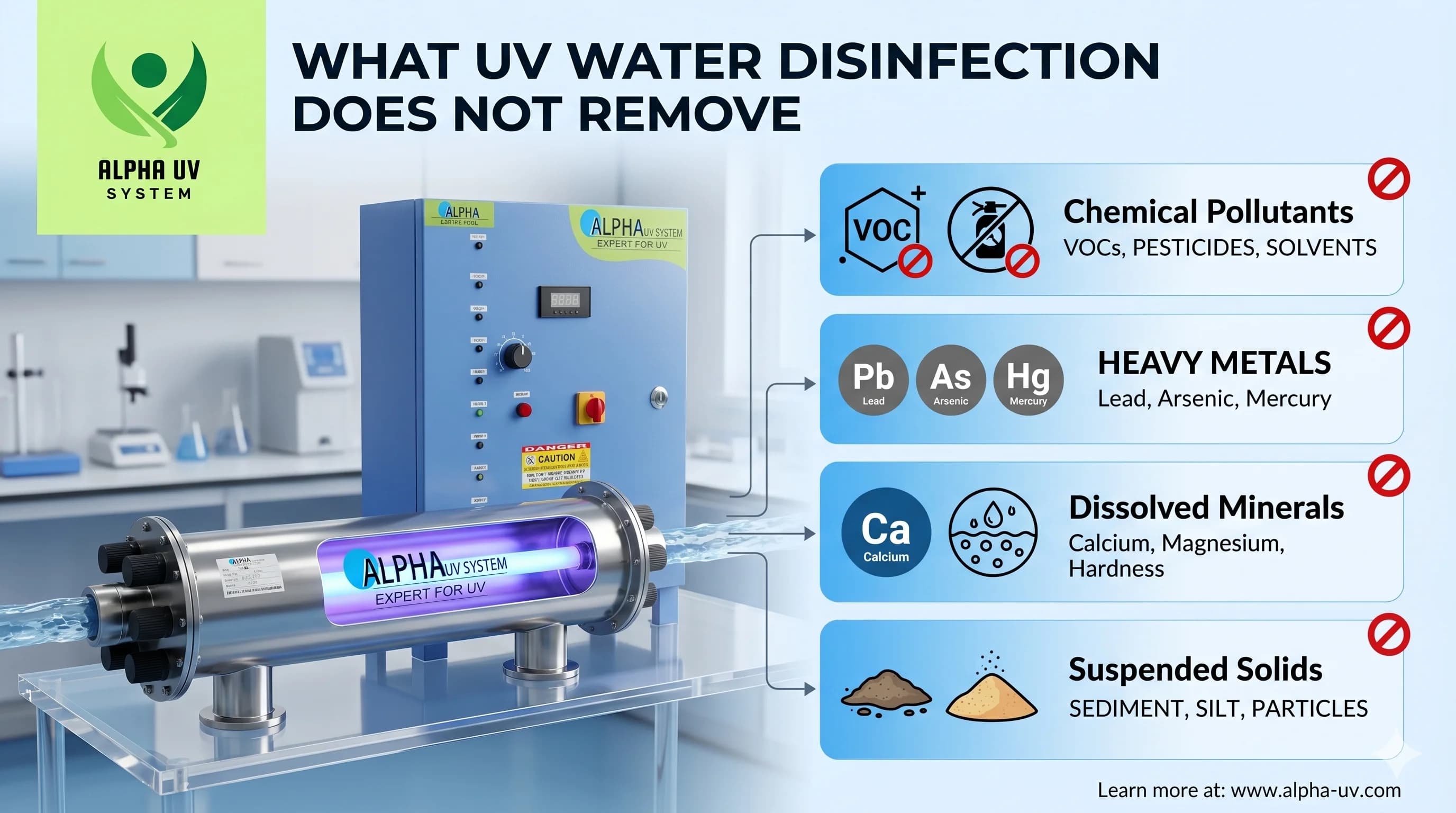
- Borewell water with arsenic — Arsenic contamination is a serious groundwater problem in West Bengal, Bihar, Assam, Jharkhand, and parts of Punjab and Uttar Pradesh. UV has no effect on dissolved arsenic. Arsenic removal requires coagulation-flocculation, activated alumina, or iron hydroxide-based filtration. A UV system combined with arsenic removal media can make borewell water safe.
- High TDS water (above 500 mg/L) — UV does not reduce TDS. Water with very high TDS (above 500 mg/L as per BIS IS 10500:2012 acceptable limit) may require partial RO treatment before or after UV. This is common in borewell water in Rajasthan, Gujarat, and parts of Andhra Pradesh.
- Fluoride above 1.5 mg/L — Excess fluoride causes dental and skeletal fluorosis, particularly in children. UV does not remove fluoride. Activated alumina or bone char filtration is required before UV treatment for fluoride-affected sources in Karnataka, Andhra Pradesh, Telangana, and parts of Rajasthan.
- Nitrate above 45 mg/L (as NO3) — Nitrate contamination from agricultural runoff is a concern in several Indian agricultural states. UV does not remove nitrate. Ion exchange or reverse osmosis is required for nitrate reduction.
- Heavy metals (lead, chromium, cadmium) — UV does not remove dissolved heavy metals. Sources near industrial areas or with old lead plumbing require appropriate filtration or RO treatment.
Alpha UV System provides water quality testing guidance and multi-barrier system design for sources that require treatment beyond UV alone. If you are unsure whether your source water requires additional treatment before UV, contact our team — we will advise on a testing protocol and appropriate system configuration.
BIS Certification: What to Look For When Buying a UV System in India
For Indian families evaluating UV water purifier home safety India options, BIS certification is the most important indicator of system quality and safety. When purchasing a UV system, look for:
- BIS IS 14962 certification — the Indian standard for domestic UV water purifiers, covering construction, materials, performance, and safety requirements. Systems carrying BIS IS 14962 certification have been tested to deliver the minimum UV dose at rated flow rate.
- UV intensity sensor with alarm — a certified system must include a mechanism to alert the user when UV output falls below the safe threshold. This is a mandatory safety feature in properly designed systems.
- Stainless steel chamber (SS 304 minimum) — food-grade stainless steel is required for the wetted surfaces of the UV chamber. Avoid systems with plastic chamber bodies.
- Rated flow clearly stated — the flow rate at which the system delivers 40 mJ/cm² must be stated on the product label. A system rated for 12 litres per minute (LPM) must deliver 40 mJ/cm² at 12 LPM under worst-case conditions (end-of-lamp-life).
- Philips TUV lamp specification — the lamp brand and model directly affects UV-C output reliability. Systems using Philips TUV lamps have published lamp performance data available for verification.
Frequently Asked Questions
Is UV water disinfection approved in India?
Yes. BIS IS 10500:2012 — India's primary drinking water quality standard — recognises UV as an approved primary disinfection method. FSSAI regulations also recognise UV as an approved treatment step for food businesses and packaged drinking water production. UV water disinfection is used across India in municipal water treatment, NABH-accredited hospitals, pharmaceutical manufacturing, and residential applications. The BIS IS 14962 standard specifically governs domestic UV water purifier performance and safety in India.
Can I use UV water for my baby?
Yes. UV-treated water is safe for infant formula preparation and direct consumption by infants. Since UV adds no chemicals to the water and does not remove minerals, the water is nutritionally equivalent to the source water with pathogens eliminated. This makes it safer than untreated municipal tap water and equivalent in safety to freshly boiled-and-cooled water — but without the re-contamination risk that comes with storing boiled water in open vessels. During monsoon months, when municipal supply contamination risk is highest across Indian cities, UV water is especially important for infant feeding safety.
Is UV water treatment better than boiling?
For home use in India, UV offers several practical advantages over boiling while achieving equivalent or better pathogen inactivation. Both methods achieve 4-log or better inactivation of bacteria and viruses. UV additionally provides reliable Cryptosporidium and Giardia inactivation at very low doses — inactivation that boiling achieves only at full 100°C for an extended time. Practically: UV is instant (no wait time for heating and cooling), consumes only 11–25 W of electricity, does not alter mineral content or concentrate TDS through evaporation, and does not expose water to open-air re-contamination during cooling and storage. For families in Delhi NCR, Mumbai, or any city with reliable electricity, UV is the more practical and equivalently safe choice.
Does UV treatment affect pH or minerals in water?
No. UV treatment at 254 nm does not affect any chemical parameter of the water. pH, TDS, hardness (calcium and magnesium), alkalinity, dissolved oxygen, and all trace minerals remain at exactly the same concentration before and after UV treatment. This is a key distinction from RO systems, which remove 90–95% of dissolved minerals. UV is a purely microbiological treatment — it changes only the viability of pathogens, not the chemistry of the water. If your water has the right mineral balance for your family's health, UV preserves it completely.
What happens if the UV lamp fails?
If the UV lamp fails, the UV system will continue to pass water through the chamber without disinfection. Water flow is not automatically interrupted unless the system includes a solenoid valve interlock linked to the UV sensor alarm (a feature available in higher-specification residential and commercial systems). For systems with a UV intensity indicator only (without automatic valve shutoff): if the indicator shows reduced or absent UV output, stop using the water for drinking immediately and arrange lamp replacement. Alpha UV System residential units include a UV intensity indicator lamp that provides continuous visual confirmation of UV output. Lamp replacement is typically a 15-minute procedure; our team provides 24–48 hour response for service calls across India.
How do I know if my UV system is actually working safely?
Three verification methods, used together, confirm that your UV system is operating safely. First, daily visual check: the UV intensity indicator should show green/active status — this confirms the lamp is producing UV-C output above the safety threshold. Second, annual lamp and sleeve inspection: replace the UV lamp every year regardless of visible lamp condition (UV-C output decays before visible light fails), and clean the quartz sleeve to ensure there is no iron or scale fouling. Third, annual water quality test: submit a post-UV water sample to a NABL-accredited laboratory for total coliform and E. coli analysis. BIS IS 10500:2012 specifies zero coliforms per 100 mL for safe drinking water — if your post-UV sample meets this standard, your system is working. This test costs Rs 300–600 and provides definitive confirmation of microbiological safety.
For a UV water system recommendation suited to your home's source water, family size, and installation requirements — WhatsApp our team at +91 95995 00580. We assess your water source, advise on pre-treatment if needed, and recommend a correctly sized system. We respond within 24–48 hours for all enquiries across India.
Standards, authorities & further reading
External references used to inform this guide. Regulations evolve — check the latest revision on each authority's site before compliance decisions.
Recommended UV Systems
Alpha UV System products for this application — powered by genuine Philips UV-C lamps.
UV System for Drinking Water
100 – 50,000 LPH
Chemical-free UV drinking water disinfection — from homes to municipalities
Residential UV Disinfection System
100 – 500 LPH
Safe drinking water for homes and villas — no chemicals, no taste change
Not sure which system suits your application? WhatsApp our engineers for a free recommendation →
Related solutions
See how Alpha UV System applies this to your industry or city.
Need a UV system?
Talk to our UV engineers — WhatsApp for a quote in 2 hours, or browse the full catalog on IndiaMART.