Quick Answer
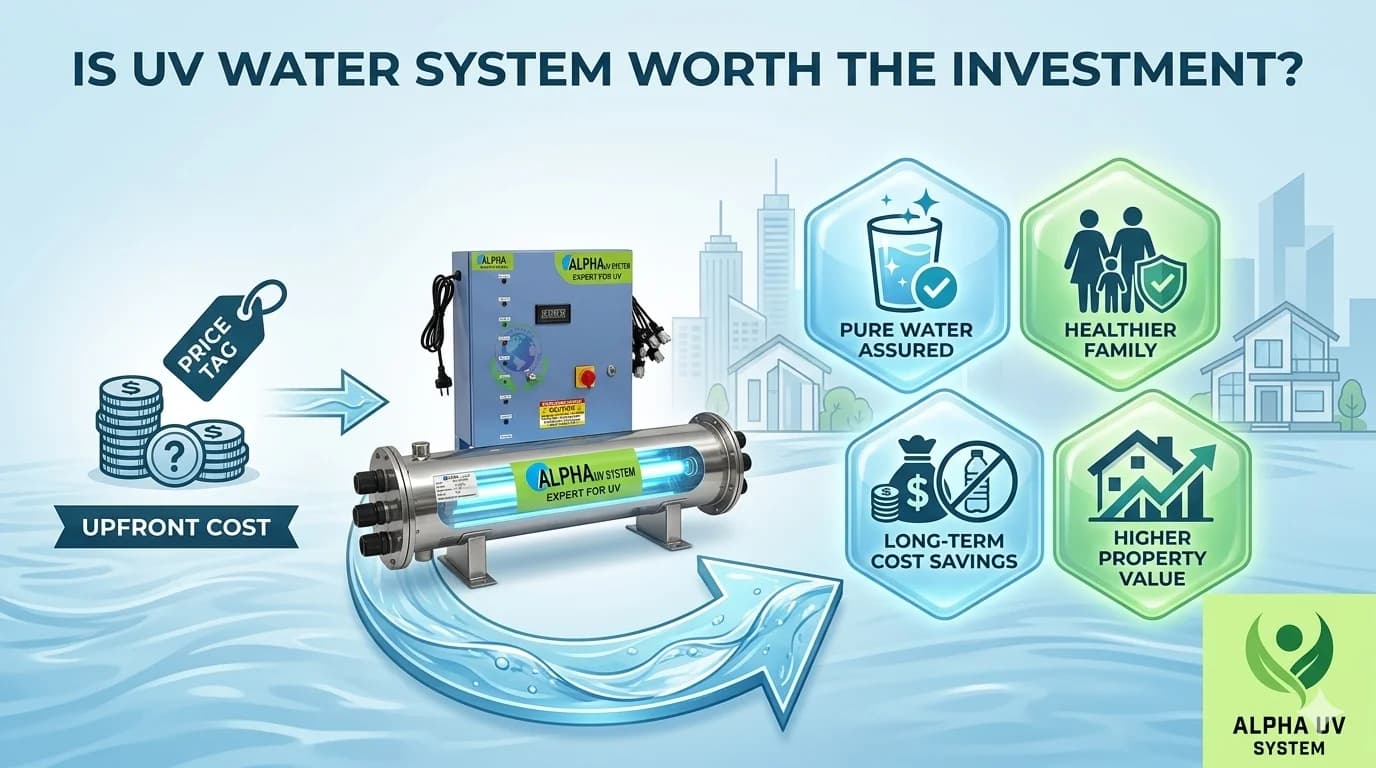
For most Indian families, a UV water system pays back within 12–18 months through savings on boiling fuel, bottled water, and avoided waterborne illness costs. At Rs 8,000–25,000 upfront with Rs 1,200–3,000 annual maintenance, the 10-year total cost of UV is typically 60–80% lower than bottled water dependency and 40–60% lower than frequent boiling. For commercial users, the compliance value alone — FSSAI, HACCP, Schedule M 2025 — makes UV essential.
The Real Question: Compared to What?
When Indian households ask is UV water system worth investment, the question is almost never answered correctly — because it is not compared against anything realistic. The honest answer depends entirely on what you are doing right now for drinking water safety.
There are four realistic alternatives in Indian homes: boiling, buying bottled water, using an RO system, or doing nothing at all. For families currently relying on boiling, UV is faster, uses less energy, produces better-tasting water, and carries far lower re-contamination risk from open pot storage. For families buying bottled water — the most common urban habit in Delhi NCR and other metros — a UV system pays back in under 12 months for a 4-person family consuming even modest quantities. For the majority of Indian households that use untreated municipal tap water directly, whether due to cost or habit, UV provides essential safety at a lower annual cost than a single waterborne illness episode.
The real question is not "is UV expensive?" It is this: is continued exposure to waterborne pathogen risk more expensive than a UV water system? The data below makes that comparison in detail. Is UV water system worth investment? The answer becomes straightforward once you put real numbers alongside real risk.
UV vs Boiling: The True Cost Comparison
Most Indian families who boil drinking water underestimate the total cost of boiling because fuel is a shared household expense and time is not counted at all. When you include both, the picture changes sharply. The table below is based on a 4-person Indian household consuming 8 litres of drinking water per day — a conservative estimate for cooking, drinking, and food preparation.
| Cost Element | Boiling (LPG) | UV System |
|---|---|---|
| Fuel cost | Rs 3,000–5,000/year (40–60 min LPG use daily) | Zero |
| Time cost (cook's time) | Rs 10,000–20,000/year (15 min/day × 365 days) | Zero — instant flow |
| Equipment upfront | Rs 0 (existing stove used) | Rs 8,000–25,000 |
| Annual maintenance | Zero (stove maintenance excluded) | Rs 1,200–3,000 (Philips UV-C lamp + pre-filter) |
| Taste quality | Flat, mineral-depleted, needs cooling | Natural, minerals intact, ready instantly |
| Re-contamination risk | High — open pot storage, ladles, hands | Low — closed stainless chamber, point-of-use |
| 5-year total cost (fuel only) | Rs 15,000–25,000 | Rs 14,000–40,000 |
| 5-year total cost (including time) | Rs 65,000–1,25,000 | Rs 14,000–40,000 |
Boiling is not free. LPG costs in India have risen steadily — a 14kg cylinder in Delhi NCR now costs Rs 800–900, and boiling 8 litres of water daily consumes approximately 4–6 cylinders per year on that task alone. When the cook's time is valued even at minimum wage (Rs 200–300 per hour), the cost of boiling water for a family of four reaches Rs 65,000–1,25,000 over five years. Against that benchmark, whether a UV water system is worth the investment becomes a clear yes within the first 18–24 months, even before a single illness is prevented.
A further disadvantage of boiling that most families do not quantify: boiled water stored in open pots can be re-contaminated within 2–4 hours by household contact. UV at point of use eliminates this re-contamination vector entirely.
UV vs Bottled Water: The ROI Case
Urban Indian families — particularly in metros like Delhi NCR, Mumbai, Bengaluru, and Hyderabad — have increasingly shifted to buying 20-litre water jars as a substitute for in-home treatment. This feels convenient but is expensive, and the quality assumption is often wrong.
An average 4-person family consumes 4–6 jars of 20-litre water per month for drinking and cooking. At Rs 50–80 per jar in most cities, this works out to Rs 2,400–5,760 per year on jar water alone — not counting the delivery charges and the time spent managing jar inventory. Families that also buy 1-litre bottled water for drinking away from home or for guests can spend Rs 15,000–30,000 per year on packaged water in total.
The table below shows the payback period for a Rs 15,000 UV system against different levels of bottled water spending. This is the clearest way to answer — is UV water system worth investment for your specific household situation.
| Monthly bottled water spend | Annual spend | UV payback period (Rs 15,000 system) |
|---|---|---|
| Rs 300 (20L jars, small family) | Rs 3,600 | 4.2 years |
| Rs 600 (20L jars, 4–5 person family) | Rs 7,200 | 2.1 years |
| Rs 1,500 (mixed 1L and 20L bottles) | Rs 18,000 | 0.8 years |
| Rs 3,000 (premium branded bottles) | Rs 36,000 | 0.4 years |
There is also a quality caveat that changes the calculus further: municipal 20-litre jar water in India is not reliably tested between production and delivery. Independent studies have found faecal coliform in a significant proportion of packaged water jars sold by local suppliers. A UV system installed at home provides confirmed, continuous disinfection at every draw — the jar delivery business does not offer that assurance.
The Health Cost Avoided
The most underestimated element in the ROI calculation is the cost of waterborne illness that UV prevents. India records approximately 37.7 million cases of waterborne disease annually, according to WHO and Ministry of Health and Family Welfare data. The average Indian family without any water treatment faces a statistically significant probability of one to two waterborne illness episodes per year across family members.
The financial cost of these episodes in private healthcare is substantial:
| Illness | Treatment cost (private hospital) | UV system cost (Rs 15,000) | Break-even events |
|---|---|---|---|
| Gastroenteritis | Rs 3,000–8,000 | Rs 15,000 | 2–5 episodes |
| Typhoid | Rs 15,000–50,000 | Rs 15,000 | 1 episode |
| Cholera | Rs 20,000–80,000 | Rs 15,000 | 1 episode |
| Hepatitis A | Rs 30,000–80,000 | Rs 15,000 | 1 episode |
A single hospitalisation for typhoid fever — common in north Indian cities including Delhi NCR during and after monsoon season — costs more than a residential UV system. One prevented episode of Hepatitis A, with its long recovery period and potential for prolonged absence from work, covers the cost of a UV system two to five times over. This is the most direct answer to whether a UV water system is worth the investment: in health risk terms, the system pays for itself the first time it prevents a serious illness.
This is not a speculative calculation. One prevented typhoid hospitalisation pays for the system in full — a single data point that settles the question for any Indian family. Waterborne typhoid, gastroenteritis, and Hepatitis A are endemic in Indian cities. Municipal water contamination spikes are documented and recurrent — particularly during the monsoon months of July through September, when water distribution infrastructure is under stress. UV at point of use provides continuous protection through these high-risk periods at a cost of under Rs 5 per day in running expenses.
UV Running Cost: What You Actually Pay Each Year
One of the most common misconceptions about UV water systems is that running costs are high. In practice, the annual operating cost of a residential UV system is one of the lowest of any active water treatment method. The three real cost components are electricity, the annual Philips UV-C lamp replacement, and sediment pre-filter cartridges.
Electricity is negligible: a 7W residential UV lamp running 24 hours costs approximately Rs 37 per year at Rs 6 per kWh. Even a 25W commercial system costs only Rs 131 per year in electricity. The lamp itself — a genuine Philips TUV lamp — costs Rs 800–2,500 per year depending on system size. Pre-filter sediment cartridges, replaced every three months, add Rs 400–1,200 per year. The complete annual running cost picture by system size is below.
| System size | Electricity/year | Philips TUV lamp/year | Pre-filter/year | Total annual cost |
|---|---|---|---|---|
| Residential 7W (500 LPH) | Rs 37 | Rs 800 | Rs 400 | Rs 1,237 |
| Residential 11W (1000 LPH) | Rs 58 | Rs 1,000 | Rs 600 | Rs 1,658 |
| Commercial 25W (2000 LPH) | Rs 131 | Rs 1,500 | Rs 800 | Rs 2,431 |
| Industrial 55W (4000 LPH) | Rs 289 | Rs 2,000 | Rs 1,200 | Rs 3,489 |
Running a UV system costs less per day than a cup of tea. At Rs 1,237–1,658 per year for a residential system, the daily operating cost is Rs 3.40–4.55. The quartz sleeve — the only other periodic replacement component — costs Rs 400–1,000 and is typically replaced once every 2–3 years. No chemicals. No membrane replacements. No water wastage.
Commercial ROI: Compliance Value
For commercial operators, is UV water system worth investment has a different and more urgent answer: regulatory compliance. Three major frameworks mandate documented water treatment for different commercial sectors in India, and UV is an accepted method under all three.
FSSAI (Food Safety and Standards Authority of India) requires food and beverage businesses to maintain water quality documentation as part of licence compliance. HACCP certification — increasingly required by institutional buyers, exporters, and hotel chains — requires a verified, documented water treatment process. Schedule M 2025 under India's drugs regulations requires pharmaceutical manufacturers to provide documented water treatment records for all process water. In each case, a UV system with a UV intensity monitor provides verifiable, auditable treatment records.
The cost of non-compliance dwarfs the cost of the UV system itself:
| Sector | Annual UV system cost | Risk avoided | Compliance value |
|---|---|---|---|
| Restaurant (FSSAI) | Rs 15,000–40,000 | FSSAI licence suspension, Rs 50,000–5,00,000 fine | High |
| Hotel (5-star) | Rs 40,000–1,50,000 | Guest health liability, brand reputation damage | Very high |
| Pharma plant | Rs 50,000–2,00,000 | CDSCO audit failure, Schedule M 2025 breach | Critical |
| School / college | Rs 15,000–60,000 | Student health liability, CBSE/university norms | High |
A single FSSAI inspection failure for a restaurant or cloud kitchen can result in a closure notice, fines starting at Rs 50,000, and the loss of revenue during the closure period. For a pharma facility, a Schedule M 2025 audit failure on water treatment documentation can result in production suspension — a liability that can reach crores per day of lost output. For these operators, the ROI on a UV system is not a cost-savings calculation. It is a risk elimination calculation, and the numbers are not close.
UV vs RO: Is the Extra Investment in RO Worth It?
A common question when asking is UV water system worth investment — versus simply buying an RO system — is whether RO is the better alternative. The honest answer is that they solve different problems, and the right choice depends on your water source.
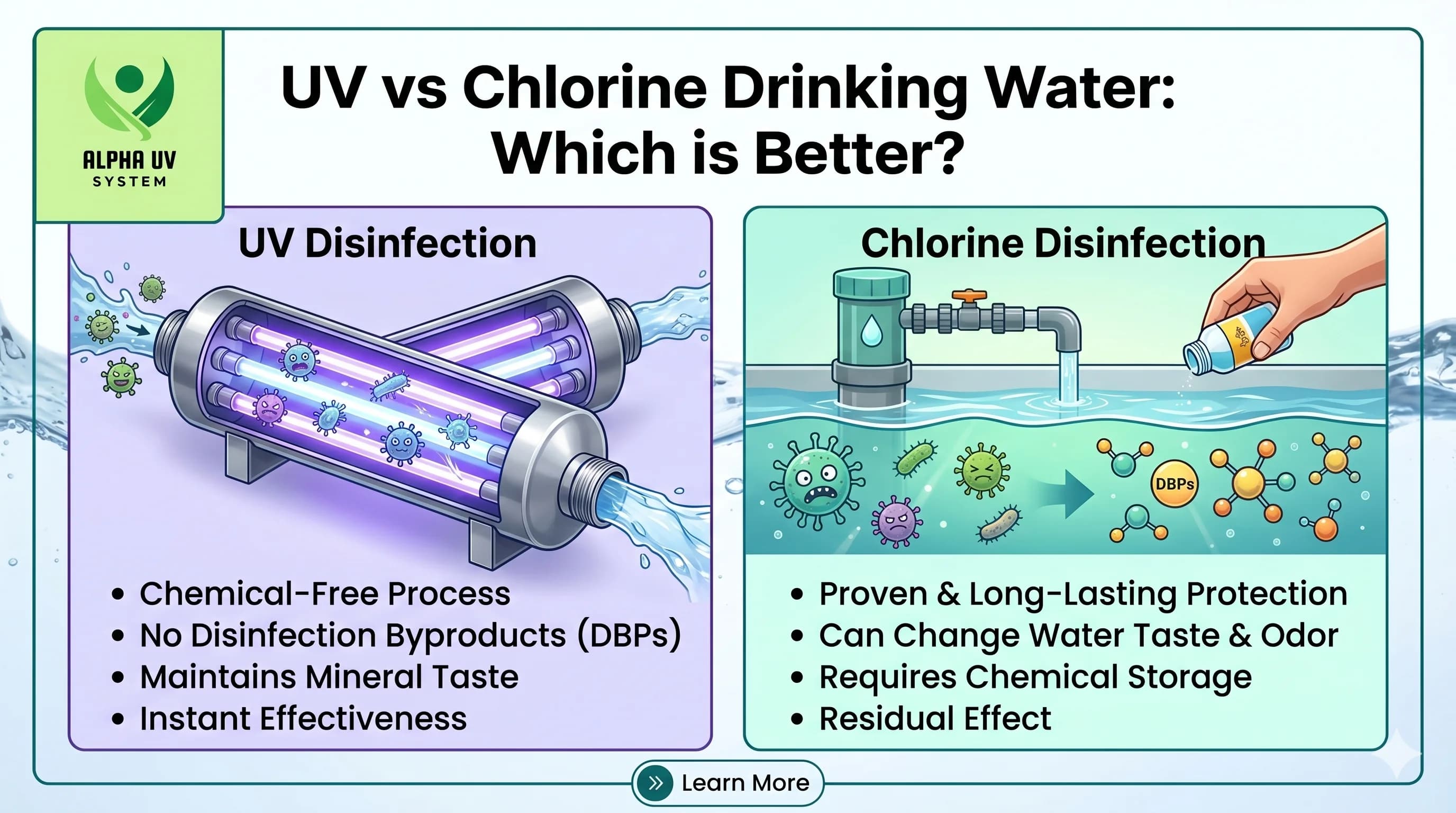
RO systems cost Rs 8,000–25,000 upfront — similar to UV — but carry annual maintenance of Rs 2,500–6,000 for membrane replacements, pre-filter cartridges, and electricity. More significantly, RO rejects 3 litres of water for every 1 litre it produces, which is a substantial water wastage concern in cities with water scarcity or metered supply. RO also strips beneficial minerals from water — demineralised water is not the preferred long-term drinking water source for health reasons and is often described as "flat" by regular users.
UV adds zero waste water. It preserves all naturally occurring minerals in your source water. It provides superior microbiological kill verification through UV intensity monitoring — something RO membrane integrity cannot provide without expensive testing.
The guidance is straightforward: if your municipal water TDS is below 500 ppm and you have no confirmed concern for arsenic, fluoride, or heavy metals, UV alone is the appropriate and more cost-effective solution. If your borewell water has high TDS, arsenic, or fluoride — conditions common in parts of Rajasthan, Punjab, and parts of Delhi NCR — the correct configuration is RO for chemical removal followed by UV for biological safety. The two are complementary, not competing.
What Reduces UV ROI
Not every UV system delivers the ROI outlined above. Several purchasing and maintenance decisions can undermine the value of the investment significantly.
The single largest factor is lamp quality. UV systems fitted with non-Philips UV-C lamps deliver inconsistent germicidal output, have shorter rated lives (typically 4,000–6,000 hours versus 9,000 hours for Philips TUV), and require more frequent replacement — increasing annual maintenance cost while delivering lower pathogen kill rates. A system that looks more cost-effective to buy may cost more to run and protect less effectively.
Skipping pre-filtration is the second most common ROI-reducing mistake. Without a sediment pre-filter, suspended particles in the incoming water coat the quartz sleeve inside the UV chamber, blocking UV light transmission. A fouled sleeve can reduce effective UV dose by 30–60%, meaning pathogens pass through inadequately irradiated. This requires more frequent sleeve cleaning and replacement, adding cost and creating treatment gaps.
Undersizing the system for your actual peak flow demand means the UV chamber retention time is insufficient at peak draw rates — water moves through faster than the required 30 mJ/cm2 dose can be delivered. Buying an undersized system to save upfront cost often means replacing the system within 2–3 years, which eliminates any initial saving.
Finally, running the Philips UV-C lamp past its rated 9,000-hour service life is the most dangerous cost-cutting measure. The lamp continues to glow visibly past 9,000 hours but its germicidal UV-C output degrades to levels that may not achieve the required dose. The system provides a false sense of security while bacteria and viruses pass through. Annual lamp replacement is not optional maintenance — it is the basis on which the system's performance is guaranteed.
Frequently Asked Questions
Is a UV system worth it if I already filter my water?
Yes, and the combination is actually stronger than either alone. Standard sediment or carbon filters remove particulates, chlorine, and some chemicals but do not kill pathogens — bacteria and viruses pass through intact. UV disinfects but does not remove particles or chemicals. Running filtered water through UV gives you both physical and biological treatment. If you already have a sediment filter in place, adding a UV chamber downstream is the most cost-effective upgrade you can make to your water safety setup.
Is UV cheaper than RO in the long run?
For most Indian households on municipal water with TDS below 500 ppm, yes — UV is significantly cheaper than RO over a 5–10 year period. UV has lower annual maintenance cost (Rs 1,237–1,658 vs Rs 2,500–6,000 for RO), zero water wastage (RO wastes 3 litres per litre produced), and no membrane replacement cost. The only scenario where RO's higher cost is justified is when your source water has chemical contamination — high TDS, arsenic, fluoride, or heavy metals — that UV cannot address. For biological safety alone, UV is the more cost-effective long-run solution.
How long does a UV system last?
The stainless steel chamber, quartz sleeve housing, and electronics of a quality UV system last 10–15 years with normal maintenance. Only the Philips UV-C lamp requires annual replacement. This means the major capital cost is a one-time investment — what you pay each year after the first year is the running cost (Rs 1,237–3,489 depending on system size), not equipment replacement. Over a 10-year period, the total cost of ownership of a Rs 15,000 UV system is approximately Rs 27,000–50,000 — a fraction of 10 years of bottled water expenditure.
Is a Rs 25,000 UV system better than a Rs 8,000 one?
It depends on what the price difference reflects. A higher-priced system is justified when it includes a larger flow rate chamber (1000 LPH vs 300 LPH), a UV intensity monitor with alarm, food-grade SS316L chamber construction, a longer warranty, and documented Philips UV-C lamp specification. A higher price that reflects only brand margin on equivalent hardware is not justified. The correct question is whether the specified lamp is a genuine Philips TUV lamp, whether the chamber material is appropriate for your application, and whether the system includes intensity monitoring. For most residential applications, a well-specified Rs 12,000–18,000 system with Philips lamp delivers the same UV dose as a Rs 25,000 system — the difference is in material grade, flow rate, and ancillary features.
Does a UV system save money compared to buying water jars?
For most families, yes — within 2–4 years, and sometimes sooner. A family spending Rs 600 per month on 20-litre jars spends Rs 7,200 per year. A Rs 15,000 UV system pays back in 2.1 years and then saves Rs 7,200 per year indefinitely (less Rs 1,237–1,658 annual running cost, so net saving of Rs 5,500–5,960 per year from year 3 onward). For families spending more on 1-litre bottles, the payback is under 12 months. There is also a quality advantage: home UV treatment provides confirmed disinfection at every draw, which jar suppliers cannot guarantee for the period between production and delivery.
Is UV worth it for a family of 2 people with low water consumption?
For a family of two with very low daily water consumption — say, 3–4 litres of drinking water per day — the cost-savings case versus boiling or jar water is slower to break even, typically 3–5 years. However, the health protection case remains fully valid regardless of household size. The risk of a single waterborne illness episode — typhoid, Hepatitis A, or severe gastroenteritis — is not proportional to household size. One prevention event at Rs 15,000–50,000 in medical costs justifies the investment for a 2-person household just as clearly as for a family of six. For very small households, a compact 500 LPH residential UV system at Rs 8,000–12,000 with annual running cost of Rs 1,237 provides the same protection at the lowest available price point.
Get a UV System ROI Analysis for Your Home or Business
Not sure which system suits your home or business? Share your water source, household size, and current treatment method — our technical team will send you a written cost comparison within 24–48 hours.
WhatsApp Us for a Free ROI AnalysisStandards, authorities & further reading
External references used to inform this guide. Regulations evolve — check the latest revision on each authority's site before compliance decisions.
Recommended UV Systems
Alpha UV System products for this application — powered by genuine Philips UV-C lamps.
UV System for Drinking Water
100 – 50,000 LPH
Chemical-free UV drinking water disinfection — from homes to municipalities
Residential UV Disinfection System
100 – 500 LPH
Safe drinking water for homes and villas — no chemicals, no taste change
Not sure which system suits your application? WhatsApp our engineers for a free recommendation →
Need a UV system?
Talk to our UV engineers — WhatsApp for a quote in 2 hours, or browse the full catalog on IndiaMART.