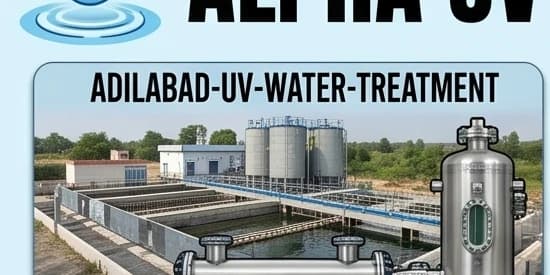
UV water treatment in Adilabad addresses 5 critical needs: (1) tribal community water in Gond, Kolam, and Banjara habitations across Adilabad, Kumram Bheem Asifabad, and Mancherial districts — Jal Jeevan Mission solar-DC UV systems for remote padas; (2) SCCL Mancherial and Bellampalli coalfield worker colony water with lateritic iron pre-treatment; (3) Godavari headwater fluoride risk in Asifabad (1.0–2.5 mg/L) requiring RO where above BIS limit; (4) Adilabad Government Hospital NABH water compliance at 80 mJ/cm² for ICU/OT; and (5) TSPCB-compliant ETP polishing UV for cement clinker and sponge iron operations near Mancherial. Philips TUV 16W–95W systems are the TSPCB documentation standard for this region.
Adilabad, Telangana's northernmost district bordering Maharashtra and Chhattisgarh, presents some of the most complex water treatment scenarios in peninsular India. The district's tribal-dominated landscapes — home to Gond, Kolam, Pardhan, and Banjara communities across dense Pranahita-Godavari forest corridors — are served by shallow wells and open springs that carry seasonal E. coli contamination from open defecation and livestock activity. Simultaneously, the district's eastern belt around Mancherial and Bellampalli hosts active SCCL coalfields that generate mining-influenced water with iron, manganese, and occasional acid drainage characteristics.
The Pranahita River (major Godavari tributary) and the upper Godavari itself define Adilabad's hydrology. These rivers carry low-TDS, relatively clean water in their upper reaches — but the tribal hamlets on the Sahyadri-foothills and Sahyadri-plateau cannot rely on piped supply from these rivers given their remote location. UV water treatment, particularly solar-DC powered systems compatible with Jal Jeevan Mission (JJM) infrastructure, has emerged as the viable solution for these communities.
Adilabad District Water Quality: Zone-by-Zone Profile
| Zone / Mandal Cluster | Primary Water Source | Key Parameters | UV Treatment Need |
|---|---|---|---|
| Adilabad city + Nirmal town belt | Mancherial reservoir / Godavari canal | TDS 150–350 mg/L, turbidity 2–10 NTU (monsoon), Fe 0.1–0.4 mg/L | UV 40 mJ/cm² after sediment + carbon |
| Tribal belt (Asifabad, Wankdi, Kerameri, Tiryani) | Open well / spring / shallow borewell | E. coli positive, turbidity 5–25 NTU (monsoon), Fe 0.2–1.0 mg/L | Solar-DC UV + iron filter + sediment (JJM) |
| Mancherial / Bellampalli coalfield zone | Borewell (deep, 60–100 m) | Fe 0.5–2.0 mg/L, Mn 0.1–1.0 mg/L, TDS 200–500 mg/L | Iron filter MANDATORY + UV 40 mJ/cm² |
| Kumram Bheem Asifabad district (fluoride zone) | Borewell (crystalline aquifer, 40–80 m) | F⁻ 1.0–2.5 mg/L, TDS 200–450 mg/L | RO needed where F⁻ >1.5 mg/L → UV |
| Mancherial MIDC / industrial belt | MIDC supply + borewell (ETP) | High COD from sponge iron/cement ETP, Fe 0.3–1.0 mg/L | ETP polishing UV after biological treatment |
Tribal Community Water: Jal Jeevan Mission Solar-DC UV in Forest Padas
Tribal hamlets in Kerameri, Tiryani, Wankdi, and Indervelli mandals of Adilabad and Kumram Bheem Asifabad districts predominantly rely on open dug wells and springs for drinking water. During monsoon (June–September), E. coli contamination reaches 100–500 MPN/100 mL in these sources — over 50x the BIS safe limit of zero. Children under 5 and pregnant women are at highest risk from seasonal waterborne diarrhoea outbreaks. Chlorination is difficult to implement consistently in remote forest settings where trained operators are unavailable. Solar-powered UV water kiosks under JJM are the most operationally viable intervention for these habitations.
Adilabad district has the highest Scheduled Tribe population percentage among Telangana's districts — Gond (including Koitur subgroups), Kolam, Pardhan, Naikpod, and Banjara communities constitute 35–55% of the population in the forest mandals. The National Rural Drinking Water Programme and its successor Jal Jeevan Mission have committed to universal piped water supply to tribal padas — but grid-independent, solar-powered infrastructure is required given the remote forest location of many habitations.
Solar-DC UV systems are the appropriate technology for JJM water kiosks in Adilabad's tribal belt. A typical configuration for a 100–300 household tribal pada uses a solar panel (300–500 W) → DC battery storage → DC-UV chamber (24V or 12V) → stainless steel overhead storage tank → gravity-flow community tap stands. The UV system draws 15–30W and runs on battery during night-time peak water collection periods. No chlorine chemicals, no grid connection, and no skilled operator required beyond monthly lamp inspection — making it appropriate for communities where literacy and technical skill are limited.
The Telangana Government's JJM programme under the RWSS department specifies UV as the preferred terminal treatment for tribal micro water supply schemes in Schedule V areas. Philips TUV 16W systems (DC-compatible versions) with IP65-rated controllers are the standard specification for RWSS district procurement, compatible with 24V solar-battery systems.
SCCL Mancherial and Bellampalli Coalfield: Iron-Affected Borewell Water
Borewell water in the SCCL coalfield zones around Mancherial, Bellampalli, Chennur, and Mandamarri carries dissolved iron at 0.5–2.0 mg/L from coal-bearing Gondwana sandstone aquifers. Iron above 0.3 mg/L deposits on UV lamp quartz sleeves as orange-brown scaling, reducing UV output by 30–60% within 4–8 weeks. The UV controller shows no fault indication — lamp appears lit — but actual dose delivered is below safe disinfection threshold. An iron removal filter must be installed upstream of every UV system in coalfield borewell applications. Manganese (0.1–1.0 mg/L) co-occurs and also causes dark deposits on quartz sleeves; greensand or birm filters remove both Fe and Mn simultaneously.
SCCL (Singareni Collieries Company Limited) operates several underground and opencast coal mines in the Mancherial–Bellampalli belt of Adilabad district. Worker colonies for these mines — housing 500–5,000 workers and families per colony at Mancherial HQ, Bellampalli, Chennur, and Mandamarri — require reliable drinking water supply meeting IS 10500:2012 standards.
The SCCL CMOH (Chief Medical Officer Health) specifies water quality requirements for all worker colonies under DGMS (Directorate General of Mines Safety) welfare guidelines. UV water treatment is the preferred approach over chlorination for these communities because: (a) it requires no chemical storage in residential areas adjacent to explosive materials; (b) it leaves no taste or odour; and (c) it provides demonstrable compliance documentation (lamp-hours counter, flow meter records) that DGMS inspectors can verify.
For SCCL worker colony water treatment in Mancherial and Bellampalli, the pre-treatment + UV chain is: dual-media pressure sand filter → greensand iron + manganese removal filter → 5-micron polypropylene sediment cartridge → UV chamber (Philips TUV 36W or TUV 55W depending on colony size) → overhead SS304 storage tank → chlorinated distribution network (low-dose residual chlorination for distribution line protection). The UV provides primary disinfection; the downstream chlorine residual (0.2 mg/L) prevents recontamination in the distribution pipes serving dispersed housing blocks.
Godavari Headwaters and Fluoride in Asifabad Zone
The newly bifurcated Kumram Bheem Asifabad district (carved from Adilabad in 2016) occupies the upper Pranahita-Godavari forest zone. Its crystalline granite-gneiss basement aquifers — where borewells are drilled to access water in this geologically complex terrain — carry moderate fluoride concentrations of 1.0–2.5 mg/L in the deeper borewells (>60 m). BIS 10500:2012 specifies the acceptable limit for fluoride as 1.0 mg/L (maximum permissible 1.5 mg/L).
Where fluoride is between 1.0–1.5 mg/L, UV-only systems after sediment filtration provide adequate disinfection. Where fluoride exceeds 1.5 mg/L (common in the deeper borewells of Asifabad, Sirpur-Kagaznagar, and Wankdi mandals), a high-rejection RO system with Nalgonda-grade polyamide membrane (96%+ fluoride rejection) must precede the UV unit. UV cannot remove fluoride under any circumstances — fluoride is an ionic contaminant that passes through UV chambers unchanged.
Pranahita River water, used for irrigation in the valley areas, has significantly lower fluoride (typically 0.3–0.7 mg/L) and lower TDS (100–200 mg/L during dry season). Where Pranahita-origin piped supply is available, UV alone (without RO) is sufficient for drinking water disinfection. The distinction between Pranahita-origin and borewell-origin water sources is therefore critical in sizing and configuring UV systems for Asifabad subdivision.
Mancherial Industrial Belt: Cement, Sponge Iron, and Paper Industry ETP UV
Mancherial district (bifurcated from Adilabad in 2016) hosts several large industrial operations:
- Mancherial Paper Mills (ITC PSPD — India's largest board mill): Godavari River drawdown with high lignin and organic load in process water
- Sponge iron plants (various operators in TSSIDC Mancherial industrial estate): High iron and COD in cooling water and ETP
- Cement clinker grinding units (Chettinad, Orient, Ramco in the corridor): ASHRAE 188 Legionella-risk cooling towers
For each of these sectors, UV plays a different role:
Paper mill process water (ITC): The Mancherial paper mill requires large volumes of Godavari River water, pre-treated through clarification → multi-grade filtration → UV before contact with paper pulp. Process water microbiological quality is critical because biological contamination causes slime formation in the pulp, reducing paper quality. UV at 40 mJ/cm² on pre-clarified, sand-filtered Godavari water (UVT typically 75–85%) provides effective slime prevention without chlorine, which can bleach or de-colour specialty paper grades.
Sponge iron cooling towers (ASHRAE 188): Sponge iron DRI (direct reduced iron) production uses large cooling water volumes. Cooling tower water with high dissolved iron content (from process contact) is particularly susceptible to Legionella colonisation at 30–40°C bulk water temperatures. ASHRAE 188:2018 Legionella Water Management Plans specify sidestream UV treatment at 10–25% recirculation for Legionella control. At sponge iron plant scale (20,000–1,00,000 LPH cooling water circulation), a bank of TUV 95W UV systems in sidestream mode (2,000–10,000 LPH UV flow) provides effective Legionella suppression documented for TSPCB audit.
Cement plant cooling water: Orient Cement's Mancherial plant, the largest single employer in the district, uses evaporative cooling towers at the kiln and grinding circuit. ASHRAE 188 UV sidestream requirements apply here as they do for sponge iron — Philips TUV 95W bank in sidestream configuration with documented 3-log UV dose for Legionella inactivation.
UV System Sizing for Adilabad District Applications
| Application | Flow Rate Required | Philips TUV Model | UV Dose | Pre-Treatment |
|---|---|---|---|---|
| Tribal pada community kiosk (100–200 HH) | 500–1,000 LPH | TUV 16W (solar-DC) | 40 mJ/cm² | Slow sand filter + 5µ cartridge |
| SCCL worker colony (500 families) | 3,000–5,000 LPH | TUV 36W–TUV 55W | 40 mJ/cm² | Iron filter MANDATORY + sediment |
| Government hospital (NABH general ward) | 2,000–5,000 LPH | TUV 36W–TUV 55W | 40 mJ/cm² | Sediment + carbon filter |
| ICU / OT / NICU (dedicated loop) | 500–1,000 LPH | TUV 16W (reduced flow) | 80 mJ/cm² | 5µ + 1µ microfiltration |
| Sponge iron cooling tower (sidestream) | 2,000–10,000 LPH | TUV 95W × 2–10 | 40 mJ/cm² (ASHRAE 188) | 5µ strainer + softener |
| Paper mill process water (ITC) | 50,000–2,00,000 LPH | TUV 95W × 20–80 bank | 40 mJ/cm² | Coagulation + multi-grade filter |
| ETP polishing (industrial discharge) | 5,000–30,000 LPH | TUV 55W–TUV 95W × 2–10 | 40 mJ/cm² | Secondary treatment + sand filter + 5µ |
Government Hospital Adilabad: NABH Water Compliance
Government Hospital Adilabad (District Headquarters Hospital) serves as the primary referral centre for the combined Adilabad-Kumram Bheem Asifabad-Mancherial district cluster. With a large tribal population in the catchment area — many of whom present with waterborne diseases, fluorosis, and malnutrition-related infections — the hospital's clinical workload demands the highest water quality standards for patient safety.
NABH accreditation requires documented UV treatment with monthly water quality records maintained in IPSG-8 format. The hospital water system should be configured as:
Main hospital supply: Philips TUV 55W (5,000 LPH) at 40 mJ/cm² serving general wards, OPD, kitchens, laundry, and ablution blocks.
ICU and OT dedicated loop: Dedicated Philips TUV 16W UV reactor running at 700 LPH to achieve 80 mJ/cm² — separate from main hospital supply, with dedicated SS304 distribution piping to ICU bed water points and OT scrub stations.
Tribal ward special consideration: Patients from tribal habitations with no prior exposure to treated water may have lower natural immunity to waterborne organisms that urban populations have developed tolerance to. This makes the 80 mJ/cm² dose for paediatric wards and tribal patient wards (where children and immunocompromised patients are concentrated) a prudent operational standard even where NABH requires only 40 mJ/cm².
The Nirmal District Hospital and the Government Area Hospitals at Mancherial, Bellampalli, Bhainsa, and Utnoor are all on NABH accreditation pathways, creating a cluster procurement opportunity for standardized Philips TUV-based UV systems with unified maintenance contracts.
Philips TUV Product Recommendations for Adilabad District
| Philips TUV Model | Rated Flow | UV Output | Best Fit in Adilabad | Lamp Life |
|---|---|---|---|---|
| Philips TUV 16W | Up to 1,500 LPH | 16W, 254 nm | Tribal JJM kiosks, household, ICU dedicated loop | 9,000 hours |
| Philips TUV 36W | Up to 3,000 LPH | 36W, 254 nm | SCCL small worker colony, hospital (300-bed) | 9,000 hours |
| Philips TUV 55W | Up to 5,000 LPH | 55W, 254 nm | DHQ hospital, large SCCL colony, paper mill sub-circuit | 9,000 hours |
| Philips TUV 95W | Up to 9,000 LPH per lamp | 95W, 254 nm | ITC paper mill, cooling tower sidestream, ETP polishing | 12,000 hours |
Regulatory Compliance for Adilabad District
| Regulation | Applicable Sector | Key Requirement | UV Role |
|---|---|---|---|
| JJM / RWSS Telangana | Tribal community kiosks | E. coli zero at tap point, solar-compatible UV | Solar-DC UV — terminal disinfection |
| DGMS Welfare Guidelines | SCCL worker colony water | IS 10500 coliform zero, documented treatment records | Primary disinfection CCP |
| NABH IPSG-8 | District hospital, Nirmal hospital | 80 mJ/cm² ICU/OT, monthly NABL water test reports | Dedicated critical-care UV loop |
| TSPCB CTO Conditions | ITC paper mill, sponge iron ETP | Coliform <1,000 MPN/100 mL at discharge | ETP polishing UV at final discharge stage |
| ASHRAE 188:2018 | Sponge iron, cement cooling towers | Legionella WMP with sidestream UV documented | Sidestream UV at 10–25% recirculation |
Frequently Asked Questions
Q1: Can UV water treatment be used in Adilabad's remote tribal forest villages without grid electricity?
Yes, solar-powered DC UV systems are specifically designed for off-grid tribal habitations. A 300W solar panel paired with a 100Ah battery bank and a 16W DC-UV chamber (drawing 15–20W) can operate a community water kiosk serving 100–200 households with 5–8 hours of UV treatment output daily — sufficient for peak morning and evening water collection. The Telangana RWSS (Rural Water Supply and Sanitation) department procures solar-DC UV systems for JJM tribal water kiosk schemes under Schedule V area provisions. These systems are IP65-rated for monsoon protection and use vandal-resistant SS316 chambers. No chlorine chemicals, no trained chemical operator, and no daily maintenance beyond monthly lamp inspection are required — making them operationally sustainable in the tribal forest padas of Kerameri, Tiryani, and Wankdi mandals.
Q2: Does fluoride in Kumram Bheem Asifabad district borewell water require RO before UV?
It depends on the measured fluoride level. BIS 10500:2012 permits fluoride up to 1.0 mg/L (acceptable limit) and 1.5 mg/L (permissible maximum). In Kumram Bheem Asifabad district, shallow borewells (30–50 m) in Pranahita valley alluvium typically yield fluoride of 0.5–1.0 mg/L — UV alone is adequate. Deeper borewells (60–100 m) in the crystalline granite aquifer in Asifabad, Sirpur-Kagaznagar, and Wankdi mandals often yield fluoride of 1.5–2.5 mg/L — these require an RO system with high-rejection TFC membrane first. UV cannot remove fluoride — it is an ionic dissolved contaminant unaffected by UV light. Get your borewell water tested at a NABL-accredited lab for fluoride, iron, and TDS before purchasing any UV system. The test report determines whether RO + UV or just UV is the appropriate configuration.
Q3: What UV system is right for an SCCL coal mine worker colony of 1,000 families in Mancherial?
For 1,000 families (approximately 4,000–5,000 persons), peak water demand is typically 8,000–12,000 LPH during morning and evening periods. A Philips TUV 55W (rated 5,000 LPH) operating in tandem with a second TUV 55W for redundancy — or a single TUV 95W bank (9,000 LPH per unit) — is appropriate. The mandatory pre-treatment for SCCL coalfield borewell water is: pressure sand filter (dual media) → greensand iron and manganese removal filter → 5-micron cartridge sediment filter → UV chamber. Iron must be below 0.1 mg/L at the UV inlet. After UV, a low-dose chlorination dosing pump (to maintain 0.2 mg/L residual in the distribution pipes) is recommended for DGMS compliance in colonies with long pipe distribution networks. The complete system should include an hour counter, alarm-on-lamp-failure, and stainless steel SS304 chamber for DGMS welfare guideline documentation.
Q4: What is the UV requirement for Government Hospital Adilabad's ICU and OT under NABH?
NABH IPSG-8 mandates 80 mJ/cm² UV dose for ICU, OT, NICU, and CSSD water points. This is double the standard 40 mJ/cm² for drinking water. For ICU/OT at Government Hospital Adilabad, a dedicated Philips TUV 16W UV reactor should be installed in a reduced-flow configuration (600–800 LPH rather than the rated 1,500 LPH) to achieve the 80 mJ/cm² dose. This ICU/OT UV loop must be completely separate from the general hospital water supply — using dedicated SS304 piping with no connection to general ward distribution. Monthly water culture reports from a NABL-accredited lab (reporting total bacteria count, coliform, E. coli) must be maintained in IPSG-8 format and available for NABH assessors during scheduled and surprise inspections. The UV lamp must be replaced at 9,000 hours or annually, whichever comes first.
Q5: How does UV help ITC paper mill in Mancherial control slime in pulp production?
Paper mills like ITC's Mancherial board plant use large volumes of process water that comes into contact with wood pulp, starch, and paper fibre. This organic-rich environment supports rapid growth of slime-forming bacteria — Pseudomonas, Klebsiella, and various Bacillus species — that colonize papermaking equipment, form biofilms in white water loops, and cause slime spots, breaks, and quality defects in the finished paper. UV treatment at 40 mJ/cm² on the clarified, sand-filtered Godavari River water input prevents these slime-forming bacteria from entering the papermaking circuit in the first place. Unlike chlorine-based biocides, UV leaves no chemical residue that could affect paper colour or interfere with specialty coating chemistry. At paper mill scale (50,000–2,00,000 LPH), a multi-lamp bank of Philips TUV 95W systems in parallel manifold provides both the flow capacity and the biological kill needed for continuous mill operation with minimal downtime for biocide dosing.
Adilabad's water treatment landscape is defined by the intersection of tribal welfare needs and industrial compliance requirements. From solar-DC UV kiosks in Gond and Kolam forest padas to large-scale ASHRAE 188 cooling tower sidestream systems for the Mancherial industrial belt — UV water treatment scaled and configured correctly addresses every segment of this district's complex water quality challenges.
Alpha UV System designs and supplies Philips TUV-based UV water treatment systems for Adilabad, Mancherial, Nirmal, and Kumram Bheem Asifabad districts — from solar-DC tribal JJM kiosks to SCCL worker colony systems, NABH hospital compliance, ITC paper mill process water, and TSPCB ETP polishing. Iron pre-treatment assessment, fluoride risk evaluation, and complete TSPCB/NABH/DGMS documentation support included.
WhatsApp Us for Adilabad UV QuoteStandards, authorities & further reading
External references used to inform this guide. Regulations evolve — check the latest revision on each authority's site before compliance decisions.
Recommended UV Systems
Alpha UV System products for this application — powered by genuine Philips UV-C lamps.
Commercial UV Water Purification System
500 – 5,000 LPH
HACCP-compliant UV water purification for hotels, restaurants, and offices
Industrial UV Water Treatment System
5,000 – 50,000 LPH
Schedule M 2025 and HACCP compliant UV for pharma, food & beverage, and process water
Not sure which system suits your application? WhatsApp our engineers for a free recommendation →
Related solutions
See how Alpha UV System applies this to your industry or city.
Need a UV system?
Talk to our UV engineers — WhatsApp for a quote in 2 hours, or browse the full catalog on IndiaMART.