Quick Answer: Azerbaijan's UV water treatment system market is led by Baku's Caspian oil and gas sector (SOCAR, BP Azerbaijan — ACG field, BTC pipeline; Caspian brine SWRO post-treatment UVT 91–95%), Kura River industrial zone (Mingachevir, Ganja — UVT 65–78%, auto de-rating essential), food and beverage export sector (pomegranate juice, wine, bottled water — EU HACCP compliance), Baku's growing 5-star hospitality cluster, and Nakhchivan Autonomous Republic oil and mineral supply. Baku Kur WTP post-treatment UVT 72–80%; SOCAR Bibiheybat SWRO permeate 91–94%; Sheki/Gabala mountain spring 84–90%. AZS (Azerbaijan State Standard) AZS 709 governs drinking water (aligned with WHO). Alpha UV ships via Baku Port (Caspian) in 15–20 days from India via Dubai, or air freight to Heydar Aliyev International Airport (GYD) in under 48 hours.
Azerbaijan's UV Water Treatment System Context
Azerbaijan — a South Caucasus nation of 10.2 million with a GDP of USD 68 billion (2025), primarily driven by Caspian Sea oil and gas (Shah Deniz gas field, Azeri-Chirag-Gunashli oil bloc — the largest producing oil field in the Caspian) — is the regional hub for Caspian energy logistics. The country's water resources centre on the Kura River (Kür in Azerbaijani, flowing from Georgia through central Azerbaijan to the Caspian) and the Araz River (the Iran-Azerbaijan border river), supplemented by Caspian desalination for Baku's water needs.
The UV water treatment system Azerbaijan market is defined by: (1) Caspian offshore oil platform and onshore camp post-SWRO UV polishing for SOCAR and BP operations, (2) Kura River-sourced municipal supply to industrial zones (low UVT requiring auto de-rating), (3) food and beverage export to EU and Russia requiring HACCP-documented water treatment, (4) Baku's rapidly expanding 5-star hotel and conference sector, and (5) Nakhchivan Autonomous Republic's isolated water supply infrastructure requiring UV for potable supply.
AZS 709:2010 (Azerbaijani State Standard for Drinking Water Quality) governs water quality — aligned with WHO Guidelines 4th edition and CIS SanPiN 2.1.4.1074-01, requiring E. coli = 0/100 mL. IP65 enclosures are standard for all Azerbaijan UV installations — Baku's Absheron Peninsula creates a uniquely challenging environment: Caspian summer heat (40°C+), saline aerosol (Caspian Sea 12–13 g/L salinity, lower than ocean but sufficient for corrosion), and petroleum hydrocarbon dust from oil industry operations.
SOCAR and BP — Caspian Oil Sector Camp Supply
Azerbaijan's Caspian oilfields — Azeri-Chirag-Gunashli (ACG bloc, operated by BP with SOCAR, ExxonMobil, Equinor, Inpex, MOL, TPAO — producing 650,000 BPD) and SOCAR's Bibiheybat, Balakhani, and Ramana onshore fields — require NSF/ANSI 55 Class A UV for all worker accommodation potable supply.
| Oil/Gas Site | Location | Camp Scale | Water Source | Alpha UV System |
|---|---|---|---|---|
| ACG Deep Water Gunashli (BP/SOCAR) | Offshore Caspian | 5,000 offshore workers | SWRO Caspian brine UVT 91–94% | AU-M 30, IP66 marine, amalgam |
| Sangachal Terminal (BP/SOCAR) | Absheron Peninsula | 3,000 workers | Caspian SWRO UVT 91–94% | AU-M 25, IP66, NSF/ANSI 55 |
| Shah Deniz gas platform (BP/SOCAR/Lukoil) | Caspian offshore | 2,000 offshore workers | SWRO offshore UVT 91–94% | AU-M 25, IP66 marine |
| SOCAR Bibiheybat onshore | Baku, Absheron | 4,000 workers | Bibiheybat SWRO + mains blend | AU-M 25, IP65, MODBUS RS485 |
| STAR Refinery (SOCAR, Izmir Turkey — reference) | SOCAR Turkey refinery model | Reference for SOCAR's international standards | Post-RO UVT 88–94% | AU-M 30 duty/standby, NSF/ANSI 55 |
Caspian Sea brine (12–13 g/L salinity) cannot supply potable water directly — all offshore and coastal oil installations use SWRO desalination, producing post-RO permeate at UVT 91–94%. UV final polish at NSF/ANSI 55 Class A (40 mJ/cm²) is the mandatory final step before distribution in the potable water loop. BP Azerbaijan applies BP's global Group HSE Water Quality Standard (WQS-001), which specifies NSF/ANSI 55 Class A UV as the mandatory final treatment for all BP-operated camp potable water systems worldwide.
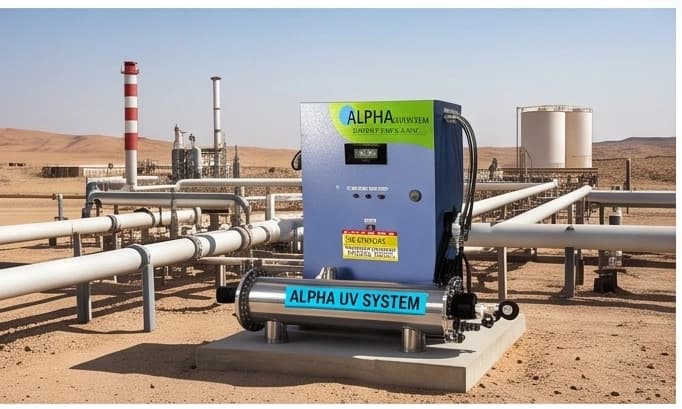
Offshore platform UV installations require IP66 rated enclosures — the Caspian offshore environment combines humidity 80–90% RH, saline aerosol, hydrocarbon mist from platform deck operations, and wave spray on platform lower decks. All Alpha UV units for Caspian offshore specify IP66 and marine-grade corrosion protection.
Baku — Industrial and Hospitality
Baku (metropolitan area 2.9 million) draws water from the Kura River (Kür) through the Oguz-Gabala-Baku water pipeline (168 km) and local WTP systems. Kura River post-WTP supply shows UVT 72–80% — moderate organic loading from agricultural catchment and upstream industrial discharge from Georgia and Armenia. Auto de-rating UV control is essential for consistent dose delivery during seasonal turbidity fluctuations.
| Baku Application | Water Source / UVT | Standard | Alpha UV System |
|---|---|---|---|
| 5-star hotels (Four Seasons, Fairmont, JW Marriott, Park Hyatt) | Baku WTP 74–80% | AZS 709, HACCP, hotel brand standards | AU-M 25, NSF/ANSI 55 Class A |
| Baku Conference Centre / COP29 legacy venues | Baku WTP 74–80% | AZS 709, WHO 4th edition | AU-M 30, MODBUS TCP BMS |
| Food processing (pomegranate, wine, hazelnut) | Baku WTP / borewell 74–82% | AZS food standards, EU HACCP, ISO 22000 | AU-M 25, zero residual Cl |
| Pharma (Azerpharma, Ecepharm) | Baku WTP 74–80% | AZS, EAEU Pharmacopoeia | AU-H 80 mJ/cm², 316L SS |
| Absheron resort hotels (Novkhani, Nardaran) | Caspian SWRO 91–94% | HACCP, AZS 709 | AU-M 25, IP65, zero residual Cl |
Baku's COP29 (UN Climate Conference, November 2024) legacy infrastructure — including the Baku Stadium (68,000 seats), refurbished Exhibition Centre, and the expanding Baku White City urban development — requires UV water treatment for large-scale venue and residential use. MODBUS TCP integration into building automation systems (BMS) for the White City luxury residential and commercial complex is a feature of Alpha UV's Baku commercial installations.
Sheki and Gabala — Wine and Food Export
Northern Azerbaijan (Sheki, Gabala, Gakh oblasts) produces wine (Sheki Winery, Qax wine cooperative), hazelnuts (Azerbaijan is the 6th largest hazelnut producer globally), and fruit. Mountain spring water supply in the Sheki-Zagatala region (UVT 84–90%) provides excellent feedwater for food processing UV installations. EU export HACCP plans for hazelnut and dried fruit (fresh hazelnut exported to EU under EU-Azerbaijan relations framework) require documented process water treatment.
Gabala District has been developed as a mountain resort (Tufandag Mountain Resort, 22 km of ski pistes, Four Seasons Baku Gabala concept — international tourism) drawing from pristine Caucasus mountain springs (UVT 86–92%). HACCP-compliant UV water treatment with zero chemical residual is specified for resort hotel water supply.
Nakhchivan — Isolated Supply
Nakhchivan Autonomous Republic — an Azerbaijani exclave separated from mainland Azerbaijan by Armenian territory — has limited water infrastructure and some of the most isolated supply logistics in the South Caucasus. Nakhchivan draws from Araz River tributaries and mountain boreholes (UVT 78–86%). UV systems for Nakhchivan supply reach via air (Nakhchivan Airport — NAJ, daily flights from Baku) or road through Iran (the southern route through Iranian territory, the primary land route after 2020 war developments opened new corridors).
Frequently Asked Questions
What IP rating is required for Caspian offshore UV installations?
Caspian Sea offshore platform environments combine: relative humidity 80–90%, saline aerosol (Caspian salinity 12–13 g/L — less than ocean but sufficient for significant corrosion), hydrocarbon mist from platform deck operations, and wave splash on lower platform decks. IP66 (complete dust exclusion + protection against high-pressure water jets) is the minimum specification for all Caspian offshore UV installations — exceeding the IP65 standard specified for onshore Absheron Peninsula operations. UV lamp and quartz sleeve materials (SS316L body, quartz borosilicate sleeve, PTFE seals) are inherently corrosion-resistant to saline aerosol; the IP66 enclosure protects the electronic controller and UV intensity sensor from moisture and hydrocarbon mist ingress. BP Azerbaijan and SOCAR specifications for ACG and Shah Deniz platforms require IP66 as minimum.
How does COP29 (Baku 2024) legacy affect UV water treatment demand in Azerbaijan?
COP29 in Baku (November 2024) required international standard water quality across all Conference venues, hotels, and the new Baku Stadium. Azerbaijan's government committed to "legacy infrastructure" — maintaining COP29 venues as international-standard conference and sports facilities through 2030. This created demand for MODBUS TCP-integrated UV water treatment systems with BMS connectivity for the Baku Stadium, COP29 Convention Centre, and White City development. Hotels (Four Seasons Baku, Fairmont, JW Marriott) completed pre-COP upgrade programs specifying NSF/ANSI 55 Class A UV replacing older chemical treatment systems to meet international hotel brand F&B water quality standards. The COP29 legacy water infrastructure investment is estimated at approximately USD 50 million across venues and hotels.
What AZS standard governs UV water treatment in Azerbaijan?
AZS 709:2010 (Azerbaijan State Standard: "Drinking Water — Hygienic Requirements and Quality Control") is Azerbaijan's national drinking water standard, published by AzStandard (Azerbaijan State Agency for Standardisation, Metrology, and Patents). AZS 709 requires E. coli = 0/100 mL, total coliforms = 0/100 mL, and a comprehensive physico-chemical parameter set aligned with WHO Guidelines 4th edition. NSF/ANSI 55 Class A UV validation documentation (English and Azerbaijani) satisfies AZS 709 microbiological requirements at the UV disinfection step. Alpha UV supplies AzStandard-formatted compliance declarations for commercial installations requiring government regulatory documentation.
Why does the Kura River supply in Baku require auto de-rating UV control?
The Kura River (Kür) flows 1,364 km from northeastern Turkey through Georgia and Azerbaijan before entering the Caspian — collecting agricultural runoff, urban wastewater, and industrial discharge along its journey. By the time Kura water reaches Baku's WTP inlet, post-treatment UVT ranges from 72–80% (clean season) to 64–72% during spring snowmelt and autumn rainfall events. At UVT 64–68%, a fixed-flow UV reactor operating at rated capacity cannot deliver 40 mJ/cm² — the system would under-dose. Alpha UV's auto de-rating controller monitors UVT continuously via calibrated inline sensor, reduces permitted flow proportionally when UVT falls below 72%, maintains 40 mJ/cm² delivered dose at all times, and logs every de-rating event to MODBUS RS485 for AZS 709 compliance audit records.
What is the delivery route for UV systems to Baku?
For Baku: air freight to Heydar Aliyev International Airport (GYD) in under 48 hours from India (connections via Dubai, Istanbul, or Moscow). Sea freight via Dubai → Baku Port (Caspian Sea): goods shipped from Nhava Sheva to Dubai (7–10 days), then transshipped to Caspian cargo ships from Bandar Abbas or Bandar Anzali (Iran) to Baku Port (2–3 days Caspian crossing) — approximately 14–18 days total. Alternatively, Novorossiysk (Russia) sea freight then road via Derbent border (Dagestan Russia → Azerbaijan) — 18–24 days from India. For Nakhchivan: air freight Baku → Nakhchivan domestic (1 hour flight, daily service); or road via Iran (Julfa border). All packages designed for manual handling without forklifts (max 60 kg per carton).
Logistics and Supply Chain
Azerbaijan is the Caspian hub for regional logistics — Baku Port is the western Caspian's largest port (Baku International Sea Trade Port, BITP, opened 2018). Alpha UV supplies Azerbaijan via air freight to Heydar Aliyev Airport (GYD) for pharmaceutical and urgent project deliveries (under 48 hours from India) or Caspian sea freight via the Baku Port route from Dubai for planned project cargo (14–18 days). Azerbaijan customs clearance under EAEU-observer status procedures averages 3–7 working days.
For SOCAR and BP Caspian offshore installations, goods arrive at Baku Port and transfer to supply boats for offshore platform delivery under SOCAR/BP marine logistics management. IP66 packaging withstands offshore supply boat deck exposure.
Documentation with every Azerbaijan installation: NSF/ANSI 55 Class A validation report, AZS 709:2010 compliance declaration (Azerbaijani and English), BP Group HSE Water Quality Standard WQS-001 conformance statement (oil sector), EU HACCP CCP documentation (food export sector), EAEU Pharmacopoeia pharmaceutical dossier (AU-H units), MODBUS register map, IP65/IP66 certification (IEC 60529), and O&M manual in English, Russian, and Azerbaijani.
Alpha UV Systems — UV water treatment system Azerbaijan specialists. NSF/ANSI 55 Class A | AZS 709/WHO compliant | BP/SOCAR Caspian HSE documentation | IP66 offshore-rated | EU HACCP food export documentation | COP29 legacy venue specifications. Delivery via Baku Airport 48 hours or Caspian Port. Contact us for Caspian oilfield camp or Baku hospitality sizing.
Standards, authorities & further reading
External references used to inform this guide. Regulations evolve — check the latest revision on each authority's site before compliance decisions.
Recommended UV Systems
Alpha UV System products for this application — powered by genuine Philips UV-C lamps.
Commercial UV Water Purification System
500 – 5,000 LPH
HACCP-compliant UV water purification for hotels, restaurants, and offices
Industrial UV Water Treatment System
5,000 – 50,000 LPH
Schedule M 2025 and HACCP compliant UV for pharma, food & beverage, and process water
Not sure which system suits your application? WhatsApp our engineers for a free recommendation →
Related solutions
See how Alpha UV System applies this to your industry or city.
Need a UV system?
Talk to our UV engineers — WhatsApp for a quote in 2 hours, or browse the full catalog on IndiaMART.