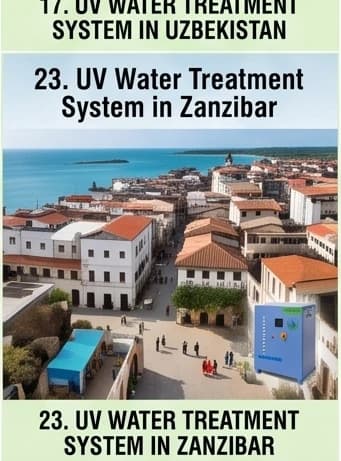
Quick Answer: UV water treatment system Zanzibar addresses water quality for the Zanzibar Archipelago (Unguja Island + Pemba Island, 1.9 million population) — one of East Africa's most important tourism destinations (700,000+ international tourist arrivals annually; USD 800 million+ tourism revenue) and the world's leading producer of cloves (Zanzibar and Pemba supply 75–80% of global clove production). ZAWA (Zanzibar Water Authority) supplies Unguja Island from groundwater wells and surface catchments — UVT 68–80% at distribution, chlorine residual 0.2–0.4 mg/L. Zanzibar's UV water treatment demand is driven by: international beach resorts (Nungwi, Kendwa, Matemwe, Pongwe, Jambiani — Marriott, Hyatt, Park Hyatt Mnemba, Constance Aiyana, The Residence) requiring 5-star brand HACCP water standards; Stone Town (UNESCO World Heritage Site — 1,200-year-old Arab-Swahili historic urban fabric) heritage hotel and restaurant sector; clove and spice processing export compliance (TFDA food safety); and Zanzibar's SWRO desalination dependency in the dry season (coastal groundwater salinity risk). NSF/ANSI 55 Class A at 40 mJ/cm². Alpha UV ships to Zanzibar International Airport (ZNZ) or via Dar es Salaam (DAR) with ferry crossing.
Zanzibar's UV Water Treatment System Landscape
Zanzibar's island geography creates distinct water challenges:
- Coastal groundwater salinity: Unguja Island's shallow coral limestone aquifer is vulnerable to seawater intrusion — coastal hotels within 200 m of the Indian Ocean (Nungwi, Kendwa, Jambiani beachfront properties) experience groundwater TDS 500–3,000 ppm, chloride 200–1,500 mg/L; SWRO (seawater reverse osmosis) or deep inland borehole + UV is the standard for coastal resort water supply
- ZAWA intermittent supply: ZAWA supply is intermittent throughout Unguja — many areas receive supply only 4–8 hours/day; all commercial premises use large storage tanks (1,000–20,000 litre rooftop tanks); post-storage UV at building entry is standard for hotels and restaurants
- Dry season groundwater decline: July–October dry season reduces groundwater recharge — some inland resorts switch to SWRO desalination for potable supply; UV is mandatory post-RO in SWRO systems for biological safety of permeate
Zanzibar Tourism and Hospitality UV Applications
| Property Type | Location | Water Source | UV Application | Alpha UV System |
|---|---|---|---|---|
| 5-star international beach resort (Park Hyatt Mnemba Island, Constance Aiyana, The Residence Zanzibar) | Nungwi/Kendwa/Pemba Island | SWRO desalination (coastal seawater) or deep island borehole + RO | Post-RO UV mandatory; zero Cl for ultra-luxury resort water (high-end guests object to chlorine taste); spa pool water; guest potable supply from private SWRO + UV | AU-M 25, post-RO, 316L SS, 40 mJ/cm²; zero Cl; compact installation in resort plant room; NSF/ANSI 55 Class A for Hyatt/Constance brand audit |
| Mid-scale beach lodges (Matemwe, Pongwe, Jambiani — boutique eco-lodges) | East coast Unguja | ZAWA supply + large storage tanks (10,000–50,000 litre) | Post-storage UV at lodge water distribution entry; kitchen and restaurant UV; solar-compatible for lodges with solar-primary power | AU-S 15, 40 mJ/cm², solar-compatible; NSF/ANSI 55 Class A; TFDA food premises compliance |
| Stone Town heritage hotels and restaurants (Jafferji House, Tembo Hotel, Zanzibar Coffee House) | Stone Town, Unguja Island | ZAWA supply + old stone cisterns (Portuguese-era or Arab-era stone water storage) | Post-cistern UV — old stone cisterns in Stone Town heritage buildings have biofilm from 50–100+ year accumulation; UV at building water entry; compact installation compatible with heritage building constraints | AU-S 8 or AU-S 15, compact wall-mount, NSF/ANSI 55 Class A; discreet installation for UNESCO heritage property |
| Zanzibar International Airport zone (hotels near ZNZ, Tunguu area) | ZAWA Tunguu supply | 70–78% | Transit hotels and airport commercial premises; HACCP for airport food service catering | AU-S 15, 40 mJ/cm², NSF/ANSI 55 Class A; TFDA food premises licensing |
Clove and Spice Processing Water Quality
Zanzibar and Pemba Islands supply 75–80% of global cloves — the archipelago's primary agricultural export. Clove processing involves:
- Clove washing at harvest: Freshly harvested clove buds are washed before drying — contaminated wash water introduces E. coli and Salmonella into dried clove product; EU RASFF has historically flagged Salmonella in dried spices including cloves from sub-Saharan origin; TFDA export certification requires E. coli 0 CFU/g in finished dried cloves
- Clove oil distillation (Zanzibar Town processing units): Steam distillation of clove buds and stems for eugenol extraction — steam feedwater quality (TDS <100 ppm) and boiler feed biological safety; post-RO UV for boiler feed at clove oil distillation units
- EU export compliance: EU Regulation (EC) 2073/2005 (microbiological criteria for foodstuffs) — spice export microbiological limits; Zanzibar Spices Association works with TFDA on export certification; UV at washing stage is cited in TFDA spice processing best practice guidance as approved treatment for wash water
FAQ
What UV specification is appropriate for a Nungwi beachfront resort with SWRO water supply?
Nungwi beachfront resort (coastal Unguja, Indian Ocean frontage): seawater inlet (35 ppt salinity, TDS 35,000 ppm) → SWRO membrane system (capacity 5–20 m³/hour for medium resort, 100–400 rooms) → RO permeate (TDS 50–200 ppm, UVT 90–96% — high UVT typical of RO permeate) → UV at 40 mJ/cm² → potable distribution. UV specification for Nungwi SWRO: AU-M 25 (316L SS, 1.5" tri-clamp or BSP, 10 m³/hour rated) at 40 mJ/cm² at 90% UVT (SWRO permeate typical) — system is effectively oversized at high UVT, ensuring ample dose margin. Key points: 316L SS housing is used because in coastal Zanzibar, ambient salt air (aerosol chloride) can cause pitting corrosion on 304 SS external surfaces even in interior plant rooms; zero Cl — luxury resort brand standard prohibits chlorine in guest water (chlorine-free is a premium resort water marketing point in ultra-luxury Indian Ocean resorts); NSF/ANSI 55 Class A for brand HACCP audit. Annual lamp replacement (12,000-hour lamp life = 18 months at 16-hour/day operation) coincides with resort dry-season low-occupancy period for minimum disruption.
Does Zanzibar's Stone Town status as a UNESCO World Heritage Site affect UV installation?
Stone Town of Zanzibar was inscribed as a UNESCO World Heritage Site in 2000 (outstanding universal value — Arab-African-Indian-Portuguese architectural fusion). Heritage building regulations under Zanzibar Stone Town Heritage Society (ZSTHS) and Zanzibar Commission for Tourism: no structural modifications to heritage building facades or structural walls; interior plumbing modifications for water treatment equipment must be concealed and reversible. UV system installation implications: (1) Compact wall-mount units required — AU-S 8 (25W, 340 mm length × 60 mm diameter) fits within existing utility rooms in Stone Town's small-footprint historic buildings; (2) No penetration of exterior heritage walls for new water lines — UV must be installed on existing internal pipework; (3) Power supply from existing internal circuit — no new external electrical penetrations in heritage walls. AU-S 8's compact form factor and simple 2-connection inline installation (insert into existing supply pipe) makes it the preferred system for Stone Town heritage building water treatment compliance.
How does Alpha UV reach Zanzibar?
Zanzibar International Airport (ZNZ, Kisauni) receives direct international flights from Nairobi (KQ), Addis Ababa (ET), Doha (QR), and regional charters. Air freight from India to ZNZ: connect via Nairobi (NBO) or Dar es Salaam (DAR) — total transit 48–72 hours. Alternative: air freight to DAR (48 hours from India) + ferry from Dar es Salaam port to Zanzibar Malindi Port (2-hour crossing on MV Kilimanjaro or Azam Marine fast ferry). Import customs: Zanzibar is semi-autonomous (Zanzibar Revolutionary Government — ZRG) but operates within Tanzania Customs Union; TRA customs clearance at ZNZ or DSM applies. Import duty HS 8421.21 same as Tanzania mainland: 25% (non-EAC preferential origin). For resort projects where project cost justifies expedited delivery: air freight DAR + ferry is often faster than waiting for cargo clearance at ZNZ small cargo terminal.
Standards, authorities & further reading
External references used to inform this guide. Regulations evolve — check the latest revision on each authority's site before compliance decisions.
Recommended UV Systems
Alpha UV System products for this application — powered by genuine Philips UV-C lamps.
Commercial UV Water Purification System
500 – 5,000 LPH
HACCP-compliant UV water purification for hotels, restaurants, and offices
Industrial UV Water Treatment System
5,000 – 50,000 LPH
Schedule M 2025 and HACCP compliant UV for pharma, food & beverage, and process water
Not sure which system suits your application? WhatsApp our engineers for a free recommendation →
Related solutions
See how Alpha UV System applies this to your industry or city.
Need a UV system?
Talk to our UV engineers — WhatsApp for a quote in 2 hours, or browse the full catalog on IndiaMART.