Quick Answer: UV water treatment Bangladesh garment sector demand is driven by the world's second-largest ready-made garment (RMG) export industry — USD 46+ billion annually from 4,000+ BGMEA member factories and 2,200+ BKMEA knitwear units — whose international buyers (H&M, Inditex/Zara, Primark, Next, M&S, Walmart, Target) mandate zero chlorine in wet processing water via GOTS v7.0, OEKO-TEX Standard 100, ZDHC MRSL v3.3, and brand-specific Higg FEM sustainability indices. Chlorine-based disinfection in process water causes fabric discoloration, degrades organic fibre tensile strength, creates halogenated by-products (trihalomethanes) in effluent, and triggers GOTS audit failure. UV disinfection at 40 mJ/cm² (NSF/ANSI 55 Class A, 254 nm) achieves >4 log pathogen reduction without any chemical residual — making it the BGMEA Sustainability Committee's recommended disinfection method for GOTS/OEKO-TEX certification. Factories are concentrated in Gazipur, Savar/Ashulia, Narayanganj, Tongi (Dhaka Division) and Chittagong EPZ. Alpha UV ships within 48 hours to Hazrat Shahjalal International Airport.
Why UV Water Treatment is Essential for Bangladesh's Garment Industry
Bangladesh's ready-made garment (RMG) sector — established in the early 1980s and now employing 4.5 million workers, predominantly women — operates in an international buyer environment where water quality is not a compliance footnote but a core supply chain audit criterion. The UV water treatment Bangladesh garment industry requirement stems from the fundamental incompatibility between chlorine-based water disinfection and sustainable textile production.
Chlorine (as NaOCl or Cl₂) in process water affects Bangladesh garment factories across three critical dimensions: (1) fabric damage — chlorine at 0.5–2 mg/L causes oxidative degradation of cotton, viscose, and modal fibres; in high-chlorine-content process water, tensile strength reduction of 12–18% in 100% cotton knit has been documented in BGMEA technical committee studies; (2) GOTS and OEKO-TEX non-compliance — both certification bodies prohibit chlorine in process water for certified fabric, with GOTS v7.0 specifically listing sodium hypochlorite as a prohibited substance in Annex 6 (Permitted Chemical Inputs); (3) effluent non-compliance — chlorination of process water containing organic matter generates trihalomethanes (THMs) and haloacetic acids (HAAs), regulated under DOE ECR 2023 effluent standards and ZDHC Wastewater Guidelines (WWG) enforced by brand auditors.
UV water treatment Bangladesh garment factories achieves pathogen reduction at 40 mJ/cm² without introducing any chemical into the water stream. The 254 nm germicidal wavelength damages the DNA of bacteria, viruses, and protozoa — preventing reproduction — without altering water chemistry, pH, conductivity, or introducing any residual compound detectable in downstream effluent testing.
Bangladesh Garment Industry Water Sources and UV Challenges
| Industrial Zone | Primary Water Source | UVT Range | Key Challenge | Alpha UV System |
|---|---|---|---|---|
| Gazipur (Tongi, Kaliakoir EPZ, Kashimpur) | DWASA/GWASA tube wells; private boreholes | 74–83% | Nitrate from garment effluent recirculation; E. coli; iron | AU-M 25/30, MODBUS RS485, auto de-rating |
| Savar / Ashulia EPZ corridor | Private tube wells (Holocene aquifer), DWASA extension | 76–85% | Surfactant contamination; shallow groundwater coliform | AU-M 25, NSF/ANSI 55 Class A, continuous UVI sensor |
| Narayanganj (old textile belt) | Shitalakhya River draw + deep tube wells | 58–76% | Dyeing effluent legacy contamination; chromium; BOD | AU-M 30/40, upstream pre-treatment mandatory |
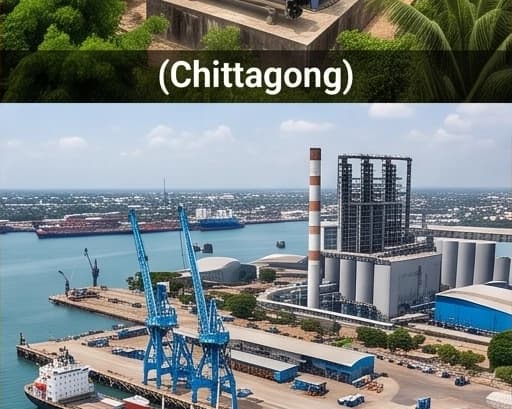
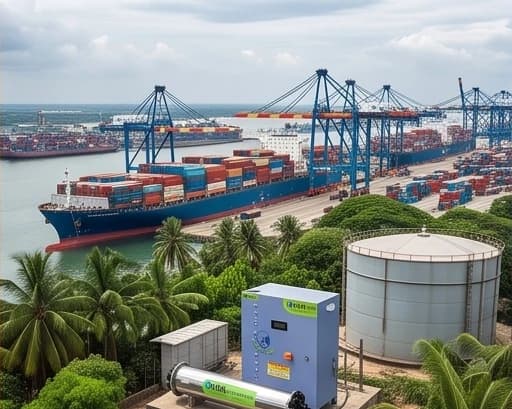
| Chittagong EPZ (CEPZ, KEPZ) | CWASA zone supply + EPZ tube wells | 64–84% (seasonal) | Mixed-source variable UVT; surfactant; monsoon turbidity | AU-M 25, auto de-rating, dual UVI sensors |
| Hemayetpur (Dhaka fringe, denim cluster) | Private deep tube wells, DWASA extension | 78–86% | Iron 1–3 mg/L; manganese; coliform in storage tanks | AU-M 25, post iron-removal, NSF/ANSI 55 Class A |
Narayanganj — Bangladesh's historic textile capital and home to the country's oldest dyeing and yarn-processing clusters — presents the most challenging UV water treatment Bangladesh garment application. Shitalakhya River at Narayanganj has been classified as one of the world's most polluted rivers (in 2003 UNEP "Global Freshwater Quality" report), with BOD exceeding 30 mg/L in dry season from decades of untreated dyeing and tannery effluent. Factory-level UV sizing in Narayanganj requires comprehensive upstream pre-treatment: coagulation-flocculation → multimedia filtration (to <1 NTU) → activated carbon (for BOD and THM precursor removal) → UV at 40 mJ/cm². Without upstream pre-treatment to achieve UVT above 75%, UV dose delivery cannot be guaranteed.
International Buyer Standards Driving UV Adoption
| Buyer / Standard | Water Quality Requirement | Audit Mechanism | UV System Requirement |
|---|---|---|---|
| H&M — Higg FEM v3.1 + Chemical MRSL | Zero chlorination in process water; ZDHC MRSL v3.3 wastewater; water management metered and documented | Annual Higg FEM self-assessment + 3rd party verification | AU-M 25/30, MODBUS logging, Higg-compatible data export |
| Inditex (Zara, Pull&Bear, Massimo Dutti) — Green to Wear 2.0 | Zero chlorine; ZDHC WWG compliance for wastewater; chemical inventory per ZDHC MRSL | Inditex environmental supplier audit (biennial); ZDHC gateway upload | AU-M 25/30, zero Cl, ZDHC WWG documentation package |
| Primark — Primark Cares Supplier Code | Buyers require GOTS or equivalent sustainable water practices; OEKO-TEX 100 product certification preferred | Factory environmental questionnaire + social audit | AU-M 25, GOTS-compatible zero Cl treatment |
| Next (UK) — Next Responsible Sourcing Code | Process water: chlorine-free; HACCP food/canteen water; ETP compliance | Sedex SMETA 4-pillar audit annually | AU-M 25 (process); AU-S 15 (canteen) |
| GOTS v7.0 — Global Organic Textile Standard | Process water: zero chlorine, coliform <100 CFU/100 mL; wastewater: GOTS Appendix 7 limits | GOTS accredited certifier annual inspection (Control Union, BV, TÜV SÜD, CERT ID) | AU-M 25/30, 40 mJ/cm², zero Cl, MODBUS data logging for audit |
The GOTS v7.0 audit requirement for process water is increasingly the binding constraint driving UV water treatment Bangladesh garment investment decisions. GOTS certification unlocks premium pricing — certified organic cotton garment contracts with H&M Conscious Collection, Patagonia, Eileen Fisher, and Gap's organic lines — typically carrying 15–25% price premiums over conventional equivalents. The capital cost of a UV water treatment Bangladesh garment system (Alpha UV AU-M 25/30, installed: USD 4,500–8,500 depending on flow rate) is recouped within 2–3 shipment cycles from premium pricing alone, representing a compelling business case for mid-size Gazipur and Savar composite mills.
BGMEA Sustainability Roadmap and UV Endorsement
BGMEA's Sustainability Committee — established following the 2013 Rana Plaza disaster and accelerated by the Bangladesh Accord on Fire and Building Safety — has progressively expanded its environmental scope from structural safety to water quality. The 2023–2025 BGMEA Sustainability Roadmap explicitly identifies water treatment as a priority action area:
- Action 3.2: "Member factories targeting GOTS or OEKO-TEX Standard 100 certification shall install UV-based or equivalent non-chlorine disinfection for all fabric contact process water. UV at NSF/ANSI 55 Class A (40 mJ/cm²) is the recommended specification."
- Action 3.4: "Effluent Treatment Plant (ETP) compliance with DOE ECR 2023 requires monitoring of chlorinated by-product levels in discharge. Factories using chlorine-based process water disinfection are at elevated non-compliance risk under ZDHC Wastewater Guidelines — UV treatment eliminates this risk category."
- Action 3.7: "Worker welfare provision: BNBC (Bangladesh National Building Code) requires safe drinking water at factory worker welfare facilities. Rooftop tank post-storage UV at 40 mJ/cm² is the recommended point-of-use compliance method."
The ZDHC (Zero Discharge of Hazardous Chemicals) Programme — whose MRSL v3.3 is incorporated by reference in H&M, Inditex, Nike, PVH, Adidas, Burberry, C&A, Gap, and Li & Fung brand chemical policies — classifies sodium hypochlorite (bleaching and disinfection agent) as a "restricted substance" when used in wet processing above MRSL concentration limits. UV water treatment Bangladesh garment sector adoption is therefore not only a quality initiative but a chemical compliance requirement under the world's largest brands' chemical management programmes.
UV System Design for Bangladesh Composite Mills
A Bangladesh composite mill (spinning → knitting/weaving → dyeing → finishing under one roof — the dominant model in Gazipur and Savar) requires UV treatment at multiple points in its water use cycle:
- Borehole/DWASA inlet UV: AU-M 25 or AU-M 30 at the factory main water intake — treats all incoming water before storage tank. Eliminates E. coli and coliform risk from distribution system. Flow rates 20–80 m³/hour for composite mills employing 2,000–8,000 workers.
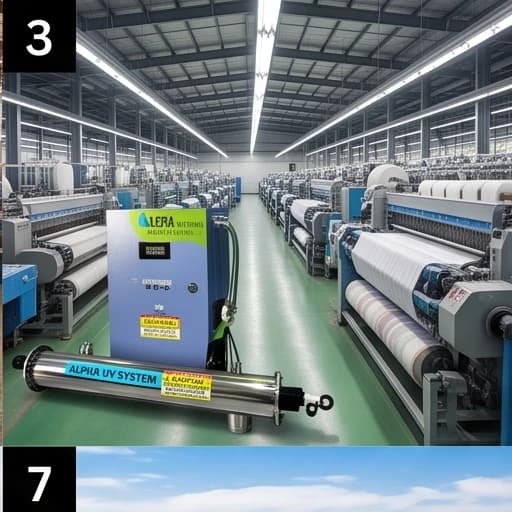
- Dyeing machine process water UV: Dedicated AU-M 25 per dyeing line (or AU-M 30 for shared manifold serving 3–4 machines) — treats softened/RO permeate water used in dyeing and finishing. Zero chlorine residual critical: chlorine interferes with reactive dye fixation chemistry and degrades natural fibre colour fastness.
- Worker drinking water UV: AU-S 15 at post-storage tank outlet for worker welfare facilities — NSF/ANSI 55 Class A, 40 mJ/cm², compliance with BNBC and BGMEA factory standards.
- Post-ETP discharge UV: AU-M 40 or AU-L 80 at ETP final effluent outlet — DOE ECR 2023 biological oxygen demand compliance and ZDHC WWG microbiological discharge limit compliance. Eliminates pathogen load in ETP effluent before discharge to municipal drain or Dhaka's low-lying channels.
CFD (computational fluid dynamics) reactor modelling is provided by Alpha UV for composite mill installations above 50 m³/hour to validate dose distribution across the full operating flow range. CFD validation is particularly important in Bangladesh garment applications where flow rates vary significantly between production shifts (20–30% flow reduction during night shift) — CFD confirms that minimum 40 mJ/cm² dose is maintained even at minimum flow, preventing over-sizing that increases energy cost.
Operational Factors in Bangladesh Garment Factories
UV water treatment Bangladesh garment installations encounter specific operational conditions that Alpha UV systems are designed to address:
Power quality: Bangladesh's garment zone power supply (from REB — Rural Electrification Board, or DESCO/BPDB grid) has frequent voltage fluctuations (170–250V) and micro-interruptions during peak industrial demand. All Alpha UV electronic ballasts operate at 100–240V, 50 Hz — eliminating AVR requirements in most installations. IP65-rated enclosures protect against humidity during monsoon season (June–October).
Water supply intermittency: DWASA/GWASA supply interruptions require UV systems to operate safely with intermittent inflow. Alpha UV flow sensor interlocks shut down UV operation during zero-flow periods (preventing dry-run lamp overheating) and automatically restart on flow resumption — critical for factory operations where supply is intermittent 4–6 hours per day.
Maintenance access: Compact chamber design (<400 mm clearance required for lamp change) suits Dhaka and Gazipur's space-constrained factory floors. Lamp change without draining the chamber (push-pull lamp extraction) minimises production interruption.
FAQ
Does UV water treatment allow Bangladesh garment factories to pass GOTS v7.0 audits?
Yes. GOTS v7.0 Annex 6 prohibits chlorine and sodium hypochlorite in process water for certified organic textile production. UV disinfection at 40 mJ/cm² introduces no chemicals and leaves zero residual — it is fully GOTS-compliant. GOTS certifiers (Control Union, Bureau Veritas, TÜV SÜD) accept UV systems with NSF/ANSI 55 Class A certification and documented operating logs (MODBUS data download showing continuous dose above 40 mJ/cm²) as evidence of compliant process water management.
What flow rate UV system does a 5,000-worker composite mill in Gazipur need?
A 5,000-worker composite mill (spinning, knitting, dyeing, finishing) typically requires 40–80 m³/hour of process water during peak production (dyeing and finishing shifts). Alpha UV AU-M 30 (30 m³/hour) in duty/standby configuration, or AU-M 40 (single unit, 40 m³/hour), covers the typical flow range. For mills with wet processing above 60 m³/hour, AU-L 80 or parallel AU-M 30 units are recommended. Flow rate confirmation from the mill's water meter records is required for accurate sizing.
Is UV treatment sufficient for ZDHC MRSL compliance in Bangladesh garment factories?
Yes, for the water disinfection aspect. ZDHC MRSL v3.3 restricts sodium hypochlorite (as a process water disinfectant) above defined concentration thresholds. Replacing chlorination with UV eliminates the MRSL restricted substance entirely. UV water treatment Bangladesh garment factories also reduces ZDHC Wastewater Guidelines (WWG) non-compliance risk by preventing THM formation in effluent. Note that ZDHC MRSL compliance also covers dyes, finishing chemicals, and other substances — UV addresses only the water disinfection chemical component.
Can one UV system serve both drinking water and process water in a garment factory?
Not recommended. Drinking water (worker welfare) requires NSF/ANSI 55 Class A certification and separate documentation under BGMEA factory welfare standards and BNBC. Process water (dyeing, washing) requires GOTS/OEKO-TEX compliance documentation and typically operates at higher flow rates and variable pressures than drinking water supply. Alpha UV recommends dedicated AU-S 15 for worker drinking water and separate AU-M 25/30 for process water — this also ensures that maintenance of one system does not disrupt the other.
What documentation does Alpha UV provide for GOTS certifier audit submissions?
Alpha UV provides: NSF/ANSI 55 Class A certificate for the installed model; lamp calibration certificate (dated within 12 months); installation commissioning report with measured UV intensity at rated flow; MODBUS data log export (CSV format) showing continuous UVI sensor readings — typically exported monthly for certifier documentation. For GOTS audits, the certifier also requires the factory's water quality test report (BSTI-accredited lab) confirming zero coliforms at UV system outlet, taken at the time of UV commissioning and annually thereafter.
How often do UV lamps need replacement in Bangladesh's garment factory environment?
Alpha UV lamps are rated at 12,000 hours of operation (approximately 16–18 months at 20 hours/day factory operation). Bangladesh garment factories typically operate 2 shifts (16–18 hours/day, 6 days/week) — lamp life in this duty cycle is approximately 14–16 months. The electronic ballast triggers a lamp-life alarm at 80% of rated life, prompting planned replacement before performance degradation. Replacement lamps are stocked by Alpha UV's Dhaka and Chittagong distributor partners; lead time for replacement lamps is 24–48 hours from local distributor stock.
Standards, authorities & further reading
External references used to inform this guide. Regulations evolve — check the latest revision on each authority's site before compliance decisions.
Recommended UV Systems
Alpha UV System products for this application — powered by genuine Philips UV-C lamps.
Commercial UV Water Purification System
500 – 5,000 LPH
HACCP-compliant UV water purification for hotels, restaurants, and offices
Industrial UV Water Treatment System
5,000 – 50,000 LPH
Schedule M 2025 and HACCP compliant UV for pharma, food & beverage, and process water
Not sure which system suits your application? WhatsApp our engineers for a free recommendation →
Related solutions
See how Alpha UV System applies this to your industry or city.
Need a UV system?
Talk to our UV engineers — WhatsApp for a quote in 2 hours, or browse the full catalog on IndiaMART.