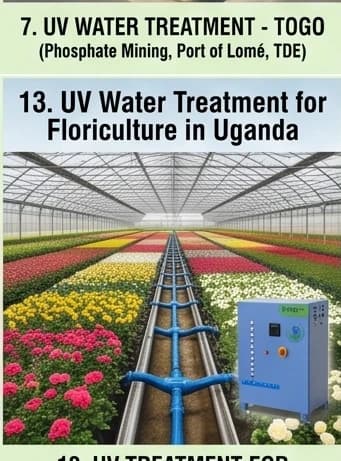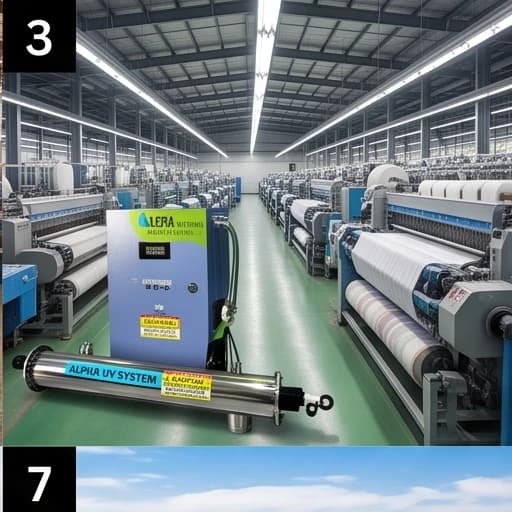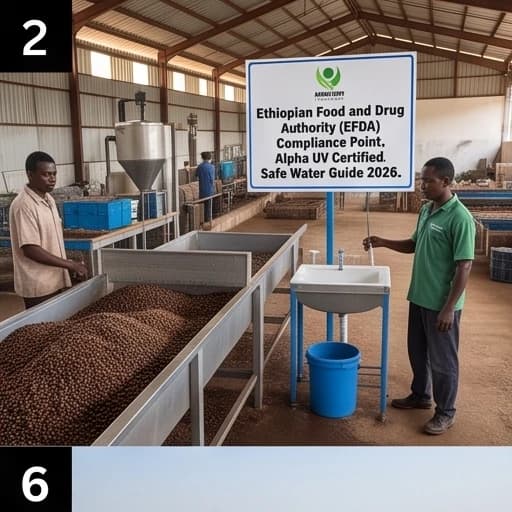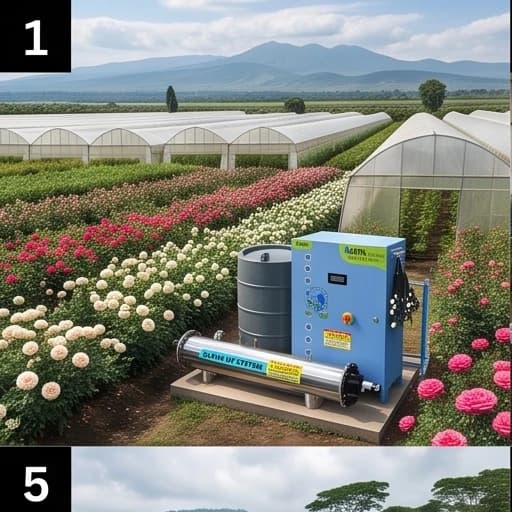
Quick Answer: UV water treatment Ethiopia floriculture is critical for the world's second-largest cut flower exporter after the Netherlands — Ethiopia exports 300,000+ tonnes of cut flowers annually (2023: 320,000 tonnes), generating USD 750+ million in forex earnings; 80%+ goes through the Dutch Aalsmeer auction (VBA — Veiling Bloemenmarkt Aalsmeer / Royal FloraHolland). Ethiopia's floriculture sector employs 100,000+ workers on 100+ large flower farms clustered around three highland growing zones: Ziway (Oromia Region — 170 km south of Addis, Rift Valley Lake Ziway basin; largest cluster — 40+ farms, roses and alstroemeria); Holeta (West Shewa, Oromia — 30 km west of Addis; government-established floriculture zone; highest altitude, best rose head size); and Sebeta/Addis Ababa surroundings (30+ farms, diversified species). Water quality for Ethiopian floriculture: Lake Ziway water (alkaline, pH 8.2–8.8, TDS 350–600 ppm, EC 0.6–1.2 mS/cm — highest-TDS floriculture water in East Africa due to Rift Valley soda ash geology); Holeta highland borehole (excellent quality, TDS 100–200 ppm, pH 6.8–7.2). Zero-chlorine mandatory throughout — MPS certification, GlobalG.A.P. IFA v6.0, and Dutch auction buyer specifications all prohibit Cl in irrigation. NSF/ANSI 55 Class A at 40 mJ/cm². Alpha UV ships to Addis Ababa Bole Airport (ADD) within 48–72 hours; Ziway delivery via Addis-Ziway highway (2.5 hours).
Ethiopia Floriculture — Water Sources and UV Challenge
Ethiopia's three floriculture clusters have distinct water quality profiles:
- Lake Ziway cluster (170 km south of Addis — largest cluster): Lake Ziway is the primary water source for 40+ farms in the Ziway-Batu zone; Rift Valley soda lake (sodium bicarbonate-dominated chemistry); TDS 350–600 ppm (highest in East Africa floriculture); pH 8.2–8.8 (alkaline — requires pH adjustment before drip irrigation); EC 0.6–1.2 mS/cm; UVT 72–80% (good — lake water clarity is high despite TDS due to low humic acid); UV applied after RO or NF membrane (to reduce TDS to <200 ppm for roses) — post-RO UVT 90–96% (excellent)
- Holeta highland zone (30 km west of Addis, 2,400 m altitude): Holeta aquifer (basaltic volcanic aquifer — excellent water quality); TDS 100–200 ppm; pH 6.8–7.2 (near-neutral); EC 0.2–0.4 mS/cm (ideal for roses without treatment); UVT 82–90%; no RO required — direct UV on borehole water after sediment filter; iron 0.05–0.15 mg/L (low — minimal fouling risk); best natural water quality for Ethiopian floriculture
- Sebeta/Addis surroundings (15–30 km from Addis): AAWSA + borehole mixed; UVT 70–80%; farms at lower altitude (2,200–2,400 m) with slightly more turbid supply from surface water contribution; standard pre-filter + UV specification
UV Water Treatment Applications in Ethiopian Flower Farms
| Application | Water Source | UVT | Pathogen / Issue | Alpha UV System |
|---|---|---|---|---|
| Drip irrigation (rose growing tunnels — Ziway and Holeta) | Lake Ziway (post-RO) or Holeta borehole | 88–96% (post-RO); 82–90% (borehole) | Pythium spp. (root rot in drip irrigation — major Ethiopian rose farm crop loss); Fusarium oxysporum; Phytophthora; zero Cl mandatory (MPS; Dutch buyer specification) | AU-M 25, zero Cl, 40 mJ/cm²; Pythium 4-log inactivation at 40 mJ/cm²; MPS/GlobalG.A.P. water documentation |
| Post-harvest hydration (stem recut in cold rooms — all Ethiopia farms) | Farm borehole or post-RO treated water | 82–96% | Botrytis cinerea (grey mould in conditioning buckets — major Ethiopian rose export quality issue; 10°C cold room Botrytis risk during 48-hour conditioning before air shipment); E. coli; Erwinia | AU-S 15, zero Cl, 40 mJ/cm²; compact cold room installation; Botrytis conidium inactivation; VBA/Aalsmeer auction vase life quality |
| Worker welfare water (100+ workers per farm — OSHA Ethiopia) | Borehole (shared with irrigation but separate potable branch) | 82–90% | E. coli; Salmonella; E. coli O157:H7 (farmworker gastroenteritis — MPS social standard requires safe drinking water for workers) | AU-S 8 (25W, compact) on separate potable branch from irrigation UV; NSF/ANSI 55 Class A; MPS-Social and GlobalG.A.P. worker welfare documentation |
| Spray irrigation (humidity control, foliage misting — Holeta high-altitude farms) | Holeta borehole (low TDS, low EC — ideal for overhead misting without leaf salt burn) | 84–92% | Pseudomonas syringae (bacterial speck from overhead misting — Holeta farms use misting at high altitude for humidity); Phytophthora dispersal via spray | AU-S 8 (0.5–1.5 m³/hour misting flow); compact; zero Cl; Holeta farm spray system |
Dutch Auction and Export Compliance
- Royal FloraHolland / VBA (Veiling Bloemenmarkt Aalsmeer) — MPS certification requirement: MPS-ABC (environmental) and MPS-SQ (safety and quality) certification is required for auction floor eligibility at Aalsmeer — 80% of Ethiopian flowers sell through FloraHolland. MPS Section 4 (water) prohibits chlorine-based disinfection; requires annual water quality test; UV documentation accepted by MPS as treatment evidence. Ethiopia's MPS inspections are conducted by MPS inspectors visiting Ethiopia farms (2–3 times/year) — UV installation and documentation is checked at each visit
- GlobalG.A.P. IFA v6.0 (Flowers and Ornamentals module): Major European direct buyers (Tesco, REWE, Edeka, Carrefour) require GlobalG.A.P. IFA certification from Ethiopian suppliers; Section FO AF 1.2 (irrigation water quality) — documented treatment for pathogen risk; UV satisfies GlobalG.A.P. water treatment evidence requirement
- Ethiopian Horticulture Producers and Exporters Association (EHPEA): EHPEA's Code of Practice for Ethiopian Horticulture (Section 7 — water) recommends UV or equivalent chemical-free treatment for MPS-aligned farms; EHPEA promotes UV adoption through technical extension services to member farms
FAQ
How does Lake Ziway's alkaline water affect UV system design for Ethiopian rose farms?
Lake Ziway water (TDS 350–600 ppm, pH 8.2–8.8, EC 0.6–1.2 mS/cm) is challenging for direct drip irrigation due to high TDS and alkalinity — roses are sensitive to EC >1.0 mS/cm in drip irrigation (tip burn, reduced head size). Most Ziway-zone farms use nanofiltration (NF) or reverse osmosis (RO) to reduce TDS to 100–200 ppm before drip irrigation application. UV placement: post-NF/RO, treating RO permeate (TDS 80–150 ppm, pH 6.5–7.0, UVT 90–96%). At 90% UVT post-RO, Alpha UV AU-M 25 achieves 40 mJ/cm² at significantly higher flow than at typical borehole UVT — providing dose margin. Key advantage of UV post-RO: RO removes all bacteria and protists passing through membrane (including Pythium zoospores in some RO designs), but RO permeate can be re-contaminated in post-RO piping and storage tanks — UV disinfects this post-membrane re-contamination risk zone. For Ziway farms without RO (direct lake water use — smaller farms with TDS-tolerant species): UV applied to lake water after 25-micron sediment pre-filter and iron removal (if needed); design at 72% UVT (Lake Ziway minimum in dry season).
What is MPS-Social standard and how does it require worker welfare water at Ethiopian farms?
MPS-Social (Social Qualification — part of MPS certification suite) is the social standard for Dutch auction-connected flower farms — aligned to ILO Fundamental Conventions and ETI Base Code (Ethical Trading Initiative). MPS-Social Section 7 (Health and Safety): employers must provide safe drinking water for all workers at all times; water quality test required (E. coli 0 CFU/100 mL); treatment documentation required. For Ethiopian farms with 300–2,000 workers each: OSHA Ethiopia (Occupational Safety and Health Act) independently requires safe workplace drinking water (same E. coli 0 CFU/100 mL standard). Alpha UV AU-S 8 (25W, compact, 3 m³/hour) on a dedicated potable water branch (separate from irrigation UV) serves worker canteen and welfare facility drinking water — 3 m³/hour UV capacity serves approximately 1,500 workers/day at 2 litres/person/day consumption. MPS-Social inspector checks: UV system certificate, annual water quality test, lamp replacement log (confirms UV is operational).
Standards, authorities & further reading
External references used to inform this guide. Regulations evolve — check the latest revision on each authority's site before compliance decisions.
Recommended UV Systems
Alpha UV System products for this application — powered by genuine Philips UV-C lamps.
Commercial UV Water Purification System
500 – 5,000 LPH
HACCP-compliant UV water purification for hotels, restaurants, and offices
Industrial UV Water Treatment System
5,000 – 50,000 LPH
Schedule M 2025 and HACCP compliant UV for pharma, food & beverage, and process water
Not sure which system suits your application? WhatsApp our engineers for a free recommendation →
Related solutions
See how Alpha UV System applies this to your industry or city.
Need a UV system?
Talk to our UV engineers — WhatsApp for a quote in 2 hours, or browse the full catalog on IndiaMART.