Quick Answer: The One Number That Matters
When you ask what size UV system do I need for my house, the answer comes down to a single number: your peak flow rate in litres per hour (LPH). Not your average daily demand. Not your monthly water bill. Your peak — the maximum volume of water flowing through the UV chamber at the busiest moment of your day.
Size your UV system for the peak, and the water is protected at all times. Size it for the average, and you have created a gap in your disinfection barrier at exactly the moment your family needs it most — 6:30 a.m. on a weekday when two showers, the kitchen tap, and a flush valve are all running simultaneously.
A practical first answer for common household types in India:
- Under-sink (kitchen tap only, any flat size): 500 LPH UV system
- 2 BHK flat, whole flat from overhead tank: 2,000–2,500 LPH UV system
- 3 BHK flat or large apartment: 3,000–4,000 LPH UV system
- Villa or bungalow with borewell: Match the borewell pump LPH output, minimum 3,000 LPH
- Apartment complex (50 flats): 20,000–30,000 LPH centralised UV system
Everything below explains how to calculate the exact figure for your specific installation, apply safety margins, and select the right product tier. This UV system LPH sizing guide India covers every common residential and commercial scenario.
The Physics: Why Sizing Matters
UV disinfection obeys a simple but unforgiving equation:
UV Dose (mJ/cm²) = UV Intensity (mW/cm²) × Exposure Time (seconds)
Pathogens like E. coli, Salmonella, Vibrio cholerae, and Giardia cysts require a minimum UV dose to render them non-viable — typically 16–40 mJ/cm² depending on the organism. The Philips UV-C lamp inside a rated UV chamber delivers a fixed intensity at a fixed electrical input. What changes with flow rate is the exposure time: how long each litre of water spends inside the UV reaction chamber.
Flow rate and exposure time are inversely related. Double the flow rate and you halve the exposure time, which halves the delivered UV dose. The rated LPH on a UV system is the maximum flow at which the system still delivers the required minimum dose — it is not a suggestion, it is a physical boundary.
This is why the answer to what size UV system do I need for my house is never a guess. Exceeding the rated flow rate does not produce "slightly less disinfection" — it can produce water that looks and smells treated but carries live pathogens.
What Happens at Different Flow Rates vs Rated Capacity
| Flow as % of Rated | Example at 1,000 LPH Rated | UV Dose Delivered | Pathogen Risk | Action Required |
|---|---|---|---|---|
| 50% (underload) | 500 LPH through a 1,000 LPH unit | ~2× rated dose | None — excess safety margin | None; system works well |
| 100% (at rating) | 1,000 LPH through a 1,000 LPH unit | Full rated dose | None — design target met | None; this is ideal |
| 120% (moderate overload) | 1,200 LPH through a 1,000 LPH unit | ~83% of rated dose | Low-moderate; robust pathogens may survive | Upsize UV system |
| 150% (significant overload) | 1,500 LPH through a 1,000 LPH unit | ~67% of rated dose | Moderate-high; Giardia cysts likely to survive | Upsize UV system urgently |
| 200% (severe overload) | 2,000 LPH through a 1,000 LPH unit | ~50% of rated dose | High; viral and bacterial breakthrough possible | Replace with correctly sized unit immediately |
The dose percentages above assume UV transmittance (UVT) stays constant. In practice, iron or turbidity in borewell water reduces UVT further, compounding the dose deficit. The UVT adjustment section later in this guide covers how to account for this.
Step 1: Identify Your Installation Point and What It Covers
Before you calculate flow rate, you need to know exactly where in your plumbing the UV system will sit. The installation point determines what fraction of your home's water the UV system protects — and therefore what flow rate the UV chamber must handle.
In Indian homes, water typically enters from one of three sources: municipal mains supply, an overhead storage tank (filled by the municipal supply or borewell pump), or directly from a borewell pump. Understanding which path your water follows is the first step in answering what size UV system do I need for my house for your specific situation.
| Installation Point | What It Treats | Flow Rate Needed | Best For |
|---|---|---|---|
| Under-sink (kitchen tap) | Drinking and cooking water at one tap | 200–600 LPH | Flats with municipal supply; point-of-use protection |
| Overhead tank outlet (whole flat) | All water entering the flat from storage tank | 1,000–4,000 LPH | Apartments in Delhi NCR, Mumbai, Bangalore — protection against tank contamination |
| Mains entry (whole house) | All water entering the property before storage | 2,000–6,000 LPH | Villas, bungalows, farmhouses with direct mains pressure |
| Borewell pump outlet | All water pumped from borewell before overhead tank | Must match pump LPH | UP/Haryana/Rajasthan borewell homes; North India semi-urban housing |
| Pre-RO (before RO membrane) | Feedwater to RO unit — reduces biofouling on membrane | 50–300 LPH | High-TDS areas like Rajasthan; extends RO membrane life |
For most Indian apartments, the overhead tank outlet installation gives the best protection because it guards against tank contamination — the most common source of waterborne illness in apartment complexes in Delhi NCR, Mumbai, and Bangalore housing societies. A UV system installed at the mains entry does not protect against algae, birds, or biofilm accumulation inside the overhead storage tank.
Step 2: Measure Your Peak Flow Rate (Bucket Method)
The bucket test is the most reliable way to measure actual tap flow rate in Indian homes, where municipal pressure varies by time of day, floor level, and season. Here is the exact procedure:
- Gather materials: A 10-litre bucket (or any container of known volume) and a stopwatch or phone timer.
- Test at peak time: Run the test when water pressure is at its highest — typically early morning before 7 a.m. when demand on the municipal system is low.
- Open the tap fully: Test with the tap at full flow, since that is what you are sizing for.
- Measure fill time: Start the timer when water starts flowing, stop it when the bucket reaches 10 litres.
- Calculate flow rate: Flow rate (LPH) = (10 litres ÷ seconds to fill) × 3,600
Example: 10-litre bucket fills in 42 seconds → 10 ÷ 42 × 3,600 = 857 LPH
For a whole-flat or whole-house installation, you need to estimate simultaneous peak demand — the sum of all taps that could run at the same time during the morning rush. In a 3 BHK flat in a Delhi NCR apartment complex, that might be: kitchen tap (800 LPH) + bathroom 1 shower (700 LPH) + bathroom 2 wash basin (400 LPH) = 1,900 LPH simultaneous peak demand.
Typical Indian tap flow rates at 1–2 bar inlet pressure for reference:
- Kitchen tap (full flow): 500–900 LPH
- Bathroom wash basin: 300–500 LPH
- Shower head (standard): 500–800 LPH
- Overhead shower (rain shower): 800–1,200 LPH
- Flush valve (cistern fill): 400–700 LPH
Step 3: Apply a 20–25% Safety Margin
Once you have measured or estimated your peak simultaneous flow rate, add a 20–25% safety margin before selecting your UV purifier capacity for home. The margin accounts for:
- Future demand growth: Family size changes, guests, servants quarters added
- Pressure fluctuation: Municipal supply pressure can spike, briefly increasing flow rates
- UV lamp ageing: Lamp intensity degrades over time; a margin compensates until the annual lamp replacement
- Measurement uncertainty: Your bucket test captures one moment; conditions vary
Formula: Minimum UV size (LPH) = Peak flow rate (LPH) × 1.25
Example: Measured peak demand 1,900 LPH → 1,900 × 1.25 = 2,375 LPH → choose a 2,500 LPH UV system
Always round up to the next standard product size — 500, 1,000, 1,500, 2,000, 2,500, 3,000, 4,000, 5,000 LPH are the common residential and light commercial sizes available in the Indian market.
Residential Sizing by Household Type
1 BHK Flat — Municipal Supply, 1–2 Occupants
A 1 BHK flat in a Mumbai or Bangalore housing society typically has one kitchen, one bathroom, and 1–2 occupants. Peak morning demand: kitchen tap + wash basin + shower running simultaneously rarely exceeds 1,500 LPH. For under-sink kitchen protection only, a 500 LPH UV system is sufficient. For whole-flat protection from the overhead tank outlet, a 1,000–1,500 LPH UV system covers all scenarios with margin. Understanding what size UV system do I need for my house starts here — even a small flat benefits from whole-flat sizing over under-sink only.
2 BHK Flat — Borewell Supply, 3–4 Occupants
A 2 BHK flat in a UP or Haryana borewell-supplied housing colony presents different challenges. Borewell water carries higher bacterial load and iron content, making correct UV system sizing critical — not just for dose but for UVT adjustment (covered below). Peak simultaneous demand: kitchen (800 LPH) + two bathrooms (400 + 400 LPH) = 1,600 LPH. With 25% margin: 2,000 LPH UV system. If the borewell pump output exceeds 2,000 LPH, match the pump instead.
3 BHK Flat / Large Apartment — 4–6 Occupants
A 3 BHK flat in a Delhi NCR or Bangalore apartment complex typically has 2–3 bathrooms and 4–6 family members. Morning peak: kitchen (850 LPH) + two showers (700 + 700 LPH) + wash basin (400 LPH) = 2,650 LPH. With 25% margin: 3,312 LPH → 3,500–4,000 LPH UV system. Many premium 3 BHK flats now have rain showers (1,200 LPH each) and multiple simultaneous users — in this case, 4,000 LPH is the safer choice for a how to size UV system calculation.
Villa / Bungalow / Farmhouse — 6–12 Occupants
Villas and independent bungalows, common in Greater Noida, Gurugram, Noida, and Rajasthan, often combine municipal supply with a borewell for garden and utility use. Peak residential demand with 3+ bathrooms, a kitchen, and servant quarters can reach 4,000–6,000 LPH. The UV system flow rate home India sizing for villas must account for the borewell pump capacity on the utility side. A typical villa setup: 5,000 LPH UV system at mains entry plus a separate system matched to borewell pump output.
UV System Size Guide for Indian Homes
| Home Type | Occupants | Installation Point | Active Taps at Peak | Peak Demand LPH | Recommended UV Size LPH | Alpha UV Product Tier |
|---|---|---|---|---|---|---|
| 1 BHK flat (municipal) | 1–2 | Under-sink | 1 | 500–600 | 500 | Residential Compact |
| 1 BHK flat (municipal) | 1–2 | Overhead tank outlet | 2–3 | 900–1,200 | 1,500 | Residential Standard |
| 2 BHK flat (municipal) | 3–4 | Overhead tank outlet | 3–4 | 1,400–1,800 | 2,000 | Residential Standard |
| 2 BHK flat (borewell) | 3–4 | Borewell pump outlet | Match pump | 1,600–2,500 | 2,500–3,000 | Residential Plus |
| 3 BHK flat (municipal) | 4–6 | Overhead tank outlet | 4–5 | 2,400–3,000 | 3,000–4,000 | Residential Plus |
| 3 BHK flat (borewell) | 4–6 | Borewell pump outlet | Match pump | 2,500–4,000 | 4,000 | Commercial Light |
| Villa / bungalow | 6–10 | Mains entry + borewell | 6–8 | 3,500–5,500 | 5,000 | Commercial Light |
| Farmhouse / estate | 10–20 | Mains entry + borewell | 8–12 | 5,000–8,000 | 8,000–10,000 | Commercial Medium |
This UV system size guide for Indian homes covers the most common residential configurations. Use it as a starting point, then refine with the bucket test measurement from Step 2.
Apartment Complex Sizing: Coincident Demand Calculation
For a centralised UV system serving an entire apartment building — installed at the common overhead tank outlet before water enters the building's distribution risers — you cannot simply multiply per-flat peak demand by the number of flats. Not all flats are at peak demand simultaneously. This is the coincident demand principle.
A practical rule of thumb for Indian residential apartments: assume 30–40% of flats are at peak demand simultaneously during morning rush hour (6:00–8:30 a.m.). For a 50-flat building where each flat has a peak demand of 2,000 LPH:
Coincident peak demand = 50 flats × 2,000 LPH × 0.35 = 35,000 LPH
Add 20% safety margin: 35,000 × 1.2 = 42,000 LPH → specify a 40,000–50,000 LPH UV system (multi-lamp configuration).
For Mumbai flats and Bangalore housing societies where water availability windows are narrow (supply only available 4–6 hours per day), tanks fill rapidly when supply resumes — meaning the fill-rate flow into the tank also needs to be treated if the UV is installed on the supply side rather than the outlet side. In this case, size the UV system to match the municipal supply flow rate during the filling window, which can be 10,000–30,000 LPH even for a medium-sized building.
Commercial and Institutional Sizing
Commercial UV system sizing follows the same peak-demand logic as residential, but with different occupancy patterns. A restaurant has a very high peak demand during service hours; an office building peaks at morning arrival and lunchtime; a school peaks at recess and lunch. Knowing the application's coincident demand pattern is essential for a UV system capacity guide for commercial installations.
| Application | Scale | Typical Peak Demand LPH | Recommended UV Size LPH | Multi-Lamp Needed? |
|---|---|---|---|---|
| Small restaurant / dhaba | 30–40 covers | 1,500–3,000 | 3,000 | No |
| Hotel (small) | 30 rooms | 4,000–6,000 | 6,000 | Possibly (dual-lamp) |
| Hotel (medium) | 100 rooms | 12,000–18,000 | 15,000–20,000 | Yes |
| School | 500 students | 5,000–8,000 | 8,000–10,000 | Yes |
| Office building | 200 people | 2,500–4,000 | 4,000–5,000 | No |
| Apartment complex (small) | 50 flats | 30,000–40,000 | 40,000–50,000 | Yes (multi-bank) |
| Apartment complex (large) | 200 flats | 100,000–140,000 | 120,000–150,000 | Yes (multi-bank) |
| Hospital / clinic | 50 beds | 8,000–15,000 | 15,000–20,000 | Yes (redundant pair) |
Hospitals require redundant UV systems — a standby unit that activates automatically if the primary unit fails — because waterborne infection risk for immunocompromised patients is severe. This doubles the installed capacity. For all commercial applications, contact Alpha UV System for a site-specific engineering sizing calculation.
Borewell Pump Sizing: Match the Pump Output
For homes in UP, Haryana, Rajasthan, and North India semi-urban areas where water comes from a borewell, the UV system must be sized to match the borewell pump's maximum discharge flow rate. The UV system is installed at the pump outlet before water enters the overhead tank — this means whenever the pump runs, all water passes through the UV chamber. If the UV system is undersized relative to the pump, a fraction of the water bypasses adequate dose every pump cycle.
How to find your borewell pump flow rate: Look for the nameplate on the pump motor or control panel. It lists HP (horsepower) and head specifications. The "max head discharge" or "rated discharge at X metres head" is your pump's flow rate. Alternatively, check the pump manual or look up the model number on the manufacturer's website.
| Pump HP | Typical Discharge LPH | Minimum UV Size LPH | Safety Margin (25%) | Recommended UV Size LPH |
|---|---|---|---|---|
| 0.5 HP | 800–1,500 | 1,500 | 375 | 2,000 |
| 1 HP | 1,500–2,500 | 2,500 | 625 | 3,000 |
| 1.5 HP | 2,500–4,000 | 4,000 | 1,000 | 4,000–5,000 |
| 2 HP | 4,000–6,000 | 6,000 | 1,500 | 6,000–8,000 |
| 3 HP | 6,000–10,000 | 10,000 | 2,500 | 10,000–12,000 |
Pump discharge varies with head (the vertical height the pump pushes water). The figures above are for typical residential submersible pumps at moderate head (20–40 metres). If your borewell is very deep (60+ metres), the pump discharge at that head may be lower — in this case the pump nameplate curve or manufacturer data is more reliable than the HP rule of thumb.
UVT Adjustment: When to Upsize for Low-UVT Water
UV transmittance (UVT) measures what percentage of UV-C light passes through a 10 cm column of your water at 254 nm wavelength. Clean municipal water typically has UVT above 85%. Borewell water, especially in iron-rich or high-TDS areas like Rajasthan and Haryana, can have UVT as low as 50–70%. Low UVT means the water absorbs UV light before it reaches the pathogens — the effective UV dose delivered drops even at the rated flow rate.
When your water source has low UVT, you must either pre-treat the water to restore UVT (sediment filter + iron removal) or upsize the UV system to compensate. This is a critical part of UV water system size calculator India decisions for borewell installations.
| Water Source | Typical UVT % | Upsizing Factor | Example: Rated 3,000 LPH — Use At | Pre-Treatment to Restore UVT |
|---|---|---|---|---|
| Municipal treated supply | 85–95% | 1.0× (no adjustment) | 3,000 LPH | None needed |
| Municipal supply + old piping | 75–85% | 1.2× | 2,500 LPH | 5-micron sediment pre-filter |
| Borewell (low iron, moderate TDS) | 65–75% | 1.5× | 2,000 LPH | Sediment + activated carbon filter |
| Borewell (high iron, Haryana/UP) | 50–65% | 2.0× | 1,500 LPH | Iron removal filter + sediment filter |
| High-TDS / surface water (Rajasthan) | 40–55% | 2.5× | 1,200 LPH | Iron removal + media filter + sediment |
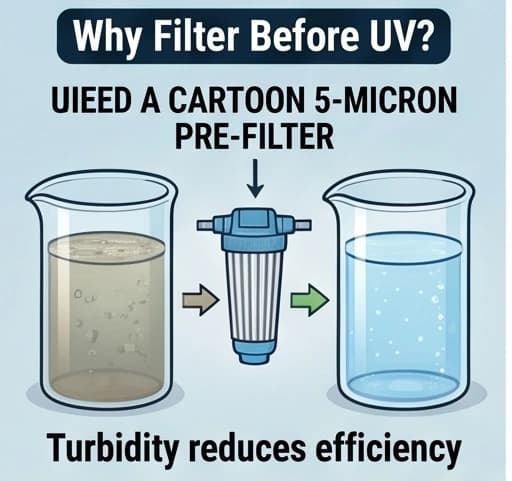
The practical recommendation: always install a 5-micron sediment pre-filter before any UV system, regardless of water source. For borewell water, add an iron removal filter if your water has visible orange/brown colour or iron content above 0.3 mg/L. This restores UVT to a range where the UV system operates at its rated capacity — simplifying the answer to what size UV system do I need for my house to a straightforward flow rate calculation.
5 Common UV System Sizing Mistakes in Indian Homes
Sizing for average demand, not peak demand: The most frequent error. An average family uses perhaps 300–500 LPH across the day, but peak simultaneous demand at 7 a.m. can be 2,000–3,000 LPH. A UV system sized for average demand fails during every morning rush. Understanding what size UV system do I need for my house means always thinking about peak, not average.
Ignoring the borewell pump flow rate: Installing a 1,000 LPH UV system on a 1 HP borewell pump (which delivers up to 2,500 LPH) means the UV system is overloaded every time the pump runs at speed. The water entering the overhead tank is not fully treated.
Forgetting UVT adjustment for borewell water: A UV system rated at 3,000 LPH in clean municipal water may only effectively treat 1,500 LPH in iron-rich borewell water. Not accounting for UVT is the hidden sizing error in North India borewell homes.
Installing under-sink when whole-flat protection is needed: An under-sink UV system protects one tap. Water from the overhead tank entering bathrooms, the washing machine, and the kitchen for vessel washing is not treated. In areas with tank contamination risk — virtually all Delhi NCR apartments, Mumbai housing societies, and Bangalore housing societies — whole-flat or building-level protection is the correct choice.
Not adding a safety margin: Buying exactly the rated flow rate without any margin means the system is already at its limit. Municipal pressure fluctuations, lamp ageing, and UVT variation can all push the system over the design boundary. A 20–25% margin is not optional — it is the correct engineering approach to UV system capacity for home sizing.
Running Cost by UV System Size
UV system electricity cost is low compared to alternatives. The Philips TUV lamp inside each unit consumes power in proportion to system size:
- 500 LPH residential: 11W Philips TUV lamp → approximately ₹40–55 per month at ₹8/kWh running 16 hours/day
- 1,000–2,000 LPH residential: 16–25W → ₹60–100 per month running 16 hours/day
- 3,000–5,000 LPH light commercial: 30–55W → ₹115–220 per month running 20 hours/day
- 10,000 LPH commercial: 75–150W → ₹360–720 per month running 24 hours/day
- Multi-lamp 30,000+ LPH: Multiple lamps in parallel; cost scales linearly with lamp count
Annual lamp replacement (every 9,000–12,000 operating hours, or approximately once per year for continuous-use systems) is the main maintenance cost. Philips TUV replacement lamps for residential systems cost ₹800–2,500 per lamp depending on wattage. The combination of low electricity cost and once-yearly lamp replacement makes UV systems among the most cost-effective water disinfection technologies available — the sizing decision has far greater impact on safety than on running cost.
Frequently Asked Questions
Is a higher LPH UV system always better?
Not necessarily, and this is an important nuance in answering what size UV system do I need for my house. An oversized UV system costs more upfront, uses a larger and slightly more power-hungry Philips TUV lamp, and in some configurations has a minimum flow requirement — if water flows too slowly through a large chamber designed for high flow, turbulence patterns change and the UV intensity sensor may not read the chamber accurately. The correct approach is to choose a system sized to your actual peak demand plus a 20–25% safety margin, then stop. Going significantly above that margin wastes money without improving safety.
What if my water pressure is very low?
Low water pressure is actually beneficial for UV dose delivery because it reduces flow rate, increasing the time water spends in the UV chamber. If your tap fills a 10-litre bucket in 90 seconds instead of 40 seconds, your actual peak flow rate is only about 400 LPH — meaning a smaller UV system is sufficient and every litre receives more than the minimum required UV dose. However, very low pressure can also indicate a problem with the supply that causes intermittent or no flow, which creates biofilm growth opportunities in the UV chamber during stagnation periods. Install a flow switch that turns off the UV lamp when water is not flowing if your supply is highly intermittent. Always measure actual tap flow rate with the bucket test rather than estimating from standard figures, especially in high-rise buildings in Mumbai or older Delhi neighbourhoods where top-floor pressure is notoriously low.
Can one UV system serve the whole apartment building?
Yes — centralised UV systems installed at the common overhead tank outlet are the most cost-effective and comprehensive solution for apartment buildings. A single high-capacity UV system at the tank outlet treats all water before it enters the building's distribution plumbing, protecting all flats simultaneously. This is particularly important for Mumbai flats and Bangalore housing societies where overhead tanks are shared and tank contamination — from algae growth, bird droppings, or biofilm on tank walls — is a well-documented source of building-wide waterborne illness. The central UV system is sized using the coincident demand calculation described above. Alpha UV System offers engineering sizing services for apartment complex installations; response within 24–48 hours.
How do I know if my existing UV system is undersized?
Several signs indicate a UV system is undersized for actual demand. First, the UV intensity monitor alarm triggers during peak usage — morning showers and kitchen activity — but clears when demand drops. Second, water flow noticeably slows through the UV unit, suggesting it is acting as a flow restriction (undersized UV chambers can create back-pressure). Third, and most concerning: a bacteriological water quality test (total coliform or E. coli) taken during peak usage shows contamination even though the UV lamp is running. If you suspect your existing UV system is undersized, measure actual flow through the system using the bucket test at peak time and compare the result to the rated LPH on the system nameplate. If your measured flow exceeds the nameplate rating, your water is receiving insufficient UV dose during that period. Upgrading to the correctly sized UV system resolves the problem immediately.
What size UV system for a 4-person family in Delhi?
For a typical 4-person family in a Delhi NCR apartment — 2 BHK or 3 BHK flat, overhead tank supplied by municipal water — the UV water system size calculator India approach gives the following answer. Morning peak simultaneous demand: kitchen tap (800 LPH) + one shower (700 LPH) + one wash basin (400 LPH) = 1,900 LPH. Add 25% safety margin: 1,900 × 1.25 = 2,375 LPH. The correct answer is a 2,500 LPH UV system installed at the overhead tank outlet. If the flat uses borewell water (common in older South Delhi colonies and Noida sectors), check the borewell pump HP and size to match — typically a 2,500–3,000 LPH UV system for a 1–1.5 HP pump. This is the UV system flow rate home India sizing for Delhi's most common residential configuration.
How does borewell pump HP relate to UV system size needed?
The borewell pump HP rating gives you a rough estimate of the pump's maximum discharge flow, which is the minimum UV system size required at the pump outlet. As a general rule in Indian submersible pump specifications: a 1 HP pump delivers approximately 1,500–2,500 LPH; a 1.5 HP pump delivers approximately 2,500–4,000 LPH; a 2 HP pump delivers approximately 4,000–6,000 LPH. These ranges are wide because discharge also depends on borewell depth (head) and pump efficiency. Always verify against the pump nameplate or manual rather than relying solely on the HP rule of thumb. When in doubt, upsize the UV system to the next standard capacity — a 3,000 LPH UV system on a pump that occasionally delivers 2,800 LPH is safe; the reverse is not. The Borewell Pump vs UV System Sizing table earlier in this guide provides specific recommendations for common Indian pump HP ratings.
Get a Sizing Recommendation for Your Home
If you have measured your peak flow rate, identified your installation point, and applied the safety margin but still want a second opinion — or if your installation is non-standard (multiple boreholes, high-rise building, institutional use) — our team provides UV system sizing guidance within 24–48 hours.
WhatsApp us with your household size, water source (municipal or borewell), installation point, and any water quality concerns: WhatsApp Alpha UV System for sizing help. We will specify the correct model, explain the calculation, and confirm the Philips TUV lamp specification for your application.
Standards, authorities & further reading
External references used to inform this guide. Regulations evolve — check the latest revision on each authority's site before compliance decisions.
Recommended UV Systems
Alpha UV System products for this application — powered by genuine Philips UV-C lamps.
Commercial UV Water Purification System
500 – 5,000 LPH
HACCP-compliant UV water purification for hotels, restaurants, and offices
Industrial UV Water Treatment System
5,000 – 50,000 LPH
Schedule M 2025 and HACCP compliant UV for pharma, food & beverage, and process water
Not sure which system suits your application? WhatsApp our engineers for a free recommendation →
Need a UV system?
Talk to our UV engineers — WhatsApp for a quote in 2 hours, or browse the full catalog on IndiaMART.