Quick Answer
UV disinfection for STP and ETP plants inactivates fecal coliforms, E. coli, Salmonella, and enteric viruses in secondary treated effluent at 40–80 mJ/cm² — meeting CPCB General Discharge Standards (fecal coliform ≤ 1,000 MPN/100 ml for surface water discharge; zero for irrigation reuse) without producing trihalomethanes (THMs), haloacetic acids (HAAs), or residual chlorine that causes aquatic toxicity in receiving water bodies. UV disinfection for STP ETP plants is increasingly mandated by State Pollution Control Boards (SPCBs) in their environmental clearance conditions for housing complexes, industrial townships, and STPs discharging into rivers designated as Ecological Sensitive Zones (ESZ). Systems range from 10,000 LPH for housing society STPs to 5,00,000 LPH for municipal STPs and large CETP (Common Effluent Treatment Plants), with SCADA-ready monitoring and continuous CPCB compliance documentation built into every installation.
Why UV Disinfection Is the Right Technology for STP and ETP Tertiary Treatment
UV disinfection for STP ETP plants has become the technology of choice for tertiary disinfection in India because it solves the three specific problems that have made chlorination of treated sewage increasingly problematic under CPCB and SPCB regulations:
Problem 1: Trihalomethane (THM) formation. When chlorine reacts with natural organic matter (NOM) — the dissolved organic carbon in secondary treated sewage effluent — it forms trihalomethanes (chloroform, bromodichloromethane, dibromochloromethane) and haloacetic acids. These are regulated carcinogens. When STP effluent chlorinated to meet fecal coliform limits is discharged into a river used downstream for irrigation or drinking water abstraction, the THMs travel with the discharge. NGT (National Green Tribunal) orders have cited chlorinated STP discharge as a contributor to THM contamination in river water bodies used for drinking water abstraction — creating compliance and liability risk for STP operators.
Problem 2: Residual chlorine aquatic toxicity. CPCB General Discharge Standards set a residual chlorine limit of 1.0 mg/L in STP effluent discharged to surface water bodies. Achieving adequate fecal coliform kill (4-log reduction to ≤1,000 MPN/100 ml) typically requires a chlorine dose of 5–15 mg/L with a contact time of 15–30 minutes. The residual after disinfection is typically 2–5 mg/L — above the CPCB limit, requiring dechlorination (sodium bisulphite or sulphur dioxide addition) as an additional treatment step. Dechlorination adds capital cost (additional tank and dosing system), operating cost (chemical), and an additional compliance point. UV disinfection for STP ETP plants produces zero residual — no dechlorination step is needed.
Problem 3: Chemical storage and handling on residential/mixed-use sites. Housing society STPs, commercial complex ETPs, and institutional STPs are operated by facilities management teams or contracted operators who are not equipped for hazardous chemical handling. Sodium hypochlorite (the chlorine source for STP chlorination) is a Class 5.1 oxidising agent that requires dedicated storage, MSDS protocols, spill containment, and restricted access. UV disinfection for STP ETP plants uses no chemicals — the only consumable is the UV lamp (replaced annually) — making it appropriate for operation by non-specialist facilities staff. For a detailed comparison of the two approaches, see our dedicated post on UV vs chlorine for sewage treatment in India.
CPCB Discharge Standards for STP and ETP Effluent
UV disinfection for STP ETP plants must meet specific CPCB General Discharge Standards. The relevant microbiological parameters depend on the discharge destination:
| Discharge Destination | CPCB Fecal Coliform Limit | Required UV Dose | Notes |
|---|---|---|---|
| Surface water (rivers, lakes) | ≤ 1,000 MPN/100 ml | 40 mJ/cm² | General Standards — Schedule VI, Environment Protection Act |
| Land/irrigation (non-food crops) | ≤ 100 MPN/100 ml | 60 mJ/cm² | CPCB Reuse Guidelines; WHO irrigation water quality standards |
| Irrigation (food crops, raw vegetables) | ≤ 10 MPN/100 ml | 80 mJ/cm² | WHO Class A guidelines; CGWB groundwater protection requirement |
| Groundwater recharge (injection wells) | Zero (not detectable) | 100+ mJ/cm² | CGWB Artificial Recharge Guidelines; requires UV + filtration |
| Municipal sewer (pre-treatment) | No CPCB limit for pre-treatment discharge | UV typically not required | UV may be required by municipality or STP operator |
These limits apply to the final effluent leaving the STP or ETP boundary. UV disinfection for STP ETP plants must deliver the required dose at the maximum design flow rate — including peak flows during monsoon infiltration events, which can be 2–3× the dry-weather design flow for combined sewer systems. Alpha UV System sizes all STP/ETP UV systems for the peak design flow rate with a minimum 20% hydraulic safety factor, not for average daily flow.
STP vs ETP: How UV Disinfection Requirements Differ
UV disinfection for STP ETP plants applies to two fundamentally different types of treated effluent, and the differences affect UV system design:
Sewage Treatment Plant (STP) Effluent Characteristics
STP secondary treated effluent (after biological treatment — activated sludge or SBR) typically has: BOD ≤ 10 mg/L, TSS ≤ 10 mg/L, UV transmittance (UVT) 55–75%, fecal coliform 10⁵–10⁷ MPN/100 ml (inlet to UV), turbidity 2–8 NTU. The relatively high microbial load and moderate UVT of STP secondary effluent require UV systems sized for a 3–4 log fecal coliform reduction at 55–65% UVT — which demands higher UV lamp intensity or longer contact time than equivalent-flow drinking water UV systems. Multi-lamp channel reactors or multi-lamp annular reactors are common for STP applications at flows above 500 m³/hour. For background on the STP treatment process and where UV fits in, see our guide on ETP vs STP: differences explained.
Effluent Treatment Plant (ETP) Effluent Characteristics
ETP secondary treated effluent characteristics vary significantly by industry type. Pharmaceutical ETP effluent may have very low microbial load (high antibiotic concentration in raw effluent kills most organisms during treatment) but very low UVT (30–50%) due to coloured compounds. Textile ETP effluent has low UVT (20–40%) due to dyestuff residuals — requiring pre-treatment (colour removal by coagulation or advanced oxidation) before UV is feasible. Food processing ETP effluent is typically the most amenable to UV disinfection: UVT 60–80%, moderate microbial load, relatively clean after biological treatment. UV disinfection for STP ETP plants in industrial contexts requires industry-specific UVT measurement to correctly size the UV reactor. For the specific case of UV in textile ETP, our textile ETP UV guide covers pre-treatment requirements in detail.
Secondary Treatment Quality Required Before UV
UV disinfection for STP ETP plants performs optimally when secondary treatment is functioning correctly. The following secondary effluent quality parameters determine UV system sizing and effectiveness:
| Parameter | Optimal for UV | Marginal for UV | Pre-treatment Required |
|---|---|---|---|
| UV Transmittance (UVT at 254 nm) | > 65% | 50–65% | < 50% — tertiary filtration (sand/disc) required |
| Turbidity (NTU) | < 5 NTU | 5–10 NTU | > 10 NTU — tertiary filtration required |
| Total Suspended Solids | < 10 mg/L | 10–20 mg/L | > 20 mg/L — polishing filter required |
| BOD | < 10 mg/L | 10–20 mg/L | > 20 mg/L — biological treatment inadequate |
| Fecal coliform (pre-UV) | 10⁴–10⁶ MPN/100 ml | 10⁶–10⁷ MPN/100 ml | > 10⁷ — biological treatment inadequate |
UV disinfection for STP ETP plants does not correct for poor secondary treatment — it disinfects adequately treated effluent. STPs with BOD exceedance or high TSS require biological system remediation before UV can achieve CPCB discharge limits reliably. The most common cause of UV system underperformance in housing society STPs is not UV system failure but secondary treatment failure (sludge bulking, organic overload) that increases turbidity and fecal coliform load above UV system design parameters.
Open Channel vs Pressure Vessel UV for STP/ETP
UV disinfection for STP ETP plants can be delivered by two distinct reactor configurations, each suited to different flow scales:
Open Channel UV (Low-Pressure Medium-Pressure Lamp Arrays)
Open channel UV systems suspend lamp-sleeve assemblies vertically in an open concrete or stainless steel channel. Water flows horizontally past the lamps. This configuration is standard for large municipal STP applications (above 5,000 m³/day) because it handles the large hydraulic variations typical of municipal flows without pressurisation, is maintainable by lane isolation (one lamp bank taken offline for maintenance while others continue), and integrates naturally with existing gravity-flow STP effluent channels. Open channel UV for STP systems uses banks of low-pressure high-output (LPHO) lamps or medium-pressure polychromatic lamps depending on required dose and footprint constraints.
Pressure Vessel UV (Closed Reactor Systems)
Pressure vessel UV reactors — the standard Alpha UV System design for STP applications — enclose the lamp-sleeve assembly in a sealed SS316L chamber through which treated effluent flows under pressure. This configuration is appropriate for smaller STP and ETP applications (10,000 LPH to 2,00,000 LPH), for retrofitting into existing pressurised pipework systems, and for applications where open channel installation is not feasible due to space constraints (basement STPs in residential towers, underground ETPs in industrial parks). Pressure vessel UV disinfection for STP ETP plants is more compact than open channel systems and integrates easily with existing STP pipework at the tertiary treatment stage. Our guide on UV disinfection for STP plants in India 2026 covers both system types in detail.
Typical STP UV Installation Sequence
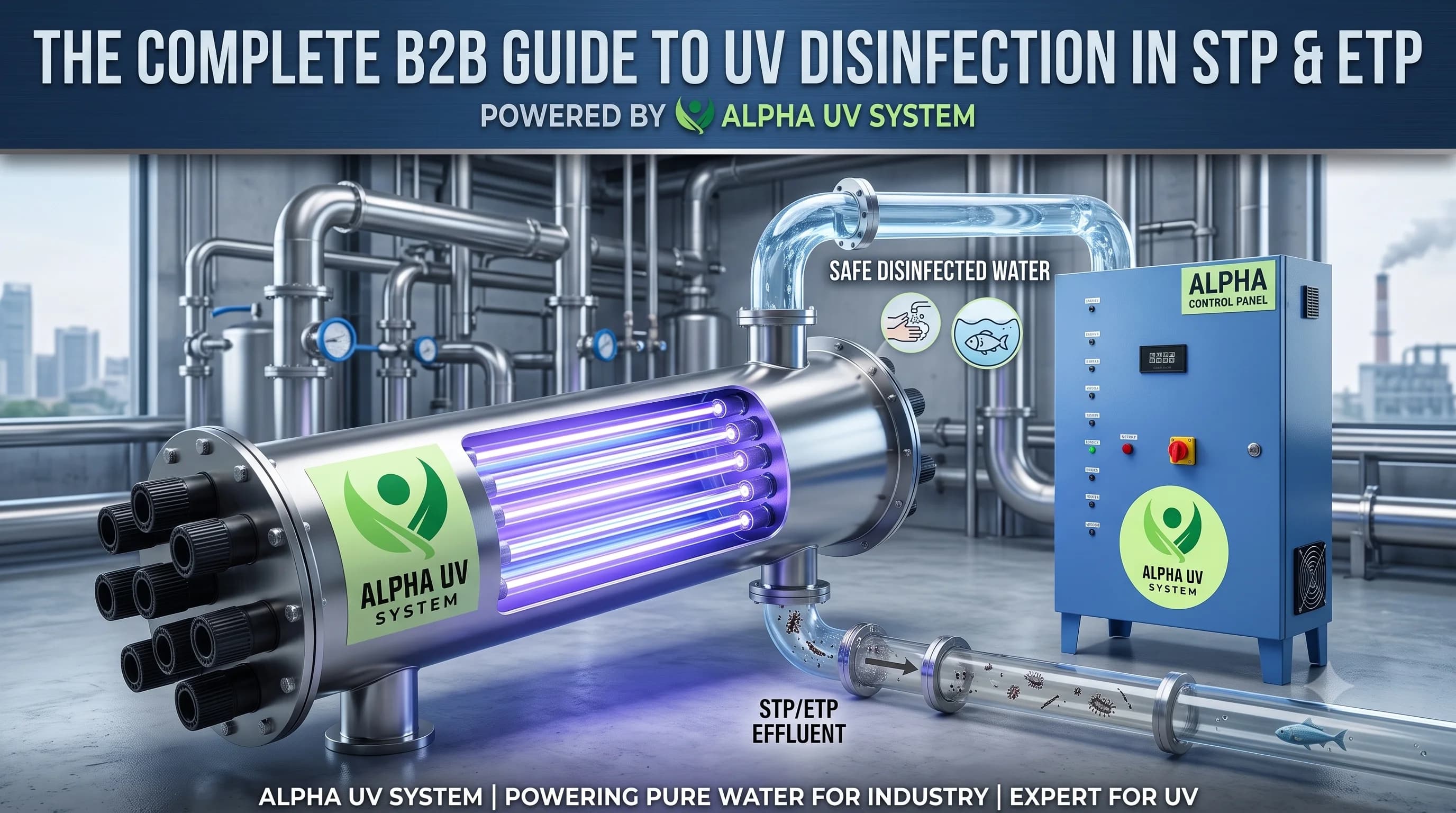
UV disinfection for STP ETP plants is installed at the tertiary treatment stage — after secondary biological treatment and before the final effluent discharge point:
- Secondary clarifier effluent → Tertiary filter (optional): If secondary effluent TSS exceeds 10 mg/L or UVT is below 60%, a tertiary sand filter or disc filter removes residual suspended solids before UV. This pre-treatment is required for UV system performance, not a standalone treatment step.
- Filtered effluent → UV reactor: Treated effluent passes through the UV reactor at the design flow rate. Minimum UV dose delivered: 40–100 mJ/cm² depending on discharge standard.
- UV-treated effluent → Outlet sump / discharge: UV-treated effluent is collected in the outlet sump and discharged to the receiving water body, irrigation field, or reuse system. No dechlorination required — UV leaves no chemical residual.
- UV intensity monitoring → Control panel → SCADA: The UV intensity sensor output is monitored by the control panel, which can integrate with the STP's SCADA/BMS system for remote monitoring and alarm management. CPCB Online Continuous Effluent Monitoring (OCEM) stations deployed at STP outlets increasingly include UV intensity as a tertiary treatment performance parameter alongside BOD, TSS, and pH.
UV System Sizing for STP and ETP Applications
| STP/ETP Scale | Daily Flow | Peak Hourly Flow | UV System Capacity | UV Dose |
|---|---|---|---|---|
| Housing society / small commercial | 50–500 KLD | 10,000–1,00,000 LPH | 10,000–1,00,000 LPH | 40 mJ/cm² |
| Large housing complex / township | 500–5,000 KLD | 1,00,000–10,00,000 LPH | 1,00,000–10,00,000 LPH | 40–60 mJ/cm² |
| Municipal STP (small town) | 5–50 MLD | 10,00,000–50,00,000 LPH | Multi-lamp open channel or multi-reactor bank | 40 mJ/cm² |
| Industrial ETP / CETP | Site-specific | Site-specific | Sized after effluent UVT testing | 40–100 mJ/cm² |
KLD = Kilolitres per Day; MLD = Million Litres per Day. Peak hourly flow for combined sewer systems serving areas with significant stormwater infiltration can be 2–3× the average daily flow ÷ 24 hours — this peak flow must be the basis for UV system sizing to ensure CPCB compliance even during monsoon peak events.
SCADA Integration and CPCB Online Monitoring
UV disinfection for STP ETP plants increasingly requires integration with CPCB Online Continuous Effluent Monitoring Systems (OCEMS). CPCB's mandate for online monitoring at STPs above 10 MLD includes UV intensity as a tertiary treatment verification parameter. Alpha UV System UV controllers provide 4–20 mA analogue outputs for UV intensity and flow rate that connect directly to OCEMS data logger systems. This integration:
- Provides real-time UV dose calculation (intensity × contact time) transmitted to the CPCB OCEMS server
- Generates automated CPCB non-compliance alerts when UV intensity drops below the minimum setpoint
- Creates an auditable electronic log of UV system performance that satisfies CPCB inspection requirements without manual log sheets
- Enables remote monitoring by STP operator, facilities manager, and SPCB simultaneously
For large municipal UV disinfection for STP ETP plants, Alpha UV System provides full SCADA-compatible controller configurations with Modbus RTU/TCP communication, enabling integration with the STP's existing PLC/SCADA system from Siemens, ABB, or Rockwell Automation.
Frequently Asked Questions
Is UV disinfection mandated by NGT for STP effluent?
The NGT has issued multiple orders requiring STPs in catchments affecting specified river stretches (including the Yamuna, Ganga, and Godavari catchments) to achieve fecal coliform limits of ≤ 1,000 MPN/100 ml or better. While NGT orders do not specify UV by name (they specify the outcome standard, not the technology), chlorination to this standard requires dechlorination to avoid aquatic toxicity exceedance — adding cost and a second chemical treatment step. UV disinfection for STP ETP plants achieves the NGT fecal coliform standard without chlorination or dechlorination, making it the preferred technology for STPs under NGT compliance pressure. SPCB consent conditions in Uttar Pradesh, Maharashtra, and Tamil Nadu increasingly specify "chemical-free tertiary disinfection" in environmental clearances for new housing complex STPs — effectively mandating UV over chlorination.
Can UV-treated STP effluent be reused for flushing or irrigation?
Yes — UV disinfection for STP ETP plants is the enabling technology for treated water reuse in residential and commercial complexes. CPCB Guidelines for Treated Sewage Reuse permit UV-treated secondary effluent for: toilet flushing (fecal coliform ≤ 100 MPN/100 ml, BOD ≤ 10 mg/L), irrigation of non-food crops (fecal coliform ≤ 100 MPN/100 ml), and landscape irrigation (fecal coliform ≤ 1,000 MPN/100 ml). RERA (Real Estate Regulation and Development Act) provisions require builders in several states to demonstrate treated water reuse capacity in new residential projects — UV-treated STP effluent for toilet flushing is the most common compliance approach. For the full reuse standard requirements, see our comprehensive guide on UV-powered sustainable wastewater treatment.
Our STP secondary effluent has high turbidity. Can UV still work?
UV disinfection for STP ETP plants at effluent UVT below 50% requires pre-treatment to restore UVT before the UV reactor. The most cost-effective pre-treatment for housing society STPs is a tertiary disc filter (Amiad or equivalent) that removes residual TSS at 50–100 μm cut-off. This typically raises UVT from 45–55% to 65–75%, within the range where standard UV systems achieve the required fecal coliform reduction. If turbidity is high because of biological treatment failure (activated sludge washout, SBR malfunction), the primary fix is biological system remediation — UV cannot compensate for a failing secondary treatment stage. Alpha UV System can measure your effluent UVT on-site as part of the system assessment visit, at no charge for projects above 50 KLD daily flow.
What maintenance does a STP UV system require?
UV disinfection for STP ETP plants requires more frequent sleeve cleaning than drinking water UV applications because STP effluent contains higher concentrations of minerals, biofilm-forming bacteria, and colloidal organic matter that deposit on quartz sleeves. Recommended maintenance for STP UV systems: weekly automatic or manual sleeve wipe (automated wiper mechanisms are standard on larger STP UV systems), monthly sleeve cleaning with 2% citric acid solution, and annual Philips UV-C lamp replacement. NABL-calibrated UV intensity sensor recalibration annually. Total maintenance time for a housing society STP UV system (10,000–1,00,000 LPH): approximately 1–2 hours per month for sleeve cleaning plus 2 hours per year for annual lamp replacement.
What happens to CPCB compliance if the UV system loses power?
UV disinfection for STP ETP plants stops when power is lost — UV lamps are not effective without electrical supply. For STPs under CPCB online monitoring, a UV intensity drop to zero during a power outage is logged as a monitoring gap. To manage this risk: (1) connect the UV system to the STP's UPS or generator supply, which is standard practice for compliant STP operations; and (2) configure the STP outlet valve to close during UV power failure (divert-on-failure), preventing non-compliant effluent from discharging. The UV intensity alarm output connects to the STP control panel to trigger the outlet valve closure. Generator backup for UV systems adds minimal cost because UV system power consumption is small (1–10 kW for most housing society STPs) relative to total STP power demand.
We are currently chlorinating. Can we switch to UV?
Yes — UV disinfection for STP ETP plants can replace existing chlorination systems directly. The UV reactor is installed in the effluent line at the same point as the existing chlorine contact tank or downstream of it. If the existing chlorine contact tank is being decommissioned, its volume can often be converted to an equalization buffer ahead of the UV reactor. The chlorine dosing system, chemical storage, and dechlorination system are all decommissioned. Operating cost typically decreases — UV operating cost is ₹0.5–2.0 per 1,000 litres (lamps + power), compared to chlorination + dechlorination at ₹3–8 per 1,000 litres. Contact Alpha UV System for a retrofit assessment — we will review your existing STP layout and design the UV system integration.
Related Resources
- STP/ETP UV Disinfection System — application overview and inquiry
- UV Disinfection System for STP Plants in India 2026 — detailed STP system guide
- ETP vs STP: Differences Explained — complete treatment process comparison
- UV vs Chlorine for Sewage Treatment in India 2026 — full comparison for STP operators
- UV-Powered Sustainable Wastewater Treatment — reuse applications and CPCB standards
- UV vs Chlorine — complete technical comparison
- Certifications — ISO 9001:2015, CE, CPCB OCEMS documentation support
Recommended UV Systems
Alpha UV System products for this application — powered by genuine Philips UV-C lamps.
Commercial UV Water Purification System
500 – 5,000 LPH
HACCP-compliant UV water purification for hotels, restaurants, and offices
Industrial UV Water Treatment System
5,000 – 50,000 LPH
Schedule M 2025 and HACCP compliant UV for pharma, food & beverage, and process water
Not sure which system suits your application? WhatsApp our engineers for a free recommendation →
Related solutions
See how Alpha UV System applies this to your industry or city.
Need a UV system?
Talk to our UV engineers — WhatsApp for a quote in 2 hours, or browse the full catalog on IndiaMART.