UV water system vs boiling water: both achieve 4-log pathogen kill in clear water. UV is 5–15× more energy efficient per litre, works instantaneously (no waiting or cooling time), preserves taste and minerals, and eliminates re-contamination risk during storage. Boiling remains the right choice when there is no electricity, at high altitude (>2,000m) for extended boiling, or as emergency backup during UV system maintenance.
Both Work — The Pathogen Kill Comparison First
Any UV water system vs boiling water comparison must start with the most important question: does each method actually make water safe? The honest answer is that both do, when used correctly in clear water.
Boiling has been the gold-standard household water treatment method for centuries. Maintaining water at 70°C for just 30 seconds inactivates all common waterborne pathogens — bacteria, viruses, and protozoa — including the chlorine-resistant Cryptosporidium and Giardia. At 100°C (sea-level boiling point), the process takes under one minute. The heat directly denatures pathogen proteins and destroys cell membranes, leaving no viable organisms in the water.
A UV water system achieves equivalent results through a completely different mechanism. At a UV-C dose of 40 mJ/cm² — the standard rated dose for residential and commercial UV water systems — the UV-C light penetrates pathogen cells and scrambles their DNA, preventing reproduction. This UV water system vs boiling water comparison on pathogen kill is effectively a tie in clear water: 4-log (99.99%) kill for bacteria, 3–4 log for most viruses, and 3-plus log for Cryptosporidium and Giardia.
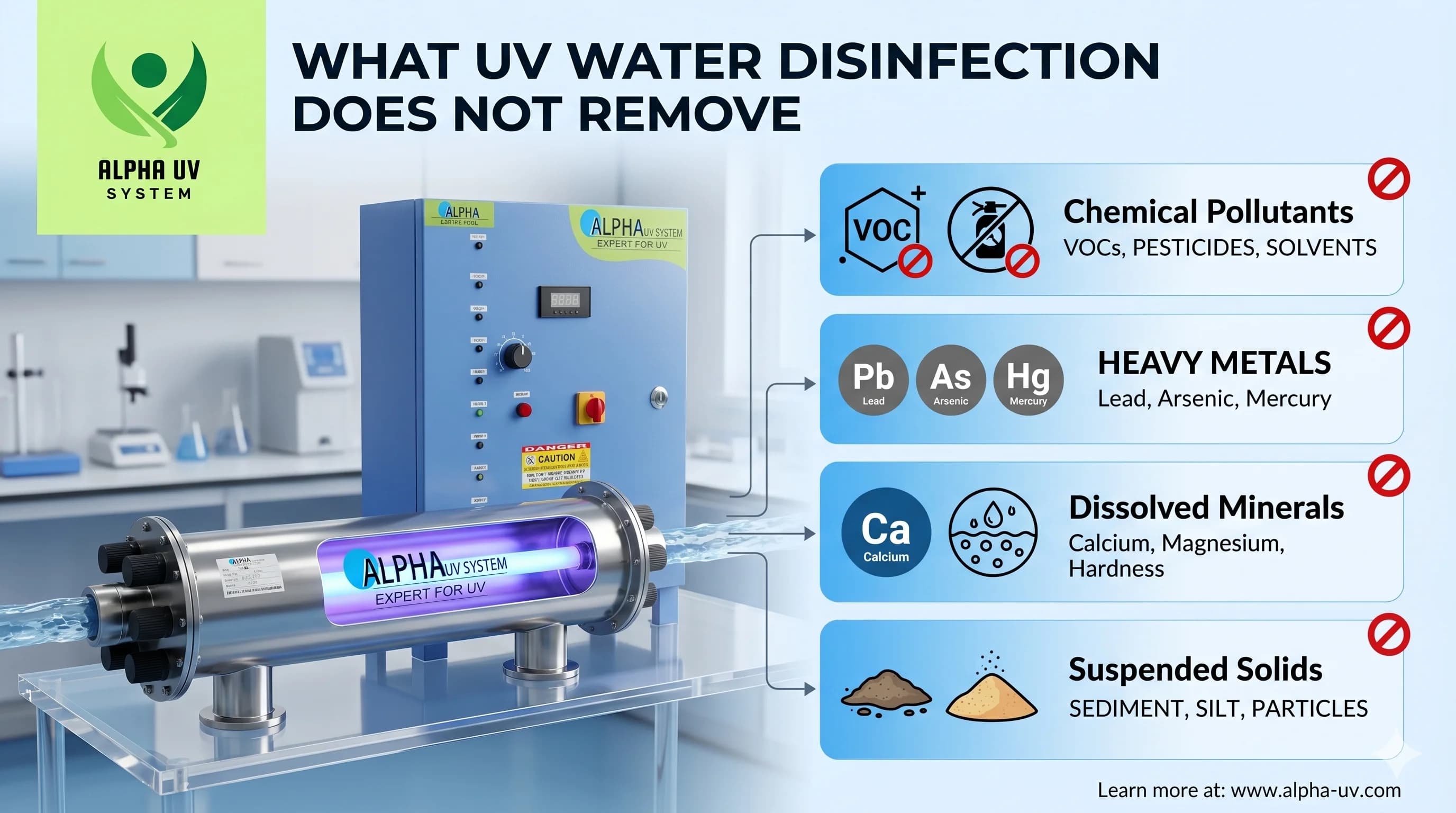
Neither method removes chemical contaminants, heavy metals, or total dissolved solids. Both require clear (low-turbidity) water to work at rated efficiency — turbidity above 1 NTU can shield pathogens from UV light, and heavily turbid water in a kettle may protect pathogens from heat at the surface.
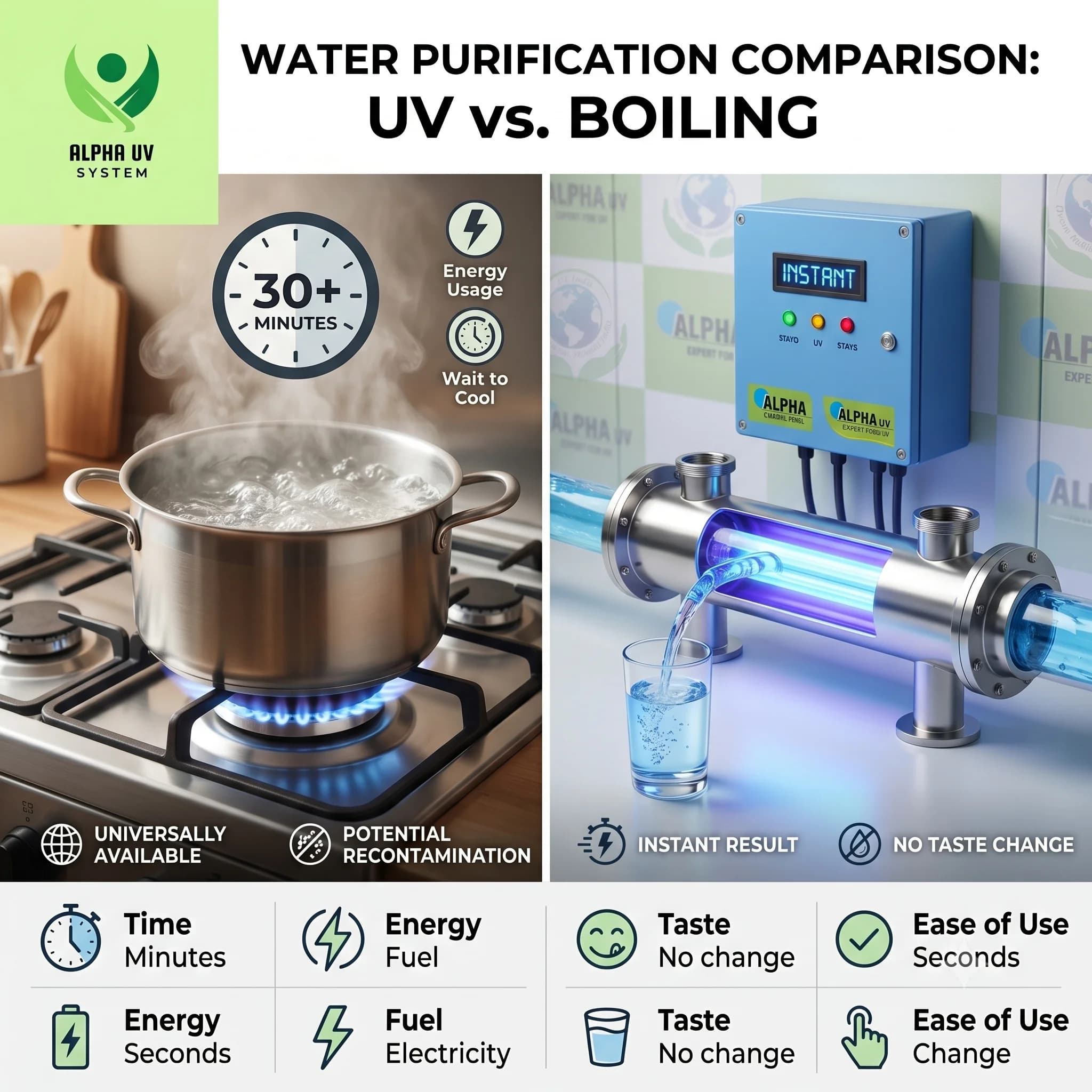
| Factor | UV Water System | Boiling Water | Winner |
|---|---|---|---|
| Pathogen kill (4-log) | Yes — at 40 mJ/cm² in clear water | Yes — at 100°C for 1 minute | Tie |
| Energy cost per year | ₹77–381/year | ₹584–1,168/year | UV System |
| Time to safe drinking water | Instantaneous at tap | 40–60 minutes (heat + cool) | UV System |
| Taste and mineral preservation | No change to taste, pH, or minerals | Flat taste; minerals concentrated | UV System |
| Re-contamination risk in storage | Drink directly from tap — no storage needed | High in open containers at 30°C+ | UV System |
| Works at high altitude (>2,000m) | Yes — unaffected by altitude | Extended boiling required (3 minutes) | UV System |
| Works without electricity | No | Yes (gas, wood, induction) | Boiling |
| Multi-tap whole-home coverage | Yes | No | UV System |
| Removes chemicals / heavy metals | No | No | Tie |
| 5-year total cost | ₹16,000–23,000 (system + running costs) | ₹29,200+ (energy only) | UV System |
Pathogen Kill Effectiveness: The Detailed Science
In this UV water system vs boiling water comparison on pathogen kill, the data shows near-identical effectiveness in ideal conditions. The differences emerge in edge cases — primarily turbidity and altitude — where one method has a practical advantage over the other.
UV-C light at 254nm is absorbed by nucleic acids in pathogen DNA and RNA. At 40 mJ/cm², virtually all pathogens present in municipal or borewell supply water are rendered unable to replicate. This is the rated operating dose for a properly maintained UV water system with a Philips UV-C lamp at rated flow and water turbidity below 1 NTU.
| Pathogen | UV System at 40 mJ/cm² | Boiling at 100°C for 1 min | Notes |
|---|---|---|---|
| E. coli (bacteria) | 4+ log kill | 4+ log kill | Both fully effective |
| Salmonella typhi (typhoid) | 4+ log kill | 4+ log kill | Both fully effective |
| Vibrio cholerae (cholera) | 4+ log kill | 4+ log kill | Both fully effective |
| Rotavirus | 3–4 log kill | 4+ log kill | Boiling marginally higher kill rate |
| Hepatitis A virus | 3 log kill | 4+ log kill | Boiling marginally higher at 1-min |
| Cryptosporidium oocysts | 3+ log kill | 4+ log kill (extended time at altitude) | UV highly effective; boiling needs 3 min above 2,000m |
| Giardia cysts | 3+ log kill | 4+ log kill | Both effective; UV unaffected by altitude |
| Legionella | 4+ log kill | 4+ log kill | Both fully effective |
The key takeaway: the UV water system vs boiling water comparison on pathogen kill shows that both are medically adequate for household drinking water safety in clear water at sea level. UV has a slight practical edge at high altitude (see the altitude section below), while boiling at 100°C achieves marginally higher log reduction for some enteric viruses at 1-minute contact time.
Energy Efficiency: UV vs Boiling for Indian Families
This is where the UV water system vs boiling water comparison produces the sharpest difference. Boiling is fundamentally energy-intensive: you must raise the entire water volume from ambient temperature to 100°C, then maintain it there. India's average domestic electricity tariff of ₹8/kWh makes this cost visible and significant over a year.
A UV water system operates on an entirely different energy model. An 11-watt UV lamp disinfects water continuously at rated flow. Running 24 hours a day, it consumes 0.26 kWh per day — less energy than a single cup of electric kettle use — while treating every litre of water entering your home.
| Method | Energy Used per 5L | Units/Day (at 5L/day drinking water) | Annual Electricity Cost at ₹8/kWh |
|---|---|---|---|
| Electric kettle boiling | 0.2–0.4 kWh | 0.2–0.4 units | ₹584–1,168/year |
| Gas stove boiling (₹950/cylinder, 10–12L per fill) | ~0.15–0.25 gas units | Variable | ₹800–1,400/year (LPG cost) |
| UV system (11W, 12 hr/day — point-of-use) | 0.0022 kWh per litre | 0.13 units/day | ₹381/year |
| UV system (11W, 24 hr/day — whole-home) | 0.0011 kWh per litre at 250 LPH flow | 0.26 units/day | ₹77/year (treats all home water, not just 5L) |
The UV water system vs boiling water comparison on energy is unambiguous: UV is 5–15 times more energy efficient per litre of safe water produced. The reason is thermodynamic: boiling forces water through a phase-change-adjacent process that wastes large amounts of energy on heating the vessel, heating the air above the water, and evaporating water. A UV water system skips all of this and delivers only the photons that directly affect pathogens.
For a family of four drinking 15 litres of water per day and boiling twice daily, the annual energy cost of boiling in 2026 runs between ₹1,168 and ₹2,800 depending on fuel type. The same family's UV water system costs ₹77–381 per year in electricity — while also covering all household water use, not just drinking water.
Speed and Convenience: UV Is Instantaneous
The UV water system vs boiling water comparison on time and convenience is the most practical dimension for busy Indian households. Boiling requires active presence, waiting, and planning ahead. A UV water system produces safe water the moment you open a tap.
| Step | UV Water System | Boiling Water | Time Saving with UV |
|---|---|---|---|
| Fill vessel / turn on tap | Open tap — water is immediately safe | Fill kettle or pot: 1–2 minutes | 1–2 minutes |
| Heat water | Not required | 10–15 minutes to reach boiling | 10–15 minutes |
| Maintain boil | Not required | 1 minute at sea level; 3 minutes at altitude | 1–3 minutes |
| Cool to safe drinking temperature | Not required — tap water is at ambient temp | 25–40 minutes at room temperature | 25–40 minutes |
| Transfer to storage container | Not required — drink directly from tap | Pour into clean container: 2–3 minutes | 2–3 minutes |
| Total time per 2L batch | 0 minutes (continuous) | 40–60 minutes | 40–60 minutes saved |
| Daily time for family of 4 (15L/day) | 0 minutes | 60–120 minutes across multiple batches | 1–2 hours/day |
For a family consuming 15 litres of drinking water per day through multiple boiling cycles, the time cost of boiling is 60–120 minutes of active kitchen involvement every single day. A UV water system eliminates this entirely. Over a year, this represents 365–730 hours of recovered time — a meaningful practical advantage in the UV water system vs boiling water comparison for working families.
Taste, pH, and Mineral Profile: What Each Method Does to Water
One of the least-discussed dimensions in a UV water system vs boiling water comparison is what each method does to water chemistry. The differences matter both for taste and for households tracking mineral intake.
Boiling drives off dissolved carbon dioxide (CO₂) from water. CO₂ in water forms carbonic acid, giving water its slight freshness and crispness. Removing it raises the pH slightly and produces the characteristic "flat" or "stale" taste most people associate with stored boiled water. Additionally, as water evaporates during boiling, dissolved minerals become slightly more concentrated. Over time, mineral scale from this process deposits inside kettles and pots.
A UV water system makes zero changes to water chemistry. UV-C photons interact only with pathogen DNA — they do not alter pH, dissolved gases, mineral content, or taste. Water treated by a UV water system tastes identical to the input water. If your source water is clean-tasting municipal supply, UV-treated water will taste exactly the same.
For households in India where source water already has acceptable mineral content (calcium, magnesium, potassium), the UV water system vs boiling water comparison on minerals is clear: UV preserves the natural mineral profile, while repeated boiling gradually concentrates minerals and alters the balance.
Re-Contamination Risk: Boiling's Most Underestimated Weakness
The most critical practical difference in the UV water system vs boiling water comparison is not pathogen kill — it is what happens after disinfection. Boiling produces safe water only at the moment of boiling. Once boiled water is transferred to a storage container, it has no residual protection against recontamination.
In Indian kitchens, where ambient temperatures routinely exceed 30°C, bacteria introduced through the environment, unclean containers, or human hands can multiply rapidly in stored boiled water. This is a documented reason why households that diligently boil water still experience waterborne illness — the contamination occurs during storage, not at the source.
| Scenario | UV-Treated Water | Boiled Water | Safety Outcome |
|---|---|---|---|
| Consumed directly from tap/dispenser | Safe — no storage involved | Safe immediately after boiling | Both safe |
| Stored in sealed container, refrigerated, <24 hours | Safe | Safe | Both safe |
| Stored in open pot on kitchen counter, 30°C+ | Not recommended for UV-treated water either | Bacterial regrowth within 2–4 hours | Boiled water unsafe after 2–4 hours |
| Stored in unclean vessel (washed without soap) | Risk from vessel, not from UV treatment | High risk — contamination from vessel | Both risky without clean vessel |
| Water collected with unwashed hands touching rim | Risk from hands, not from UV treatment | High risk — contamination from hands | Boiled water loses safety immediately |
| Stored >24 hours at room temperature | Not recommended for UV-treated water | Unsafe — significant bacterial regrowth | Boiled water clearly unsafe |
The UV water system vs boiling water comparison on re-contamination reveals a structural advantage of UV: because a UV water system provides safe water instantaneously at the tap, there is no reason to store treated water. You open the UV-filtered tap when you need water. You eliminate the storage step — and the contamination risk that comes with it — entirely.
Boiling cannot eliminate this step. You must boil in advance, store the water, and then retrieve it later. Every one of those steps is a contamination vector in a typical Indian kitchen environment.
Practicality for High-Volume and Multi-Tap Use
The UV water system vs boiling water comparison shifts dramatically when you consider total household water volume rather than just drinking water. A family of four uses 80–150 litres per day for all purposes — cooking, washing vegetables, making tea and coffee, and drinking. Boiling as a daily water safety strategy is practical only for 5–10 litres of dedicated drinking water.
A residential UV water system — such as Alpha UV System's 500 LPH to 3,000 LPH range — connects to the main water line and treats every litre entering the home. You cook with UV-treated water, rinse vegetables in UV-treated water, and drink UV-treated water, all from the same plumbing without any additional steps.
Boiling simply does not scale to this use case. To achieve equivalent coverage through boiling alone, a family would need to boil and store 80–150 litres per day — an impractical time and energy commitment. In the UV water system vs boiling water comparison for high-volume household use, UV has no viable alternative.
High-Altitude India: How Boiling Changes Above 2,000m
India has significant populated areas above 2,000 metres — Shimla, Manali, Mussoorie, Nainital, much of Sikkim, Arunachal Pradesh, and parts of Jammu and Kashmir. The UV water system vs boiling water comparison changes meaningfully at these altitudes because boiling point decreases by approximately 0.34°C for every 100 metres of elevation gain.
At 2,000m, water boils at roughly 93°C. At 3,000m, it boils at approximately 90°C. At these temperatures, some pathogens — particularly Cryptosporidium oocysts — may not be fully inactivated at the standard 1-minute boiling protocol. The WHO specifically recommends extending boiling to 3 minutes above 2,000m elevation to compensate for the lower boiling temperature.
A UV water system is entirely unaffected by altitude. The Philips UV-C lamp delivers the same 40 mJ/cm² UV dose at sea level and at 4,000 metres. There is no adjustment, no extended contact time, and no increased energy use. For families in high-altitude regions of Himachal Pradesh, Uttarakhand, and Northeast India, this is a practical advantage that weighs significantly in the UV water system vs boiling water comparison.
When Boiling Is Still the Right Choice
A complete UV water system vs boiling water comparison must acknowledge when boiling is genuinely the better option. Boiling is a proven, universally available method that requires no infrastructure beyond a heat source and a pot.
| Scenario | Recommended Method | Reason |
|---|---|---|
| No electricity (remote area, extended outage) | Boiling | UV water system requires electrical power |
| Emergency — UV system under maintenance | Boiling | Temporary backup while lamp is replaced |
| Highly turbid water (flood, post-rain surge) | Boiling (after settling/filtering) or add pre-filtration to UV | High turbidity reduces UV efficacy; boiling is less affected |
| Travel / camping (no fixed infrastructure) | Boiling or portable UV pen | Fixed UV water system not portable |
| Daily household drinking water (grid-connected home) | UV water system | Lower cost, faster, better taste, no recontamination risk |
| High-volume whole-home treatment | UV water system | Boiling cannot scale to 80–150L/day practically |
| High-altitude home (above 2,000m) with electricity | UV water system | UV unaffected by altitude; boiling needs extended time |
| Apartment with intermittent power (2–4 hr outages) | UV water system with boiling as backup | UV handles daily use; boiling as fallback during outages |
The practical conclusion from this dimension of the UV water system vs boiling water comparison is that boiling is best treated as an emergency backup method rather than a daily primary disinfection strategy for households with reliable electricity access.
Total Cost Comparison: UV System Investment vs 5-Year Boiling Cost
The 5-year total cost is one of the most persuasive dimensions of the UV water system vs boiling water comparison for Indian families making a buying decision. The UV system has a higher upfront cost but lower running costs; boiling has zero upfront cost but significant ongoing energy expense.
A residential UV water system from Alpha UV System ranges from ₹8,000 to ₹15,000 for a 500–3,000 LPH unit. Annual running costs include electricity (₹77–381/year depending on hours of operation) and a Philips TUV lamp replacement every 9,000 hours — approximately every 12–15 months at 24-hour operation — at approximately ₹1,500 per lamp.
Over five years, a UV water system costs ₹16,000–23,000 total (purchase + 5 years of electricity + 4–5 lamp replacements). Over the same five years, a family boiling 10 litres per day with an electric kettle spends ₹29,200 on electricity alone — not counting gas costs, not counting kettle replacements, and not counting the 60–120 daily minutes of time.
The UV water system vs boiling water comparison on 5-year total cost shows UV becoming more cost-effective within the first two years for most Indian families. After that crossover point, every additional year of UV use generates net savings relative to continued boiling.
This UV water system vs boiling water comparison underscores that switching to UV is not merely a quality-of-life upgrade — it is a financially rational decision for any household with stable electricity access and water use above 10 litres per day.
Frequently Asked Questions
Is UV water safer than boiled water?
In terms of pathogen kill, the UV water system vs boiling water comparison shows both achieve equivalent 4-log reduction of bacteria and protozoa in clear water. However, UV water consumed directly from a UV system at the tap is safer in practice because it eliminates the re-contamination risk inherent in storing boiled water before consumption. Boiled water stored in open containers at 30°C+ can develop unsafe bacterial counts within 2–4 hours. UV water requires no storage — it is safe the moment it exits the UV tap, on demand.
Does boiling remove Cryptosporidium?
Yes — boiling at 100°C for 1 minute fully inactivates Cryptosporidium oocysts. However, in the high-altitude regions of India where boiling point falls below 93°C, Cryptosporidium may survive at the reduced temperature without extended contact time. The WHO recommends boiling for 3 minutes above 2,000m specifically because of this risk. In a UV water system vs boiling water comparison for high-altitude households, UV is more reliable: it delivers a consistent 40 mJ/cm² UV dose regardless of altitude, achieving 3-plus log Cryptosporidium inactivation at any elevation without adjustment.
How much does it cost to run a UV system vs boiling water every year?
At India's average tariff of ₹8/kWh, an 11W UV water system running 24 hours a day costs approximately ₹77/year in electricity while treating all household water. Running 12 hours a day at a point-of-use tap, the cost is ₹381/year. By comparison, boiling 10 litres per day with an electric kettle costs ₹584–1,168/year in electricity alone — for only a fraction of the household's total water use. Adding the Philips TUV lamp replacement at ₹1,500 per year still leaves the UV water system vs boiling water comparison firmly in UV's favour on annual running cost.
I've been boiling water for years — why should I switch to UV?
If boiling has protected your family's health, it has been technically working. The UV water system vs boiling water comparison does not argue that boiling fails — it shows that UV achieves the same result with significantly lower energy cost, zero time investment, better taste, and no re-contamination risk during storage. The switch makes most practical sense for families who spend 60–120 minutes per day boiling, who want safe water for cooking and vegetable washing (not just drinking), or who have experienced continued illness despite consistent boiling (often caused by post-boiling container contamination). A UV water system also scales to cover the whole home without any change in daily routine.
Does boiling remove chemicals and heavy metals from water?
No. Boiling kills pathogens through heat, but it does not remove dissolved chemicals, pesticides, pharmaceuticals, or heavy metals such as lead, arsenic, or nitrates. In fact, boiling concentrates some of these contaminants as water volume reduces through evaporation. A UV water system similarly does not remove chemicals or heavy metals — UV-C light targets pathogen DNA only. For chemical or heavy metal contamination, a pre-filtration stage using activated carbon or reverse osmosis is required upstream of the UV water system. This is true of both methods in the UV water system vs boiling water comparison: neither is a chemical treatment technology.
What is the UV dose equivalent of boiling water?
There is no direct UV dose equivalent to boiling because the two methods use different mechanisms — photochemical DNA damage vs thermal protein denaturation. However, the standard UV water system vs boiling water comparison on outcome shows that 40 mJ/cm² UV dose achieves 4-log kill of bacteria (equivalent to boiling) and 3-plus log kill of protozoa including Cryptosporidium (comparable to 1-minute boiling at sea level). Some regulatory frameworks treat 40 mJ/cm² UV as providing equivalent public health protection to boiling for municipal water treatment. Alpha UV Systems' Philips TUV lamp is rated to deliver 40 mJ/cm² at the system's rated flow rate for the full 9,000-hour lamp life at 80% UV-C output.
Alpha UV System supplies residential UV water systems from 500 LPH (single-tap) to 3,000 LPH (whole-home). Share your household size and water source and we will recommend the right model with full Philips TUV lamp documentation. Response within 24–48 hours.
WhatsApp Us to Choose the Right UV SystemStandards, authorities & further reading
External references used to inform this guide. Regulations evolve — check the latest revision on each authority's site before compliance decisions.
Recommended UV Systems
Alpha UV System products for this application — powered by genuine Philips UV-C lamps.
UV System for Drinking Water
100 – 50,000 LPH
Chemical-free UV drinking water disinfection — from homes to municipalities
Residential UV Disinfection System
100 – 500 LPH
Safe drinking water for homes and villas — no chemicals, no taste change
Not sure which system suits your application? WhatsApp our engineers for a free recommendation →
Need a UV system?
Talk to our UV engineers — WhatsApp for a quote in 2 hours, or browse the full catalog on IndiaMART.