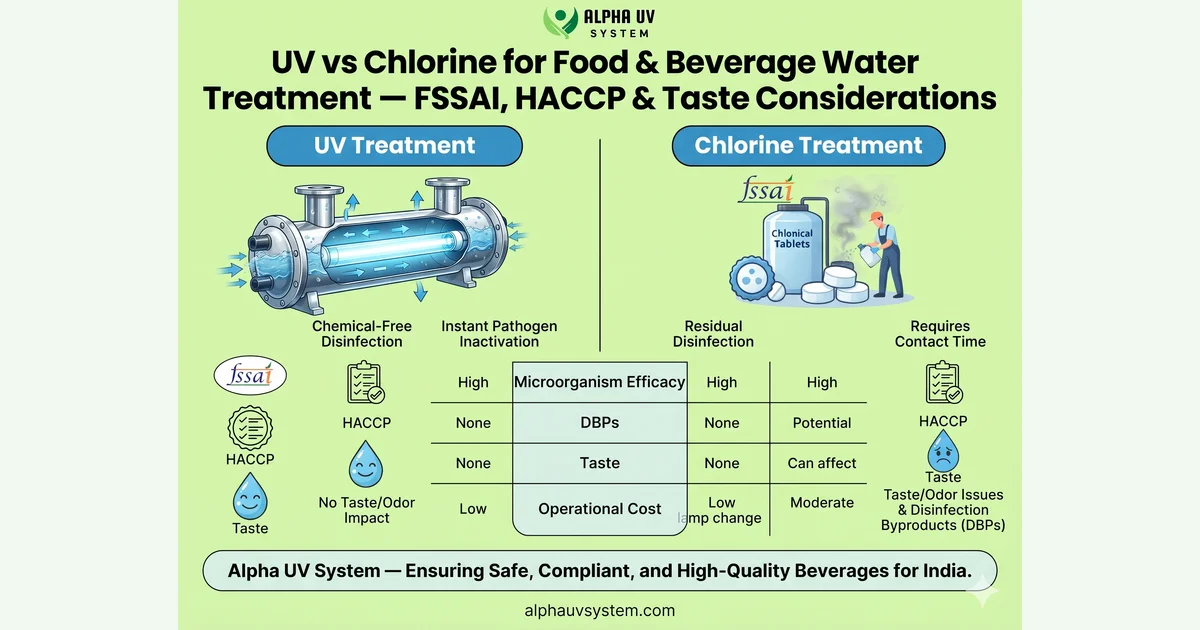
For food and beverage process water, UV disinfection outperforms chlorination on the criteria that matter most to manufacturers: zero taste or odour impact on products, no THM formation, effective against Cryptosporidium (which chlorine at standard doses cannot inactivate), and simpler HACCP documentation (UV intensity monitoring vs chlorine residual testing + corrective action). The only scenario where chlorine retains an advantage in food processing is when distribution pipe length requires a residual disinfectant — UV has no residual effect. For food contact water (ingredient water, CIP rinse, beverage water, dairy process water), UV is the preferred technology.
Why Food & Beverage Water Treatment Is Different from General Disinfection
The UV vs chlorine choice for a municipal water plant is primarily about efficacy, cost, and regulatory compliance. For a food or beverage manufacturer, two additional dimensions dominate the decision:
- Product impact: The disinfectant or its by-products must not affect the taste, aroma, colour, or safety of the food or beverage product. Chlorine in ingredient water, CIP rinse water, or beverage make-up water creates measurable product quality problems.
- FSSAI HACCP audit readiness: Water treatment is a Critical Control Point in every HACCP food safety plan. The monitoring system, records, and corrective action must satisfy FSSAI third-party audit requirements.
These two dimensions make the UV vs chlorine choice significantly more one-sided in food and beverage manufacturing than in municipal water treatment — UV wins on both criteria in almost all food industry water applications.
Head-to-Head Comparison — UV vs Chlorine for Food Process Water
| Parameter | UV Disinfection | Chlorination | Food Industry Verdict |
|---|
The Taste and Taint Problem: Why Chlorine Fails in Food Processing
The most significant reason food and beverage manufacturers choose UV over chlorination is the taste-taint risk. Chlorine — even at the low residual concentrations required for FSSAI IS 10500:2012 compliance (0.2 mg/L) — reacts with phenolic compounds naturally present in food manufacturing environments to form chlorophenols. These compounds are detectable by trained sensory panels at concentrations below 1 part per billion, and by most consumers below 20 ppb.
In practice, this means:
- Breweries: Chlorinated CIP rinse water is the leading cause of chlorophenolic off-flavours in Indian craft and commercial beer. Even trace chlorine residual on tank and pipe surfaces after CIP final rinse reacts with hop polyphenols to form 2-chlorophenol and 2,6-dichlorophenol — the medicinal, TCP-like flavour fault most commonly encountered in poorly treated Indian craft beer batches.
- Dairies: Chlorinated rinse water contacting milk or dairy products (paneer, curd, fresh cheese) leaves detectable chlorine notes in products with mild flavour profiles — a quality failure in premium dairy products and heritage dairy brands.
- Soft drinks and beverages: Chlorinated ingredient water affects flavour stability, particularly in fruit-based beverages where chlorine oxidises natural flavour compounds during storage. Beverage manufacturers that chlorinate ingredient water consistently report shorter shelf life and increased consumer complaints about off-notes.
- RTE food and packaged food: Produce wash water chlorination is effective for surface pathogen control but introduces chlorine taste in products with high water activity (leafy vegetables, cut fruit, fresh salads) — a quality concern for premium food brands.
UV disinfection eliminates all of these taste-taint risks because no chemical is added to the water. The UV-treated water is microbiologically clean and chemically unchanged — the only effect is inactivation of microbial DNA.
Cryptosporidium: The Case Where UV Has No Competition
Cryptosporidium parvum is a chlorine-resistant protozoan parasite responsible for waterborne disease outbreaks globally, including documented Indian incidents. Standard chlorination at food industry dose rates (0.2–1.0 mg/L, contact time 20–30 minutes) achieves less than 1-log Cryptosporidium inactivation — insufficient for safe food process water from surface water sources.
UV disinfection achieves 3-log (99.9%) Cryptosporidium inactivation at just 3 mJ/cm² — far below the 40 mJ/cm² standard for food processing applications. The practical implication: any food manufacturer using surface water or water with potential surface-water influence (river-based municipal supply during monsoon, lake-sourced borewell recharge zones) is not achieving Cryptosporidium control with chlorination alone, but achieves it routinely with UV.
This is particularly relevant for Indian food manufacturers in Maharashtra (river-dependent Mumbai and Pune water supply), Karnataka (Cauvery-dependent Bengaluru), and Assam (Brahmaputra basin water) where surface water influence on municipal supply increases during monsoon.
HACCP CCP Documentation: UV vs Chlorine Recordkeeping Compared
Under FSSAI FSMS requirements, water treatment at every food manufacturing plant is a Critical Control Point requiring:
- Defined critical limit
- Continuous monitoring method
- Corrective action procedure when limit is breached
- Verification records
- Documentation maintained for FSSAI audit
For chlorination, satisfying these requirements means: daily chlorine residual testing (manual test, test kit or photometer), corrective action when residual is out of range (adjust dose, re-test, hold product if residual was absent), maintaining daily test records, and periodic verification by NABL-accredited lab. The daily manual testing requirement adds labour cost and creates a risk of documentation gaps that FSSAI auditors flag.
For UV disinfection, the same HACCP CCP requirements are satisfied by the UV intensity monitor: the sensor provides continuous monitoring (not daily manual testing), the alarm output provides automatic corrective action trigger (water supply isolation when UV intensity falls below setpoint), and the data logger provides continuous records. FSSAI auditors reviewing UV-treated water CCPs consistently encounter cleaner documentation and fewer non-conformances than chlorine-treated water CCPs at Indian food manufacturing plants.
Annual Operating Cost: UV vs Chlorination for Food Process Water
For a 10,000 LPH food process water system (continuous operation, BIS IS 10500 compliance required):
| Cost Element | UV Disinfection | Chlorination (NaOCl) |
|---|
UV disinfection typically delivers Rs 1.5–3 lakh per year in direct cost savings over chlorination at 10,000 LPH — before accounting for the value of eliminated taste-taint batch loss risk and simplified HACCP documentation.
When Chlorine Is Still Needed Alongside UV
UV does not provide a residual disinfectant effect. This is a limitation in one specific scenario: very long distribution pipe runs where water sits in the pipe for extended periods after UV treatment, allowing microbial regrowth from pipe biofilm. For food factories with long pipe runs between the UV system and the point of use — particularly in large multi-building campuses — a small chlorine residual (0.1–0.2 mg/L) in the treated water may be necessary to prevent biofilm regrowth during distribution.
The practical solution in most food manufacturing plants is UV as the primary disinfection step, with a low-dose chlorine residual added downstream for distribution protection only. This UV + chlorine combination dramatically reduces the chlorine dose required (and therefore the taste-taint and THM risk) while maintaining the residual protection needed for pipe distribution.
Which Industries Should Switch to UV
UV is the preferred technology, without reservation, for:
- Breweries: Any brewery using municipal supply. UV destroys chloramines without activated carbon changeouts or SMB dosing. Zero chlorophenol risk in CIP rinse.
- Dairies: CIP final rinse water and all milk-contact process water. FSSAI HACCP CCP is simpler and cleaner with UV intensity monitoring.
- Packaged drinking water: FSSAI BIS IS 14543 compliance — UV is the standard technology. Chlorination of PDW creates THM risk in a product that is 100% water.
- Soft drinks and beverages: Ingredient water, container rinse water. Taste neutrality of UV-treated water protects flavour consistency batch-to-batch.
- RTE food and produce: Produce wash water. UV effectively inactivates Cryptosporidium (chlorine cannot) and E. coli O157:H7 without flavour impact on the washed produce.
- Pharmaceutical water: Schedule M 2025 purified water systems. UV is specified as the standard technology for PW loop disinfection — no chlorine in pharmaceutical manufacturing water systems.
Alpha UV System supplies food-grade SS316L UV disinfection systems with Philips UV-C lamps, FSSAI HACCP CCP documentation, and IIT Patna-engineered dose calculations for dairy, brewery, beverage, pharmaceutical, and food processing plants across India. Quote in 24–48 hours.
WhatsApp Us for Food Industry UV SizingSee also: Food & Beverage UV Disinfection | Dairy UV Systems | Brewery UV Systems | General UV vs Chlorine Comparison
Recommended UV Systems
Alpha UV System products for this application — powered by genuine Philips UV-C lamps.
Commercial UV Water Purification System
500 – 5,000 LPH
HACCP-compliant UV water purification for hotels, restaurants, and offices
Industrial UV Water Treatment System
5,000 – 50,000 LPH
Schedule M 2025 and HACCP compliant UV for pharma, food & beverage, and process water
Not sure which system suits your application? WhatsApp our engineers for a free recommendation →
Related solutions
See how Alpha UV System applies this to your industry or city.
Need a UV system?
Talk to our UV engineers — WhatsApp for a quote in 2 hours, or browse the full catalog on IndiaMART.