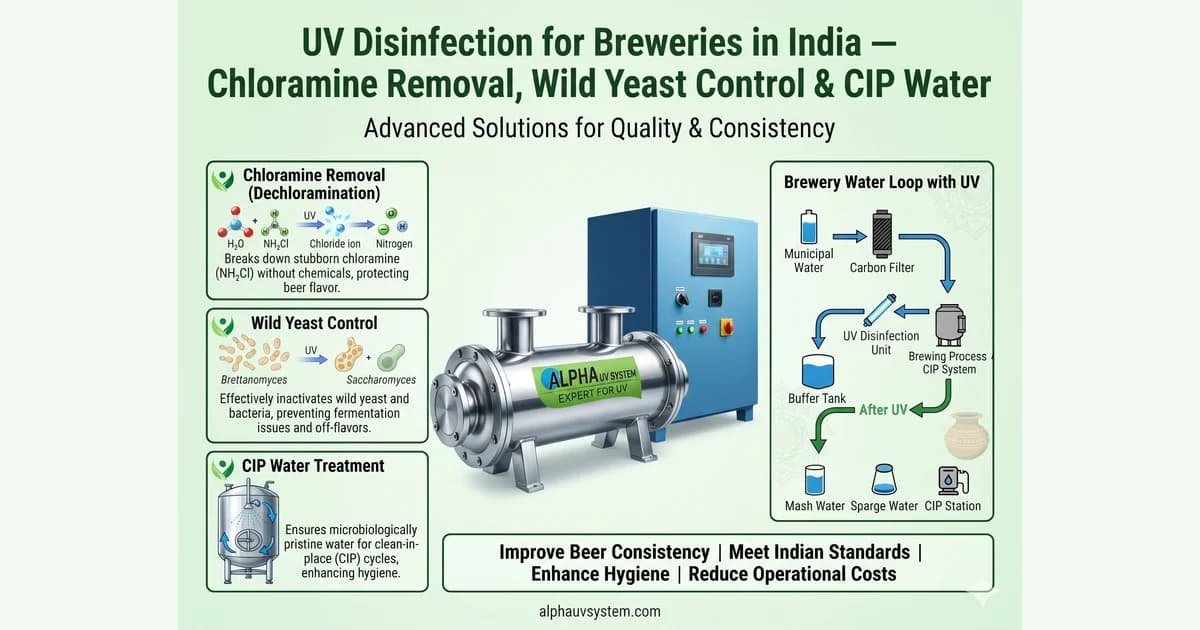
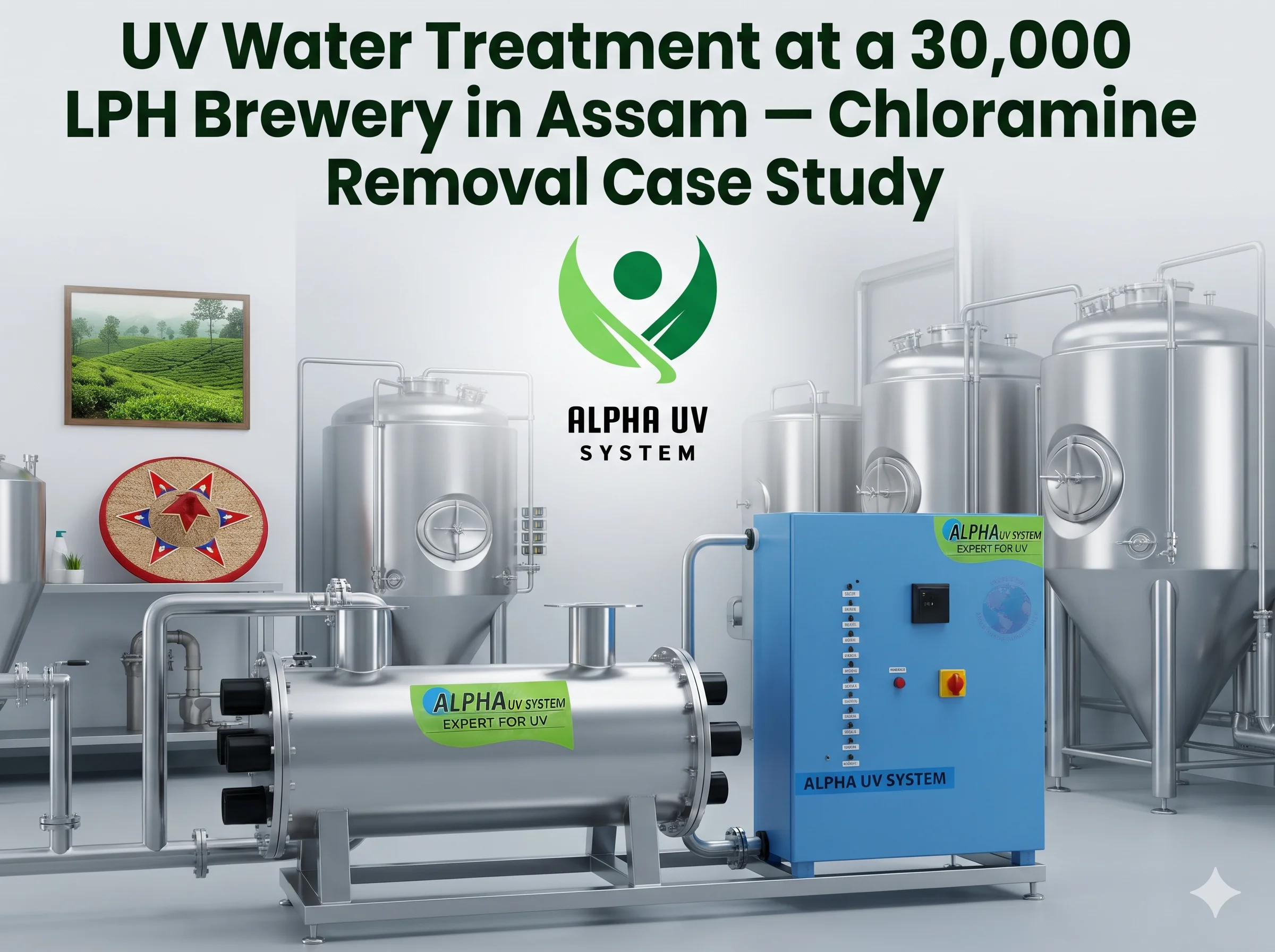
A commercial brewery in Nalbari, Assam was drawing chloraminated municipal supply for brewing make-up water and CIP final rinse. Chloramines were causing detectable chlorophenolic off-flavours in finished beer. The brewery replaced activated carbon with an ALPHA-ED754550P UV system (300 W UV-C, 60 mJ/cm² dose, 25–35 mW/cm² intensity at sensor, 76 mm Tri-Clamp SS-304) installed on the make-up water line and CIP final rinse return. Result: chloramine-free process water, CIP-compatible sanitary installation, and FSSAI HACCP CCP documentation accepted at third-party audit.
Background: Why Chloramines Are a Brewery's Worst Water Problem
Indian municipal water supply systems increasingly use chloramination (combined chlorine) instead of free chlorination to meet WHO and BIS disinfection by-product (DBP) limits. Chloramination reduces trihalomethane (THM) formation and provides a more stable disinfectant residual through the distribution network. For drinking water consumers, this is a positive development. For breweries, chloraminated supply is a serious process water problem.
The specific chemistry: monochloramine (NH₂Cl) — the dominant chloramine species at typical municipal pH 7–8 — reacts with phenolic compounds naturally present in malt and hops during the brewing process to form chlorophenols, specifically 2-chlorophenol and 2,6-dichlorophenol. These are the compounds responsible for the medicinal, TCP-like off-flavour that affects Indian craft and commercial beers brewed with chloraminated municipal water. Sensory panels detect these compounds at concentrations below 1 ppb; trained consumers detect them below 20 ppb.
The same chemistry affects CIP final rinse water. When chloraminated water is used as the final rinse after CIP cleaning of fermentation vessels, bright beer tanks, and pipe circuits, trace chloramine adheres to the vessel and pipe surfaces. On the next production run, this residual chloramine contacts wort phenolics and continues the chlorophenol formation reaction — producing off-flavours in the finished beer even when the make-up water quality was good.
This is why chloramine removal at both the make-up water inlet and the CIP final rinse return are both necessary: a half-solution (treating only make-up water) still allows CIP rinse contamination to reach product.
Why Activated Carbon Was Not Working
The brewery in this case study had tried activated carbon granular adsorption beds as the chloramine removal step. Carbon works for free chlorine removal — the reaction is fast and complete at typical bed contact times. Chloramine removal on carbon beds is a different story:
- Slower kinetics: Monochloramine removal on activated carbon requires significantly longer bed contact time than free chlorine removal. At the contact times available in typical brewery carbon bed installations, chloramine removal is often incomplete — particularly at higher flow rates during peak brewing production.
- Exhaustion and channelling: Activated carbon beds exhaust at different rates across the bed cross-section. As the bed exhausts unevenly, treated water quality becomes inconsistent — some batches pass with low chloramine, others do not. Without continuous online chloramine monitoring, the brewery cannot know in real time whether the carbon bed is performing.
- Microbial risk: An exhausted or partially exhausted carbon bed becomes a microbial growth medium. Bacteria colonise the carbon surface, creating a contamination source immediately upstream of the brewing process. For FSSAI HACCP requirements, a carbon bed is a critical control point with its own surveillance requirements — adding complexity to the HACCP plan rather than simplifying it.
- Change-out frequency: In chloraminated water, carbon beds exhaust faster than brewers expect. What was designed as a quarterly or semi-annual change-out often becomes monthly in Assam's high-flow brewing season. The change-out cost and production disruption during carbon bed replacement adds up.
UV System Installed: Technical Specifications
Alpha UV supplied an ALPHA-ED754550P UV system for the Nalbari brewery application. The key specification decisions for this installation:
| Parameter | Specification | Why This Matters |
|---|---|---|
| UV Max Power | 300 W | Total UV-C photon flux at 254 nm — 300 W is the minimum to deliver 60 mJ/cm² at 30,000 LPH with UVT 98% |
| UV Dose | 60 mJ/cm² at 30,000 LPH | Achieves >95% monochloramine (NH₂Cl) photolysis; 50% above 40 mJ/cm² FSSAI minimum |
| UV Intensity | 25–35 mW/cm² at sensor (absolute + relative) | Continuous mW/cm² online sensor output with both absolute and relative monitoring modes — the FSSAI HACCP CCP record; no manual test required. Lamp end-of-life alarm triggers before dose falls below CCP limit. |
| UV Wavelength | 253.7 nm (germicidal peak) | Low-pressure mercury UV-C emission peak; maximum N–Cl bond photolysis efficiency for monochloramine and dichloramine |
| UVT (Water) | 98% (post-5 µm filter) | UV Transmittance at 254 nm; high UVT means minimal UV absorption by water — full dose reaches target molecules |
| Model | ALPHA-ED754550P | 54 mm bore, 50-inch chamber; hydraulically optimised for 30,000 LPH with zero dead zones |
| Flow Rate | 30,000 LPH | Covers peak combined demand across brewing make-up water and CIP final rinse circuits |
| Construction | SS-304, 76 mm Tri-Clamp | EHEDG-compliant brewery sanitary construction; CIP-through without disassembly or bypass |
| Pathogen Reduction | >4-log E. coli; >95% chloramine | Both microbial kill and chloramine photolysis confirmed at rated flow in a single UV pass |
| Lamp Technology | Low-pressure mercury UV-C, 9,000 hr — Amalgam (12,500 hr) on request | Standard LP mercury: 9,000 hr rated life. Amalgam lamps operate at higher temperature — 12,500 hr life and stable output at flow temperatures up to 40°C |
| UV Dose (SI unit) | 600 J/m² (= 60 mJ/cm²) | SI unit for UV dose: 1 mJ/cm² = 10 J/m². European DVGW W294 and USEPA validation documents use J/m² |
Why 76 mm Tri-Clamp Construction Is Mandatory for Breweries
The Tri-Clamp (also written Triclamp or TC) sanitary fitting is the standard connection type for all sanitary pipework in Indian and international breweries. This is not an aesthetic preference — it is a hygiene engineering requirement. Standard threaded BSP or flanged connections used in municipal water or industrial UV systems have threads, crevices, and gasket seats that cannot be cleaned in place (CIP): food debris and biofilm accumulate in these areas during normal operation and are not fully cleared by CIP chemical and thermal cycles.
Tri-Clamp fittings have a smooth bore, a simple clamp-and-gasket connection, and no internal threads or dead legs. This geometry is specifically designed so that the fitting and all pipe surfaces it connects to can be cleaned in place using the standard brewery CIP sequence (caustic rinse at 70–80°C, water rinse, acid rinse, final water rinse) without disassembly. For the ALPHA-ED754550P UV reactor, the 76 mm Tri-Clamp connections mean the UV chamber is included in the brewery's standard CIP routing — the UV system is cleaned every time the connected pipework is cleaned, without any special maintenance procedure or disassembly.
The practical consequence: the brewery does not need to schedule a separate UV reactor cleaning maintenance event, does not need to remove the UV reactor from the line during CIP, and does not need to train production staff on a special procedure for the UV system. The UV system becomes part of the brewery's standard operating rhythm rather than an exception to it.
Installation: Two Points, Not One
The UV system was installed at two points in the brewery water circuit — not as a single central treatment step:
- Make-up water inlet UV: Installed downstream of the existing 5 µm cartridge pre-filter, upstream of the brewery water storage tank. This UV system treats all incoming municipal supply before it enters the brewery water circuit. The measured inlet UVT from Nalbari municipal supply, post-5 µm filtration: 98% — well above the minimum 85% UVT for effective UV chloramine photolysis at the rated flow.
- CIP final rinse UV: A second identical UV unit installed on the CIP final rinse return line. After the main CIP sequence (caustic, water rinse, acid, water rinse), the final UV-treated water rinse ensures that every fermentation vessel and pipe surface that will contact the next batch of beer or wort is rinsed with water that has been confirmed chloramine-free by the UV system.
The two-point installation is what makes the solution complete. Make-up water UV alone eliminates chloramine from ingredient water and product water but does not protect against CIP rinse contamination. CIP rinse UV alone does not address chloramine entering the process through ingredient water additions during brewing. The two-system architecture closes both contamination pathways — the same logic as the Delhi NCR hotel case study where separate UV systems were installed at each water use point for independent documentation and protection.
FSSAI HACCP CCP Documentation
Under FSSAI FSMS requirements, water disinfection at a brewery is a Critical Control Point. The CCP documentation package supplied with the ALPHA-ED754550P installation covers:
- CCP identification sheet: Hazard — microbial contamination and chloramine contamination of brewing make-up water and CIP rinse; Control measure — UV disinfection at 60 mJ/cm²; Critical limit — UV intensity ≥ [calibrated set point in mW/cm²]
- Monitoring procedure: Continuous UV intensity sensor with absolute and relative intensity monitoring modes, 3,000-record onboard data logger, daily log export (CSV), automated alarm if intensity drops below set point. Lamp warmup mode prevents dose shortfall during cold starts; end-of-life alarm triggers before lamp reaches rated hour limit.
- Corrective action protocol: If UV alarm triggers — halt water intake to brewery storage and CIP final rinse; switch to standby water if available; notify engineering; resume only after lamp replacement and recommissioning
- Verification procedure: Annual UV intensity measurement with NABL-calibrated radiometer; lamp COA update on annual UV lamp replacement
- Record format: UV intensity log exported as CSV from data logger for monthly FSSAI audit documentation file
The FSSAI third-party auditor reviewing this CCP documentation received continuous automated records rather than a daily manual test log — a documentation approach that FSSAI auditors consistently rate as stronger than manual chlorine residual testing CCPs at comparable brewery installations.
Results
| Metric | Before UV | After UV |
|---|---|---|
| UV Dose Delivered | 0 mJ/cm² (no UV system) | 60 mJ/cm² (600 J/m²) at 30,000 LPH |
| UV Intensity (online sensor) | Not monitored | 25–35 mW/cm² (continuous CCP log) |
| Monochloramine (NH₂Cl) | 0.4–0.9 mg/L inlet | Below detection (>95% photolysis at 60 mJ/cm²) |
| Chlorophenolic off-flavour | Present — TCP/medicinal in hoppy batches | Eliminated — sensory panel confirmed |
| CIP rinse chloramine | Present after final rinse | Absent — UV-treated final rinse confirmed |
| FSSAI HACCP CCP monitoring | Manual DPD daily test + paper log | Automated continuous UV intensity log — auditor-ready CSV |
Which Indian Breweries Have This Problem
Chloramine-caused off-flavours are not specific to Nalbari or Assam. Any Indian brewery drawing municipal supply from a chloraminated network has this risk. The cities and regions with confirmed chloramination in municipal supply that affect Indian breweries include:
- Bengaluru (BWSSB): Confirmed chloraminated supply; a primary cause of chlorophenolic off-flavours in Bengaluru craft beer batches drawn from BWSSB supply.
- Mumbai (BMC): BMC has used chloramination at water treatment plants serving high-TDS zones; brewery process water from certain Mumbai supply points contains detectable monochloramine.
- Hyderabad (HMWSSB): Chloramine usage varies by zone; breweries in Cyberabad and Medchal supply zones should test for chloramine rather than assuming free-chlorine supply.
- Delhi NCR (DJB and neighbouring utilities): Free chlorine dominant; chloramine formation in distribution depending on ammonia in supply. Test required rather than assumed.
- Nashik and Pune: Reservoir-sourced supply has lower chloramine risk than groundwater-influenced supply, but CIP rinse chloramine from any free chlorine residual should still be tested.
The diagnostic test is simple: a standard colorimetric chloramine test kit (DPD-3 reagent, not DPD-1 which shows only free chlorine) on the make-up water supply will confirm whether monochloramine is present and at what level. Any detection above 0.1 mg/L is worth treating, given the sub-ppb sensory detection threshold for chlorophenolic compounds in beer.
Frequently Asked Questions
What UV dose is needed for complete chloramine removal in brewery water?
UV photolysis of monochloramine at 253.7 nm (the low-pressure mercury UV-C emission peak) is a dose-dependent process. At 40 mJ/cm² (400 J/m²), typically 85–90% chloramine destruction; at 60 mJ/cm² (600 J/m²), typically 95–98% destruction; at 90–100 mJ/cm² (900–1,000 J/m²), near-complete destruction. For brewing applications where even trace chloramine creates product quality risk, 60 mJ/cm² is the recommended minimum. The ALPHA-ED754550P installed in this case study was specified at 60 mJ/cm² for exactly this reason — the stricter the beer quality standard, the higher the required UV dose for chloramine removal.
Can't activated carbon do this more cheaply?
Activated carbon beds remove monochloramine, but the removal kinetics are slower than for free chlorine and highly dependent on bed depth, contact time, temperature, and bed condition. In practice, activated carbon beds at breweries frequently deliver incomplete chloramine removal during peak flow periods, exhaust faster than anticipated, and become microbial contamination risks when exhausted. The annual cost of carbon change-outs plus the HACCP documentation burden of managing a carbon CCP often exceeds the annual lamp cost of a UV system. Additionally, UV provides a continuous online intensity monitor (the sensor output) which is a stronger FSSAI CCP record than the periodic manual tests required for a carbon bed CCP.
Is Tri-Clamp construction necessary for all brewery UV installations?
For any UV system installed on a line that is included in the brewery's CIP circuits — make-up water, CIP rinse return, bright beer circuit, fermentation vessel supply — Tri-Clamp construction is strongly recommended. It is not strictly mandatory if the UV system can be bypassed during CIP, but bypassing the UV system during CIP means CIP fluids do not contact the UV reactor interior — which then remains uncleaned and becomes a potential biofilm harbour. Tri-Clamp construction (and CIP-through installation) eliminates this risk. For non-CIP lines (utility water, non-contact cooling water), standard flanged or threaded construction is acceptable.
Why install UV on both make-up water and CIP rinse — can one unit serve both purposes?
In principle, if the entire make-up water supply passes through the UV system before any branch point, the CIP final rinse line would already be drawing UV-treated water. In practice, most brewery water systems have a storage tank between the UV system and the CIP make-up point — and water sitting in a storage tank after UV treatment can experience trace bacterial regrowth. By installing a separate UV unit on the CIP final rinse return (the final step before cleaned vessels are closed for the next batch), the brewery eliminates any risk of storage-associated contamination in the final rinse step. The incremental cost of a second UV unit is a minor addition compared to the production value of the batches protected.
Alpha UV System supplies SS-304 and SS-316L UV systems with Tri-Clamp sanitary connections, low-pressure mercury UV-C lamps (LP or Amalgam), and FSSAI HACCP CCP documentation for Indian breweries. Systems sized for 1,000–1,00,000 LPH. Quote in 24–48 hours.
WhatsApp for Brewery UV SizingSee also: Brewery UV Disinfection Systems | UV vs Chlorine for Food & Beverage Water | All UV Case Studies
Recommended UV Systems
Alpha UV System products for this application — powered by genuine Philips UV-C lamps.
Commercial UV Water Purification System
500 – 5,000 LPH
HACCP-compliant UV water purification for hotels, restaurants, and offices
Industrial UV Water Treatment System
5,000 – 50,000 LPH
Schedule M 2025 and HACCP compliant UV for pharma, food & beverage, and process water
Not sure which system suits your application? WhatsApp our engineers for a free recommendation →
Related solutions
See how Alpha UV System applies this to your industry or city.
Need a UV system?
Talk to our UV engineers — WhatsApp for a quote in 2 hours, or browse the full catalog on IndiaMART.