
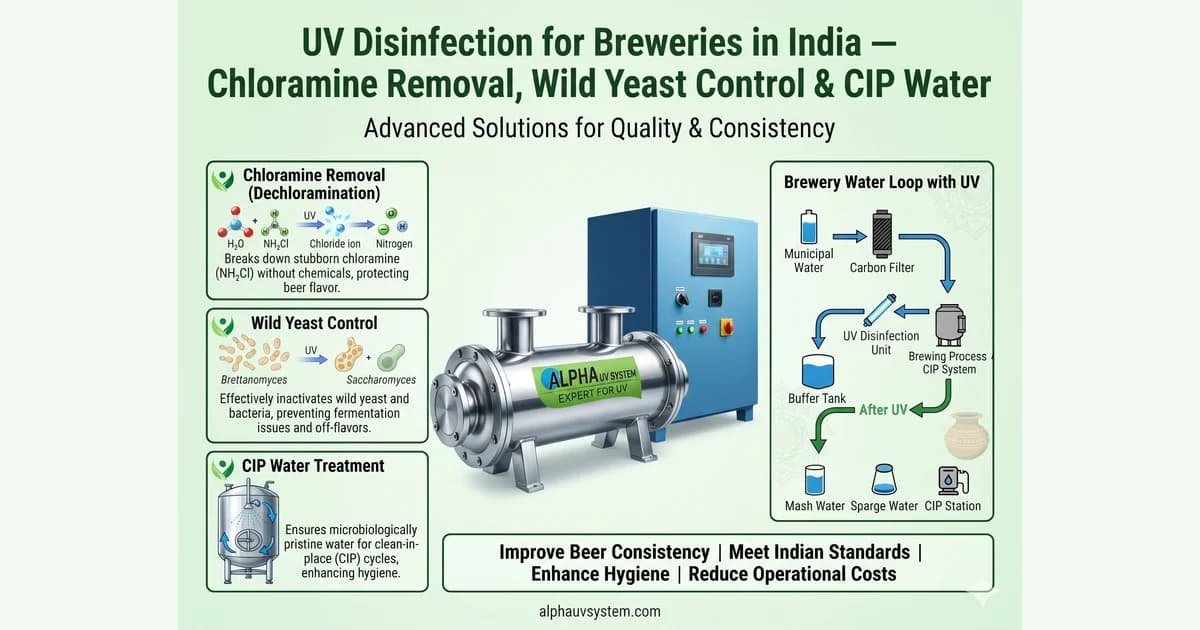
UV disinfection for breweries destroys chloramines (which ruin hop aroma and create harsh flavours) and kills wild yeast and bacteria in process water — without activated carbon media changeouts, without sodium metabisulphite dosing, and without affecting water mineral content. Install UV post-filtration on your make-up water line and on the CIP final rinse return. At 40 mJ/cm² dose, UV achieves 4-log kill of E. coli, Lactobacillus, Pediococcus, and wild Saccharomyces — the microorganisms that cause souring, ropiness, and off-flavour in spoiled batches.
Why Chloramines in Municipal Water Ruin Beer — and Why UV Fixes It
Indian municipal water is treated with chlorine or chloramine-forming compounds for distribution safety. By the time this water reaches a brewery, free chlorine has partially converted to chloramines — combined chlorine compounds formed by the reaction of chlorine with nitrogenous compounds in the water. Chloramines are significantly more difficult to remove than free chlorine and are a primary cause of chlorophenolic off-flavours in beer: when chloramines react with phenolic precursors from malt, they form 2-chlorophenol and 2,6-dichlorophenol — compounds detectable by trained tasters at concentrations below 1 ppb and responsible for the plastic, medicinal, or antiseptic notes that characterise poorly water-treated beer.
The traditional approaches to chloramine removal in brewing are activated carbon filtration or sodium metabisulphite (SMB) dosing. Activated carbon removes chloramines effectively but requires media changeout every 3–6 months (a brewery consumable cost and a microbial risk if the carbon bed is not changed on schedule — exhausted or biologically fouled carbon can contaminate the downstream water supply). SMB dosing is effective but adds sulphite residual that can affect yeast health at high concentrations and requires careful dose control. UV at 254 nm photolyses chloramines without media changeouts, without chemical addition, without affecting mineral content (critical for beer style recipe water), and without operational variability. A single UV unit on the make-up water line, sized for the peak flow rate, eliminates both chloramine and microbial risk in a single pass.
UV Applications Across the Brewery Process
Make-Up Water Treatment
Brewery make-up water — the water that becomes the beer — is the most volume-critical application. It must meet two requirements simultaneously: microbiologically safe (no coliforms, no wild yeast) and chemically appropriate for the beer style (correct mineral content, no chloramines). UV achieves the microbiological requirement without altering mineral content — unlike RO, which strips beneficial minerals along with contaminants, requiring remineralisation for most beer styles. Install UV on the make-up water line after carbon filtration or at the outlet of the water treatment skid. At 40 mJ/cm², UV delivers 4-log E. coli inactivation and effective wild yeast kill (Saccharomyces diastaticus and Brettanomyces require 20–40 mJ/cm² for 3-log reduction).
CIP Final Rinse Water
Clean-in-place (CIP) final rinse water quality directly affects the microbiological integrity of the vessel being cleaned. If the CIP final rinse water carries coliform contamination, residual organisms remain on vessel surfaces after the rinse cycle completes — typically at concentrations below the detection threshold of a standard surface swab, but high enough to seed the next batch. UV on the CIP final rinse return line disinfects the rinse water immediately before it contacts vessel surfaces, ensuring the final rinse leaves surfaces microbiologically clean. This is particularly critical for fermentation tanks, bright beer tanks, and packaging lines where low-level contamination can cause refermentation or premature spoilage.
Yeast Propagation and Pitching Water
Yeast propagation and pitching water must be of the highest microbiological quality — wild yeast or bacterial contamination at pitching sets up competition with the production strain that cannot be corrected downstream. UV disinfection at 60–80 mJ/cm² on yeast propagation water supply provides a consistently clean water source for propagator make-up and wort dilution. At this dose level, UV achieves 4-log kill of Lactobacillus and Pediococcus (the primary lactic acid bacteria responsible for souring) in addition to wild yeast — the two microorganism families that cause the most economically damaging brewery contamination events.
Packaging Line Rinse and Filler Water
Bottle rinsers, can rinsers, and tunnel pasteurisers use large volumes of water that must be microbiologically clean. UV on the packaging line water supply eliminates coliform and spoilage organisms that enter via municipal water, preventing re-contamination of bottles and cans after washing. For breweries that do not use tunnel pasteurisation (craft and unfiltered beer producers), packaging line water quality is a critical control point — coliform contamination at packaging will cause in-package re-fermentation and consumer complaints within the shelf life.
UV Sizing Methodology for Brewery Applications
UV system sizing for a brewery requires three inputs: peak flow rate (LPH), source water UV transmittance (UVT), and target log reduction. For Indian municipal water with pre-treatment (cartridge filtration to 5 µm), UVT is typically 85–92% at 254 nm. For pre-treated RO permeate used as make-up water base, UVT is 95–99%. The sizing table below covers typical brewery scales:
| Brewery Scale | Production Volume | Make-Up Water Flow | UV System Size |
|---|---|---|---|
| Micro / Craft | 500–2,000 L/day | 500–2,000 LPH | Compact 40W–90W unit |
| Regional Craft | 2,000–20,000 L/day | 2,000–10,000 LPH | Commercial 150W–400W |
| Mid-Scale | 20,000–1,00,000 L/day | 10,000–50,000 LPH | Industrial multi-lamp |
| Large Scale | 1,00,000+ L/day | 50,000+ LPH | High-flow SS316L system |
UV sizing must be based on peak hourly flow rate — the maximum rate at which water is drawn during brewday operations — not average daily volume. Undersizing UV for average flow means that during peak demand (mashing, lautering, CIP) the UV system operates above its rated flow and delivers below the design dose.
FSSAI and HACCP Compliance for Brewery UV Systems
Brewery process water is a food-contact water under FSSAI Regulation 2.3.1, which requires microbiological standards equivalent to IS 10500:2012 drinking water specifications. FSSAI third-party audits (by NABL-accredited certification bodies) examine the brewery water treatment system as a Critical Control Point (CCP) in the HACCP plan. UV disinfection satisfies the CCP requirement: it provides a continuous, monitored kill step with UV intensity monitoring as the CCP monitoring parameter and a low-UV alarm as the corrective action trigger. The UV intensity log (from the 4–20 mA SCADA output) provides the HACCP CCP monitoring record required by FSSAI third-party auditors.
For export-oriented breweries targeting EU or US markets, UV disinfection documentation aligns with FSSC 22000 and BRC Global Standard requirements for water used as a food ingredient.
Alpha UV System for Breweries
Alpha UV System supplies UV disinfection systems for craft breweries, regional brewers, and industrial beer plants across India — FSSAI and HACCP compliant, SS316L food-grade construction, Philips UV-C lamps, 4–20 mA UV intensity output for HACCP CCP monitoring. Systems are sized from your measured make-up water flow rate and UVT.
See full specifications and inquiry details on our brewery UV disinfection application page.
Share your make-up water flow rate, brewery scale, and source water type — our engineers will recommend the right UV configuration for make-up water, CIP rinse, and packaging line applications, with FSSAI HACCP CCP documentation included.
WhatsApp for Brewery UV SizingStandards, authorities & further reading
Regulations evolve — check the latest revision on each authority's site before compliance decisions.
Recommended UV Systems
Alpha UV System products for this application — powered by genuine Philips UV-C lamps.
Commercial UV Water Purification System
500 – 5,000 LPH
HACCP-compliant UV water purification for hotels, restaurants, and offices
Industrial UV Water Treatment System
5,000 – 50,000 LPH
Schedule M 2025 and HACCP compliant UV for pharma, food & beverage, and process water
Not sure which system suits your application? WhatsApp our engineers for a free recommendation →
Related solutions
See how Alpha UV System applies this to your industry or city.
Need a UV system?
Talk to our UV engineers — WhatsApp for a quote in 2 hours, or browse the full catalog on IndiaMART.


