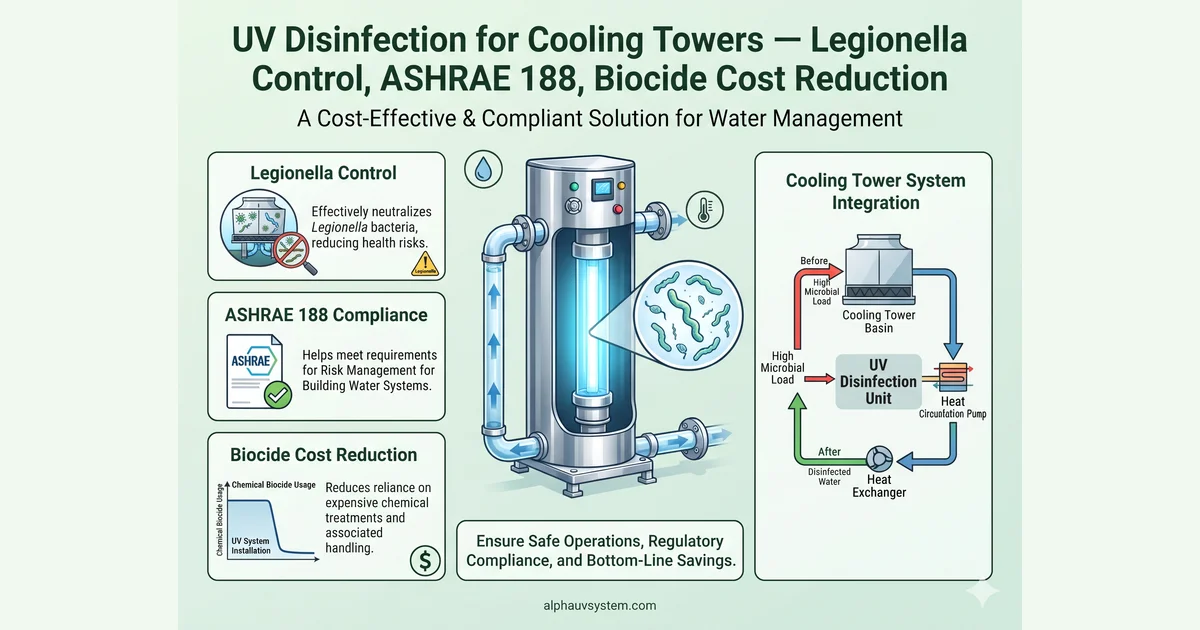
UV disinfection on cooling tower recirculation water kills Legionella pneumophila, Pseudomonas, and biofilm-forming bacteria on each pass through the UV reactor, reducing total bacterial count in the sump by 1–3 log. This continuous kill step allows biocide (chlorine, bromide, or oxidising biocides) concentration to be reduced 50–70% while maintaining or improving microbiological control — cutting chemical costs and reducing corrosion risk on heat exchange surfaces. UV is now specified in ASHRAE 188 Water Management Plans as the continuous kill step for Legionella control in high-risk cooling tower installations including hospitals, hotels, and large commercial buildings.
Why Cooling Towers Are the Primary Legionella Risk in Buildings
Legionella pneumophila, the bacterium responsible for Legionnaires' disease, is a waterborne pathogen that proliferates at water temperatures between 25°C and 45°C — precisely the temperature range of cooling tower sump water in Indian ambient conditions (25–42°C depending on season and geography). Cooling towers aerosolise water droplets to achieve evaporative cooling; these droplets, if contaminated with Legionella, become an inhalation risk for building occupants and passers-by within 100 metres of the tower. Unlike most waterborne diseases where the transmission route is ingestion, Legionella causes infection via inhalation of contaminated aerosol — a route that bypasses gastric acid and allows very low infectious doses to reach the lung.
The conditions in a poorly managed cooling tower actively encourage Legionella growth: warm water temperature, nutrient availability from biofilm on tower fill and basin surfaces, and protection from chemical biocides within biofilm microenvironments. Scaling on heat exchange surfaces reduces heat transfer efficiency and creates protected areas where Legionella survives high biocide concentrations. Indian building regulations do not yet mandate Legionella risk assessment with the same rigour as UK HSG274 or US ASHRAE 188, but hospital accreditation bodies (NABH, JCI) and multinational employer EHS frameworks are increasingly requiring written Legionella water management plans for facilities with cooling towers.
How UV Disinfection Controls Legionella in Cooling Towers
UV disinfection at 254 nm inactivates Legionella pneumophila very efficiently — a UV dose of 4–8 mJ/cm² achieves 2-log (99%) inactivation of planktonic Legionella. At the design doses used in cooling tower UV systems (40–80 mJ/cm²), UV achieves 4–5 log inactivation of planktonic Legionella on each pass through the reactor. By continuously circulating cooling tower sump water through the UV reactor (a slip-stream UV configuration, treating 10–25% of the total recirculation flow), the total Legionella concentration in the sump is progressively reduced to below detectable limits in routine sampling.
UV has an important advantage over biocide-only programmes in cooling towers: it kills organisms in free-floating (planktonic) form without creating selective pressure for biocide-resistant strains, and it does not add chemical compounds to the water that could accelerate corrosion or scale formation on heat exchange surfaces. UV operates 24 hours a day without manual dosing, operator error, or chemical delivery failures — all of which are common failure modes in biocide-only programmes.
UV + Biocide Integration — Achieving 50–70% Biocide Cost Reduction
UV disinfection in cooling towers works in conjunction with — not as a replacement for — the existing biocide programme. The UV reactor handles continuous planktonic kill, reducing the baseline microbial load in the sump. With a lower baseline load, the biocide programme achieves the same terminal log reduction at significantly lower biocide concentrations. Field data from UV-supplemented cooling tower programmes consistently shows 50–70% reduction in biocide consumption while maintaining or improving microbiological compliance with ASHRAE 188 targets (heterotrophic plate count below 10,000 CFU/mL, Legionella below detectable).
The practical result is a reduction in chemical spend, a reduction in corrosion risk (many oxidising biocides accelerate corrosion on copper and mild steel heat exchanger surfaces at high concentrations), and a simpler water management programme with fewer manual dosing events. For facilities with high-value heat exchangers — pharmaceutical manufacturers, data centres, process cooling — the reduction in corrosion-related maintenance costs alone often justifies UV installation within 12–18 months of OPEX payback.
ASHRAE 188 and Legionella Risk Assessment in India
ASHRAE Standard 188 (Legionellosis: Risk Management for Building Water Systems) provides the framework for Legionella Water Management Plans (WMPs) used by US-headquartered multinationals, hospital accreditation programmes (JCI, NABH international standards), and large commercial real estate operators in India. The standard requires identification of all water system components with Legionella risk potential, written control measures for each, monitoring frequencies, and corrective action procedures.
For cooling towers, ASHRAE 188 identifies continuous chemical treatment (biocide programme) and physical treatment (UV disinfection) as the two primary control measures. A WMP that relies solely on intermittent biocide dosing without a continuous treatment element is considered incomplete under ASHRAE 188. UV disinfection installed on the cooling tower recirculation provides the continuous treatment element required by the standard, completing the WMP and providing written evidence for accreditation inspections.
India's National Building Code 2016 and Bureau of Indian Standards have not yet published a mandatory cooling tower Legionella standard equivalent to UK ACoP L8 or ASHRAE 188, but facilities seeking NABH, JCI, LEED, or WELL certification are applying these international standards. UV disinfection is the simplest path to compliance documentation for the continuous treatment requirement in all of these frameworks.
UV System Configuration for Cooling Towers
Cooling tower UV systems use a slip-stream configuration: a bypass line takes a portion of the cooling tower recirculation flow (typically 10–25% of total flow) through the UV reactor before returning it to the sump. This configuration treats the entire sump volume in 1–3 hours depending on the slip-stream fraction, achieving the target Legionella reduction without requiring a full-flow UV reactor sized for the total recirculation rate (which would be significantly larger and more expensive).
| Cooling Tower Capacity | Recirculation Rate | Slip-Stream UV Flow (15%) | UV System Size |
|---|---|---|---|
| 50 TR | 30,000 LPH | 4,500 LPH | 5,000 LPH UV unit |
| 150 TR | 90,000 LPH | 13,500 LPH | 15,000 LPH UV unit |
| 500 TR | 3,00,000 LPH | 45,000 LPH | 50,000 LPH UV unit |
| 1,000 TR+ | 6,00,000+ LPH | 90,000+ LPH | Custom multi-lamp |
Cooling tower water has lower UV transmittance than potable water — typically 65–80% UVT due to turbidity, suspended solids, biocide compounds, and scaling agents. UV sizing must account for this lower UVT, which requires higher lamp power and closer lamp spacing to deliver the target dose. Alpha UV engineers calculate the required UV dose from your measured cooling tower sump water UVT — do not accept UV sizing based on UVT assumptions for potable water.
Pre-Treatment Requirements for Cooling Tower UV
Cooling tower sump water typically requires pre-filtration before the UV reactor to remove suspended solids and turbidity above 5 NTU that would otherwise shield organisms from UV dose. A cartridge filter (25–50 µm) or disc filter on the slip-stream before the UV reactor achieves sufficient pre-treatment for most cooling tower applications. For towers with heavy scaling or high turbidity, an automatic self-cleaning strainer may be required to maintain filter performance without manual changeout. Pre-filter specification must be provided by the UV system supplier as part of the system design, not left to the client.
Alpha UV System for Cooling Towers
Alpha UV System supplies UV disinfection systems for cooling towers from 50 TR to 1,000+ TR installations — slip-stream configuration, SS316L chambers, Philips UV-C High-Output lamps, 4–20 mA SCADA output for BMS integration, and auto-wiper quartz sleeve cleaning for cooling tower water turbidity. Systems are sized by IIT Patna engineers from your measured sump water UVT and total recirculation rate. ASHRAE 188 Water Management Plan documentation support available.
For full specifications and inquiry: cooling tower UV disinfection application page.
Share your cooling tower tonnage (TR), recirculation rate (LPH), and sump water quality — we will recommend the right UV slip-stream configuration with Legionella control documentation for ASHRAE 188 or NABH compliance.
WhatsApp for Cooling Tower UV SizingStandards, authorities & further reading
Regulations evolve — check the latest revision on each authority's site before compliance decisions.
- ASHRAE Standard 188 — Legionellosis: Risk Management for Building Water Systems
- CDC — Developing a Water Management Program for Legionella
- UK HSE ACoP L8 — Legionnaires' Disease: Control of Legionella Bacteria in Water Systems
- WHO — Legionella and the Prevention of Legionellosis
- NSF/ANSI 55 — Ultraviolet Microbiological Water Treatment Systems
Recommended UV Systems
Alpha UV System products for this application — powered by genuine Philips UV-C lamps.
Commercial UV Water Purification System
500 – 5,000 LPH
HACCP-compliant UV water purification for hotels, restaurants, and offices
Industrial UV Water Treatment System
5,000 – 50,000 LPH
Schedule M 2025 and HACCP compliant UV for pharma, food & beverage, and process water
Not sure which system suits your application? WhatsApp our engineers for a free recommendation →
Related solutions
See how Alpha UV System applies this to your industry or city.
Need a UV system?
Talk to our UV engineers — WhatsApp for a quote in 2 hours, or browse the full catalog on IndiaMART.