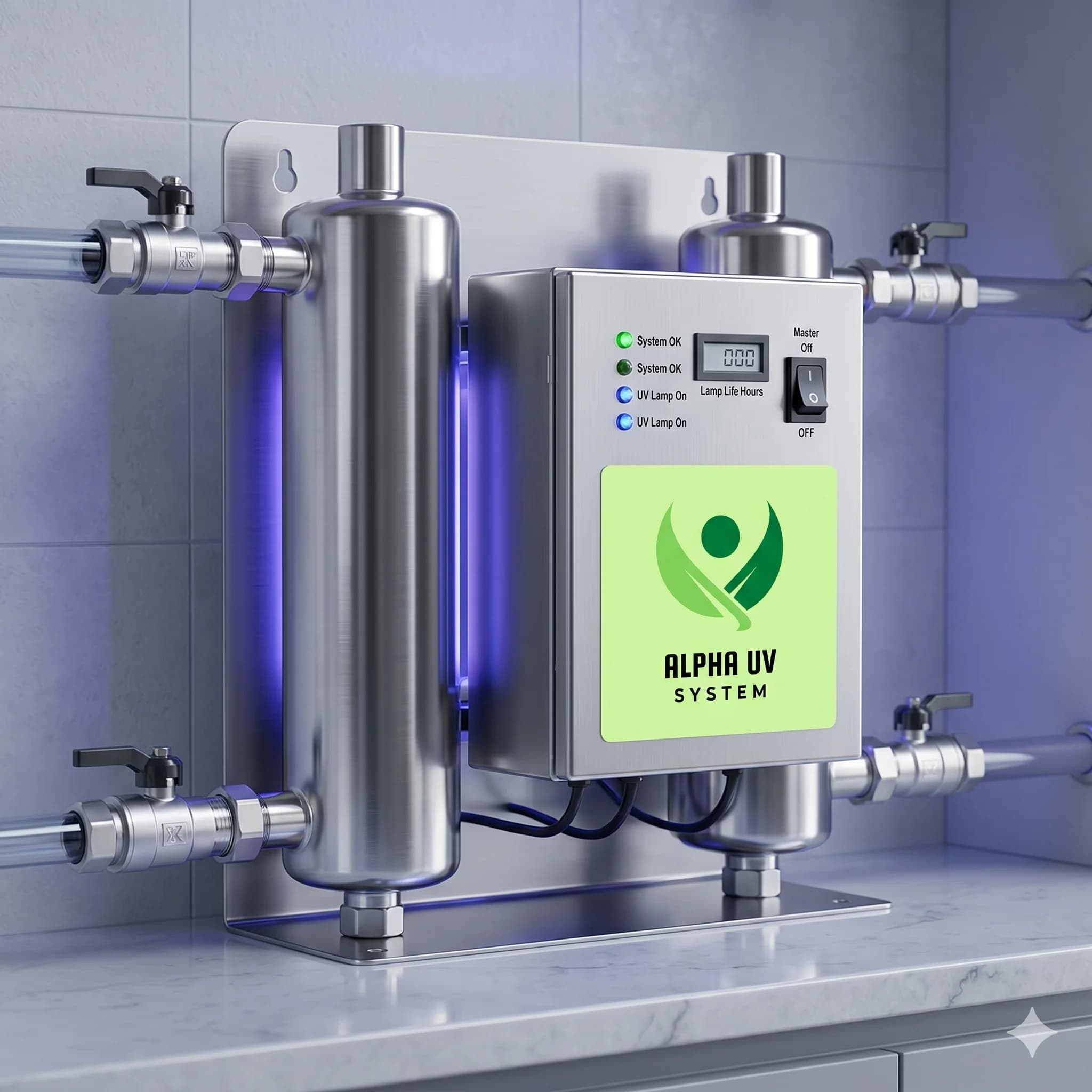
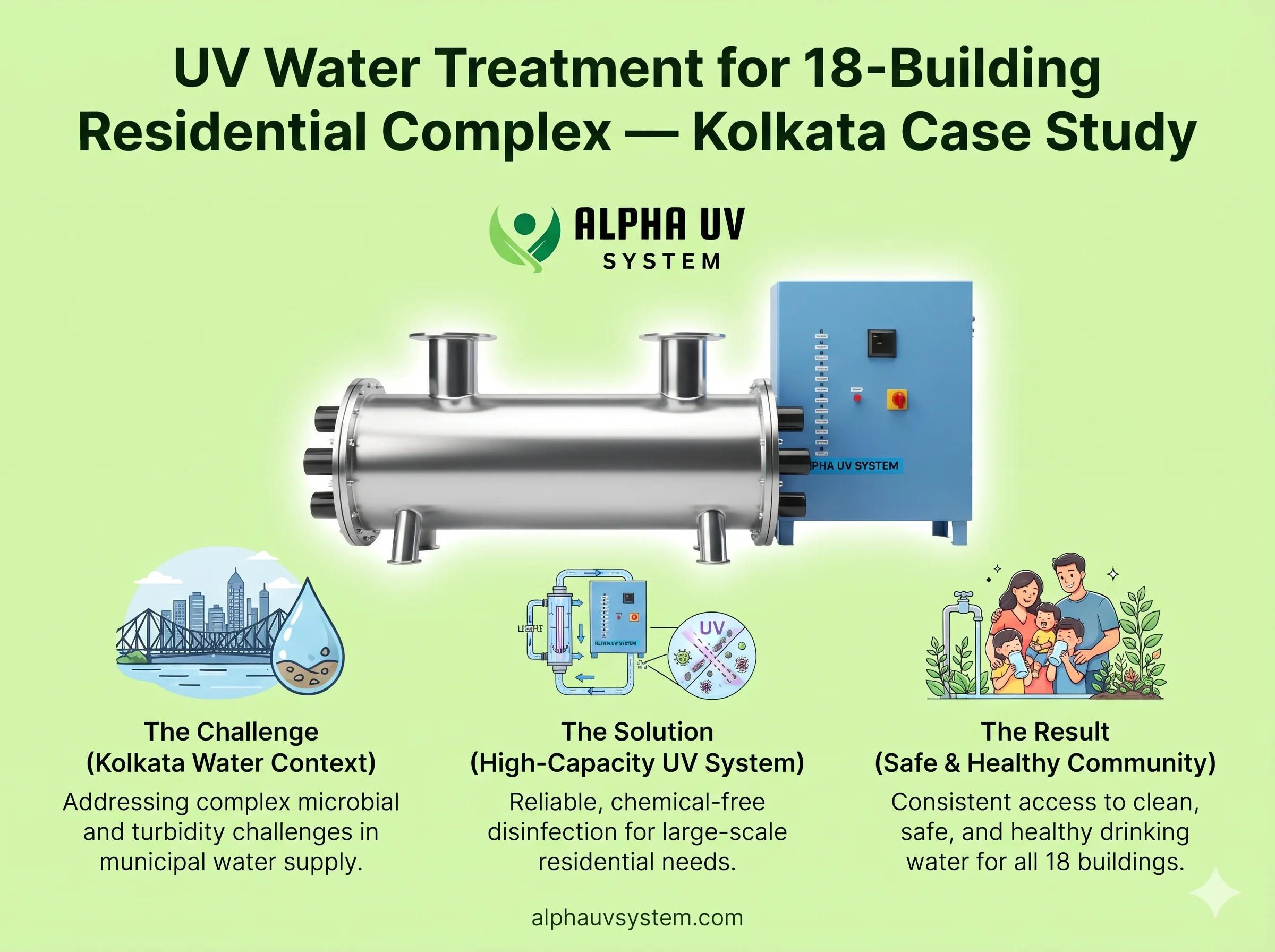
A large residential development in Rajarhat, Kolkata comprising 18 buildings required UV water disinfection for every building's potable water supply. Alpha UV supplied 18× ALPHA-ED755563P UV systems — one per building, 375 W UV-C per unit, 60 mJ/cm² (600 J/m²) at rated flow, SS-304 construction, 2.5-inch thread connections, UVT 98%. All 18 units supplied with UV lamp certificates and BIS IS 10500 compliance documentation as a RERA project handover package.
The Residential Complex Water Safety Challenge
Large residential developments in Indian cities face a water quality problem that is poorly understood at the design stage: overhead tank bacterial regrowth. Municipal water utilities deliver treated, disinfected water to the boundary of a residential project. The moment that water enters the project's storage and distribution system — underground sumps, overhead tanks, rooftop tanks, internal distribution pipes — it begins to degrade. Chlorine residual dissipates within hours in an overhead tank. Bacteria present in biofilm on tank walls, pipe surfaces, and fittings multiply in the now-unchlorinated water. By the time the water reaches a resident's tap, it may carry total coliform counts that exceed BIS IS 10500 potable water limits.
This is not a problem unique to any particular city or municipal utility. It is a structural consequence of how Indian residential developments store and distribute water. The larger the development — and the more buildings and distribution loops involved — the more complex the contamination risk becomes. An 18-building development in Kolkata has 18 separate overhead tank systems, 18 sets of distribution pipes, and 18 potential bacterial regrowth points, all supplied from the same treated municipal source.
The solution is UV disinfection at the inlet to each building's overhead tank — the last point where the water can be treated before it enters the building's distribution system and reaches residents' taps.
Project Scope: 18 Buildings, 18 UV Systems
The developer's requirement was straightforward: UV disinfection at the inlet to every building in the development. This was not a single central UV system upstream of all buildings — it was one dedicated UV system per building, treating the water supply to that building's overhead tank independently of all others.
The rationale for per-building UV rather than central treatment:
- Independent compliance documentation: RERA documentation, occupant handover packages, and building operations manuals are building-specific. A single central UV system serving 18 buildings produces one compliance record for the entire development; 18 per-building UV systems produce 18 building-specific records — one per building, matched to each building's water quality documentation.
- Maintenance independence: If a single lamp fails in a central system, the entire development's water treatment is affected. With per-building systems, a lamp failure in one building affects only that building; the other 17 continue operating normally. Annual lamp replacement can be staggered across buildings rather than requiring a complete development-wide shutdown.
- Post-distribution quality: A central UV system upstream of all buildings treats water before it enters the development's internal distribution ring main. By the time this water has travelled the full distribution loop to reach building 18, it has been in pipes for an extended period — enough for bacterial regrowth to begin even after UV treatment. Per-building UV installed at the building entry point treats water immediately before it enters that building's overhead tank, minimising the time between UV treatment and water delivery to the resident.
System Specification: ALPHA-ED755563P
| Parameter | Specification |
|---|---|
| Model | ALPHA-ED755563P |
| Quantity | 18 units (1 per building) |
| UV Max Power | 375 W per unit |
| UV Dose | 60 mJ/cm² (600 J/m²) at rated flow |
| UV Intensity | 28–38 mW/cm² at sensor (UVT 98%) |
| UV Wavelength | 253.7 nm (germicidal peak) |
| UVT | 98% (KMC treated municipal supply, post-filtration) |
| Lamp Technology | Low-pressure mercury UV-C, 9,000 hr — Amalgam (12,500 hr) on request |
| UV Intensity Monitoring | Absolute + relative, continuous online sensor |
| Construction | SS-304 stainless steel reactor |
| Connection | 2.5-inch (65 mm) thread type |
| Pathogen reduction | >4-log E. coli (99.99%) per unit |
| Warranty | 1 year per unit |
| Compliance documentation | BIS IS 10500 potable water per unit |
Why 60 mJ/cm² — Not the Standard 40 mJ/cm²
BIS IS 10500:2012 and CPHEEO guidelines specify 40 mJ/cm² as the minimum UV dose for potable water disinfection to achieve ≥ 4-log inactivation of bacteria and ≥ 3-log inactivation of viruses. The 60 mJ/cm² dose selected for this project provides 50% additional headroom above the regulatory minimum — for three reasons specific to a large residential development:
- UVT variation during monsoon: Kolkata's KMC municipal supply is reservoir-dependent and can experience turbidity and UVT variation during the monsoon season (May–September). A system designed to deliver 40 mJ/cm² at 98% UVT will drop below 40 mJ/cm² if UVT falls to 85–90% during a heavy monsoon period. Designing to 60 mJ/cm² at 98% UVT ensures that even with seasonal UVT reduction, the delivered dose remains well above 40 mJ/cm².
- Resident warranty documentation: RERA project handover documentation for a residential complex must withstand regulatory scrutiny and consumer complaints if water quality issues arise post-handover. A 60 mJ/cm² dose specification is a stronger technical claim than a 40 mJ/cm² minimum — it demonstrates that the developer specified above-minimum performance.
- Multiple pathogen coverage: At 60 mJ/cm², the UV system provides >4-log inactivation for all BIS IS 10500 indicator organisms plus effective inactivation of Cryptosporidium and Giardia (which require only 3–10 mJ/cm²). The broader coverage is appropriate for a large residential development where the water serves hundreds of residents including children and elderly occupants.
UV System Technical Performance: Dose, Intensity, UVT, and Power
Understanding what the ALPHA-ED755563P actually delivers technically — not just what it is rated at — is important for RERA compliance documentation and for evaluating the system against competing proposals.
UV Dose: 60 mJ/cm² — What It Means and Why It Was Chosen
UV dose (also written UV fluence) is the product of UV intensity and exposure time, measured in mJ/cm² — equivalently expressed in SI units as J/m² (1 mJ/cm² = 10 J/m²). So 60 mJ/cm² = 600 J/m², the unit used in European DVGW W294 and USEPA validation documents. The germicidal emission peak of low-pressure mercury lamps used in UV disinfection is 253.7 nm — commonly rounded to 254 nm in literature. At 40 mJ/cm² — the BIS IS 10500 and CPHEEO minimum — the system achieves greater than 4-log inactivation of E. coli and greater than 3-log inactivation of enteric viruses. At 60 mJ/cm², the inactivation is deeper across a broader pathogen spectrum, including Cryptosporidium and Giardia (which are resistant to chlorine but susceptible to UV at doses as low as 3–10 mJ/cm²). The 50% headroom above the regulatory minimum is specifically important for a residential development where seasonal UVT variation during Kolkata's monsoon months (May–September) can reduce the effective delivered dose if the system was designed only to the minimum.
UV Intensity: 28–38 mW/cm² at Sensor — Absolute and Relative Monitoring
UV intensity (mW/cm² or µW/cm²) is the radiant power of UV-C light measured at a fixed point in the reactor — typically by a calibrated sensor mounted in the reactor wall. The ALPHA-ED755563P uses a nitrogen-purged UV sensor design (per German DVGW W294 standard practice) that eliminates sensor fouling from dissolved gases and maintains calibration accuracy over the full lamp life cycle. The sensor operates in two monitoring modes simultaneously: absolute (actual mW/cm² reading, used for dose calculation) and relative (percentage of initial output, used for lamp end-of-life alarm). For the ALPHA-ED755563P at UVT 98%, the sensor reads 28–38 mW/cm² at rated flow — this is the real-time operational parameter that building maintenance staff monitor and that the UV system's alarm circuit references. If the intensity drops below the alarm setpoint (set at 90% of rated output), the system triggers an audible and visual alarm, alerting building staff before the UV dose falls below the BIS IS 10500 compliance threshold. A lamp end-of-life alarm activates before the lamp reaches 9,000 hours, ensuring proactive replacement scheduling. This continuous dual-mode intensity monitoring is what makes the system's BIS IS 10500 documentation defensible at a WBRERA audit: it is not a one-time installation record, it is an ongoing performance verification.
UVT: What 98% Means and What Happens if It Drops
UVT (UV Transmittance at 253.7 nm) measures how much UV-C light passes through 1 cm of the water being treated, expressed as a percentage. At UVT 98%, virtually all UV-C photons from the lamp reach their targets in the water — the water is highly transparent to UV. KMC-treated Kolkata municipal supply typically shows UVT 95–99% after basic filtration, making it one of the better supply profiles for UV disinfection in India. However, during peak monsoon, turbidity events at Palta treatment works can reduce UVT to 85–90% at the distribution boundary. When UVT drops, the delivered UV dose at the same lamp power also drops — a system designed only to 40 mJ/cm² at 98% UVT may fall to 32–35 mJ/cm² at 85% UVT, putting it below the BIS IS 10500 minimum. The 60 mJ/cm² design for this project provides a safety margin: even at 85% UVT, the delivered dose remains above 50 mJ/cm² — well within BIS IS 10500 compliance.
UV Max Power: 375 W per Unit
The UV Max Power (375 W per unit for the ALPHA-ED755563P) represents the total electrical input to the UV lamps at start-of-life. The standard lamp configuration uses low-pressure mercury UV-C lamps with a rated life of 9,000 hours — approximately 12–13 months of continuous operation. As lamps age, UV output decreases — typically losing 15–20% of initial output by the rated end-of-life. For applications requiring extended maintenance intervals, Amalgam lamps (available on request) offer a rated life of 12,500 hours (~17–18 months) with the added benefit of stable UV output over a wider water temperature range (5–40°C) compared to standard LP mercury lamps. The UV dose calculation for this project was validated at end-of-life lamp output (after 9,000 hours for LP mercury, 12,500 hours for Amalgam), not at start-of-life: the 60 mJ/cm² (600 J/m²) dose is the guaranteed minimum throughout the entire lamp cycle, not just when the lamps are new. Lamp replacement restores the system to its full start-of-life output, with a new UV dose calculation report issued at each replacement to maintain the BIS IS 10500 compliance documentation chain.
RERA and Handover Documentation Package
The documentation package supplied for this 18-unit residential complex installation was structured as a building-by-building handover package:
-
Per building (×18):
- UV dose calculation report — IIT-trained engineer, specific to this model and flow rate
- UV lamp Certificate of Authenticity — batch-traceable to manufacturer
- Commissioning test record — UV intensity at rated flow, alarm test, date of commissioning
- BIS IS 10500 compliance statement — confirming that the system is designed to deliver disinfected potable water meeting BIS IS 10500 microbiological parameters
- 1-year warranty certificate
- Operating and maintenance manual — lamp replacement procedure, cleaning schedule, alarm response
-
Project-level:
- Summary compliance letter — covering all 18 units, with individual unit serial numbers and commissioning dates
- Annual maintenance schedule — lamp replacement interval, recommended replacement date per building
This documentation structure ensures that each building has a complete, self-contained compliance record that can be handed over to residents' welfare associations, presented to WBHIDCO or WBRERA for project clearance, and maintained by the building's facility management team independently of other buildings in the development.
Scale Economics: Why Large Residential Developments Get Better UV Value
The economics of supplying 18 identical units to a single developer allow for project pricing that reflects the manufacturing, logistics, documentation, and after-sales support efficiency of volume procurement. Residential developments procuring UV systems at 10+ units can typically negotiate project pricing that is 15–25% below single-unit retail pricing — because the per-unit cost of documentation, dispatch, and commissioning support decreases with volume.
The operating cost economics are also favourable at scale: annual UV system maintenance across 18 buildings is a predictable, schedulable event. Alpha UV System supplies Annual Maintenance Contracts (AMC) for large residential developments covering lamp replacement, UV intensity re-calibration, UV dose re-verification, and updated BIS IS 10500 compliance documentation — keeping RERA documentation current across the development's operational lifetime, not just at handover. The AMC ensures that the 60 mJ/cm² dose guarantee is renewed with each maintenance cycle, backed by a fresh UV dose calculation report for each unit.
Which Residential Developers Need This
The 18-building Kolkata project is representative of a buyer segment that is growing across India's tier-1 and tier-2 residential development market:
- RERA-registered residential developments in Maharashtra (MahaRERA), Karnataka (K-RERA), West Bengal (WBRERA), Uttar Pradesh (UP-RERA), and Delhi NCR increasingly face buyer demands for water quality documentation at handover
- Premium and luxury residential developments where buyers compare project specifications — a development with documented 60 mJ/cm² UV disinfection in every building is a differentiator against a competing project without water quality documentation
- Large housing societies (500+ units) where CGWA groundwater extraction permits or CPCB STP compliance requires documented water treatment at the building level
- Housing projects near industrial or high-density urban areas where municipal supply quality is variable — Navi Mumbai, Pune periphery, Noida Greater Noida, NCR Faridabad — where developer-installed UV provides a buffer against supply quality variation
Frequently Asked Questions
Is a single large central UV system not more cost-effective than 18 smaller ones?
For a development of this scale, the central vs. per-building question comes down to two things: distribution pipe length and documentation requirements. A single central UV system would be physically located at the development's incoming water supply point — which may be hundreds of metres of internal distribution pipework away from the last building. UV has no residual effect; bacterial regrowth can occur in distribution pipe after UV treatment. Per-building installation eliminates this problem. For documentation, 18 building-specific compliance records serve RERA and residents' welfare association requirements better than one central system record. The incremental cost of 18 smaller units versus one large unit at this scale is typically 20–30% more — judged by most developers to be justified by the documentation and maintenance independence benefits.
Who maintains 18 UV systems across a residential development?
Alpha UV System provides Annual Maintenance Contracts (AMC) for large residential developments — covering all lamp replacements at the 9,000-hour interval with manufacturer-certified lamps and updated COA records. Under an AMC, the development's facility management team does not need to source replacement lamps independently or manage lamp COA documentation — Alpha UV System supplies, installs, and documents the lamp replacement for each building on the agreed schedule. AMC pricing for a development of this scale is typically structured per-building at a rate lower than the per-unit retail replacement lamp kit.
Is Kolkata municipal water quality actually a concern, or is UV optional for a KMC-supplied project?
KMC municipal supply from the Palta treatment works is well-treated and meets BIS IS 10500 at the municipal boundary. The concern in a large residential development is not KMC supply quality but internal distribution contamination: overhead tanks, distribution pipes, and rooftop storage are outside KMC's control, and bacterial regrowth in these systems is well-documented across all Indian cities regardless of supply quality. Kolkata additionally experiences seasonal monsoon turbidity events that can intermittently affect KMC supply quality at the treatment plant outlet — a UV system installed at 60 mJ/cm² provides a buffer against these events that a 40 mJ/cm² minimum-spec system does not.
Alpha UV System supplies per-building and central UV disinfection systems for residential developments with BIS IS 10500 compliance documentation, UV lamp COAs, and RERA-ready handover packages. Pricing for 5+ unit orders. Quote in 24–48 hours.
WhatsApp for Residential Project PricingSee also: Drinking Water UV Disinfection Systems | Commercial UV Systems | All UV Case Studies
Recommended UV Systems
Alpha UV System products for this application — powered by genuine Philips UV-C lamps.
Commercial UV Water Purification System
500 – 5,000 LPH
HACCP-compliant UV water purification for hotels, restaurants, and offices
Industrial UV Water Treatment System
5,000 – 50,000 LPH
Schedule M 2025 and HACCP compliant UV for pharma, food & beverage, and process water
Not sure which system suits your application? WhatsApp our engineers for a free recommendation →
Related solutions
See how Alpha UV System applies this to your industry or city.
Need a UV system?
Talk to our UV engineers — WhatsApp for a quote in 2 hours, or browse the full catalog on IndiaMART.