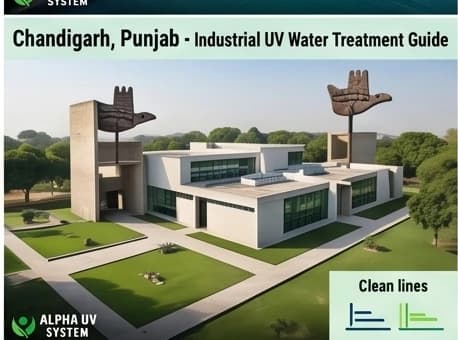
UV water treatment in Chandigarh and Punjab addresses four main requirements: (1) post-storage disinfection for residential and commercial buildings in Chandigarh, Mohali, and Panchkula where GMADA/MC-supplied canal water (Ghaggar River and Sutlej canals) loses residual chlorine in overhead tanks; (2) pharmaceutical-grade purified water for the Mohali-Derabassi-Baddi pharmaceutical cluster, including Schedule M 2025-compliant UV systems for the large number of WHO-GMP and USFDA-approved plants in this corridor; (3) food processing water disinfection for Punjab's rice milling, wheat flour, dairy, and food manufacturing sector; and (4) PPCB STP compliance UV for residential complexes in Chandigarh, Mohali, Panchkula, and the rapidly developing SAS Nagar townships. Alpha UV System supplies Philips UV-C lamp UV systems to Chandigarh and Punjab with 5–7 day delivery and PPCB documentation support.
Punjab — India's breadbasket and the state with the highest canal irrigation density in the subcontinent — draws its water from the Sutlej, Beas, and Ravi rivers through an extensive network of irrigation canals that also supply most urban water treatment plants. Chandigarh, the planned capital city shared between Punjab and Haryana, receives its municipal water supply primarily from the Ghaggar catchment and the Sutlej canal system through treatment plants at Kajauli (Sutlej) and Raipur Rani.
Punjab's water treatment market is shaped by two specific challenges that other Indian states share to a lesser degree: agricultural chemical contamination of groundwater (Punjab's intensive agriculture — rice-wheat rotation with heavy pesticide and fertiliser use — has resulted in elevated nitrate, pesticide residue, and uranium levels in borewell water in many districts) and the state's status as one of India's most important pharmaceutical manufacturing zones outside of Hyderabad, Mumbai, and Ahmedabad.
Punjab and Chandigarh Water Quality by Zone
| City / Zone | Water Source | Key Water Quality Issue | UV Solution |
|---|---|---|---|
| Chandigarh (MC supply) | Kajauli WTP (Sutlej canal) via MC piped supply | Good piped supply quality; bacterial regrowth in overhead tanks during April–July heat; older sectors with aging distribution mains | Post-tank UV at 40 mJ/cm², 1–5 m³/h |
| Mohali (SAS Nagar — GMADA supply) | GMADA piped supply (canal-derived) + borewell | Pharmaceutical cluster — pharmaceutical grade water requirements; residential township STP compliance; borewell TDS 400–1,000 mg/L in some sectors | Pharma UV (185 nm + 254 nm); residential STP UV; post-tank UV |
| Panchkula (Haryana Municipal) | HSVP piped supply + borewell | Growing residential stock; STP compliance for multi-storey buildings; borewell iron in some sectors | Post-tank UV; STP UV; iron pre-filter for borewell |
| Ludhiana | Sutlej canal + borewell backup | Textile/hosiery dye effluent affecting surface water; borewell TDS 400–900 mg/L; E. coli in some urban areas | Post-tank UV; UV-AOP for textile ETP; STP UV for residential |
| Amritsar | Ravi canal via treatment plant + borewell | Golden Temple water body — high public health sensitivity; tourism district hotels; food processing near Golden Temple | Post-tank UV for hotels and gurudwaras; food processing water UV; STP UV |
| Jalandhar | Beas and Sutlej canal + borewell | Sports goods manufacturing — bonding glue VOC effluent; borewell iron; leather small unit effluent | Post-tank UV for residential; ETP UV for sports goods units; STP UV |
| Baddi / Derabassi (Pharma cluster) | BBMB supply + borewell | Pharmaceutical manufacturing — full pharmaceutical grade water train required; Baddi is adjacent to Himachal border with Baddi Barotiwala Nalagarh (BBN) pharma zone | Full pharmaceutical water system — 185 nm + 254 nm UV mandatory; CDSCO Schedule M 2025 |
UV for the Mohali-Derabassi-Baddi Pharmaceutical Corridor
The pharmaceutical manufacturing corridor running from Mohali (SAS Nagar) through Derabassi to Baddi (Himachal Pradesh border area) is one of India's most concentrated pharmaceutical manufacturing zones. Companies including Cipla, Sun Pharma, Ranbaxy (now Sun Pharma), Lupin, Alkem, Ind-Swift Laboratories, Parabolic Drugs, and hundreds of contract manufacturing organisations (CMOs) operate plants in this corridor. Many of these plants hold WHO-GMP certification, USFDA Drug Establishment Registration, and EU GMP certificates — making regulatory compliance water treatment a non-negotiable requirement.
Pharmaceutical water UV requirements in the Mohali-Baddi corridor follow Schedule M 2025 (CDSCO) requirements, augmented by USFDA expectations for US-approved API and formulation manufacturers. Key UV specifications:
185 nm UV TOC reduction: After double-pass RO, TOC values of 50–200 ppb in the permeate are photo-oxidised to below 100 ppb using a fused silica sleeve reactor. Fused silica transmits the 185 nm wavelength; standard borosilicate sleeves block 185 nm and cannot provide TOC reduction. Flow rates 2–20 m³/h depending on plant purified water demand. Philips TUV reactors with custom fused silica sleeves are the correct specification for this application.
254 nm UV loop disinfection: On the purified water distribution loop return line at 40–80 mJ/cm². Continuous operation ensures the loop TVC remains below 100 CFU/mL at all use points. UV intensity sensor with 4–20 mA analog output integrates into plant SCADA/BMS for automatic alarm on low-UV-intensity conditions.
USFDA 21 CFR Part 11 data integrity: For USFDA-approved plants, UV intensity log data must be stored in an audit-trail-capable electronic record system. Alpha UV System provides 4–20 mA analog output from all pharmaceutical UV reactors, compatible with Wonderware, Ignition, and other SCADA platforms used in the Mohali-Baddi pharma corridor.
UV Water Treatment for Ludhiana's Textile and Hosiery Industry
Ludhiana — Punjab's largest city and industrial hub — is India's largest producer of knitwear, hosiery, and woollen goods. The textile processing cluster in Ludhiana (yarn dyeing, fabric dyeing, printing) generates dye effluent containing reactive dyes, acid dyes, and disperse dyes at concentrations that produce strongly coloured effluent requiring treatment before PPCB-consented discharge.
PPCB consent conditions for Ludhiana textile processing units specify colour discharge limits aligned with CPCB standards (<400 ADMI) and total coliform limits at the ETP outlet. UV-AOP (UV + H₂O₂) at 2,000–4,000 mJ/cm² is the established method for decolourising reactive dye effluent from hosiery yarn dyeing. Medium-pressure UV lamps provide the broad-spectrum UV output required for reactive dye chromophore breakdown. For Ludhiana's Focal Point (Phase-1 through Phase-8) and Dhandari Kalan industrial areas, UV-AOP integrated into the ETP colour treatment stage provides compliance with PPCB colour discharge standards.
UV for Amritsar's Food Processing and Tourism Sectors
Amritsar — home to the Golden Temple (Harmandir Sahib), one of the world's most visited religious sites — receives millions of domestic and international visitors annually. The langar (community kitchen) at Harmandir Sahib prepares meals for 50,000–100,000 people daily, making water quality at this site a matter of extraordinary public health significance. UV disinfection at 40 mJ/cm² on langar kitchen water supply provides a final disinfection barrier that is chemical-free, instantaneous, and safe for food preparation at scale.
Amritsar's hotel and tourism sector — serving the Golden Temple pilgrim market, the Wagah border ceremony tourism, and the historic city heritage tourism — requires UV at the hotel water supply for the same reasons as Rajasthan heritage hotels: storage tank bacterial regrowth risk and international guest susceptibility to water-borne illness.
Punjab's food processing sector — rice milling, wheat flour processing, potato chips, and dairy processing in the Amritsar, Ludhiana, and Jalandhar belt — uses water as both a process medium and a cleaning medium. FSSAI (Food Safety and Standards Authority of India) requirements for food processing water specify microbiological quality identical to potable water standards. UV at 40 mJ/cm² on process water supply ensures FSSAI compliance for food manufacturers across Punjab.
| Application | Flow Rate | UV Dose | Notes |
|---|---|---|---|
| Residential apartment (Chandigarh / Mohali) | 1–3 m³/h | 40 mJ/cm² | Post-overhead-tank UV; 5 µm pre-filter; summer months critical |
| Gated community — 150 flats (SAS Nagar) | 5–12 m³/h | 40 mJ/cm² | Twin reactors for redundancy; PPCB STP UV separate system |
| Pharmaceutical purified water (Mohali / Baddi) | 2–20 m³/h | 80 mJ/cm² | 185 nm + 254 nm; Schedule M 2025 IQ/OQ/PQ; USFDA data logging |
| Textile ETP colour treatment (Ludhiana) | 10–50 m³/h | 2,000–4,000 mJ/cm² | UV-AOP with H₂O₂; medium-pressure UV; PPCB colour limit 400 ADMI |
| Food processing water (Amritsar / Ludhiana) | 2–20 m³/h | 40 mJ/cm² | FSSAI food contact water standards; no chlorine residual in food processing stream |
| Hotel (Amritsar — heritage / Golden Temple area) | 3–15 m³/h | 40 mJ/cm² | Separate Legionella UV for cooling tower if present; kitchen water UV |
| STP outlet — 300 KLD (Chandigarh sector) | 20–30 m³/h | 40 mJ/cm² | Philips TUV 95W; PPCB consent documentation; monthly NABL test |
| Borewell with high pesticide concern (rural Punjab) | 1–3 m³/h after RO | 40 mJ/cm² | RO mandatory for pesticide / nitrate removal; UV after RO permeate storage |
PPCB STP Discharge Standards for Punjab
| Parameter | PPCB Standard (Surface Water) | PPCB Standard (Land/Irrigation) | UV Role |
|---|---|---|---|
| Total Coliform (MPN/100 mL) | <100 | <200 | Primary — UV at 40 mJ/cm² achieves <10 MPN/100 mL |
| BOD (mg/L) | <30 | <100 | None — biological treatment |
| COD (mg/L) | <250 | Not specified | None |
| TSS (mg/L) | <100 | <200 | Indirect — TSS >30 mg/L blocks UV penetration; secondary treatment must achieve TSS <30 mg/L before UV |
| pH | 6.5–8.5 | 5.5–9.0 | None |
Punjab borewell water shows nitrate and pesticide residues — what treatment do I need?
UV disinfection addresses biological contamination (bacteria, viruses) but does not remove dissolved chemicals including nitrate, pesticide residues, uranium, or arsenic — all of which have been documented in Punjab borewell water in affected districts (Malwa region particularly). For Punjab borewell water with chemical contamination concerns, the correct approach is: (1) get an NABL-accredited laboratory test for the specific parameters of concern — nitrate, pesticide residue, uranium, arsenic, fluoride, TDS; (2) based on the test report, design pre-treatment appropriately — RO removes 90–97% of nitrate, >95% of most pesticide residues, uranium, and arsenic; activated carbon removes pesticide residues and organic compounds effectively; (3) after pre-treatment, UV at 40 mJ/cm² on the RO permeate or treated water provides the microbiological safety barrier. Alpha UV System can review your NABL water test report and advise on the complete treatment chain — WhatsApp us the report for a free assessment.
For a Chandigarh apartment, is post-tank UV sufficient or do I need RO + UV?
For a Chandigarh apartment receiving MC piped supply (Kajauli WTP — Sutlej canal-derived), post-tank UV at 40 mJ/cm² is typically sufficient for microbiological safety. Chandigarh municipal supply treated at Kajauli meets IS 10500 chemical quality standards — TDS is typically 200–400 mg/L (well within the 500 mg/L IS 10500 limit), hardness is moderate, and fluoride is within limits. The primary risk is bacterial regrowth in the overhead tank, which UV resolves. RO is needed if: (a) your building uses borewell backup supply (TDS may exceed 500–1,000 mg/L); (b) your water test shows hardness above the IS 10500 limit; (c) you live in an older Chandigarh sector where the internal building plumbing is suspected to be old and potentially galvanised — in which case an NABL water test from the tap (not just the tank) is the correct first step. For piped MC supply, the recommended treatment for a Chandigarh home is: 5 µm sediment filter → UV at 40 mJ/cm². Add RO only if the water test shows a specific chemical parameter requiring it.
Alpha UV System supplies UV disinfection systems to residential complexes, pharmaceutical manufacturers, food processing units, textile ETPs, hotels, and STP operators across Chandigarh, Mohali, Ludhiana, Amritsar, Jalandhar, Panchkula, and the Baddi-Derabassi pharmaceutical corridor. PPCB STP documentation. Schedule M 2025 pharma water documentation. Philips UV-C lamps. 5–7 day delivery to Punjab and Chandigarh.
WhatsApp Us for Punjab UV System SupplyStandards, authorities & further reading
External references used to inform this guide. Regulations evolve — check the latest revision on each authority's site before compliance decisions.
Recommended UV Systems
Alpha UV System products for this application — powered by genuine Philips UV-C lamps.
Commercial UV Water Purification System
500 – 5,000 LPH
HACCP-compliant UV water purification for hotels, restaurants, and offices
Industrial UV Water Treatment System
5,000 – 50,000 LPH
Schedule M 2025 and HACCP compliant UV for pharma, food & beverage, and process water
Not sure which system suits your application? WhatsApp our engineers for a free recommendation →
Related solutions
See how Alpha UV System applies this to your industry or city.
Application
Marine UV — UV Disinfection
IMO D-2 compliant UV ballast water treatment for commercial shipping. USCG ballast water rule, MARPOL Annex IV, ISO 8217. 50,000–50,00,000 LPH. IIT Patna-trained engineers. Alpha UV System India.
Local service
UV Systems in Chandigarh
UV water disinfection systems for Chandigarh, Mohali, and Panchkula — pharmaceutical, hospitality, and municipal applications.
Need a UV system?
Talk to our UV engineers — WhatsApp for a quote in 2 hours, or browse the full catalog on IndiaMART.