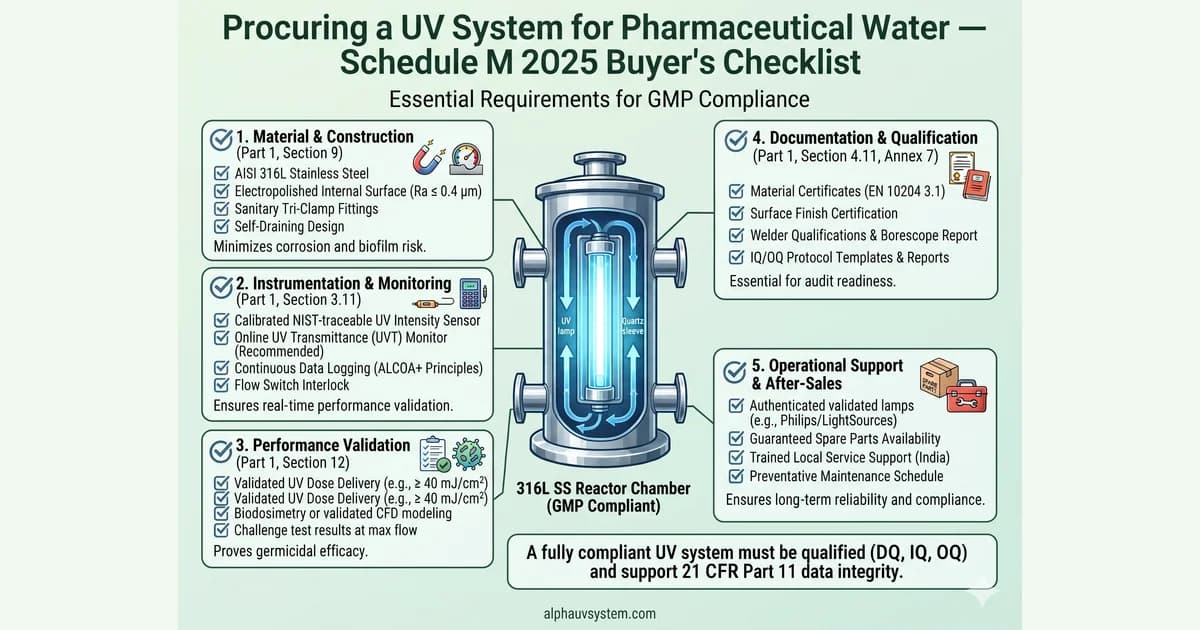
A Schedule M 2025-compliant UV system for pharmaceutical purified water must have: SS316L electropolished chamber with EN 10204 3.1 material certificate, Philips UV-C lamp with serial number and COA, NABL-calibrated UV intensity sensor with alarm relay, site-specific UV dose calculation report, and IQ/OQ/PQ documentation package. CDSCO inspectors now routinely request all 12 items listed in this checklist during GMP audits. A system that lacks any one of them fails the audit point regardless of how well it performs.
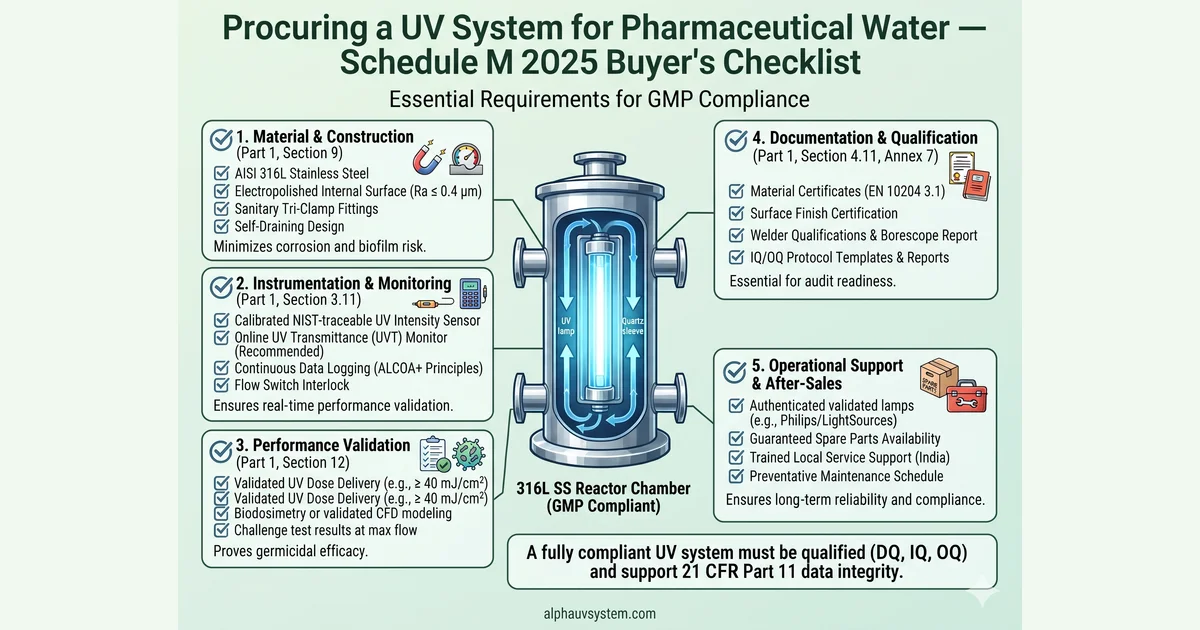
Why Procurement Decisions Determine Schedule M 2025 Audit Outcomes
Schedule M 2025 (the Revised GMP Rules enforced by CDSCO from January 2025) introduced explicit documentation requirements for UV disinfection systems in pharmaceutical water systems — purified water (PW) and Water for Injection (WFI). These requirements go beyond performance: an inspector who arrives at your facility will ask for the material certificate of the UV chamber, the Philips lamp serial number, the calibration certificate of the UV intensity sensor, the dose calculation report, and the completed IQ/OQ/PQ documentation. A UV system that delivers perfect dose but whose supplier cannot produce these documents will generate an observation — and repeat observations on water system qualification are a primary driver of Import Alerts and manufacturing suspensions in Indian pharma.
The correct time to ensure a UV system will pass a CDSCO audit is at procurement, not after installation. A specification written before the purchase order is placed determines whether the documentation package will be complete when the inspector arrives.
The 12-Point Procurement Checklist for Pharmaceutical UV Systems
1. SS316L Chamber with EN 10204 3.1 Material Certificate
The UV reactor chamber must be constructed from SS316L (not SS304, not SS316) with a surface finish of Ra 0.4 µm or better on water-contact surfaces. The supplier must provide an EN 10204 Type 3.1 material test certificate — a document issued by the steel mill that includes chemical composition (heat number traceable), tensile properties, and the inspector's attestation. A Type 2.1 or 2.2 certificate is not acceptable for Schedule M 2025. Verify the certificate before issue of purchase order: some suppliers provide a certificate upon request but the heat number on the certificate does not match the material used in construction.
2. Philips UV-C Lamp with Serial Number and Certificate of Authenticity
Schedule M 2025 requires a UV lamp from a supplier whose output-decay curve is documented and whose lamps can be individually traced. Philips UV-C germicidal lamps include a Certificate of Authenticity (COA) with a unique serial number and published intensity-decay data showing output at end-of-lamp-life (9,000 hours). This data is required to perform a credible dose calculation — a dose calculation based on generic lamp assumptions (without a specific lamp model's decay curve) cannot be validated by a CDSCO inspector. Generic or unbranded lamps fail this requirement by definition, regardless of claimed specifications.
3. Site-Specific UV Dose Calculation Report
The UV dose delivered by a system depends on lamp intensity, reactor geometry, water UV transmittance (UVT), and flow rate — none of which are generic. A supplier who quotes a system without asking for your flow rate and water UVT cannot provide a valid dose calculation. The dose calculation report must show: (a) the rated lamp intensity at the sensor position, (b) the lamp output at end-of-lamp-life (using the Philips decay curve), (c) the water UVT from your measured or specified permeate quality, (d) the resulting dose at your design flow rate, and (e) a demonstration that this dose meets the application requirement (40 mJ/cm² for PW, 80 mJ/cm² for WFI) with a specified safety margin. Confirm that the calculation covers end-of-lamp-life, not new-lamp intensity — the dose at 9,000 hours is what must meet the minimum requirement.
4. NABL-Calibrated UV Intensity Sensor with Alarm Relay
Schedule M 2025 requires continuous UV intensity monitoring with an alarm that triggers when intensity falls below the validated set-point. The sensor must be calibrated against a NABL-accredited laboratory standard — a calibration certificate from an in-house or non-accredited source is not sufficient for GMP audit. The alarm relay must have documented set-point logic (threshold mW/cm² corresponding to minimum acceptable dose at maximum flow) and the set-point must be justified in the validation documentation. Confirm that the supplier provides the NABL calibration certificate with the system, not as a later addition.
5. Tri-Clamp / Sanitary Connections — No BSP Threads on Water-Contact Joints
Threaded BSP connections on pharmaceutical water-contact joints are not acceptable under Schedule M 2025 — they cannot be CIP-cleaned or SIP-sterilised reliably. Connections must be sanitary tri-clamp (DIN 32676 or ISO 2852) with EPDM or PTFE gaskets rated for the operating temperature. Confirm connection type and gasket material specification before purchase order. Some suppliers offer tri-clamp as an upgrade at additional cost — ensure it is specified as standard, not optional.
6. Electropolished Interior Surface (Ra ≤ 0.4 µm)
The internal wetted surface of the UV reactor must be electropolished to Ra ≤ 0.4 µm to prevent microbial adhesion and facilitate CIP validation. Confirm that the supplier performs electropolishing (not just mechanical polishing) and provides surface roughness measurement data with the system delivery. Surface roughness above 0.4 µm on the reactor interior is a known Schedule M observation point for purified water systems.
7. Fused-Quartz Sleeve (Not Borosilicate Glass)
The quartz sleeve surrounding the UV lamp must be made from fused silica (fused quartz), not borosilicate glass. Borosilicate glass has UV transmittance of approximately 50–60% at 254 nm compared to over 90% for fused silica — using borosilicate means the lamp delivers less than 60% of its rated dose through the sleeve. Suppliers often substitute borosilicate because it is significantly cheaper. Specify fused silica quartz sleeve in the purchase order and require a written material confirmation in the system documentation.
8. IQ/OQ/PQ Documentation Package Aligned to Schedule M 2025
The supplier must provide IQ/OQ/PQ protocol templates pre-formatted for Schedule M 2025. Installation Qualification (IQ) must document the as-built configuration against the approved design — chamber material certificate, weld inspection records, P&ID as-built, calibration certificate for the UV intensity sensor. Operational Qualification (OQ) must demonstrate alarm actuation at the validated set-point, flow rate verification at rated capacity, and lamp warm-up time. Performance Qualification (PQ) must demonstrate that the system consistently delivers the required microbial reduction over three consecutive production periods. Suppliers who say "we can arrange this documentation" without having a pre-prepared template for Schedule M 2025 are relying on generic documentation that may not meet CDSCO inspection standards.
9. Lamp-Hours Counter with PLC Integration
The control system must include a cumulative lamp-hours counter that is logged in the PLC — not a mechanical timer that resets on power failure. CDSCO inspectors check lamp replacement records against lamp-hours counters during water system audits. A system without a PLC-logged lamp-hours counter cannot demonstrate compliant lamp replacement intervals, generating an audit observation on maintenance documentation.
10. 4–20 mA Output for SCADA / Building Management System
Pharmaceutical water systems typically require UV intensity data to be logged in the facility SCADA or building management system for continuous process monitoring. The UV control panel must provide a 4–20 mA analogue output for UV intensity and, ideally, a dry-contact output for lamp failure. Confirm the output specification and signal range before purchase — some lower-cost systems provide only a local display without analogue output, requiring a panel retrofit after installation.
11. Vendor Qualification Documentation
Your QA department's vendor qualification procedure likely requires a supplier to submit: a completed vendor questionnaire, evidence of manufacturing quality system (ISO 9001 or equivalent), reference list of comparable pharmaceutical UV systems supplied with contact details, and product liability insurance certificate. MSME registration for the Indian market (Udyam certificate) is required for certain government procurement. Collect these documents from the supplier before issuing purchase order — retroactive collection delays the IQ process.
12. Spare Parts Availability and Lead Time
A pharmaceutical UV system installed with no spare lamp or quartz sleeve in the maintenance store is a compliance risk — if the lamp fails during a production campaign, water supply is interrupted until a replacement arrives. Confirm the lamp model (Philips part number), ex-stock availability from the supplier's local warehouse, and typical replenishment lead time before purchase. For WFI-critical systems, a duty/standby UV configuration with automatic changeover is worth considering — if one lamp fails, the standby activates within seconds and production continues without interruption.
Three Common Procurement Errors That Cause Audit Failures
Specifying flow rate only, not UVT. UV dose depends on water UV transmittance as much as flow rate. A system sized for 95% UVT (typical RO permeate from clean municipal water) will under-dose at 85% UVT (typical RO permeate from bore-well or high-TOC feed water). Measure UVT of your RO permeate before purchase and provide it to the supplier as a specification requirement, not an afterthought.
Accepting generic IQ/OQ/PQ templates. Generic templates — not written for the specific system model, serial number, and your facility's water system design — are the most common documentation observation in CDSCO water system audits. Require that the IQ template references your specific chamber serial number, your Philips lamp serial number, your NABL calibration certificate number, and your site-specific dose calculation report. A template that says "insert lamp serial number here" is an IQ template awaiting completion — it is not a completed IQ record.
Buying on price without documentation scope. The cheapest UV system quote does not include the documentation scope. A ₹40,000 UV reactor without documentation costs ₹1,50,000–3,00,000 more after a CDSCO audit observation requires retroactive validation — if retroactive validation is even possible. For pharmaceutical water systems, the documentation cost is 30–50% of the total project cost and should be included in the purchase order scope, not treated as a separate optional service.
Alpha UV System Pharmaceutical UV Systems
Alpha UV System supplies pharmaceutical-grade UV disinfection systems for purified water and WFI applications across India — with the complete Schedule M 2025 documentation package included as standard: SS316L EN 10204 3.1 material certificate, Philips UV-C lamp COA with serial number, fused silica quartz sleeve, NABL-calibrated UV intensity sensor with alarm relay, site-specific dose calculation report, and IQ/OQ/PQ protocol templates pre-formatted for CDSCO audit submission. All systems use tri-clamp sanitary connections, electropolished interior surfaces (Ra ≤ 0.4 µm), PLC lamp-hours counter, and 4–20 mA SCADA output. IIT Patna engineers prepare the dose calculation and IQ/OQ/PQ documentation for each system.
See full specifications, compliance documentation scope, and capacity options on our pharmaceutical UV disinfection application page.
Share your flow rate, water grade (PW or WFI), source water UVT, and Schedule M documentation requirements — our IIT Patna engineers will provide a site-specific dose calculation and complete Schedule M 2025 procurement package within 48 hours.
WhatsApp for Pharma UV System ProposalStandards, authorities & further reading
Regulations evolve — check the latest revision on each authority's site before compliance decisions.
Recommended UV Systems
Alpha UV System products for this application — powered by genuine Philips UV-C lamps.
Industrial UV Water Treatment System
5,000 – 50,000 LPH
Schedule M 2025 and HACCP compliant UV for pharma, food & beverage, and process water
Commercial UV Water Purification System
500 – 5,000 LPH
HACCP-compliant UV water purification for hotels, restaurants, and offices
Not sure which system suits your application? WhatsApp our engineers for a free recommendation →
Related solutions
See how Alpha UV System applies this to your industry or city.
Need a UV system?
Talk to our UV engineers — WhatsApp for a quote in 2 hours, or browse the full catalog on IndiaMART.