Quick Answer
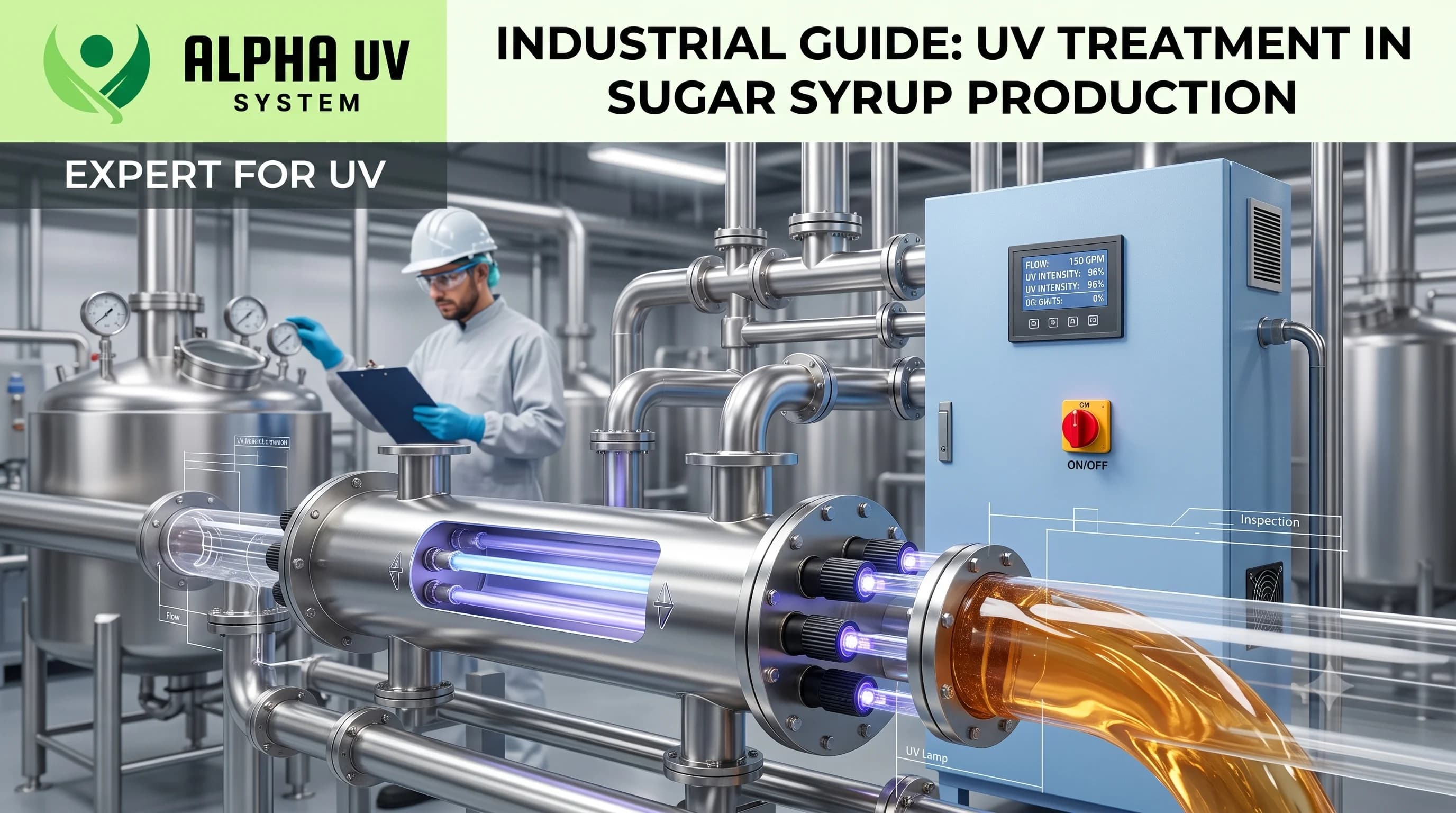
UV water treatment for the sugar industry delivers 4-log inactivation of Leuconostoc mesenteroides, Lactobacillus, wild yeast, and Bacillus stearothermophilus at 25–50 mJ/cm² — without adding any chemical to process water that contacts sugar, syrup, or juice streams. This is critical because the two conventional disinfection alternatives both damage sugar quality: chlorination at residuals above 0.3 mg/L reacts with reducing sugars to form chlorinated caramel compounds that darken white sugar colour and introduce off-notes into refined syrup; and heat treatment of process water increases energy consumption while doing nothing to control microbial regrowth in distribution pipework between the heat treatment point and the process vessel. UV water treatment for the sugar industry provides microbiologically safe process water with zero chemical addition, zero sucrose degradation risk, and zero colour impact on the finished product. Systems cover process water supply (1,000–50,000 LPH), syrup dilution water (500–10,000 LPH), CIP final rinse (2,000–20,000 LPH), and process cooling water (5,000–50,000 LPH), with FSSAI HACCP CCP documentation included as standard.
Water as a Process Variable in Sugar and Syrup Manufacturing
UV water treatment for the sugar industry exists because water contacts sucrose at multiple critical points in both cane sugar milling and syrup manufacturing — and any microbial contamination in this water transfers directly to the product stream. In cane sugar processing, water is used for: imbibition (hot water spray onto crushed bagasse to extract residual sucrose from the fibre), juice clarification (lime and water added to raw juice), multi-effect evaporation (steam condensate as process makeup), centrifuge wash (hot water washing massecuite in centrifuge baskets), and affination (water and steam for raw sugar washing in refineries). Each contact point is an opportunity for waterborne microorganisms to introduce contamination that compounds through the process.
In liquid sugar and syrup manufacturing — high-fructose corn syrup (HFCS), invert syrup, glucose syrup, and pharmaceutical-grade sucrose solutions — process water contacts the product in dilution, ion exchange regeneration, and carbon bed washing. Contamination at any of these stages introduces spoilage organisms into a high-sugar environment that promotes their rapid proliferation. UV water treatment for the sugar industry addresses this contamination risk at the water supply level — before contaminated water enters any process vessel.
The FSSAI Food Safety and Standards (Food Products Standards) Regulations classify sugar and sugar confectionery products under specific quality and purity standards that include microbiological limits on the finished product. Traceability of contamination to the process water supply is a documented cause of FSSAI product recall events in the Indian sugar sector, making process water quality a food safety liability issue as well as a quality control concern.
How Waterborne Microorganisms Cause Sugar Processing Losses
UV water treatment for the sugar industry targets spoilage organisms that cause two distinct types of economic loss: sucrose degradation losses and process equipment fouling losses.
Sucrose Degradation by Leuconostoc and Lactobacillus
Leuconostoc mesenteroides is the primary bacterial contaminant of concern in cane sugar processing. This heterofermentative lactic acid bacterium produces dextransucrase — an enzyme that cleaves sucrose and polymerises the glucose moiety into dextran, a high-molecular-weight polysaccharide. Dextran accumulates in juice and syrup streams, causing:
- Sucrose losses of 1–3% of total recoverable sugar — directly reducing factory yield and revenue. A factory processing 5,000 tonnes of cane per day losing 2% sucrose to dextran loses approximately 15–25 tonnes of white sugar per day at prevailing market prices.
- Viscosity increase — dextran dramatically increases juice and syrup viscosity, slowing filtration, reducing evaporator throughput, and increasing centrifuge wash water consumption.
- Massecuite crystal habit distortion — dextran adsorbs onto growing sucrose crystals, producing elongated "needle" crystals rather than regular cubic crystals, reducing final sugar purity and increasing downstream affination requirements.
- Pan boiling difficulties — high-dextran syrup boils unevenly, requiring additional strikes and consuming additional steam energy.
Leuconostoc contamination enters the process through imbibition water — the hot water (typically 70–80°C) sprayed onto crushed bagasse. If the imbibition water supply is contaminated with Leuconostoc, the organism is introduced at the first stage of juice extraction and proliferates through the entire juice processing sequence. UV water treatment for the sugar industry at the imbibition water supply point eliminates this contamination route. For context on how UV dose is calculated for industrial process water applications, see our UV dose calculation guide.
Thermophilic Spoilage in Syrup Evaporation
Bacillus stearothermophilus and related thermophilic Bacillus species survive the temperatures reached in multi-effect evaporators (70–110°C in early effects, cooling to 50–60°C in final effects). These organisms proliferate in the concentration gradients of the evaporation sequence, producing acid fermentation that inverts sucrose to glucose and fructose — reducing sucrose content and creating coloured compounds that increase the ICUMSA colour of the final white sugar. UV water treatment for the sugar industry on process water supply does not eliminate thermophiles already in the process — these must be controlled through hot water CIP of evaporators — but it prevents ongoing re-inoculation of the process through contaminated process water makeup additions.
Wild Yeast in Liquid Sugar and Syrup
In liquid sugar and syrup manufacturing (glucose syrup, invert syrup, high-fructose syrup), wild yeast — particularly osmotolerant Zygosaccharomyces rouxii and Torulaspora delbrueckii — is the primary spoilage concern. These species tolerate the high sugar concentrations (65–80° Brix) of concentrated syrups, producing CO₂ and ethanol that cause container bulging, off-flavour, and microbial load exceedance. Wild yeast contamination most commonly originates from the dilution water used in syrup formulation — if this water carries even a low wild yeast count, the sugar-rich environment amplifies it to spoilage concentrations within days at ambient temperature. UV water treatment for the sugar industry at the syrup dilution water supply provides the final pathogen barrier before the product is concentrated to storage-stable conditions.
Why Chlorination Damages Sugar Products
UV water treatment for the sugar industry is preferred over chlorination because chlorine — the default industrial disinfection approach — causes specific chemical damage to sugar products at concentrations required for effective disinfection:
Reaction with reducing sugars (invert sugar, glucose, fructose). Free chlorine (hypochlorous acid) reacts with reducing sugars at room temperature and accelerates markedly at elevated process temperatures. The reaction forms chlorinated hydroxymethylfurfural (Cl-HMF) and other chlorinated caramel compounds that:
- Increase ICUMSA colour units of white sugar — directly reducing grade and market value
- Produce off-flavours in glucose syrup and invert sugar used in confectionery applications
- Create chlorinated organic compounds that may trigger FSSAI maximum residue limit (MRL) exceedance in food-grade liquid sugar
Reaction with sucrose at elevated temperatures. At the temperatures used in evaporation and crystallisation (60–110°C), the rate of chlorine reaction with sucrose and its hydrolysis products accelerates significantly. Chlorinated byproducts formed at these temperatures are more stable than those formed at ambient temperature and are more difficult to remove from the product stream by subsequent processing. UV water treatment for the sugar industry avoids this reaction category entirely — UV at 254 nm does not react with dissolved sugars, does not produce chlorinated byproducts, and does not affect the colour of the product water.
For the underlying chemistry of why UV is preferred over chlorine in food product contact water, see our guide on UV vs chlorine for water disinfection.
Target Organisms and UV Dose Data for Sugar Industry Applications
| Organism | Sugar Industry Impact | UV Dose (4-log kill) | Temperature Tolerance |
|---|---|---|---|
| Leuconostoc mesenteroides | Dextran production — sucrose loss 1–3%, viscosity increase | 20 mJ/cm² | Mesophilic — optimum 20–30°C |
| Lactobacillus spp. | Lactic acid souring of juice and syrup streams | 25 mJ/cm² | Mesophilic, some thermotolerant strains |
| Bacillus stearothermophilus | Thermophilic souring in evaporator later effects | 40 mJ/cm² | Thermophilic — optimum 55–65°C, survives to 70°C |
| Zygosaccharomyces rouxii (wild yeast) | Osmotolerant — ferments concentrated syrup (65–80° Brix) | 35 mJ/cm² | Ambient — tolerates high osmotic pressure |
| Torulaspora delbrueckii (wild yeast) | CO₂ production in concentrated liquid sugar | 30 mJ/cm² | Ambient — high sugar tolerance |
| E. coli / coliforms | Food safety indicator — zero tolerance under FSSAI | 25 mJ/cm² | Mesophilic |
| Cryptosporidium parvum | Consumer health — chlorine-resistant oocysts in source water | 10 mJ/cm² | Tolerates wide temperature range as oocyst |
A standard 40 mJ/cm² UV water treatment system covers all organisms in this table except Bacillus stearothermophilus spores, which require 80–100 mJ/cm² for 4-log spore inactivation. For the imbibition water application in cane sugar mills (where thermophile control is a concern), Alpha UV System recommends 60–80 mJ/cm² as the design target. Vegetative cells of B. stearothermophilus are inactivated at standard doses; the spore form requires higher dose.
UV Water Treatment Application Points in Sugar and Syrup Operations
1. Imbibition Water (Cane Sugar Mills)
Imbibition water — hot water sprayed onto crushed bagasse at the third or fourth mill — is the first and most important UV water treatment for the sugar industry installation point in cane mills. This is where Leuconostoc enters the process: contaminated imbibition water introduces the organism into the mixed juice that becomes the starting material for all downstream processing. UV installed on the imbibition water supply line (typically 5,000–50,000 LPH for mills crushing 2,500–10,000 tonnes of cane per day) eliminates Leuconostoc and Lactobacillus before they enter the juice stream. UV dose: 40–60 mJ/cm². The imbibition water is typically at 70–80°C — hot water UV applications require lamps designed for operation at elevated water temperatures, which is a specific design parameter covered in Alpha UV System hot-water reactor designs.
2. Syrup Dilution and Formulation Water
In liquid sugar plants, syrup dilution water is mixed directly with concentrated sucrose or glucose to achieve the target Brix and purity specification. Any microbial contamination in the dilution water becomes part of the finished product. UV water treatment for the sugar industry at the dilution water supply (500–5,000 LPH depending on formulation throughput) provides the final pathogen barrier before product formulation. This application requires the highest dose specification of any sugar industry water treatment point: 60–80 mJ/cm² for pharmaceutical-grade liquid sucrose or glucose syrup destined for injectable drug formulations, where bioburden limits are strictest.
3. CIP Final Rinse Water
CIP systems in sugar refineries and syrup plants wash process vessels, pipework, and heat exchangers with hot caustic, acid, and final potable water rinse. The CIP final rinse removes chemical residuals and must itself be microbiologically safe — any Leuconostoc or wild yeast in the rinse water re-contaminates the cleaned equipment surface and survives to the next production batch. UV water treatment for the sugar industry on CIP rinse water supply (typically 3,000–20,000 LPH for large CIP ring mains) is essential for breaking the contamination cycle between batches. This is the primary intervention point for operators experiencing persistent Leuconostoc contamination despite rigorous CIP protocols — if the rinse water is itself a contamination source, no amount of CIP chemical protocol improvement will resolve the problem.
4. Process Cooling Water (Crystallisation, Condensers)
Cooling water in pan crystallisation systems — used in the vacuum pan water circuit for condenser cooling — and in syrup plate heat exchangers can carry biological contamination that cross-contaminates product streams if heat exchanger plates develop micro-leaks. UV water treatment for the sugar industry at the process cooling water supply (5,000–50,000 LPH) reduces this cross-contamination risk category. While cooling water typically does not contact the product directly, the consequences of a plate heat exchanger micro-leak into a high-value pharmaceutical-grade syrup batch justify the additional UV treatment as a risk management measure.
Dextran Testing as a Process Indicator for UV Effectiveness
UV water treatment for the sugar industry can be validated not just by UV intensity monitoring (the direct performance indicator) but by tracking dextran content in mixed juice — the key indirect indicator of Leuconostoc contamination control. The standard dextran test method for sugar mills is ICUMSA Method GS4-13 (Haze method) or the rapid Roberts dextran test:
- Dextran in juice above 300 mg/kg indicates significant Leuconostoc contamination — process losses are measurable at this level
- Dextran above 1,000 mg/kg indicates severe contamination — visible impacts on massecuite viscosity and crystal quality
- Target after UV installation: dextran below 100 mg/kg in mixed juice (the level at which processing impacts are negligible)
Comparing dextran readings before and after UV system installation on the imbibition water supply provides a direct measure of UV treatment effectiveness in reducing Leuconostoc load in the process. This data can be submitted to management and quality auditors as evidence of the economic benefit of UV water treatment.
FSSAI Compliance for Sugar and Syrup Process Water
UV water treatment for the sugar industry satisfies FSSAI compliance requirements at multiple levels:
FSSAI Food Products Standards (Sugar and Sugar Products): Finished white sugar must meet the colour specification (ICUMSA 45–100 for refined white sugar) and microbiological standards (total plate count, yeast and mould count). Process water contamination is a traceable cause of colour and microbiological exceedance.
FSSAI GMP (Good Manufacturing Practice) Requirements: Schedule 4 GMP requirements for food business operators mandate that all water used in food processing meet BIS IS 10500 microbiological standards at the point of use. The process water supply to mills and refineries is a designated GMP water use point — UV disinfection satisfies this requirement with continuous monitoring documentation.
HACCP CCP Documentation: The UV intensity log (continuous, timestamped) constitutes the CCP monitoring record for the water treatment critical control point. This is the document that FSSAI inspectors and BRC/FSSC 22000 auditors look for when assessing process water CCP compliance in sugar and syrup operations.
For more on how UV water treatment integrates into food industry HACCP programmes, see our complete guide on UV water treatment for the food and beverage industry.
System Sizing for UV Water Treatment in Sugar Operations
| Operation Type | Scale | Imbibition / Process Water UV | CIP Rinse UV | Syrup Dilution UV |
|---|---|---|---|---|
| Small cane mill | 500–2,500 TCD | 5,000–25,000 LPH | 3,000–10,000 LPH | Not applicable |
| Medium cane mill | 2,500–7,500 TCD | 25,000–75,000 LPH | 10,000–30,000 LPH | Not applicable |
| Sugar refinery | Any scale | 5,000–50,000 LPH | 5,000–20,000 LPH | 500–5,000 LPH |
| Liquid sugar / syrup plant | Any scale | 5,000–50,000 LPH process water | 5,000–20,000 LPH | 1,000–10,000 LPH |
TCD = Tonnes Cane per Day. Imbibition water flow rate is approximately 25–30% of crushing capacity in volume terms — a 5,000 TCD mill requires approximately 1,500–2,000 cubic metres of imbibition water per day, equivalent to 62,500–83,000 LPH peak demand.
Frequently Asked Questions
Does UV work on hot imbibition water (70–80°C)?
Yes — UV water treatment for the sugar industry at elevated temperatures is technically feasible with reactors specifically designed for hot water service. Standard UV reactors are designed for water temperatures up to 40–50°C; hot water applications require thermal-rated quartz sleeve seals, high-temperature O-rings, and lamp cooling provisions. Alpha UV System designs hot water UV reactors for imbibition water applications with operating temperature ratings up to 85°C. The UV dose delivered at 70–80°C water is essentially the same as at ambient temperature — UV inactivation kinetics are not significantly temperature-dependent for the organisms targeted in sugar mill applications.
We already have a dextran problem. Will UV fix it?
UV water treatment for the sugar industry prevents new Leuconostoc contamination from entering the process through contaminated water — it does not remove dextran already present in juice or syrup. If dextran levels are already elevated at the start of a season or batch, the immediate intervention is dextranase enzyme addition (which cleaves the existing dextran polymer) combined with UV system installation on the imbibition water supply to prevent ongoing re-inoculation. Within 3–5 days of UV system operation with clean imbibition water, Leuconostoc counts in mixed juice decline measurably; dextran accumulation slows; and without continuing re-inoculation from contaminated imbibition water, the dextran level stabilises and declines as dilution through the process dilutes the residual polymer.
Will UV water treatment affect white sugar colour (ICUMSA)?
No. UV at 254 nm does not react with dissolved sucrose, does not form coloured compounds in the water, and has no impact on the colour of the treated water or any product that contacts it. The ICUMSA colour of white sugar is determined by the concentration of coloured compounds (melanins, caramels, polyphenolics from cane) that co-crystallise with sucrose — not by the disinfection method used on process water. UV water treatment for the sugar industry has no colour impact; chlorination at elevated concentrations can increase ICUMSA colour through the reaction with reducing sugars described above.
We produce pharmaceutical-grade liquid sucrose. What UV dose is required?
Pharmaceutical-grade liquid sucrose (used as a vehicle in oral liquid formulations) must meet USP, EP, or IP specifications for total aerobic microbial count (TAMC ≤ 100 CFU/ml for oral liquids), yeast and mould count (TYMC ≤ 10 CFU/ml), and absence of specified organisms (E. coli, Salmonella, Pseudomonas aeruginosa, S. aureus). For the process water used in pharmaceutical-grade sucrose formulation, UV water treatment for the sugar industry should be specified at 80–100 mJ/cm² — providing the additional safety margin required for pharmaceutical water applications. This is consistent with Schedule M 2025 requirements for purified water used in drug formulation. Our guide on UV disinfection for pharmaceutical plants in India covers the Schedule M requirements in detail.
Our sugar mill runs only 5–6 months per year. Is UV cost-effective?
Yes — UV water treatment for the sugar industry on seasonal crushing operations is cost-effective because the sucrose loss prevention benefit accrues per tonne of cane crushed, not per year of operation. A 5,000 TCD mill running 5 months (approximately 150 days) processing 750,000 tonnes of cane: at 2% sucrose loss to dextran (market rate approximately ₹35,000/tonne white sugar), the annual loss is approximately ₹525 crore. Reducing this by 50% through UV imbibition water treatment represents a substantial benefit versus the UV system capital cost of ₹15–40 lakh for a mid-scale installation. Even conservatively, the payback period for UV water treatment for the sugar industry is less than one crushing season for most medium to large operations. Off-season, the UV system is powered down (lamps off, system winterised) — no operating cost is incurred during the off-season.
Does process water for a sugar mill need pre-treatment before UV?
It depends on the water source. Surface water (river, canal) drawn for imbibition — common for mills in river-adjacent locations in UP, Maharashtra, and Karnataka — typically has UVT of 50–70% and requires multimedia filtration (settling, sand filtration) before UV to restore UVT and remove suspended solids that shield microorganisms. Borewell water used in sugar refineries and syrup plants is typically clearer (UVT 75–90%) and may not require pre-filtration. A UVT measurement of the actual process water source is the essential first step before specifying the UV system capacity. Alpha UV System provides free sizing calculations based on UVT test results. See our detailed guide on whether you need a filter before UV water treatment.
Related Resources
- Sugar and Syrup Industry UV Disinfection System — application overview and inquiry
- UV Water Treatment for Food and Beverage Industry — complete F&B compliance guide
- UV vs Chlorine for Water Disinfection — full technical comparison including sucrose reaction data
- How to Calculate UV Dosage — flow rate, UVT, dose calculation for process water
- UV Disinfection for Pharmaceutical Plants — Schedule M 2025 pharma-grade water requirements
- Do I Need a Filter Before UV Water Treatment? — pre-treatment guidance for surface and borewell water
- UV vs Chlorine — complete technical comparison
- Certifications — ISO 9001:2015, CE, FSSAI documentation support
Recommended UV Systems
Alpha UV System products for this application — powered by genuine Philips UV-C lamps.
Commercial UV Water Purification System
500 – 5,000 LPH
HACCP-compliant UV water purification for hotels, restaurants, and offices
Industrial UV Water Treatment System
5,000 – 50,000 LPH
Schedule M 2025 and HACCP compliant UV for pharma, food & beverage, and process water
Not sure which system suits your application? WhatsApp our engineers for a free recommendation →
Related solutions
See how Alpha UV System applies this to your industry or city.
Need a UV system?
Talk to our UV engineers — WhatsApp for a quote in 2 hours, or browse the full catalog on IndiaMART.