Quick Answer
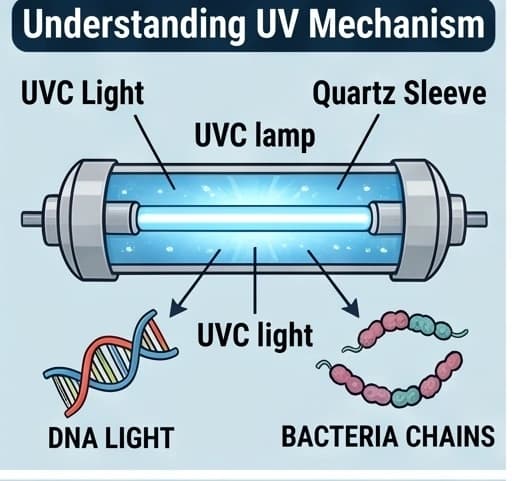
UV water treatment works by exposing flowing water to ultraviolet light at a wavelength of 254 nanometres (nm) — the UV-C band that is maximally absorbed by microbial DNA and RNA. When microorganisms in water absorb this UV-C energy, it creates thymine dimers — covalent bonds between adjacent thymine bases in the DNA strand that prevent the cell from replicating its genetic material. A microorganism that cannot replicate cannot cause infection — it is effectively inactivated regardless of whether the cell is physically destroyed. How UV water treatment works at the dose level: UV dose is measured in millijoules per square centimetre (mJ/cm²) and is calculated as UV intensity (mW/cm²) × contact time (seconds). At 40 mJ/cm² — the WHO minimum dose for drinking water disinfection — UV water treatment achieves 4-log (99.99%) inactivation of E. coli, Salmonella, Vibrio cholerae, and most waterborne viruses; and similar performance against Cryptosporidium and Giardia that are completely resistant to chlorine. UV water treatment adds no chemicals, creates no disinfection byproducts, and does not change water taste, odour, or chemistry.
The Physics of How UV Water Treatment Works
Understanding how UV water treatment works requires understanding the UV spectrum. Ultraviolet radiation spans wavelengths from 100 nm to 400 nm — shorter wavelengths than visible light (400–700 nm), invisible to the human eye, but carrying higher energy per photon. The UV spectrum is divided into four bands:
- UV-A (315–400 nm): Closest to visible light; causes tanning and some vitamin D synthesis. Minimal germicidal effect.
- UV-B (280–315 nm): Causes sunburn and vitamin D synthesis. Some germicidal effect at high doses.
- UV-C (200–280 nm): The germicidal band. Peak DNA absorption at 254 nm. Not present in sunlight reaching Earth's surface (absorbed by the ozone layer).
- Vacuum UV (100–200 nm): Extremely high energy; absorbed by water and air. Used for TOC reduction and ozone generation in specialised applications.
UV water treatment works exclusively in the UV-C band, and specifically at 254 nm — the wavelength at which both DNA and RNA have their maximum absorption coefficient. This is not a coincidence: low-pressure mercury vapour lamps, the most common UV source in water treatment, emit approximately 85% of their output at exactly 254 nm. The alignment of lamp emission peak with DNA absorption maximum is what makes mercury UV-C lamps uniquely effective for water disinfection. Our guide on UVA, UVB, and UVC differences in water disinfection explains the full spectrum in more detail.
How UV Water Treatment Works at the Molecular Level
The mechanism by which UV water treatment works at the cellular level is highly specific and well-characterised in photobiology:
Thymine Dimer Formation
DNA is a double helix polymer consisting of four nucleotide bases: adenine (A), thymine (T), guanine (G), and cytosine (C). Thymine has a high absorption coefficient at 254 nm — when a thymine base absorbs a 254 nm photon, the absorbed energy can cause a covalent bond to form between adjacent thymine bases on the same DNA strand. This is a thymine dimer (technically a cyclobutane pyrimidine dimer — CPD). This bond distorts the DNA helix geometry at that point, making it impossible for DNA polymerase — the enzyme that copies DNA during cell division — to read past the dimer site. The result: the cell cannot complete DNA replication and cannot divide. This is how UV water treatment works to inactivate microorganisms — not by physical destruction but by photochemical damage to the genetic blueprint that the cell needs to reproduce.
UV Inactivation of RNA Viruses
How UV water treatment works against RNA viruses (including enteric viruses like Norovirus, Hepatitis A, and Poliovirus) follows a slightly different mechanism. RNA viruses use RNA as their genetic material, and RNA absorbs 254 nm UV similarly to DNA. UV at 254 nm creates uracil dimers (uracil is the RNA equivalent of thymine) and other photoproducts in viral RNA that prevent the virus from replicating after entering a host cell. Enveloped viruses (which have a lipid membrane around the capsid) may also experience UV damage to the envelope proteins, reducing ability to infect host cells. UV water treatment works on both DNA-based bacteria and RNA-based viruses through nucleic acid photodamage.
Photoreactivation: The Caveat to How UV Water Treatment Works
Some bacteria have a repair mechanism called photoreactivation — they can use visible light (specifically 320–450 nm, the near-UV/blue visible range) to activate a photolyase enzyme that reverses thymine dimer formation. This has been documented in laboratory studies and raised concerns about UV water treatment efficacy when UV-treated water is subsequently exposed to sunlight or fluorescent light. In practice, photoreactivation is a minor concern for properly designed UV water treatment systems because: (1) UV doses of 40+ mJ/cm² create far more DNA damage than photoreactivation enzymes can repair; (2) water treated in underground pipes, storage tanks, and enclosed distribution systems has no light exposure for photoreactivation; and (3) Cryptosporidium and Giardia — two of the most important targets of UV water treatment — have no photoreactivation mechanism. The practical significance of photoreactivation is negligible in closed-pipe water distribution systems at standard UV doses.
UV Dose: The Core Parameter of How UV Water Treatment Works
How UV water treatment works at the system level is defined by UV dose — the quantity of UV energy delivered to water per unit volume:
UV dose (mJ/cm²) = UV intensity (mW/cm²) × contact time (seconds)
For a UV system operating at 5 mW/cm² intensity with a 10-second contact time, the UV dose is 50 mJ/cm². The minimum dose required for water disinfection depends on the target pathogen and required log reduction:
| Pathogen | 1-log (90%) kill | 2-log (99%) kill | 4-log (99.99%) kill | Chlorine resistance |
|---|---|---|---|---|
| E. coli | 3 mJ/cm² | 6 mJ/cm² | 25 mJ/cm² | Low |
| Salmonella spp. | 4 mJ/cm² | 10 mJ/cm² | 22 mJ/cm² | Low to moderate |
| Vibrio cholerae | 0.5 mJ/cm² | 1.5 mJ/cm² | 6 mJ/cm² | Low |
| Cryptosporidium parvum | 1.6 mJ/cm² | 3.4 mJ/cm² | 10 mJ/cm² | Completely resistant |
| Giardia lamblia | 1.5 mJ/cm² | 2.1 mJ/cm² | 11 mJ/cm² | Very high |
| Norovirus (GII) | 4 mJ/cm² | 11 mJ/cm² | 40 mJ/cm² | Moderate to high |
| Adenovirus (most UV-resistant human pathogen) | 14 mJ/cm² | 24 mJ/cm² | 100+ mJ/cm² | Moderate |
| Legionella pneumophila | 3 mJ/cm² | 7 mJ/cm² | 22 mJ/cm² | Low planktonic; moderate in biofilm |
| Listeria monocytogenes | 7 mJ/cm² | 15 mJ/cm² | 40 mJ/cm² | Moderate |
The WHO Drinking Water Guidelines specify 40 mJ/cm² as the minimum UV dose for drinking water disinfection — providing 4-log kill of most bacterial pathogens and protozoa, and 2-log+ kill of most waterborne viruses except adenovirus. For pharmaceutical water (WHO GMP, Schedule M 2025) and food-grade applications where higher safety margins are required, 80–100 mJ/cm² is the standard. How UV water treatment works at these different dose levels is simply a matter of more UV energy = more DNA damage = higher log reduction. For a complete application-by-application dose guide, see our UV dosage calculation guide.
UV Transmittance (UVT): How Water Quality Affects UV Water Treatment
How UV water treatment works is significantly influenced by the UV transmittance (UVT) of the water — the percentage of 254 nm UV light that passes through the water rather than being absorbed or scattered:
UVT is measured as the percentage of UV light that passes through a 10 mm water column at 254 nm. Pure water has a UVT of approximately 98%. Real water sources have lower UVT because dissolved organic compounds, iron, manganese, nitrates, and suspended particles absorb or scatter UV light:
| Water Source | Typical UVT Range | UV Treatment Implication |
|---|---|---|
| Municipal supply (Delhi NCR, dry season) | 88–95% | Standard UV sizing — no pre-treatment needed |
| Municipal supply (monsoon, high turbidity) | 70–85% | System sized for worst-case UVT; filtration if below 70% |
| Borewell (clear, low iron) | 80–92% | Standard UV sizing |
| Borewell (iron-rich, >0.5 mg/L Fe) | 40–70% | Iron removal filter required upstream of UV |
| Surface water (river, pond) | 30–65% | Multimedia filtration + carbon required before UV |
| STP/ETP secondary effluent | 55–80% | UV sized for 55–65% UVT; filtration if below 50% |
| Cooling tower recirculating water | 60–80% | Side-stream UV sized for actual recirculating water UVT |
How UV water treatment works in low-UVT water: a UV system sized for 40 mJ/cm² at 90% UVT will deliver less than 40 mJ/cm² if operated at 60% UVT water without modification. This is why correct UVT measurement and UV system sizing for worst-case UVT is essential for any UV installation. Alpha UV System uses ANSYS Fluent CFD simulation to validate UV dose distribution in each reactor design at the specified flow rate and minimum UVT — ensuring that 40+ mJ/cm² is delivered to every volume of water even at the least-favourable hydraulic and optical conditions. For more on how optical properties affect UV performance, see UV water treatment on cloudy and turbid water.
The Components of a UV Water Treatment System
How UV water treatment works at the system level involves several integrated components:
1. UV-C Lamp
The UV-C lamp is the UV light source — the component that generates 254 nm radiation. Low-pressure mercury vapour lamps (the standard in drinking water and process water UV treatment) emit approximately 85% of their output at 254 nm. They operate at a mercury vapour pressure of 0.7–1.3 Pa, which produces the characteristic 254 nm spectral line of mercury. Lamp rated life (for low-pressure Philips UV-C lamps used in Alpha UV System reactors) is 9,000 hours — approximately 12–13 months of continuous operation — at which point UV output has declined to 80% of initial output. The UV intensity sensor detects this output decline and triggers a lamp replacement alert before the dose falls below the critical limit.
2. Quartz Sleeve
The quartz sleeve is a transparent tube that surrounds the UV lamp and separates it from the water. Quartz (silicon dioxide) transmits UV-C light efficiently (90%+ transmission at 254 nm), while protecting the lamp from water cooling (lamps operate at an optimal mercury vapour temperature of 40–60°C — cooling by water contact would reduce UV output significantly). The quartz sleeve must be kept clean — mineral scale and organic deposits on the sleeve absorb UV before it reaches the water, reducing effective dose. Quarterly cleaning with dilute acid or isopropanol, or automatic wipers in high-turbidity applications, maintains sleeve transmittance.
3. Reactor Chamber
The reactor chamber (in Alpha UV System designs, machined from SS316L stainless steel) contains the lamp-sleeve assembly and the flowing water. The internal geometry of the reactor — the reflectivity of chamber walls, the number of lamps, and the water flow path around the lamp — determines the UV dose distribution. How UV water treatment works efficiently depends on the reactor ensuring that all water receives the minimum required dose, not just the water flowing closest to the lamp. Alpha UV System validates reactor dose distribution using CFD (Computational Fluid Dynamics — ANSYS Fluent 2024 R1 with 3.2 million cell mesh) before manufacturing any reactor design, confirming minimum dose delivery in worst-case hydraulic conditions including maximum flow rate and minimum UVT.
4. UV Intensity Sensor
A quartz-windowed photodetector calibrated to the 254 nm wavelength measures UV intensity in the reactor in real time (mW/cm²). This sensor output is the basis for continuous CCP monitoring in HACCP applications, for the UV intensity alarm that triggers when the lamp reaches end of life or the quartz sleeve becomes fouled, and for calculating the delivered UV dose from the measured intensity and flow rate. NABL calibration of the UV sensor — against a certified reference source — validates that the sensor reading is accurate, which is required for NABH, FSSAI, and other regulatory applications of the UV intensity log as a monitoring record.
5. Flow Control and Alarm Integration
UV water treatment works as a reliable disinfection barrier only when the flow rate through the reactor stays within the design range. Exceeding the maximum design flow rate reduces contact time and therefore UV dose below the critical limit. UV systems for regulated applications include a flow indicator and high-flow alarm — or a flow controller — to ensure the flow rate stays within the designed range. In fully automated systems (pharmaceutical plants, large municipal applications), the UV controller integrates with the site SCADA system, logging intensity, flow, and alarm events automatically.
What UV Water Treatment Does Not Remove
Understanding how UV water treatment works requires clarity on its boundaries:
- Dissolved chemicals: UV does not remove dissolved solids, heavy metals, nitrates, pesticides, or pharmaceuticals from water. UV is a disinfection technology, not a filtration or demineralisation technology. For chemical contamination, reverse osmosis or activated carbon filtration is required in addition to UV.
- Suspended solids and turbidity: UV does not remove particulate matter. In fact, high turbidity reduces UV effectiveness by shielding microorganisms from UV exposure. Pre-filtration is required for turbid water sources before UV treatment.
- Biofilm in existing pipework: UV inactivates microorganisms in the water column passing through the reactor. It does not penetrate or eliminate biofilm already established on pipe walls, tank surfaces, or fittings downstream of the UV system. UV prevents new biofilm formation by reducing the planktonic population; it does not remediate existing biofilm.
- Residual protection in distribution: Unlike chlorine, UV leaves no residual disinfectant in the treated water. If recontamination occurs downstream of the UV system — from biofilm in pipework, from storage tanks without adequate covers, from non-sanitary fittings — UV cannot prevent this recontamination. This is why UV systems are installed as close to the point of use as practical in high-risk applications.
For a complete guide to UV limitations, see our dedicated post on what UV water disinfection does not remove.
How UV Water Treatment Compares to Chlorination
How UV water treatment works is fundamentally different from how chlorination works — and the differences explain when each is appropriate:
| Parameter | UV Water Treatment | Chlorination |
|---|---|---|
| Mechanism | DNA/RNA photodamage — prevents reproduction | Chemical oxidation of cell membrane and enzymes — kills cell |
| Cryptosporidium | 4-log at 10 mJ/cm² — highly effective | No inactivation at any practical dose |
| Giardia | 4-log at 11 mJ/cm² — highly effective | Requires high dose (CT > 150 mg·min/L) — impractical |
| Adenovirus | 4-log requires 100+ mJ/cm² — limitation of UV | Moderate — effective at practical CT values |
| Residual in distribution | None — no residual after UV reactor | Residual maintained through distribution — advantage in long networks |
| Disinfection byproducts | None (no reaction with water chemistry) | THMs, HAAs, chloramines — regulated carcinogens |
| Effect on water chemistry | None — mineral profile unchanged | Increases chloride, alters pH buffering |
| Taste/odour | None detectable | Chlorine taste at >0.5 mg/L — consumer complaints common |
| Chemical handling hazard | None | Sodium hypochlorite — Class 5.1 oxidiser |
The complementary nature of UV and chlorination means many water treatment systems use both: chlorination provides residual protection in distribution networks; UV provides Cryptosporidium/Giardia control and reduces the chemical dose required. For a complete technical comparison, see our dedicated guide on UV vs chlorine for drinking water disinfection.
Where UV Water Treatment Works: Applications by Sector
How UV water treatment works in different applications varies by the water source, target pathogens, regulatory requirements, and integration with other treatment steps:
- Drinking water: UV provides the primary pathogen barrier — Cryptosporidium, Giardia, bacteria, viruses — at 40 mJ/cm². WHO standard. See our complete guide to UV water treatment systems.
- Pharmaceutical water (WFI, purified water): UV at 80–100 mJ/cm² controls bioburden in water-for-injection loops. Schedule M 2025, USP, EP compliant.
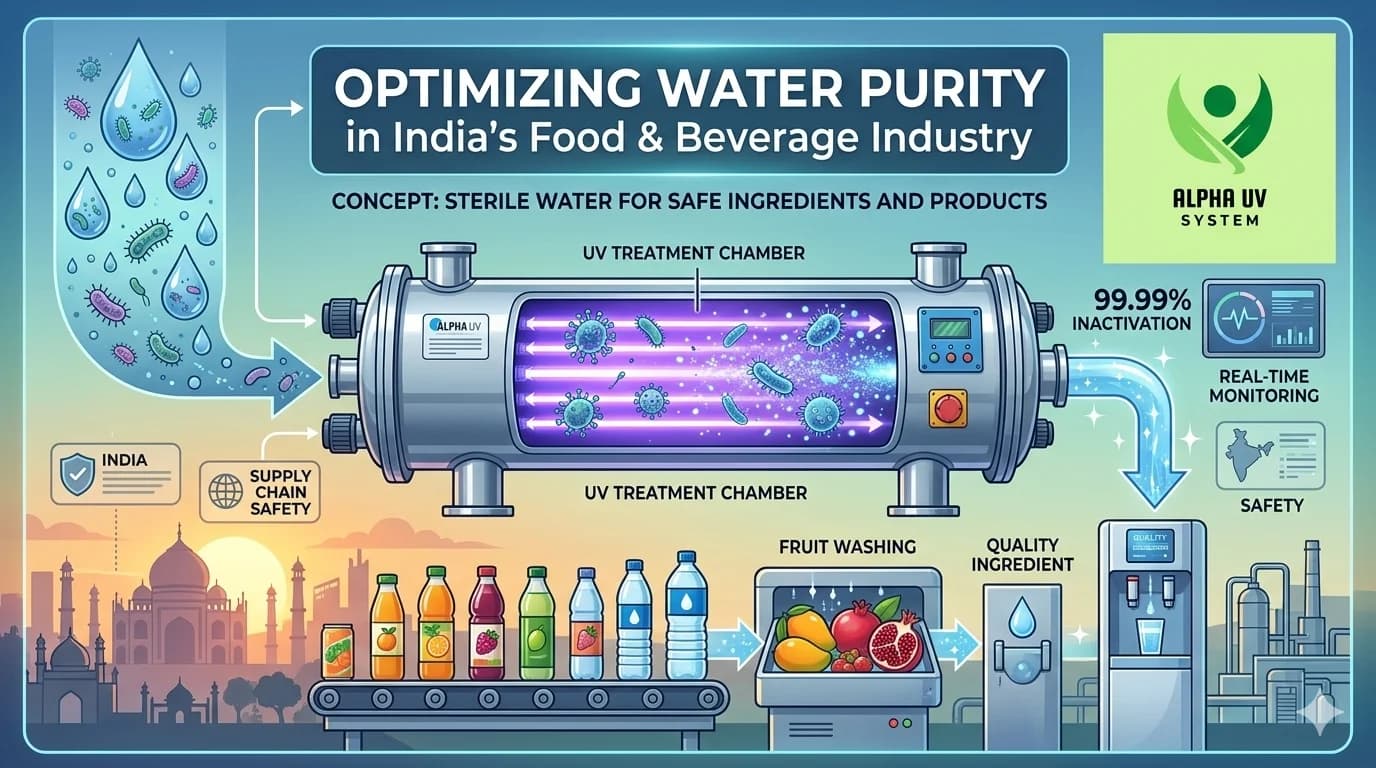
- Food and beverage: UV controls spoilage organisms (Listeria, E. coli, wild yeast) in process water and CIP rinse without chemical contamination. FSSAI HACCP compliant.
- STP/ETP tertiary treatment: UV provides final disinfection of treated effluent before discharge — no DBPs in treated discharge, CPCB compliant at 40–80 mJ/cm².
- Swimming pools: UV combined with chlorination breaks down chloramines (the cause of pool odour and eye irritation) and provides Cryptosporidium control. See our UV disinfection for swimming pools guide.
Frequently Asked Questions
Does UV water treatment actually kill bacteria, or just prevent them from reproducing?
How UV water treatment works is technically inactivation rather than killing in the biological sense. UV-damaged microorganisms may remain structurally intact (the cell membrane is not ruptured) but cannot reproduce — which means they cannot cause infection. From a water safety standpoint, this distinction is irrelevant: an inactivated pathogen is a safe pathogen. For standard UV doses of 40 mJ/cm², the DNA damage is so extensive that even UV-resistant bacteria (those with multiple DNA repair mechanisms) cannot survive the damage. At doses above 80 mJ/cm², there is also direct damage to cell membrane proteins and enzymatic systems that contributes to cellular death in the traditional sense.
Is UV water treatment safe for human consumption?
Yes — UV water treatment is completely safe. UV-C light at 254 nm is absorbed in the top layer of human skin and the tear film of the eye and cannot penetrate into tissue. The UV lamp in a water treatment reactor is enclosed within the quartz sleeve and stainless steel chamber — the UV light never exits the sealed reactor. The water passing through the UV reactor is not radioactive, does not carry UV energy, and is chemically unchanged. UV water treatment has been used for municipal drinking water disinfection since the 1910s (the first municipal UV water treatment system was installed in Pulheim, Germany, in 1910) and is approved by WHO, USEPA, and BIS for drinking water applications.
How much electricity does UV water treatment use?
UV water treatment is highly energy-efficient. A typical UV system for a home or small commercial application (1,000–2,000 LPH) uses 30–60 watts — comparable to a standard light bulb. A large industrial UV system treating 50,000 LPH uses 1–4 kW. The energy cost per 1,000 litres of treated water is typically ₹0.2–0.8 depending on system size and local electricity tariff. This is substantially lower than the energy cost of alternative disinfection methods: ozonation requires 5–15 Wh/m³ of ozone generation energy, and boiling water for disinfection requires approximately 80 Wh/litre. Our detailed analysis is in Are UV water systems energy efficient?
Do I need a filter before UV water treatment?
It depends on the source water quality. How UV water treatment works most effectively requires water with UVT above 75% and turbidity below 5 NTU. Municipal supply water in most Indian cities meets this requirement directly. Borewell water with iron above 0.3 mg/L, surface water, or water with visible colour requires pre-filtration before UV to restore UVT and remove particles that shield microorganisms from UV exposure. A simple sediment cartridge filter (5 μm) is sufficient for clear borewell water with slight turbidity. A multimedia filter + iron removal system is needed for high-iron borewell water. See our guide on do I need a filter before UV water treatment?
Does UV water treatment work at night or in the dark?
UV water treatment is powered by electricity, not sunlight — the UV lamp runs continuously regardless of whether it is day or night. This is a common confusion arising from association with solar UV disinfection (SODIS), a low-cost method used in emergency water treatment that relies on sunlight UV. SODIS is not how UV water treatment works in engineered systems. Manufactured UV water treatment systems use controlled-wavelength UV-C lamps powered by electricity that operate 24/7 regardless of ambient light conditions. The UV lamp is on whenever the system is powered — in continuous-flow applications, this means 24/7 operation.
Does water temperature affect how UV water treatment works?
Temperature has a minor effect on UV lamp output (low-pressure mercury lamps have peak output at approximately 40°C lamp wall temperature — very cold water can slightly reduce output initially) and no direct effect on UV inactivation efficiency. The photochemical reaction that UV causes in microbial DNA is not temperature-dependent — thymine dimer formation occurs equally well at 5°C (cold water) and 35°C (hot process water). Temperature does affect lamp warm-up time (cold lamps take 2–5 minutes to reach full output) and this is why UV systems should not be switched off and on frequently — lamps should run continuously in applications where water treatment must be available immediately on demand.
Frequently Asked Questions
What wavelength does UV water treatment use and why is 254 nm effective?
UV water treatment operates at 254 nm — the UV-C wavelength at which microbial DNA has its maximum absorption coefficient. Low-pressure mercury vapour lamps emit approximately 85% of their output at exactly 254 nm, coinciding with this DNA absorption peak. This alignment between lamp emission and DNA absorption maximum makes mercury UV-C uniquely efficient for water disinfection. Medium-pressure UV lamps emit across a broader spectrum (200–400 nm) and are used in applications requiring higher dose or simultaneous chloramine photolysis.
Does UV water treatment kill Cryptosporidium and Giardia?
Yes — and this is UV's most critical advantage over chlorine disinfection. Cryptosporidium parvum oocysts and Giardia lamblia cysts are completely resistant to chlorination at any practical dose used in water treatment. UV inactivates Cryptosporidium at just 10 mJ/cm² and Giardia at 8 mJ/cm² — a standard 40 mJ/cm² drinking water UV system delivers 4–5× the dose required for protozoan inactivation. This is why UV disinfection is specified wherever a surface water source has risk of agricultural or sewage runoff contamination.
What is the minimum UV dose required for safe drinking water disinfection?
The WHO minimum UV dose for drinking water disinfection is 40 mJ/cm², achieving ≥4-log (99.99%) inactivation of E. coli, Salmonella, Vibrio cholerae, and most waterborne viruses. BIS IS 10500:2012 requires zero E. coli per 100 ml and total coliform less than 1 MPN/100 ml — a correctly sized 40 mJ/cm² UV system meets this standard. Pharmaceutical, hospital, and food processing applications typically specify 40–100 mJ/cm² depending on the target organisms and applicable regulatory standard.
Does UV water treatment remove chemicals, heavy metals, or dissolved solids?
No. UV is a disinfection technology — it inactivates biological contaminants but does not remove chemical contaminants, heavy metals, dissolved solids, nitrates, fluoride, arsenic, pesticides, or pharmaceutical residues. These require chemical or physical treatment: reverse osmosis, activated carbon filtration, ion exchange, or specific chemical dosing. UV is typically installed as the final biological barrier after filtration or RO, not as a standalone total water treatment solution.
Related Resources
- UVA vs UVB vs UVC — Which wavelength matters for water disinfection?
- UV Disinfection Effectiveness Against Bacteria and Viruses — complete pathogen kill data
- How to Calculate UV Dosage — mJ/cm² calculation methodology
- UV vs Chlorine for Drinking Water — which is better and when?
- Do I Need a Filter Before UV Water Treatment?
- Are UV Water Systems Energy Efficient?
- What UV Water Disinfection Does Not Remove
- UV Dose Guide — required mJ/cm² by application and standard
- UV vs Chlorine — full technical comparison
Recommended UV Systems
Alpha UV System products for this application — powered by genuine Philips UV-C lamps.
Commercial UV Water Purification System
500 – 5,000 LPH
HACCP-compliant UV water purification for hotels, restaurants, and offices
Industrial UV Water Treatment System
5,000 – 50,000 LPH
Schedule M 2025 and HACCP compliant UV for pharma, food & beverage, and process water
Not sure which system suits your application? WhatsApp our engineers for a free recommendation →
Related solutions
See how Alpha UV System applies this to your industry or city.
Need a UV system?
Talk to our UV engineers — WhatsApp for a quote in 2 hours, or browse the full catalog on IndiaMART.